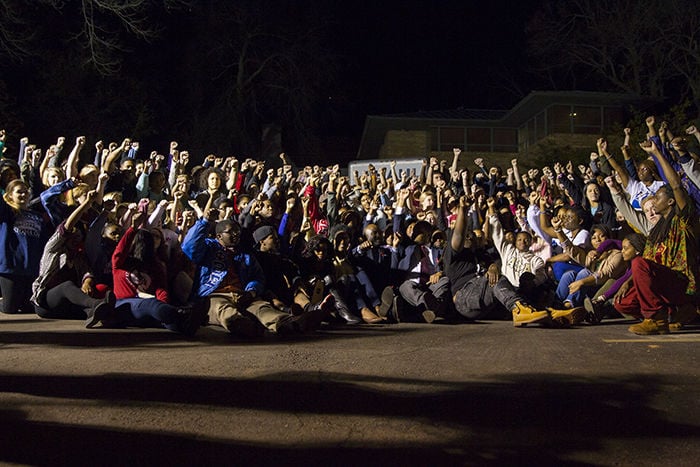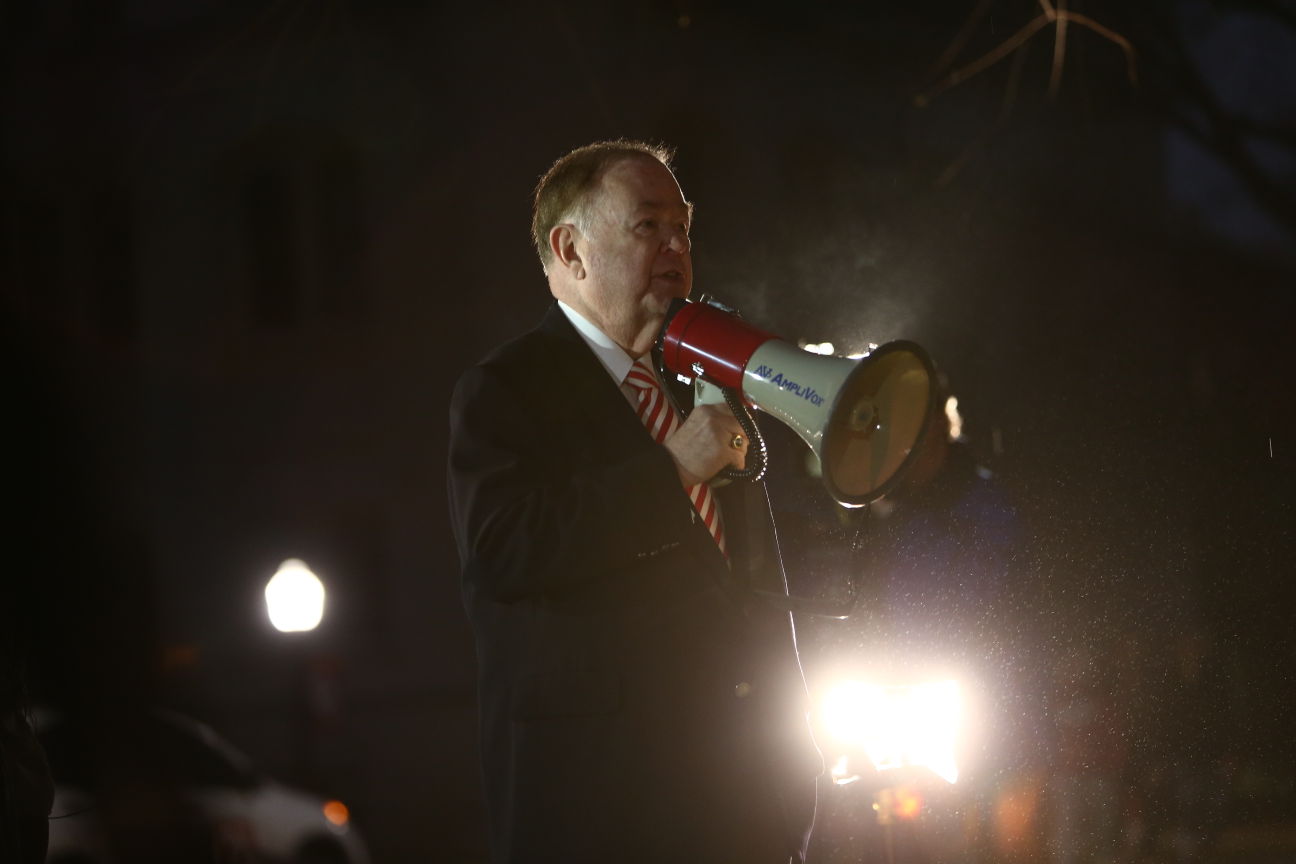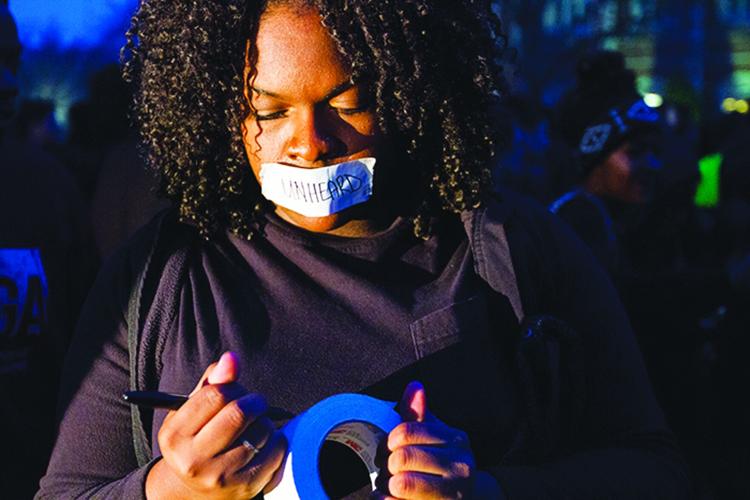

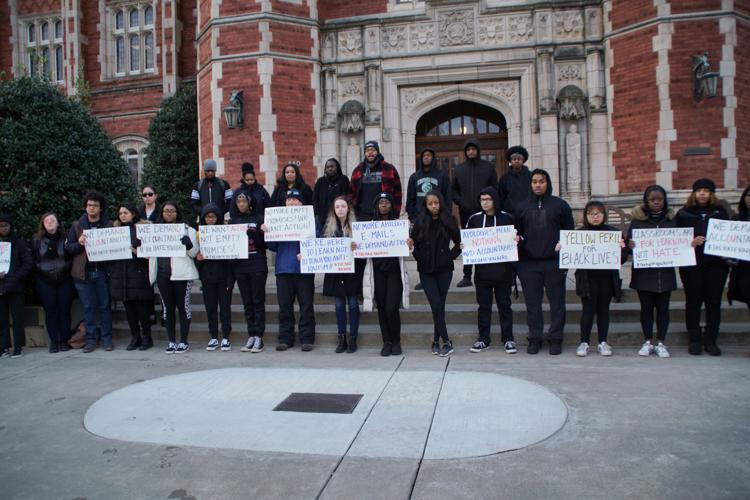


Junior African and African American studies major Dalania Blocker writes on tape for a demonstration Monday morning on the North Oval, March 9, 2015. Blocker placed tape over her mouth with the word "unheard" written on it.
Editor’s note: This story is a part of a commemorative series marking 10 years since a video went viral showing members of the Sigma Alpha Epsilon chapter at OU singing a chant with a racial slur. The video sparked protests across campus and placed OU and race relations on college campuses under a national spotlight. Several stories commemorating this milestone will be published the week of March 10, the day protests took place in front of the SAE house while members of the newly banned fraternity moved out.
When Sigma Alpha Epsilon members’ racist chants were made public, OU administrators acted swiftly. Over the course of three days, the fraternity was banned from the university, its house was boarded up and two of its members were set to be expelled before they withdrew from OU.
Within a month, a new precedent for diversity, equity and inclusion was set in a state that had banned affirmative action — combined efforts to include and provide opportunities for members of marginalized groups in employment and education — nearly three years prior.
On Nov. 6, 2012, Oklahoma voters approved State Question 759, which banned affirmative action programs in public employment, education and contracting, excluding instances of its requirement to keep and retain federal funding. Oklahoma became the eighth state in the country to ban affirmative action.
On March 8, 2015, a video showing members of SAE singing a racist chant, including repeated use of a racial slur and references to lynching, was made public, prompting a national response.
The next day, former OU President David Boren responded to the incident by booting SAE members from the house and severing OU’s ties with the chapter, giving them until midnight on March 10, 2015, to move out without university support. The national SAE organization also disbanded OU’s chapter.
By March 11, 2015, all 68 members of the fraternity had moved out, and the house was boarded up until the OU Board of Regents determined a new use for it.
“We don’t provide university services to bigots,” Boren said at a press conference. “I don’t have much sympathy for them.”

SAE's letters are taken off their house March 9, 2015. OU President David Boren announced the fraternity had been banned from OU's campus and residents of the fraternity must move out.
Prelude to DEI: ‘Diversity and inclusivity is at the core of who we are as Sooners’
On March 31, 2015, former Oklahoma legislator Jabar Shumate was appointed vice president of the Office of University Community — the precursor to OU’s Division of Diversity, Equity and Inclusion, now named the Division of Access and Opportunity. Shumate oversaw all diversity programs and admissions from June 2015 to July 2018.
At the time of his appointment, Shumate said he wanted to create a sense of diversity, inclusion and community on OU’s campuses.
In June 2015, Shumate and OU faculty members unveiled plans for a five-hour mandatory diversity training for incoming first-years, which became known as the “Freshman Diversity Experience.” Shumate later touted OU as the first school in the Big 12 Conference with mandatory diversity training.
“We really want students from the start at OU to understand that diversity and inclusivity is at the core of who we are as Sooners,” Shumate said at the time.
In July 2015, OU announced the former SAE house would be used by Southwest Center for Human Relations and the Disability Testing Center.
In September, OU received the 2016 Higher Education Excellence in Diversity Award, which is given to universities that prioritize diversity and inclusion, from INSIGHT Into Diversity magazine. OU has won the award four more times, with the most recent being awarded in October 2023.
On Nov. 9, 2016, the day after President Donald Trump’s first electoral victory, hundreds of students protested Trump’s election on OU’s campus. Both Shumate and Boren said they were committed to ensuring OU’s commitment to diversity and inclusion continued regardless of Trump’s presidency.
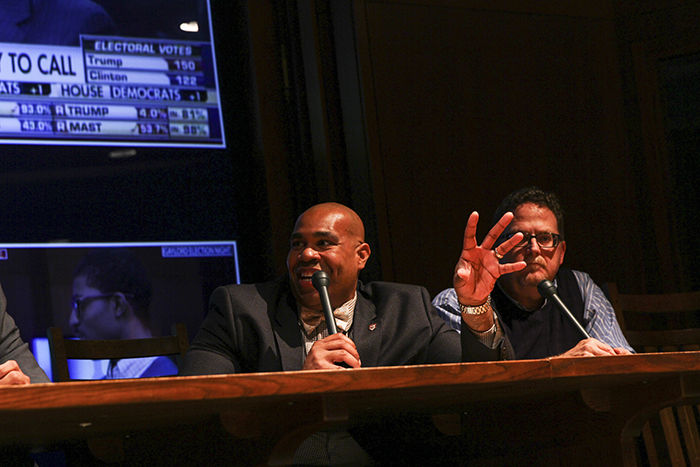
Jabar Shumate, former vice president of the University Community, smiles and explains his opinion on a policy question during the election watch party Nov. 8, 2016 in the Gaylord Auditorium. The watch party had several news broadcasts playing in the background during the panels.
“For students of all backgrounds, all races and all walks of life to come together and say we are bigger than hate is big,” Shumate said at the protest. "This lets me know that the values of our country and the ability of people to overcome hate (are) much larger and much bigger than whatever happened in those election results last night."
Shumate did not respond to multiple interview requests from OU Daily.
‘We got a lot of national attention for the wrong things, so we had to educate’
Shumate resigned on July 24, 2018, after the university alleged he misused university assets. He said former OU President James Gallogly, who became president on July 1, 2018, pressured his resignation and referred to the allegations as a “high-tech lynching.”
On Aug. 15, 2018, OU appointed Jane Irungu as interim associate vice president for the Office of University Community while the university searched for Shumate’s replacement.
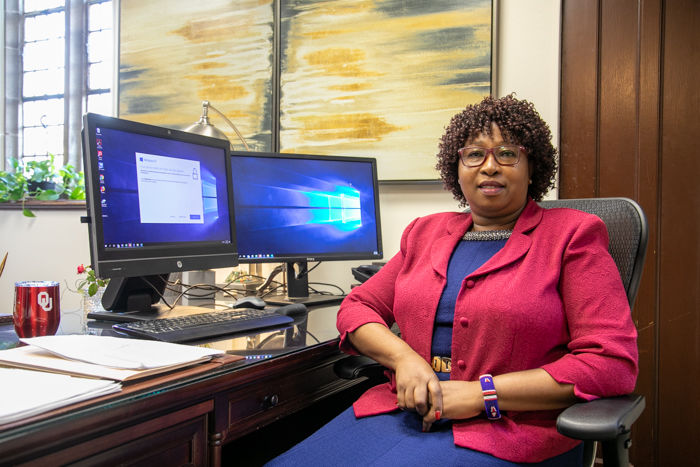
Interim Associate Vice President for University Community Jane Irungu in her office Sept. 11. Irungu formed a committee that will serve as a review council for incidents of bias that the Office of University Community receives.
Reflecting on her role, Irungu told OU Daily the office was created to further OU’s goals of diversity and inclusion, as well as educate students in the event an incident like SAE were to occur.
“Going into that role, one of the priorities was to really educate the university community on creating a climate that is conducive to acceptance and respect,” Irungu said. “We got a lot of national attention for the wrong things, so we had to educate."
On Jan. 18, 2019, a Snapchat video was released that showed an OU student using blackface and saying a racial slur while being filmed by another student who was a member of the Delta Delta Delta sorority. The member was later removed from the OU chapter of Delta Delta Delta. Gallogly also announced both students would be leaving OU.
The University Community office released a statement condemning the students’ actions.
On Jan. 22, 2019, OU students, faculty and staff gathered for a “Rally to Stop Racism” to oppose the video and express their frustration with racism at OU. Gallogly and Irungu were in attendance.
“We cannot let this moment disappear,” Irungu said at the time. “This moment means we have committed ourselves and identified where we have failed.”
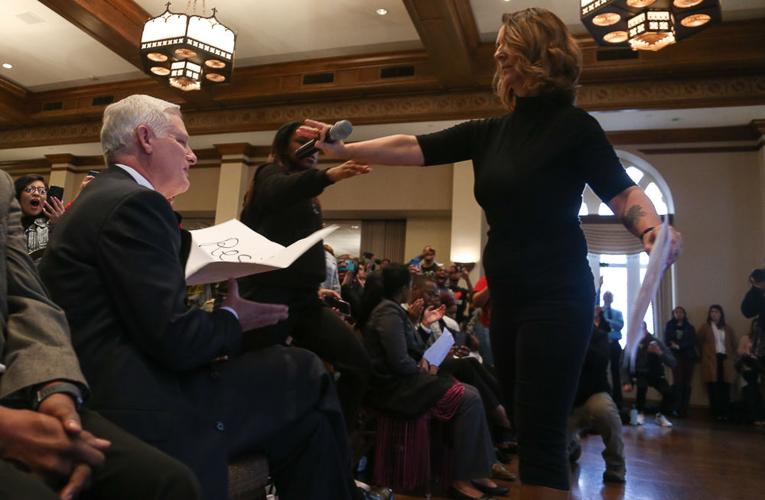
During the rally, Suzette Grillot, former dean of the College of International Studies, called for Gallogly’s resignation. She held a sign to Gallogly’s face that read “resign now” then dropped it in his lap. Gallogly eventually resigned in May 2019 after less than a year as president.
Grillot, who had been terminated from her position as dean four days before the rally, said racism at OU was systemic.
“Racism is a part of the university culture, and it goes unchallenged until a crisis arises and public relations become a priority,” Grillot said at the time. “We all know what’s going on here.”

OU professor Suzette Grillot gives a sign that reads "Resign Now" to OU President James Gallogly at the Rally to Stop Racism Jan. 22. Grillot was recently fired from her position as Dean of the College of International Studies.
On Jan. 23, 2019, an individual wearing blackface was spotted walking on OU’s Norman campus. The next day, hundreds of people, including members of OU’s Black Student Association, marched to Evans Hall with a list of demands in protest of the racist incidents.
Following the march, the Black Student Association announced the creation of the Black Emergency Response Team.
In May 2019, then-interim OU President Joseph Harroz Jr. announced Irungu would become the interim vice president of the newly-formed Office of Diversity and Inclusion. Harroz wrote at the time he wanted to create a “culture of inclusion” at OU.
“I am making this change one of my first actions as president because I want us to seize the chance to build culture together. This is an important moment for our university, in the midst of a challenging transition,” Harroz wrote in a letter. “It is important to recognize that authentic and continuing commitment to building a culture of inclusion is absolutely essential for us to move forward as an institution.”
Irungu said the university determined transitioning from the Office of University Community to the Office of Diversity and Inclusion could create specific DEI objectives and action plans. She said the creation of the office was her proudest accomplishment at OU.
“I am the one who spearheaded the transition from the University Community to the Office of Diversity and Inclusion. I'm the one who worked with President Harroz to make sure that we had a space,” Irungu said. “One of the goals was really to cultivate an equitable but also a respectful workplace environment and learning environment, because some of our students were not feeling like they are being respected.”
Irungu said she also worked closely with both Harroz and Gallogly following the protests in 2019 to address student concerns and the incidents that preceded them. She also said as the office began to grow, it started to experience pushback from the Oklahoma Legislature.
On Oct. 18, 2019, Harroz announced Belinda Higgs Hyppolite, former assistant vice president for development and enrollment services at the University of Central Florida, would serve as vice president of the Office of Diversity, Equity and Inclusion.
In January 2020, the Office of Diversity, Equity and Inclusion relocated to Copeland Hall as Higgs Hyppolite took over operations as vice president.
BERT sit-in, transition to division of DEI: ‘These are wins that we must continuously fight for’
In February 2020, two OU professors used a racial slur during classes within two weeks.
“We are all weary of racially charged incidents occurring within our university community,” Harroz wrote at the time. “It is common sense to avoid uttering the most offensive word in the English language, especially in an environment where the speaker holds the power.”
On Feb. 26, 2020, the Black Emergency Response Team organized a sit-in and hunger strike at Evans Hall that lasted three days. BERT demanded then-Provost Kyle Harper resign and the university instate a semester-long diversity program, mandate diversity training for faculty and create a center for research on race and ethnicity.
In a statement, BERT wrote Harper did not respond to demands from students for increased diversity in OU’s faculty and did not act following the professors’ use of racial slurs.

Members and supporters of the Black Emergency Response Team protesting outside of Evans Hall on Feb. 26.
Harroz declined to meet the demand for Harper’s resignation on Feb. 27, 2020, prompting BERT to create a new list of demands.
On Feb. 28, 2020, university administrators agreed to create a “360 review process” for senior executive leadership, create a student advisory committee to provide advice to the office of the provost and meet with BERT every two weeks, formally ending the protest. BERT also said many demands would become incorporated into the developing strategic plans.
“This is a win for the people,” BERT co-directors Miles Francisco and Jamelia Reed wrote in a statement. “But these are wins that we must continuously fight for. We must consistently put pressure on the administration to make it clear that we will not stay silent as long as marginalized students, staff, and faculty continue to be treated as less than human.”
Now, Francisco told OU Daily that upon reflection, he values the symbolism of the diverse, multi-racial and multicultural coalition during the strike. He said he hopes the strike inspires future protesters.
“The success of the sit-in, to me, was about the beauty of seeing so many people in Evans Hall, sitting in for days on end,” Francisco said. “That, more than symbolism, is about showing ourselves — but also showing the campus and the larger community in Oklahoma — that when we come together and fight this collective fight against systemic racism and institutional racism, we're all the better for it. I think that was the biggest win, beyond the policy wins.”
In June 2020, Harper resigned as provost to return to a teaching position.
Announced in July 2020, diversity, equity and inclusion became a part of OU’s eight-year strategic plan through its original fourth pillar, which sought to create a place of belonging and emotional growth by strengthening DEI.
Harroz announced in a mass email to the OU community Tuesday the refresh of OU’s “Lead On, University” strategic plan, “The Next Phase.”
The fourth pillar which was originally to become a place of “belonging and emotional growth” for students, faculty, staff and alums has been replaced with the effort to “Lift the Health of Oklahoma.”
In May 2021, the Office of Diversity, Equity and Inclusion became the Division of Diversity, Equity and Inclusion to make the organization more accessible and contribute to the strategic plan’s goal of creating belonging and emotional growth.
“OU’s collective efforts to truly change lives must focus on creating a culture where all community members can achieve success,” Higgs Hyppolite wrote in an email at the time. “The new division will offer high-quality outreach and engagement opportunities, provide resources, and offer workshops, training, and development opportunities on various topics, consultations, and more.”
DEI closure: ‘We would still be sitting-in right now’
On Dec. 13, 2023, Gov. Kevin Stitt signed an executive order to review diversity, equity and inclusion in Oklahoma higher education, effectively banning DEI programs in public universities across the state.
The order read that state agencies could not use state funding, property or resources for DEI programs, positions, departments, activities, procedures or programs. Public universities and state agencies were required to be in compliance with the order by May 31, 2024.
Oklahoma became the third state to implement a DEI ban at universities, following Texas and Florida.
“(This is) going to shift the focus and education back to educating our young people instead of politics and indoctrination in our colleges and our universities,” Stitt said at the time.
In response, OU wrote the executive order was disappointing but reaffirmed it would continue to create a place of belonging.
“While we are obligated to comply, the University of Oklahoma will always remain committed to its core principles that make OU a place of belonging where the American Dream is available to all,” OU’s statement read. “We know, too, that our students, university community, and the citizens of Oklahoma also are resolute in their commitment to these values.”
OU BERT responded by saying DEI provides marginalized students with safe spaces, adding the order was discriminatory.
"Stitt is aggressively targeting students from all marginalized communities with blatant discrimination, hiding behind the deceptive narrative that merit-based success and hard work are all that’s needed for advancement,” BERT wrote. “Together, let us stand against the detriment of our student body and work towards a future where our university thrives as a model of diversity, equity, and inclusion."
Now, Francisco said he would like to see OU push back against such legislation, which would signal to marginalized students that they deserve a safe space on campus. He also said he would like to see people work together to push back against racism, including white students and faculty, so that the responsibility does not fall solely on Black people.
“The reality is that the University of Oklahoma is a racist institution. Its founding on the colonialism of the state of Oklahoma is what undergirds all of the policies, the practices of the university since its founding,” Francisco said. “When one of us are suffering under systems of oppression, all of us are. … I want to see more collective action of people showing up and supporting one another and doing the best that they can to take action in this moment for the betterment of all of us.”

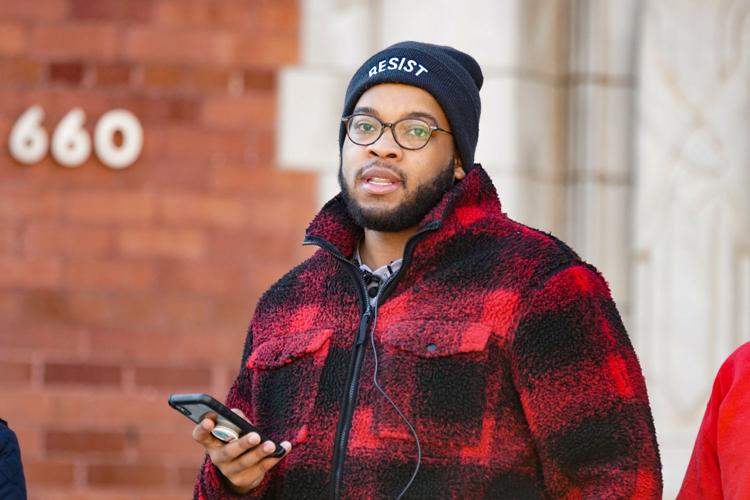
Political Science and African American studies senior dual major and Black Emergency Response Team co-director Miles Francisco speaks during a press conference held by the OU Black Emergency Response Team outside of Evans Hall on Feb. 25.
At a staff senate meeting after the executive order was signed, Higgs Hyppolite said the university would continue to increase access and opportunity and prevent barriers to success.
“We will always operate in the spirit of excellence in our campus community and work to cultivate that welcoming community for all," Higgs Hyppolite said at the meeting. “We've made promises to our faculty, staff and students. We have values as an institution and we're going to work to uphold those values. … This is the road uncharted for us. It is very, very painful for a lot of people who've been doing great work to move our institution forward.”
When asked for comment in February, Higgs Hyppolite declined and wrote to OU Daily that she was busy.
Irungu said diversity coordinators are concerned about becoming targets and must choose their public actions carefully. She added legislators misinterpret DEI as divisive and push laws without administrative input, which was unlike her experience five years ago.
“Right now, there's no dialogue. Nobody wants to listen to us,” Irungu said. “But those days, there were conversations. … Although that conversation about the anti-DEI sentiments was there, there was more open conversation.”
In February 2024, OU announced the Division of Diversity, Equity and Inclusion would change its function and name to the Division of Access and Opportunity. In an email, Harroz wrote that staff in DEI positions would change roles.

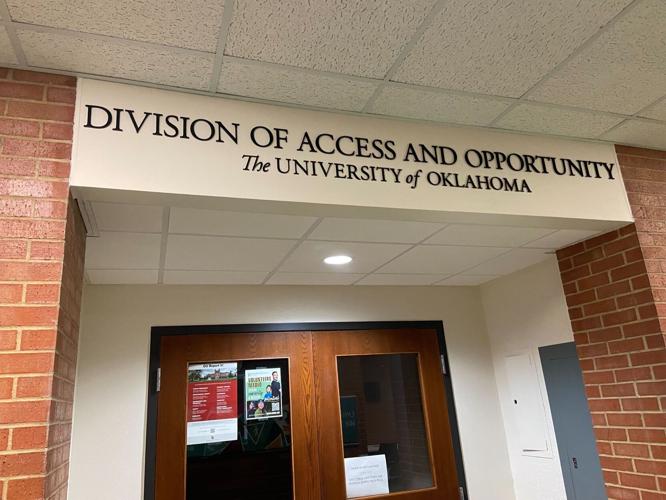
OU's Division of Access and Opportunity office on March 27.
In April 2024, David Surratt, vice president for Student Affairs and dean of students, announced the Gender + Equality Center would close in accordance with Stitt’s executive order. The GEC’s mission was to support students on campus through education, interpersonal violence prevention and advocacy for victims of gender-based violence and create programming and support for 2SLGBTQ+ inclusion. The Office of Advocacy and Education was created thereafter.
Francisco said he spent a lot of time at the GEC and that its closure was especially personal. He believes its closure, along with the dissolution of the DEI division, was an over-correction to Stitt’s executive order.
“This current governor administration in Oklahoma is only going to be emboldened by the Republican administration nationally, who is going to continue to push back on all things quote, unquote ‘woke’ or all things ‘diversity, equity, inclusion,’ which are all, to be really, really clear, just filler words for black … for LGBTQ … for marginalized people and communities,” Francisco said. “It’s just another dog whistle.”
Francisco said he believes if BERT’s sit-in was conducted today, its demands would not be responded to in the same way due to the executive order.
“We would still be sitting-in right now,” Francisco said.
Irungu currently works at Utah State University as a special adviser to the president. She was originally the university’s vice president of DEI before the department was disbanded in 2024.
Irungu said while the protests against DEI have become nationwide, its principles — including love, respect and compassion — are universal and contribute to healthy environments everywhere.
“We can’t give up on making sure that our environments are welcoming, that we don't have a repeat of 2015, so we don't have a repeat of those two incidents at the University of Oklahoma with blackface,” Irungu said. “The core mission of inclusion will never go away because who wants to be in an environment where people don't respect each other or where students don't feel supported, no matter who they are?
“Continue doing what you know is right. Continue doing what you know will make your campus better. And you can do that without ever mentioning the acronym ‘DEI,’ because some of these are timeless values.”
This story was edited by Peggy Dodd, Anusha Fathepure, Ana Barboza and Ismael Lele. Gretchen Schultz and Mary Ann Livingood copy edited this story.
A decade later: OU alums, leaders, greek life members reflect on Sigma Alpha Epsilon incident, protests
Comprehensive coverage on the legacy of the Sigma Alpha Epsilon racist video and following protests on OU's campus 10 years ago.