

Updated: This story was updated at 2:10 p.m. Wednesday to add a statement from OU's Black Emergency Response Team. This is a developing story, check back for updates.
OKLAHOMA CITY — Gov. Kevin Stitt signed an executive order Wednesday morning calling for a formal review of diversity, equity and inclusion in Oklahoma higher education.
The executive order requires state agencies and universities to review the necessity and efficiency of DEI positions, departments, activities, procedures and programs.
The order requires universities and state agencies to be in compliance with the executive order by May 31. It also asks for a certificate of compliance and a report to be submitted to the governor, speaker of the Oklahoma House and Senate pro tempore.
The Oklahoma Legislature is expected to convene on Feb. 5 and typically finishes its business on the state budget by the end of May.
Stitt said his executive order simply demands higher education to follow the law. Stitt said in the press conference that the order asks for universities to stop using state dollars to fund DEI offices and programs, but did not specify if this is immediate or after a review is complete.
“(This is) going to shift the focus and education back to educating our young people instead of politics and indoctrination in our colleges and our universities,” Stitt said before signing the executive order.
The order reads that “executive state agencies shall not utilize state funds, property or resources to grant or support diversity, equity, and inclusion positions, departments, activities, procedures, or programs to the extent that they grant preferential treatment based on one’s particular race, color, ethnicity, or national origin over another’s.”
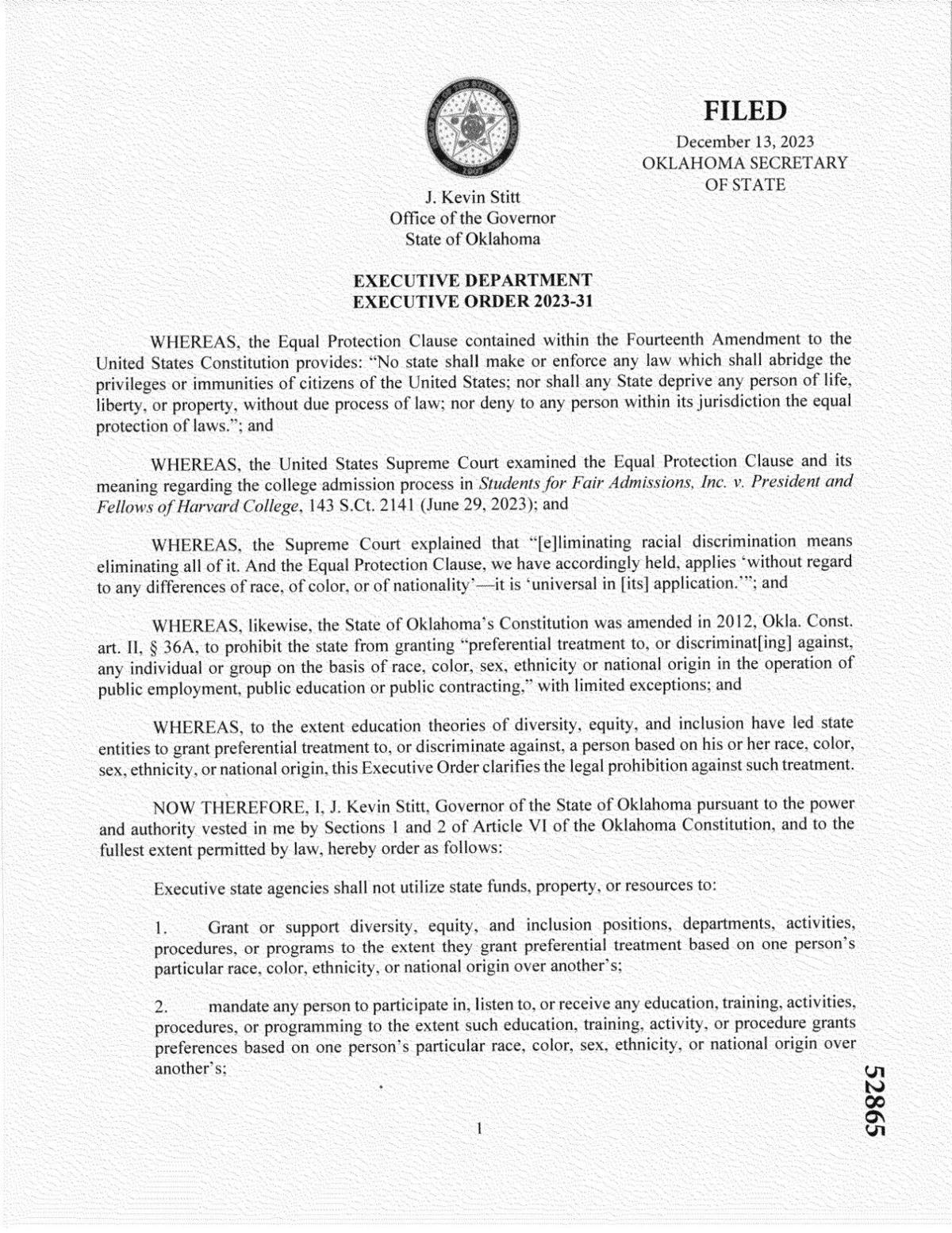
It also reads that state agencies cannot mandate education or training to the extent that they grant preferential treatment based on one’s particular race, color, ethnicity or national origin over another’s. It prohibits mandating loyalty oaths, the requirement for a person to disclose their pronouns and the mandating of DEI statements by employees.
The order specifically mentions protections for first generation college students, students from low-income families, students with disabilities or underserved student populations.
The order reads that it cannot be misconstrued in respect to academic freedom of faculty members, policies or programs required by state or federal law or for obtaining accreditation or licensure, scholarly research or creative work, guest speakers or performances, academic support or career services, data collection or programs for veterans, Pell Grant recipients, first generation students, underserved student populations, students with disabilities or students from low-income families.
Stitt said his order specifically notes the importance of support for first-generation students and low-income students; however, he said support and recruitment for those individuals need to be in the admissions offices and not in a specialized center like a DEI office or program.
DEI offices can sometimes be requirements of federal or private funding or grants for higher education. The Chronicle for Higher Education reported that it's a political gray area as banning DEI offices could affect beyond the state level.
Stitt said if Oklahoma higher education institutions face pushback or downgrades in accreditation, that he’ll cross that bridge when it comes.
“I represent 4 million Oklahomans as the governor. I've heard from all over the state that they're tired of wasting our dollars when something tries to divide us,” Stitt said.
Stitt said colleges and universities need to focus on spending more money on preparing students to get jobs and have successful careers instead of DEI programming.
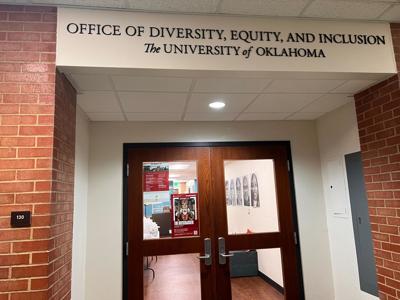
OU wrote in a statement that the university is unwavering in its values and principles. The university wrote it is disappointed in the governor’s executive order, but says it is obligated to comply.
OU said its ability to be the state’s flagship university and have increasing enrollment and diversity rates is because of its values and principles in diversity, equity and inclusion.
“These accomplishments and positive impact to the state would not be possible without the underlying values that serve as a constant north star for our university: access and opportunity for all of those with the talent and work ethic to succeed; being a place of belonging for all who attend; dedication to free speech and inquiry; and civility in our treatment of each other,” the statement read. “These principles transcend political ideology, and in them, we are unwavering.”
OU reaffirmed its commitment to being a place of belonging in its statement, which also foreshadowed such initiatives ultimately being cut pending the outcome of the review.
“We are disappointed that today’s executive order reaches into college campuses across Oklahoma and eliminates offices of Diversity, Equity, and Inclusion. While we are obligated to comply, the University of Oklahoma will always remain committed to its core principles that make OU a place of belonging where the American Dream is available to all,” the statement read. “We know, too, that our students, university community, and the citizens of Oklahoma also are resolute in their commitment to these values.
“We remain committed to ensuring an education from the University of Oklahoma remains accessible and available to all students and will continue to work to recruit and retain a workforce of the most talented and qualified minds that are representative of our state. The citizens of Oklahoma deserve nothing less.”

OU's Black Emergency Response Team issued a statement Wednesday afternoon in response to the executive order, saying DEI programs and departments offer safe spaces for historically marginalized communities on campus.
"These departments give students a voice to be heard, provide a home away from home, and create unity within the student life community on campus," the statement read. "To remove personnel, funding, and programming, is to jeopardize the existence of these spaces altogether."
BERT is a student-led organization that led a sit-in 2020 inside Evans Hall following several racist incidents on campus such as professors using racial slurs in class.
"Oklahoma political officials, led by Stitt, fail to understand the need to fund higher education DEI programs," the statement read. "Stitt is aggressively targeting students from all marginalized communities with blatant discrimination, hiding behind the deceptive narrative that merit-based success and hard work are all that’s needed for advancement. ... Together, let us stand against the detriment of our student body and work towards a future where our university thrives as a model of diversity, equity, and inclusion."
Tamera Nealy, a junior studying economics and communications at OU, spoke during the press conference. According to her LinkedIn, Nealy interned for Stitt from March to July 2022. Her LinkedIn also lists previously working as a campus coordinator with Turning Point USA, a conservative grassroots organization aimed at college and high school students.
Turning Point USA was founded by conservative radio talk show host Charlie Kirk. In 2020, Kirk chaired Students for Trump, which has more than 350 chapters present on college campuses across the country, according to his biography on the Turning Point USA website.
Nealy currently works as a correspondent reporter for the Leadership Institute’s campus reform project. The institute provides a talking points guide that “teaches conservatives how to push back against liberal arguments on hot-button issues.”
“This legislation is important because it challenges students from all around Oklahoma and the country to not only try, but do your best, and we have to raise the standard, we have to raise the bar,” Nealy said.
Tamera Nealy, a junior studying economics and communications at OU, spoke during the press conference.
On Jan. 23, Superintendent of Public Instruction Ryan Walters asked Allison Garrett, chancellor of higher education, to compile a 10-year review of its spending materials on current materials used for DEI in state higher education institutions.
The report found that there was about $10.2 million budgeted for DEI activities for the current fiscal year, of which the state contributed $3.7 million. This amounts to 0.29% of all higher education spending and 0.11% of state spending on higher education.
DEI programs at OU include the Accessibility and Disability Resource Center and the TRIO Center. Three diversity scholarship and guidance programs are part of the TRIO Center: Upward Bound, Project Threshold and the McNair Scholars.
After the Board of Regents meeting on Nov. 30, OU President Joseph Harroz Jr. told OU Daily that DEI is and will remain a priority for the university, even amid political challenges.
OU’s Division of Diversity, Equity and Inclusion lists the values of its office as empathy, accountability, civil dialogue, collaboration, equity, integrity and mutual respect. The division’s pillars focus on awareness, education and advocacy.
A significant piece of Harroz’s strategic plan, "Lead On, University," includes DEI. The pillars of DEI, according to its website, includes awareness of biases and world views on campus, educational elements and advocacy initiatives.
“One of the things we’ve been very clear about is that as these things occur, we have to stay true to our principles,” Harroz said. “This idea that everyone that has a talent and the drive should have the opportunity, regardless of their position or standing, whether it’s economic or otherwise.”
Diversity appears in the strategic plan’s pillar three: make OU’s excellence affordable and attainable; pillar four: become a place of belonging and emotional growth for all students, faculty, staff and alumni; and pillar five: enrich and positively impact Oklahoma, the nation and the world through research and creative activity.
Harroz told OU Daily in an interview at the beginning of the semester that the university cannot waiver its position on DEI even through the political division in state and national politics.
“Whatever the political winds happen, we’re not going to stray from those values,” Harroz said in September. “We can’t lose our soul in this.”
In an email to students on Wednesday, Harroz again reaffirmed OU’s commitment to DEI.
“Make no mistake: At OU, we stand firm in our promise to uphold the core principles that make our university a beacon where the American Dream is available to all,” Harroz wrote. “We know, too, that our students, university community, and the citizens of Oklahoma are resolute in their commitment to these values.”
Texas and Florida have banned or restricted DEI programming and funding in higher education earlier this year.
Rep. Jared Deck (D-Norman) said in a text to OU Daily Wednesday morning that this executive order shows that Stitt has “submitted to State Superintendent Ryan Walters” and it's an attack on public education.
“This is an attack on support for first-generation students, students with disabilities, students who are veterans, international students, not to mention our students who are racially, culturally, religiously, and economically diverse,” Deck wrote. “He may speak on behalf of the executive branch, but he doesn’t speak on behalf of the thousands of students served by programs and universities that value them for whom they are.”
Deck wrote that Stitt’s executive order wouldn’t change colleges’ diversity.
“He can make any order he wants, but he can’t take away the joy and richness our diverse student population adds to our community,” Deck said.
Walters released a statement following the press conference, calling DEI discrimination, exclusion and indoctrination.
“It does not represent American values,” Walters wrote. “Governor Stitt is right for taking a strong step to protect Oklahomans from these discriminatory programs. We must not distort important historical events that push liberal indoctrination, and our curriculum must not teach identity politics.”
In a statement from legislators from Norman and Stillwater, Sen. Mary Boren (D-Norman) wrote the governor's ban could impact economic development.
"DEI is a mainstreamed way to learn how to strengthen our universities, economy and preserve our democracy," Boren wrote.
Rep. Annie Menz (D-Norman), in the same statement as Boren, wrote no executive order could stop diversity from happening.
"Trying to swindle college kids out of their opportunity to interact with and understand that diversity is absurd and futile," Menz wrote.
Sen. Rob Standridge (R-Norman) told OU Daily last week DEI programs discriminate and favor some students, adding he wants universities to be completely merit-based.
“DEI hurts the university,” Standridge said. “When it goes to the point it has at OU where it discriminates against some to favor others based on race or gender or whatever other criteria they're using, that's when it becomes inappropriate and unconstitutional.”
In May, Standridge filed a concurrent resolution that would defund state-funded higher education should institutions continue utilizing DEI programs. In October, he held an interim study that criticized DEI programs. In the study, Standridge said tax dollars supporting DEI efforts is unfair to any taxpayer who disagrees with the initiative.
On Wednesday, Standridge announced he filed four pieces of legislation targeting DEI practices at universities and colleges.
“Our universities and colleges will continue to devolve as we veer further away from merit-based accomplishments and continue to follow the leftist ideology of DEI to its ultimate negative end,” Standridge wrote in a statement Wednesday.
The bills, Senate Bill 1303, 1304, 1305 and 1306, would prohibit the establishment of a DEI office or hiring or assigning employees to carry out DEI practices, Standridge’s statement read.
SB 1303 would direct the governing board for higher education to ensure there is not the establishment or maintenance of a DEI office. It also would prohibit universities or colleges from hiring or assigning an employee, whether of the institution or third-party, to perform the duties of a DEI office or officer. It also would require no “preference” on the basis of race, sex, color, ethnicity or national origin at the institution and would prohibit universities from requiring training, activities or programs in reference to race, color, ethnicity, gender identity or sexual orientation.
SB 1304 would create the Oklahoma Workforce Education Revolving Fund, which will award funds to institutions that do not have a DEI office, hired staff to support diversity efforts or require students to take courses that promote inclusion.
SB 1305 would instruct the governing body of each institution to establish and designate curricula and courses that do not require students to enroll in “DEI-CRT” related requirements. DEI-CRT stands for diversity, equity, inclusion and critical race theory.
Standridge defines DEI-CRT-related content as relating to one or more of the following topics: critical theory, whiteness, systemic racism, institutional racism, anti-racism, microaggressions, systemic bias, implicit bias, unconscious bias, intersectionality, gender identity, social justice, cultural competence, allyship, race based reparations, or race-based privilege, race- or gender-based diversity, race- or gender-based equity, or race- or gender-based inclusion.
SB 1306 would prohibit universities or colleges from requiring enrollment in certain courses related to DEI, like OU’s Gateway to Belonging class. For voluntary course work, the bill would require those courses to make public any materials, slides or books used in the course.
After the November regents meeting, Vice President of Student Affairs and Dean of Students David Surratt said it would be naive of the university to not be considering the future of DEI programs. Surratt said as a first-generation college student and a person of color, he knows the importance of DEI.
“I know certainly the ideas of belonging and inclusion are super important and close to me, and I know that those are values that the institution also holds,” Surratt said.
George Henderson, director of the advanced studies program in the Department of Human Relations and former dean of the College of Liberal Studies, told OU Daily in November that even though he takes issue with the structure of DEI programs, he believes the overall ideas and programs are needed.
“My conundrum is simply this: No matter what we say about where legislators are going, they’re going there, and no article or no film and nothing that you do will change that. Now the question becomes, ‘If this is the game that we’re gonna play, how do we play it well?’” Henderson said.
This story will be updated as more information is available.
Read more about DEI at the university:


Thomas Pablo contributed to this reporting.


