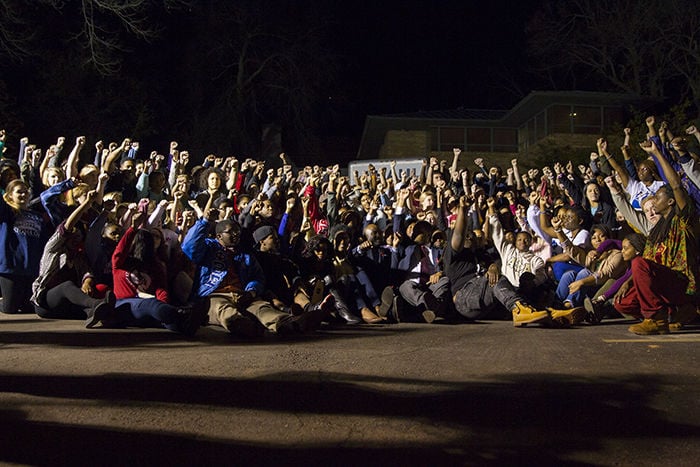


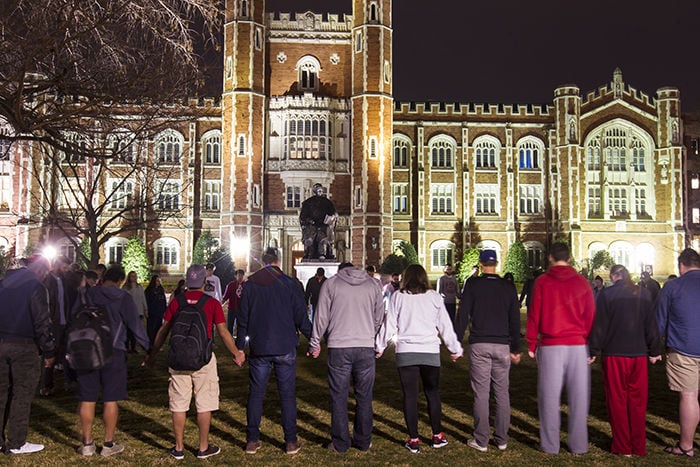
Students gather on the North Oval for a prayer vigil in response to a racist fraternity video on March 9, 2015. The video sparked a nationwide reaction.
Editor’s note: This story is a part of a commemorative series marking 10 years since a video showing members of the Sigma Alpha Epsilon chapter at OU singing a chant with a racial slur went viral. The video sparked protests across campus and placed OU and race relations on college campuses under a national spotlight. Several stories commemorating this milestone will be published the week of March 10, the day protests took place in front of the SAE house while members of the newly banned fraternity moved out.
Early in the morning of March 8, 2015, Tyler Woodward was at home when his phone rang.
This was the moment the former OU Daily photographer learned of the video depicting members of OU’s chapter of Sigma Alpha Epsilon singing a racist chant, which included racial slurs and references to lynching. The story made national news and became imprinted on the history of the university.
“Hey, things are going crazy, can you come in?” Woodward’s editor said on the other end of the line.
Woodward packed his gear and made his way to the North Oval, where a crowd of students gathered in prayer for those affected by the video, circled around the statue of former OU President George Lynn Cross.
“The tensions were just super hot,” Woodward said. “It’s just a very charged experience, lots of emotions.”
Then-OU President David Boren spoke out against the racism depicted in the video and condemned OU’s SAE chapter and the members seen in the video.
“To those who have misused their free speech in such a reprehensible way, I have a message for you. You are disgraceful,” Boren wrote in a statement on Twitter, now the social platform X. “You have violated all that we stand for. You should not have the privilege of calling yourselves ‘Sooners.’ Real Sooners are not racist.”
Boren shut down the fraternity immediately following the incident, moving to close the house indefinitely about 48 hours after the video was posted.
“Effective immediately, all ties and affiliations between this University and the local SAE chapter are hereby severed,” Boren wrote. “I direct that the house be closed and that members will remove their personal belongings from the house by midnight tomorrow.”
At a press conference a few weeks after the incident, Boren said the 25 students involved in the chant were given disciplinary actions ranging from expulsion to community service and sensitivity training, and the expelled students would not be allowed to return.
Woodward said Boren’s swift response showed him how quickly the consequences of racism could be enforced.
“President Boren dropped a hammer on SAE pretty aggressively, so it was crazy to see a vibrant house filled with lots of students just get shut down,” Woodward said.

President David Boren speaks to students condemning the fraternity's actions and officially disconnecting SAE from OU.
Boren wrote in his statement that the swift response would serve as an example of how to deal with these issues.
“We vow that we will be an example to the entire country of how to deal with this issue,” Boren wrote. “There must be zero tolerance for racism everywhere in our nation.”
The response sparked immediate and long-lasting changes in the OU community and began the process of creating a more inclusive greek community at OU.
Changes in Panhellenic leadership
Five years after the incident, OU Panhellenic Association elected its first Black president, Sydney Smith, who saw her role as an opportunity to educate and spark conversations about inclusion and equality.
Smith said she understood she had a responsibility to be a voice for underrepresented communities on campus.
“I’d be lying if I said I didn’t feel that pressure,” Smith said. “But also I was really glad to have that experience because I had women of color reach out to me. … Parents saying that they were happy to see a Black woman — a person of color — at the helm.
“It made them feel more comfortable. It made them feel like, ‘Okay, so possibly my child could do this.’ That was a really special part of my presidency.”
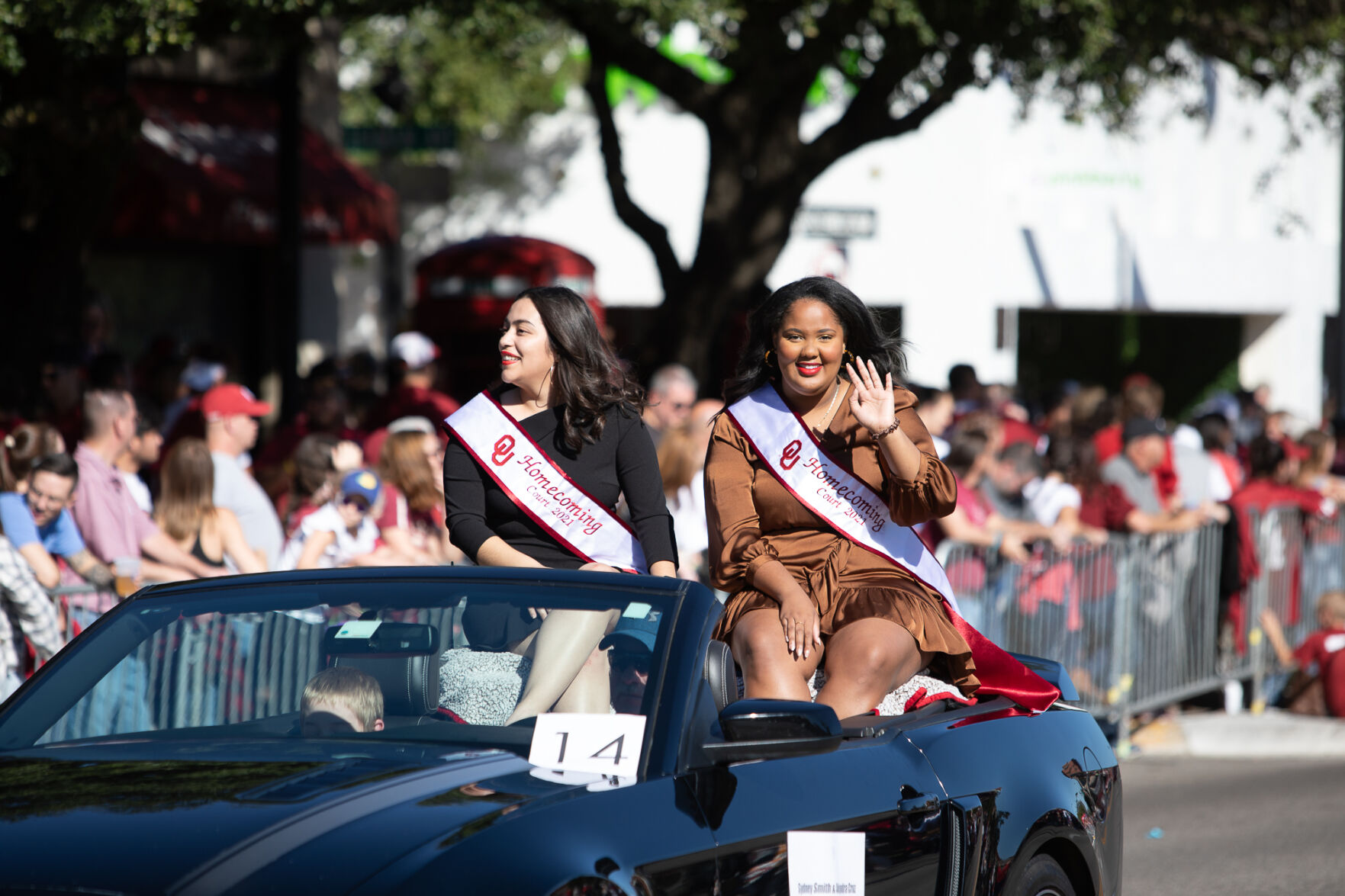
Homecoming court Sydney Smith and Alejandra Cruz at the parade on Oct. 16.
Smith was named president in November 2020 and served during the 2021 calendar year.
Before her presidency, Smith served as vice chair of judicial affairs in her sorority, Gamma Phi Beta, and then vice president of judicial affairs for Panhellenic. Smith said she was able to do a lot of work to promote inclusivity on a much smaller scale within the sorority.
“I tried to do my best to make sure that people felt included within my own sorority at GPhi,” Smith said. “I started their diversity and inclusivity council and kind of carried a lot of those tenets and programming with me.”
As vice chair of judicial affairs, Smith said she started the sorority’s diversity and inclusivity council and passed a mandatory diversity, equity and inclusion training that is still required for members today.
Smith recalled changes she made in the Panhellenic bylaws that altered the way the organization operated, placing a focus on helping members understand the importance of diversity and inclusion in greek life.
“When I was VP of judicial, I passed a mandatory diversity, equity and inclusion training,” Smith said as she read modified bylaws she wrote. “‘Every Panhellenic member must attend inclusivity and bias training before the start of formal recruitment. This training will be coordinated and funded by Panhellenic.’ Yeah, I did that.”
Angelita Ochoa, current Panhellenic president, wrote in an email to OU Daily all greek members are required to complete three educational sessions that cover hazing prevention and reporting procedures, consent and alcohol and substance education. She wrote Panhellenic also requires members to complete an implicit bias workshop.
“Panhellenic has implemented a workshop on implicit bias, which addresses the subconscious tendency to undervalue the qualifications of women, candidates of color, individuals with disabilities, and members of other underrepresented groups,” Ochoa wrote. “We believe that the first step in reducing implicit bias is understanding what it is, when it occurs, and how it influences decision-making.”
Current leadership in the OU Interfraternity Council did not respond to OU Daily’s multiple requests for participation in this story.
During her tenure, Smith said she wanted to ensure all chapters were working to improve inclusivity and accessibility. She worked with her executive team to have honest conversations with chapter presidents about how they could better promote diversity and inclusion.
Smith said some of her goals were to remain in constant communication with chapter presidents and to make clear distinctions on what equality should look like in greek life. She wanted to recognize the privileges that come with being involved in greek life at a southern school and keep an open line of communication for honest conversations.
“We really wanted to make sure that we were communicating with presidents on how they were improving accessibility, how they were improving inclusion within their chapters, how they were able to promote diversity and honesty,” Smith said. “Just having a lot of conversations about what equality looks like and truthfully acknowledging the privilege that comes along with being in a sorority. … There’s a lot of privileges that come with that.”
Smith said she didn’t just want to have conversations, she wanted to see tangible differences in how Panhellenic handled diversity and inclusion. She said sponsoring events for organizations that promoted diversity was important to her as president and considered accountability and transparency to be a cornerstone of her role.
“We made sure, as an exec, that we were attending events of other councils, that we were showing up, that we were making sure that we were sponsoring, donating, just kind of put your money where your mouth is type thing,” Smith said. “Because you can say whatever it is that you want to say, but at the end of the day, if you’re not willing to put your actions behind your words, what do your words really mean?
“Acknowledging and learning from the history of greek life is vital to creating a better experience for each student,” Smith said.
She said she wanted to make sure members were aware of the privileges that come with being in a sorority at OU and the responsibility to use them to promote inclusive practices.
“It’s really important to acknowledge the history of Panhellenic,” Smith said. “It’s important to really assess and take stock of your own privilege, and how do you wield that, and do you decide to do something with it. That really was something that I wanted presidents to be aware of.”
Diversity, membership increases in greek life
Kylie Frisby, associate director of Student Life and adviser for all greek life organizations, wrote in an email to OU Daily that she has seen the impact of the SAE incident and how it became the catalyst for shifts in the culture of greek life.
Frisby began coordinating OU greek life in 2017, two years after the SAE video was released. She said she’s seen how the incident initiated progress in five main areas: growing student involvement; enhancing community engagement; evolving traditions; developing student-led governance and leadership; and increasing accountability.
Frisby wrote that OU’s greek community has seen greater student involvement, which has led to enhanced community engagement and greek organizations placing an emphasis on community service and philanthropy.
“More students are engaging with Greek life, leading to stronger, student-led processes to manage growth and maintain equitable practices, …” Frisby wrote. “We see groups engaging more with local and national philanthropic organizations and engaging more deeply with their communities.”
From the 2014-15 rush year to the 2024-25 cycle, OU greek life saw a 75% increase in membership and a 166% increase in Black members, according to data obtained through an open records request.
Currently, white students make up 67% of the population, compared to 71% in 2015.
Frisby wrote students have taken a more active role in creating policies and practices that serve all greek members during their time at OU and beyond. According to Frisby, students have been the main initiators for change in the organization, working toward serving their peers and community in a more inclusive way.
“Student leadership has taken on a more active role in shaping policies,” Frisby wrote. “With a heightened focus on academic success and leadership training to benefit members both during and after their time at OU.”
Ochoa wrote Panhellenic added the position of vice president of inclusivity to its executive board to promote inclusivity and connect Panhellenic members with diverse student organizations. The role also works to ensure inclusive practices are in place across all sororities at OU.
“This role is dedicated to fostering social awareness and inclusivity,” Ochoa wrote. “Additionally, this position works to connect our Panhellenic members with diverse student organizations, strengthening cross-community relationships.”
Ochoa wrote that, as a person of color, she always felt like she had a place in Panhellenic, noting she felt her peers were excited to embrace and celebrate her culture. While she had a good experience, she wrote she understands that is not always the case.
As president, Ochoa wrote she is dedicated to strengthening relationships with different greek communities, including the Multicultural Greek Council, Affiliate Circle and National Panhellenic Council. Ochoa wrote that she is committed to ensuring all members have the same experience she had.
“By fostering friendships across councils, we can break down stereotypes, combat discrimination, and create a more unified Greek community,” Ochoa wrote. “Because true inclusivity comes from building connections.”
Frisby emphasized the importance of evolving cherished traditions to be more applicable to a diverse student body. She said she’s seen students prioritize community and inclusivity while maintaining long-standing traditions.
“While many cherished traditions remain, organizations have also adapted to reflect the evolving expectations of today’s student body, with a greater focus on inclusivity and siblinghood,” Frisby wrote.
One evolution of greek life over the past decade, Frisby wrote, is increased accountability among chapters, which has solidified clear standards that members must uphold. She said accountability has led to a strong emphasis on transparency and communication among the community.
“There is a stronger emphasis on transparency and accountability, ensuring all organizations uphold clearly defined standards and contribute positively to campus life,” Frisby wrote. “Our online Greek scorecards are a way we strive to be more transparent with all aspects of fraternity and sorority life.”
Chapter scorecards offer an overview of each sorority and fraternity, including chapter status, academic and scholarship information, membership statistics, service hours and funds raised for philanthropic partnerships and a five-year violation record and applicable sanctions.
Each fraternity and sorority participates in the Standards of Excellence program each year, where chapters receive a score based on scholarship, community service and philanthropy, siblinghood, leadership and values, safety and risk management and community engagement and belonging.
According to OU’s Student Life website, the Standards of Excellence program was created to unify the goals and values of all fraternities and sororities. Scores can also be found on the chapter scorecard.
Greek life at OU since SAE
While the SAE incident initiated major improvements in diversity and inclusion practices on campus, following incidents have continued to draw attention to racism in the greek community.
In 2019, a video depicting an OU student using blackface and a racial slur was released on Twitter. The video, originally posted to Snapchat, was filmed by a Delta Delta Delta sorority member who was removed from the sorority shortly after the video was released. The student in blackface was not a member of a sorority, but both students withdrew from the university.
In response to the video, OU students organized a “Better Together” march to raise awareness of racism on campus. Hundreds of students marched from Dale Hall to then-OU President James Gallogly’s office to deliver a list of demands they hoped would bring change on campus. Gallogly was not present on campus the day of the march, so demands were given to then-Provost Kyle Harper.
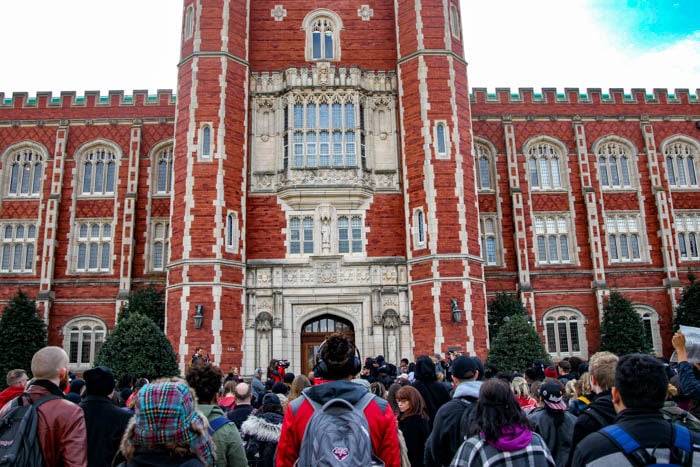
Attendees gather in front of Evans Hall during the Better Together March on Jan. 24.
The march took place less than a week after the video was released and just one day after an unknown individual walked around campus in blackface.
OU’s Black Student Association announced the creation of the Black Emergency Response Team in a press release following the march. The team would respond to racist incidents on campus and would work to hold the administration accountable. The press release also revealed the list of demands given to Harper on the day of the march, including a zero-tolerance policy for hate speech, an enhanced four-year curriculum for education on social and cultural competency, an increase in the number of multicultural faculty and staff and increased financial support of multicultural students and programs.
A year after the “Better Together” march, BERT initiated a sit-in and hunger strike on Feb. 26, 2020, at Evans Hall, OU’s administrative building, calling for Harper’s resignation among other demands. The organization expressed its grievances with Harper in a post on Twitter.
Last year, a member of OU’s Kappa Sigma chapter was removed from the fraternity after yelling racist and homophobic language out of a window at people passing by the house on the day of OU’s spring game. The fraternity member was accompanied by another student and one other person who were not members of the fraternity, according to a statement sent to OU Daily during the time of the incident from the Interfraternity Council.
As Woodward recalled his personal experience following the SAE incident, watching the protests unfold from behind his camera lens, he said he reflected on the family-like culture of the OU community and the power it holds.
“It was pretty crazy to see all these kids, all different types of people from all different types of backgrounds — just diversity up to 100% — of people linking arms and doing something as a unit and speaking for a cause together, collectively as one. One body,” Woodward said.
Woodward said the experience reminded him that, despite how divided politics are today, people still come together to support each other when injustice happens. He said he was inspired by the unified response that led to substantial changes in policy, increased accountability and the creation of a culture that prioritizes accessibility and inclusivity.
Woodward said he was able to see the impact of unity firsthand and the positive change that can come from situations like the SAE incident.
“As charged as politics are today, and as charged as our society is today, and how divisive it is, I do think that’s one of my main takeaways,” Woodward said. “A nasty thing happened, and there was a whole bunch of people that responded to it and came together with one voice.
“How incredible it is that all these people from all different backgrounds were working together to share a common voice.”
This story was edited by Peggy Dodd, Anusha Fathepure, Ana Barboza and Ismael Lele. Gretchen Schultz, Mary Ann Livingood and Grace Rhodes copy edited this story.
A decade later: OU alums, leaders, greek life members reflect on Sigma Alpha Epsilon incident, protests
Comprehensive coverage on the legacy of the Sigma Alpha Epsilon racist video and following protests on OU's campus 10 years ago.