

I was riding north on I-35, one hand on the wheel and the other covered in blood.
I had just turned off Lindsey Street when the blood started to pour — perhaps to a medically questionable amount. But I was on a 30-minute drive to fame and glory, up to the state Capitol.
And I was utterly clueless.
The beginning
About a month prior, I wandered into Copeland Hall an unwitting 18-year-old. I was attending the OU Daily’s open house, though I knew nothing of journalistic convention; AP Style, speech-to-text transcription, written clarity, newsworthiness and the editorial process all meant nothing to me.
But I had gone for several reasons.
First, then-editor-in-chief Jillian Taylor suggested I do so at a tabling event.
Second, the medium was the career decision my 16-year-old self committed to.
And third, I had witnessed the people from afar. The energy was palpable.
Within my first week of arriving on OU’s Norman campus, I explored most of the facilities for no better reason than to explore. And my foray into Copeland Hall saw me face-to-face with the environment I’d go on to step foot in hundreds of times.
I stood at the far end of the hallway, silently and perhaps creepily gazing at a close group of individuals enjoying each other’s company, even on an unusual weekday well before the semester’s start. I wanted to be a part of that.

The following Friday, I met those same people, along with some soon-to-be old friends: Anusha Fathepure, Teegan Smith, Ismael Lele. And Big OU Daily — Jillian, Karoline Leonard, Alexia Aston, Silas Bales, Jazz Wolfe — had offered us a space as soon as we entered. But more so, they gave us their trust.
I hoped they weren’t wrong.
The assignment
In late September, I received a message from Karoline. She asked Teegan and I to cover a special legislative session that day at the state Capitol, where lawmakers would consider House Bill 1007.
The bill would allocate $108 million to the state’s University Hospitals Authority and Trust under the stipulation that funds toward gender-affirming care would be banned. For OU, that meant its own medical school would follow suit.
There was a lot to unpack.
God help her, Karoline was probably desperate. I was nervous.
What’s a legislative session? Didn’t know. What’s the legal process? Didn’t care. I just ran with it, despite the complications.
That morning, I woke up feeling particularly unwell. For the past several days, I had lost significant amounts of blood from my sinuses.
I also couldn’t leave for a few hours due to classes.
But this was important. This was the big one — my big break.
I headed to the Jenkins parking garage.
The drive
The plan was simple; Teegan was already there, and my job was to take the baton. How many undereducated reporters did it take to write a legally dense story on a politically sensitive subject? We’d soon find out.
But the September heat was getting to me.
Five minutes into the drive, I turned onto the Interstate 35 on-ramp. I felt a drop hit my leg.
Then a pause.
Then bloodshed.
To this day, I have yet to experience that level of fluid exit my nose; it was a downpour from both nostrils. My pants and shirt were unfortunate casualties.
As I descended onto the interstate, my right hand clambered for a solution. The glove box, the floorboard, the door — they were all targets, up until I found a white, cloth surgical mask. I harshly pressed it against my nose to staunch the blood, tightening my grip on the steering wheel.
I was in a crisis. I could either get off the interstate and wait for the bleeding to stop, or I could hold out. But there was no time to stall, people were counting on me.
The blood was gathering, and I could feel the liquid warmth underneath.
Perhaps irresponsibly, I held on for the next 20 minutes. And so did my nose.
The scene
After 20 monotonous minutes, I pulled into the state Capitol’s southern lot. As I hit the parking brake, I feared pulling my hand away from my face.
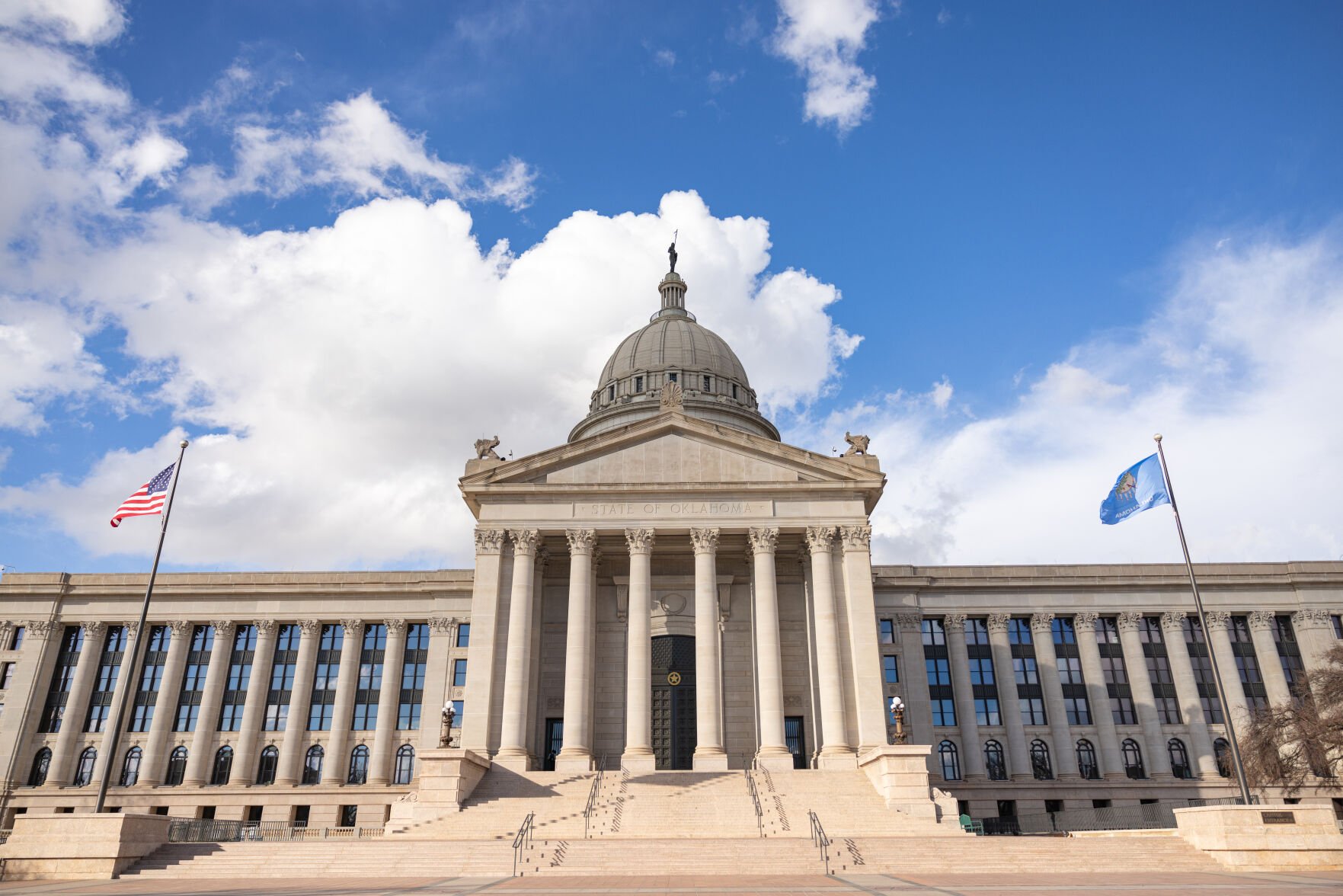
The Oklahoma State Capitol in Oklahoma City.
The mask unhappily departed, and none the whiter. Stained in dark crimson, I chucked it in the trunk.
Meanwhile, my face and torso had become suspicious sights. Bloodstained isn’t a good way to make a first impression, so I rummaged through another series of masks, fashioning them into makeshift towels.
I swabbed my face the best I could, but I realized it wasn’t going to make for an appealing opening. I put on another mask, and hid the evidence on my shirt with a jacket.
The Capitol was an unfamiliar place for a novice like myself, but I stumbled my way to the proceeding just in time for Teegan to leave.
The reporting aspect of this story was similarly rudimentary, though invaluably educational.
I saw the legislative process up close. I experienced the pace of a quick news piece. I practiced on-the-scene interviewing.
And there, I challenged my deeply introverted self in ways I never had before. That involved approaching random strangers — a prospect still fearsome to this day.
But I recognized then that I was in a moment in time, and it couldn’t be replaced, that, just for a moment, it was everything. I couldn’t lose it — I had to capture the scene.

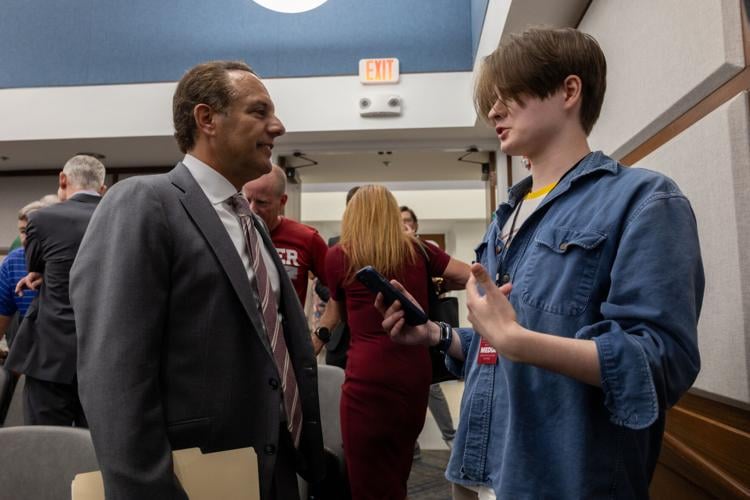
OU President Joseph Harroz Jr. with OU Daily Senior News Reporter Thomas Pablo before Norman City Council meeting on Sept. 17.
In that way, journalism required me to exit myself to document some point in history. It proved I was somewhat capable and somehow resilient.
In retrospect, the story probably wasn’t all that good. Yet as I left the scene, I knew I was somehow changed. Though not before I bled all over the Capitol bathroom.
The trip
I started out this journey in all the wrong ways.
As a 16-year-old kid, I had grandiose aspirations of reporting for the sake of excitement.
As an 18-year-old, first-year student, I wanted to be the outlaw journalist of the OU Daily. I wanted to piss people off with the truth. I wanted excitement.
But what I got instead was something irreplaceable.
In four years, I learned more here than anywhere else: about the court system, legislation, bureaucracy, fact checking and new ways to perceive the world and its people.

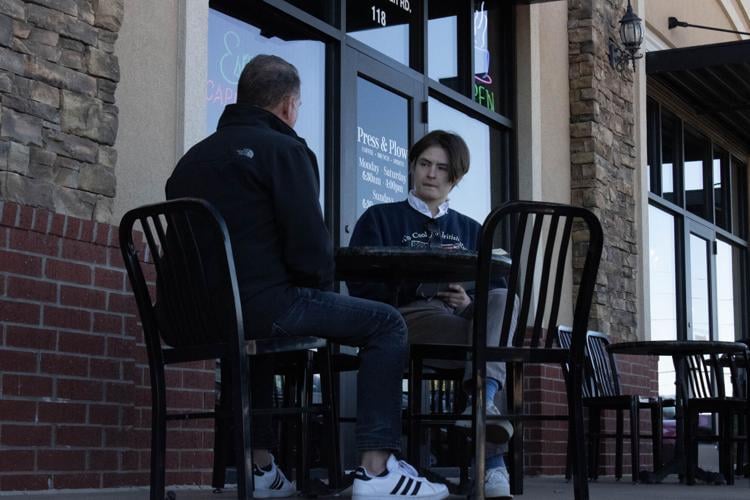
OU Daily Senior News Reporter Thomas Pablo interviewing Alexander Torvi about his political standpoint.
And along the way, I’ve mellowed out, likely due to a good group of friends at my side. I had some of the best mentors I’ve ever had, Seth Prince being one of them.
I don’t think it’s hyperbole to say Seth is the single greatest contribution to journalism in the state of Oklahoma. His influence is everywhere, even if he doesn’t know it. That goes not only for his professionalism, but his empathy as well.
Even four years later, I haven’t quite lost my taste for grandeur (I’ve suggested to Anusha I’m like 007 and she’s M).
Yet I’m still proud of that dumb kid who took a chance, the one who dove nosefirst into something he didn’t understand — discovering the truths at the heart of journalism along the way: speed, drive and, potentially, self-sacrifice — with only the faintest idea it was the people who pulled him through.
However, I’ve stopped putting my personal health on the line. Please don’t bleed and drive; take care of yourself and access appropriate health services, mental or otherwise.

I don’t know what the future of journalism looks like, especially in a time when it’s arguably more important than ever before. I’ve heard it’s bleak, but so are a lot of things.
Employers out there may not be looking to take a chance on some OU students, but it would be a safe bet.
And goddamned, they’d be lucky to have OU Daily.
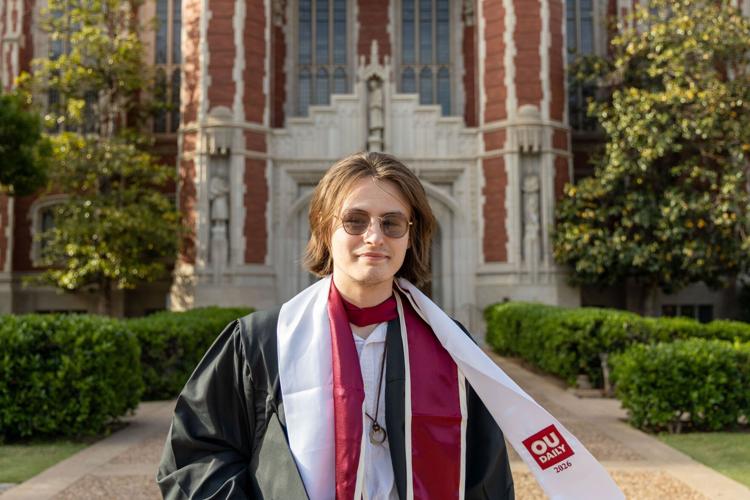
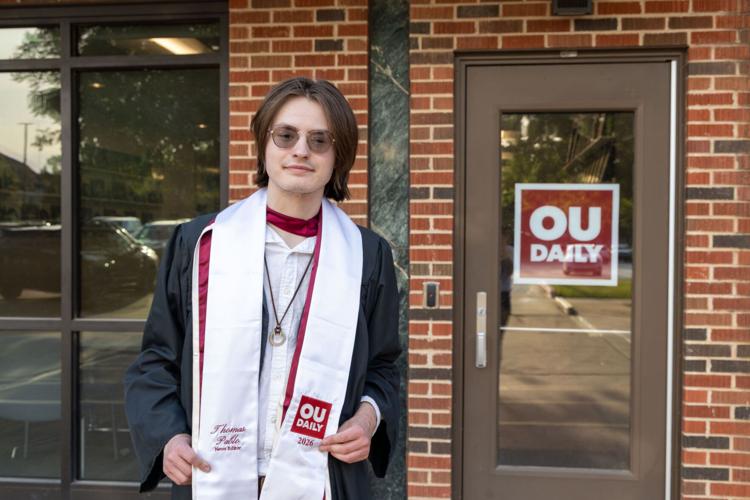
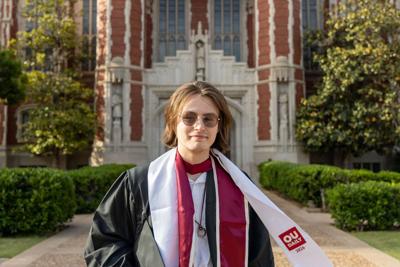
Thomas Pablo is an OU journalism and political science graduate. At OU Daily, he served as a news intern, junior news reporter, senior news reporter and news editor. After graduation, he is returning to KOSU, where he previously interned, to cover Indigenous Affairs and American politics.
Read some of Thomas’ work: