
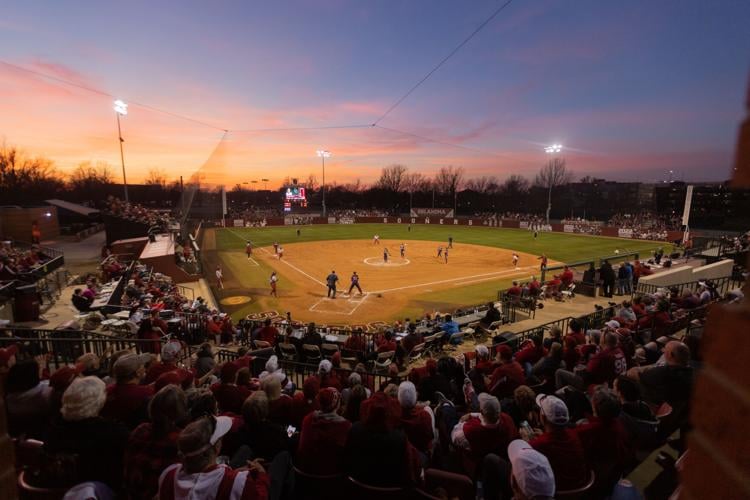

The walls of Marita Hynes Field have seen an awful lot.
Opened in 1998 as the OU Softball Complex, the stadium has seen six national championships, 15 Women’s College World Series, and 14 Big 12 championships. It’s become a fortress for the Sooners, as they’ve gone undefeated at home since a loss to Wisconsin in May 2019.
The stadium has been home to some of OU’s greatest players, such as NCAA all-time home run leader Jocelyn Alo, two-time USA Softball Collegiate Player of the Year Keilani Ricketts and 2019 Softball America Pitcher of the Year Giselle Juarez. It’s also witnessed 26 of coach Patty Gasso’s 29 seasons with the Sooners, where she’s held a 1,247-282-2 record at Marita Hynes Field.
What started as a simple replacement for Reaves Park has turned into one of the most vibrant environments in college softball. Not only has OU’s softball program grown during its time at Marita Hynes Field, but softball in Oklahoma has grown, in part due to the stadium’s atmosphere.
“It’s just grown and grown and grown since I got there,” Kelli Braitsch, former OU shortstop from 2000-03 and member of OU’s 2000 national championship team, told the Daily. “We got our first kick of the ball with (the stadium), and it just keeps getting bigger and bigger. It’s amazing. It’s very prideful for us.”
But OU will soon say goodbye to its beloved home. The Sooners’ new stadium, Love’s Field, is expected to be completed before the 2024 season begins. OU announced plans for the stadium in 2018 and broke ground on its location off Imhoff Road in 2022.
The move to Love’s Field is universally loved by OU players, coaches and fans, and is regarded as a well-deserved prize for the Sooners’ success. It will include a 10,500-foot indoor training facility and several team spaces such as a training room and even a classroom. It will also have a capacity of 3,000, close to double Marita Hynes Field’s capacity of 1,600.
Despite the excitement, leaving Marita Hynes Field will be bittersweet for many. It’s where OU won nearly all of its national and conference championships, and where it became softball royalty.
Now, the Sooners hope to leave a lasting legacy with one more WCWS run, closing the stadium with yet another championship.
“It’s weird. It’s like when you’re going to college and you leave home and say, ‘I wonder what’s going to happen, are they going to demolish our home?’” Braitsch said. “But then again, it’s very exciting because they’re about to … be in this new stadium, and it’s going to be great.”
‘We’d fill it up to capacity every single game’
Before Marita Hynes Field, the Sooners played at Reaves Park, a public park owned by the City of Norman. Knowing OU needed a better stadium to grow, Marita Hynes, a former OU coach turned associate athletic director, went to then-athletic director Donnie Duncan to discuss a new stadium.
The two found a site, and eventually secured funding from donors to build it.
“I thought it was a wonderful facility,” Hynes told the Daily. “It had a nice locker room, enough seats for fans, and we were really happy about what we built. It was such a beautiful sight.”
The capacity sat at 1,378, and while it was above and beyond what OU had, it still left much to be desired. There wasn’t a wall around the stadium. Instead, there was a four-foot chain-link fence, so small that someone could lean over it. The top of the fence was lined with pipes so players wouldn’t scratch themselves while playing.
The only seats were behind home plate. For postseason play, OU installed 10-foot long benches behind the outfield fence, with five seats per bench. They were so close to the fence that fans who sat there could lean their arms on top of the wall while sitting down.
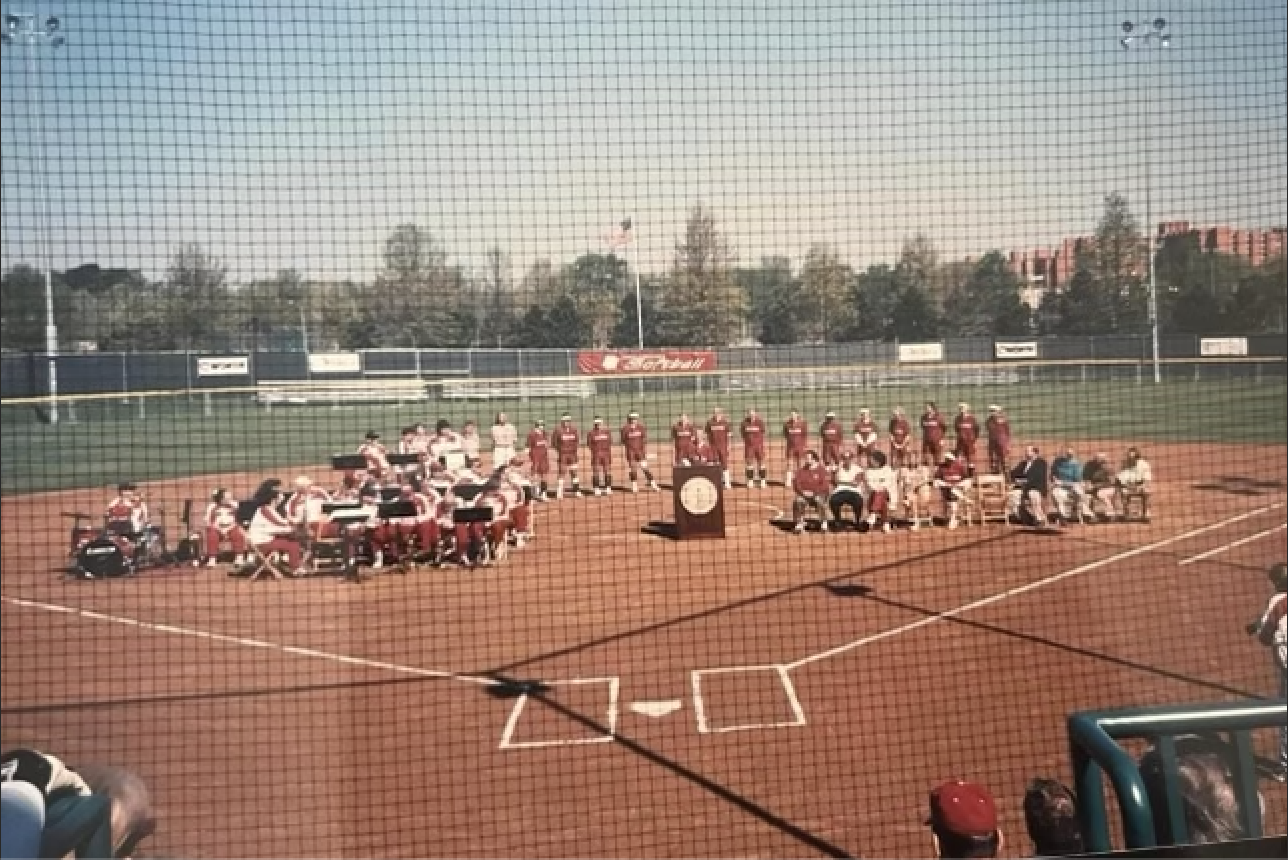
The Sooners line up before their first game at Marita Hynes Field in 1998.
There was also no bathroom in the dugout, so players had to go to the one in the locker room. But, because it had tile flooring, it meant many players slipped as they entered it.
“I can guarantee you every single player that ever ran into the bathroom fell,” Braitsch said. “I fell many times. Thank God I did gymnastics, so I could do the splits and recover quite well.”
In 2000, the chain-link fence was removed and replaced by a wooden wall. But, that presented its own problems.
“One team came to play us my sophomore year, and their centerfielder ran nearly a full sprint and knocked herself out cold,” Braitsch said. “I think she thought she would ricochet off it, but I’m pretty sure she knocked herself out cold.”
Despite its slippery bathrooms and knockout walls, the Sooners made magic happen on their home turf. The beginning of the stadium saw the beginning of OU’s championship success, starting with its first WCWS run in 2000. Braitsch remembers the Sooners winning the Norman Regional that season against Oregon State, and witnessing one of OU’s earliest defining moments.
Down 2-0 in the third inning, junior LaKisha Washington hit just her fifth career home run to tie the game before OU won 3-2 to clinch a spot in the WCWS. There, the Sooners brought home their first national championship.
OU would make the WCWS in the next four seasons, including an emphatic Norman Regional win in 2002 against Big 12 rivals Texas and Texas A&M. Braitsch remembers those games as some of the first where the Sooners showcased their intimidating home atmosphere, with OU having to bring fire marshals in to prevent the stadium from exceeding capacity.
“We’d fill it up to capacity every single game,” Braitsch said. “It was always so loud and so crazy. Our fans, they were always there to support us.”
Once OU Softball Complex opened, it didn’t take long to cultivate its raucous atmosphere. Braitsch looks back with fondness, knowing the growth that’s occurred in the years since began with her teams.
“(The fans) were always so close to us,” Braitsch said. “I think that allows you to bond differently with them … because they were an extension of our family. And now, we just keep compacting them up and up and up.”
‘People hate playing at Oklahoma’
As the Sooners changed their culture, their stadium changed with it.
In 2004, OU Softball Complex was named after Hynes, whose 257 wins from 1977-84 rank second in program history behind Gasso. It was an honor fit for an integral part in the Sooners’ growth, and Hynes couldn’t help but feel emotional.
“I started crying,” Hynes recalls. “It was so neat. A lot of hard work led to that. It’s neat when I’m watching ESPN and hear ‘We’re here at Marita Hynes Field.’ I’m just happy it’s not the Marita Hynes Memorial Stadium.”
But in the following years, the Sooners struggled to make the WCWS consistently, appearing in it just once for the rest of the decade. But, fans kept coming, leading to the addition of extra seats in 2012. The capacity expanded to 1,600, just in time for the Sooners to reach the top of the mountain again.
Ricketts, a four-time All-Big 12 honoree from 2010-13, remembers the moment it happened. In 2012, the Sooners faced Arizona in the Norman Super Regional. It was a rematch of a 2011 Super Regional matchup where OU defeated the Wildcats in Tucson. Instead of Arizona avenging its loss, Marita Hynes Field was where the Sooners re-established themselves as a consistent contender.
OU swept the Wildcats behind two complete games from Ricketts. She candidly recalls the booming OU crowd as she racked up 22 strikeouts across the two games, bringing to life the intimidating atmosphere Marita Hynes Field would come to be known for.
For Ricketts, it was the Sooners’ best crowd yet.
“In 2012 … that’s when we started seeing sold out crowds every weekend,” Ricketts told the Daily. “It was really cool just to see how invested Sooner fans were at that field. Being able to clinch (the Super Regional) at Marita Hynes, and being able to have our fans celebrate with us, it was really cool.”

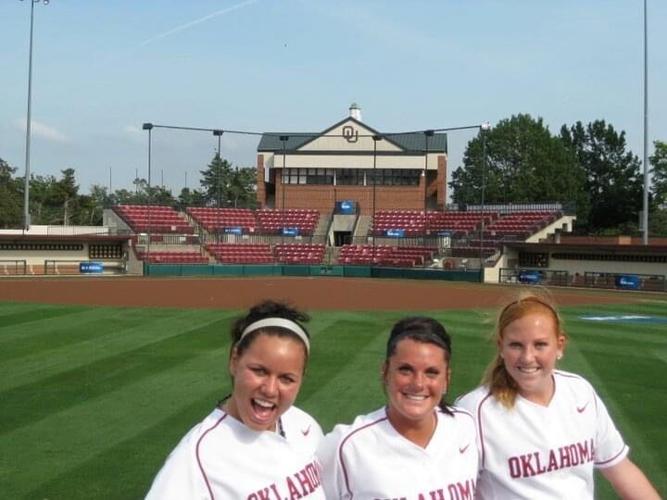
Keilani Ricketts (left), Kirsten Allen (middle) and Michelle Gascoigne (right) pose for a photo at Marita Hynes Field in 2013.
Not only was Marita Hynes Field where the Sooners ascended into softball’s upper echelon, it was where the community felt united. Before OU played Texas A&M in the 2013 Norman Super Regional, a devastating EF5 tornado hit Moore killing 24 people and causing an estimated $2 billion in damages.
In its aftermath, people rallied behind the Sooners. The day the game was supposed to be played, OU instead invited softball players from Plaza Towers Elementary School, who lost seven students to the tornado, to practice with them at Marita Hynes Field.
When the series was eventually played, another passionate crowd showed up, desperate to see something positive after days of heartache. That’s exactly what the Sooners provided with two run-rule wins over Texas A&M followed by its second national title against Tennessee in the WCWS finals.
“I think that we were really giving the state something to get their minds off of what was going on,” Jessica Shults, an OU catcher from 2010-13, told the Daily. “That was special within itself. We were able to be a glimpse of happiness when there was so much tragedy that was happening around us.”
The more OU won, the more people came to Marita Hynes Field. And the more fans showed up, the more it earned its reputation.
“People hate playing at Oklahoma,” Shults said. “The fans are definitely a huge factor. You're not able to create that atmosphere if you don't have the support. Those fans … they're up close and personal with you. You felt like you were in it with them.”
‘It was just a sea of red’
Plans for a new stadium started in 2017, with some players being shown early renderings of what it could look like.
But, OU couldn’t get enough funding to make Gasso’s vision come to life. It meant in the meantime, Marita Hynes Field was still the Sooners’ home, one that was feeling more like it with each passing year.
“They were telling me it was going to come soon, but you’re gonna play at Marita for now,” Nicole Mendes, an OU utility player from 2017-21, told the Daily. “That stadium, it became more than just a field. It was a field that felt like home, and it had everything I wanted.”
That home was where OU continued to win. The Sooners claimed back-to-back national championships from 2016-17 and again from 2021-22 alongside six Big 12 titles during that time. The connection with the fans grew to where players like Mendes would have conversations with them during games, ranging from friendly chats to urges to get louder.
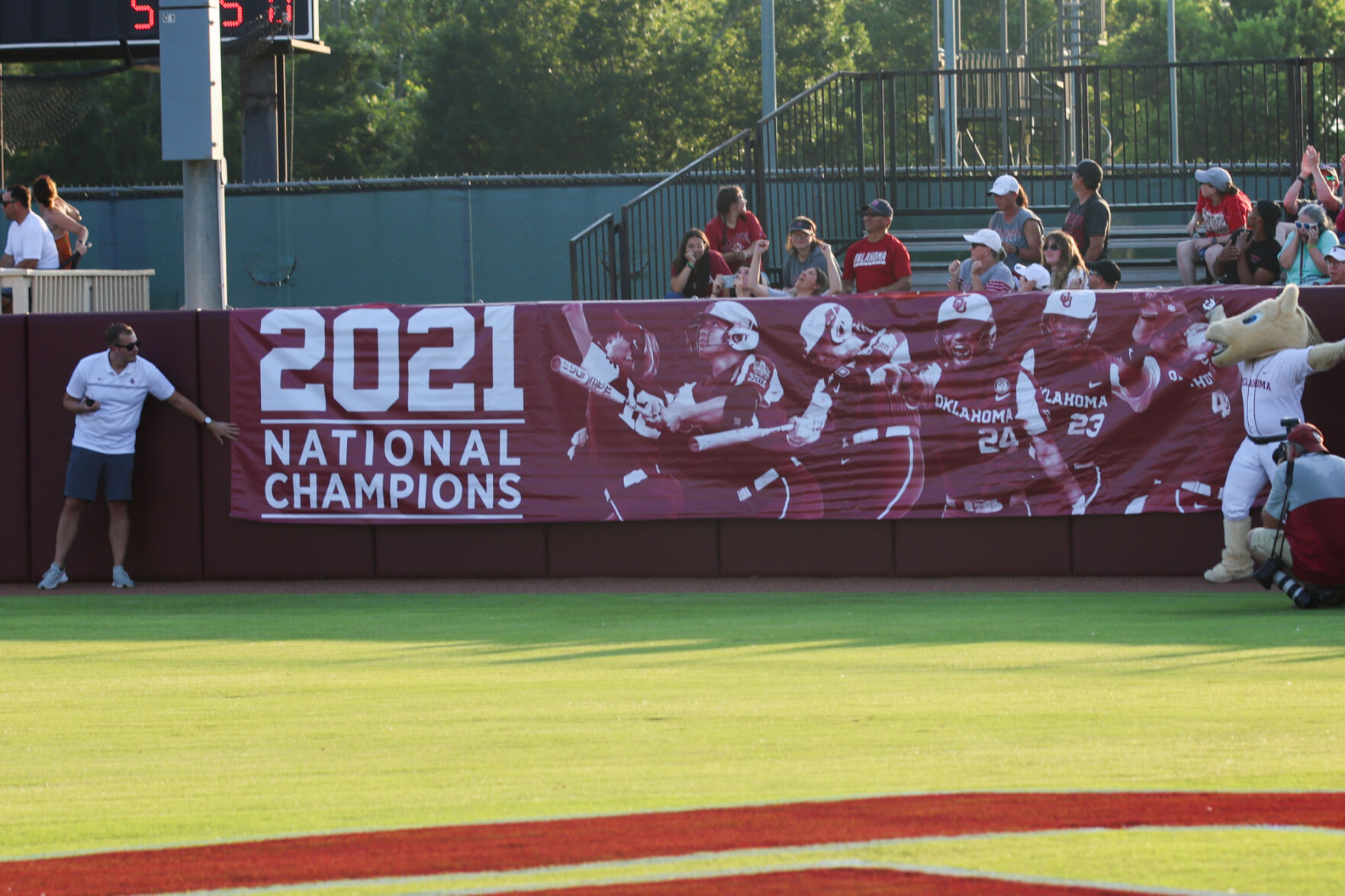
The 2021 national champion banner is unveiled during the OU softball national championship celebration at Marita Hynes Field on June 12.
Pitcher Shannon Saile, who played at OU from 2019-21, remembers being blown away during her first home game.
“It was just a sea of red,” Saile told OU Daily. “They’re all on your side, and they’re all chanting back and forth and they all just surround you. That’s what was really cool about it.”
Demand for tickets continued to increase, so much so that former players struggled to find ways to support their alma mater in person.
“I'm alumni, and I can’t get season tickets,” Braitsch said. “Because so many people have tickets and have had them that there's a waiting list. As a national champion, I’m on a waiting list. It’s a catch-22. It sucks, but at the same time, that many people want to come out and watch softball. It’s the greatest thing.”
Marita Hynes Field once again had its moments, including another home Super Regional victory in 2016. Both Mendes and Saile recall the 2021 Norman Super Regional as their favorite, where OU faced Washington, and after winning game one, would play game two on ABC, the first collegiate softball game to be broadcast on the platform.
OU took advantage of the massive spotlight, as Saile pitched a complete game in an 8-1 run-rule win in front of 1,800 fans at Marita Hynes Field. Mendes remembers the roar of the crowd as she made the final out — a running catch near the wall in right field. Once again, the Sooners made another memory on their home turf.
𝐆𝐨𝐢𝐧’ 𝐠𝐨𝐢𝐧’ 𝐛𝐚𝐜𝐤 𝐛𝐚𝐜𝐤 𝐭𝐨 𝐎𝐊𝐂‼️ pic.twitter.com/Wo5oQgTIZL
— Oklahoma Softball (@OU_Softball) May 29, 2021
“For that to be my last play ever on that field was unreal,” Mendes said. “That’s the one that always stands out to me. Doing it for my teammates and the fans was a real special moment.”
After 25 years at Marita Hynes Field, OU will play what could be its final games there during its upcoming postseason push, beginning with the Norman Regional from May 19-21. Then, the Sooners will move to Love’s Field, a move seen by many as the obvious next step for a juggernaut program like OU.
“There’s no team more deserving to play in that kind of a stadium,” Ricketts said. “I just can’t wait for them to finally get into it.”
Marita Hynes Field is a place full of history. For the Sooners, that means there’s only one way to close it out — by earning one more trip to the WCWS en route to a potential third consecutive championship.
“It’s bittersweet, knowing we’re going to be the last ones to play there,” said junior second baseman Tiare Jennings. “We just have to try and represent the legends that played before us.
“We’re gonna miss this field, so we’re gonna leave it all out there this weekend.”
Editor's Note: This story was corrected at 1:17 p.m. on May 20 to reflect the correct name of Reaves Park.


