
Editor’s note: This story is featured in OU Daily’s voter guide, which is available in print on racks across campus and Norman in mid-October. Check out the other featured stories at the bottom of this article.
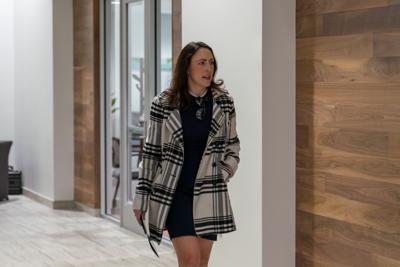
Atop former Norman Mayor Breea Clark's bookshelf lies the gavel she would use to keep decorum during city council meetings she presided over. Clark’s gavel became a method to command the respect she said is harder to attain as a woman.
“The city clerk, who sat to my right, told me that no one had ever used a gavel that much in their tenure,” Clark said. “I had some pretty tough issues. As a woman, you have to run a tighter ship, or they will walk all over to you.”
During her time on council, Clark said she was bullied, harassed and made to feel unsafe on several occasions. Comments would be made about her appearance and uncomfortable questions asked including, “Aren’t you the prettiest mayor I’ve ever seen?” and “Shouldn’t you be at home with your children?”
In one council meeting, Clark said she had to use her gavel to silence two residents speaking longer than their allotted time. Shortly after, one told Clark to “shut up” and a local preacher called her “the Jezebel of Norman.”
One night, after being recognized, Clark was yelled at and insulted by a man who followed her outside of a bar on Main Street. The man continued to berate her as she waited for an Uber to pick her up.
Around this time, Clark filed a police report for death threats in a Facebook post that read, “Mayor dipshit needs to be pulled out of office and tried on the courthouse lawn … the problem with politicians, they don’t get hung in public anymore … #bringbackpublichangings!”
According to Clark, interactions like these are just a few examples of the trials women face while working in male-dominated spaces, particularly in politics.
A 2022 data collection conducted by Princeton University’s Bridging Divides Initiative and the Anti-Defamation League, a nonpartisan “anti-hate organization” fighting antisemitism, found that among over 400 cases, women accounted for 42.5% of all threats and harassment towards local officials, 3.4 times more than men.
“I feel like once I had gotten elected mayor, I had this shield that could protect me from what normal women go through,” Clark said. “That was not the case at all.”
Clark’s time as mayor was full of contention. In 2020, a grassroots organization called Unite Norman attempted to recall Clark from her position after city council reallocated over $800,000 of the Norman Police Department’s proposed $23 million budget to other facets of the city.
According to Clark, this decision led to online and in-person harassment, making her time as mayor more strenuous than she had hoped.
“It's ridiculous what I went through in a three year period,” Clark said. “My kids have been bullied. During COVID, I received death threats that the (district attorney) refused to prosecute. I've had creepy letters mailed to my home. I've seen pictures of my home on social media. It's a very risky thing.”
Clark served as Norman’s Ward 6 council member for three years before running for mayor in 2019. Clark lost her bid for reelection in 2022 to current Mayor Larry Heikkila, a defeat she said lifted a tremendous weight off her shoulders.
“I thankfully lost. I wasn't planning on it because it was so difficult, personally and professionally,” Clark said. “I have kids, so I got kind of pushed into it because I had to protect the seat.”
Despite feeling relieved stepping down from her position, Clark said she continues to advise and encourage young women to be leaders. Clark serves as the faculty adviser for IGNITE, a student organization for young women interested in politics at OU.
“I still think that people look up to me, especially young women,” Clark said.
Unite Norman’s recall for Clark and other city council members came during a contentious time in American politics. Former Ward 6 Councilmember Elizabeth Foreman said this unique time is when national politics began to blend with local government.
Foreman was sworn into Norman’s Ward 6 seat in July 2020, three weeks after council voted to reallocate a portion of NPD’s proposed budget.
In 2020, the U.S. was reeling from the effects of COVID-19 and a summer of protests over the murder of George Floyd. The last few months of 2020 began with a controversial presidential election.
Foreman said she was surprised by the concerns she would hear from residents when campaigning, confused as to what people thought local politicians could actually do.
“I would have people blowing me up, like, ‘What’re your feelings on gun rights?’ and ‘Do you support abortion’ and, you know, ‘the gay community?’” Foreman said. “A lot of people conflate all of national politics with (city council), and I would say, ‘You know, city council is not partisan.’”

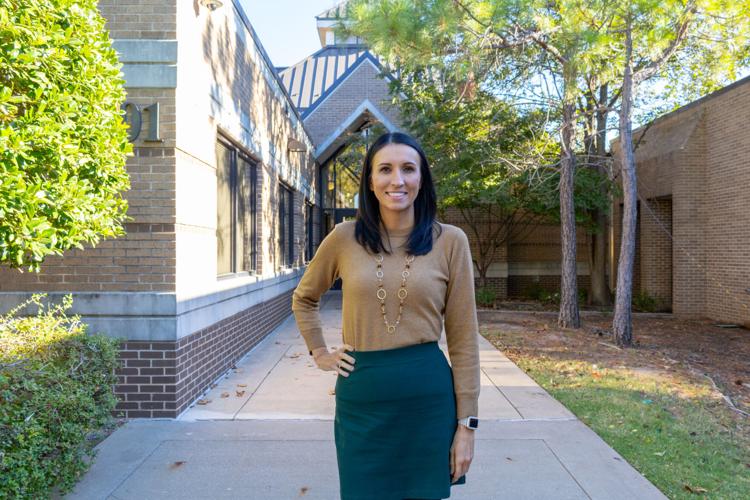
State Senator district 15 candidate Elizabeth Foreman at Norman City Hall on Oct. 16.
Foreman described her first term on council as difficult, but she said she always understood that her time as a council member was intended to be the first step toward running for a state Senate seat.
In November, Foreman will face Republican Lisa Standridge in the election for state Senate District 15.
Foreman said she had to be hyper-conscious of how she conducted herself in person and online, and though she would never do anything to compromise her own character, there were restrictions that came with being a woman in power, especially during such a turbulent time.
“You have to really be very meticulous and plan how you present yourself. If you’re too serious you’re a ‘bitch.’ You’re not serious enough, then you're a ‘bimbo.’ Or you don't smile enough, or you smile too much. It's a really fine line,” Foreman said.
Despite being cognizant of how she acted for the sake of her future campaign, Foreman said, similar to Clark, she experienced in-person and online harassment and misogyny.
“My recycling and trash cans are still in my garage because people would come and knock over our trash cans, vandalize our homes, take off our mailboxes. That only happens to women,” Foreman said.
Less than a year after Foreman joined council, Vice President Kamala Harris became the first woman to hold that office, four years after former Secretary of State Hillary Rodham Clinton became the first woman to win the Democratic primary race.
In 2023, women made up 28% of Congress. In Oklahoma, women accounted for only 19.4% of state elected officials, according to IGNITE.
Women are making gains in elected positions, according to the Pew Research Center. As the Democratic nominee for president, Harris is now the second candidate in eight years who has a chance to become the first woman elected president of the United States.
Though Clinton and Harris represent politics on a national level, like Clark they have been scrutinized because of their gender. A Sage Journal study found that women leaders will face political and social repercussions whether they speak about their gender or not.
“Clinton did suffer for a lot of sexism during that race,” Allyson Shortle, an OU professor of political science, said.
According to a study conducted by Shortle, white women in Oklahoma City voted against Clinton more than white men.
“It's really important to know that sexism can be held by anybody,” Shortle said. “You don't have to be a man to be sexist.”
Unlike Clinton, Harris has garnered support from younger voters who feel she may bring a deeper level of understanding compared to President Joe Biden.
“In 2016, the young people were millennials. Now the young people are Generation Z,” Shortle said. “What we're finding for the first time in a very long time is that young people — who are women, LGBT — are engaging more in politics than men, young men, and not only that, but they are very progressive.”
Harris’ race and gender have been a topic of conversation among her political opponents. Republican candidate Donald Trump’s current running mate, Sen. JD Vance (R-Ohio) referred to Harris and other women politicians as “childless cat ladies.” Trump himself has also questioned Harris’ racial identity.
Despite political attacks against her identity, Shortle believes that Harris being mixed race gives her the ability to appeal to a multitude of demographics in the U.S.
“(Harris) and I kind of have that in common,” Rep. Annie Menz (D-Norman) said. “Talking about our gender, our race, those identifiers, it's just kind of like tired. It's just an old playbook.”

Oklahoma House Representative Annie Menz during the Norman Community Candle Light Vigil for Nex Benedict.
Menz, who represents District 45 and is seeking reelection, is the first Latina and one of few openly queer people to be voted to the Oklahoma House.
She said representation is an essential component to making sure that all voices are heard. Growing up in Oklahoma as a child of immigrants, Menz said she saw the inequities that came with being lower class.
“What we have left here in Oklahoma is to really do some introspection and support candidates that people can get excited about,” Menz said.
According to Menz, the older political leaders in Oklahoma thought she was “brand new,” ignoring the fact she had been in Oklahoma for most of her life. She said it wasn’t until she became a representative that those same leaders actually took note of her existence.
“They just didn't see me,” Menz said. “I wasn't a young guy, you know, that had a lot of potential and showed a lot of promise. I was a young girl who had a lot of potential and showed a lot of promise.”
In her time as a representative, Menz said she has witnessed many situations where her peers were unable to relate or understand how their decisions could impact people that they wouldn’t personally know due to their different lived experiences.
“You have different lived experiences. I guarantee you that there are people like that in every single House district in this state, every single one,” Menz said. “Not all House representatives are listening to all the voices in their district.”
Among the younger generation, women’s voices have continued to grow stronger in recent years.
Hope Rhoads, chair of the OU Undergraduate Student Congress, said her leadership experience began as early as elementary school. In high school, she was junior class president, and in college she participated in the Student Government Association and Crimson Leadership Association.
As chair, Rhoads said she enjoys working alongside fellow college students but said there is a stark difference between being politically engaged on a college campus like OU and being politically engaged in Oklahoma.
“Going up to the (state) Capitol, especially after the DEI executive order, was nerve-racking,” Rhoads said. “I do think that sometimes when you're in those settings, I have to be a lot more serious and tone down myself a lot more when I'm speaking to adult men so they take me seriously.”
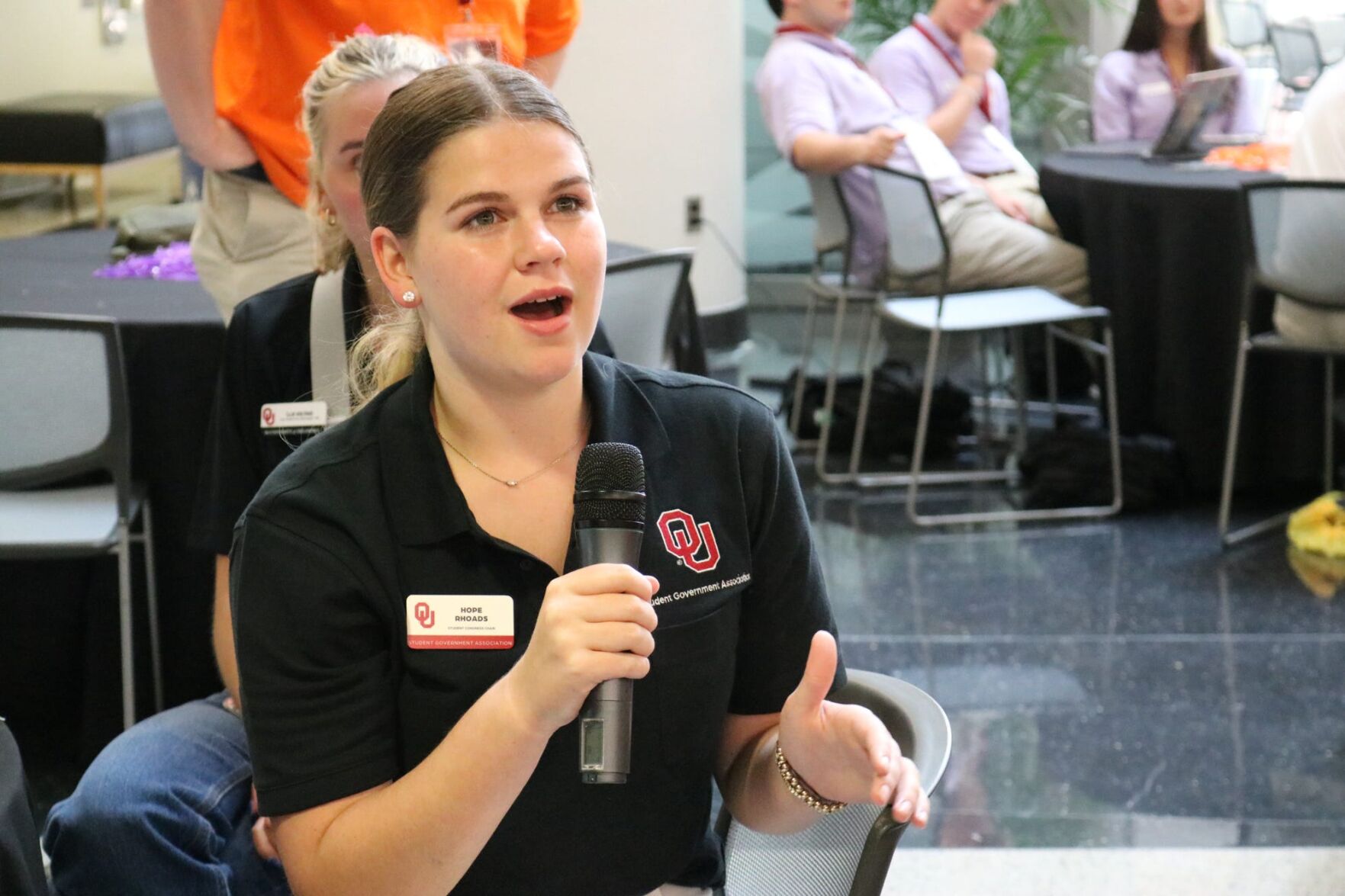
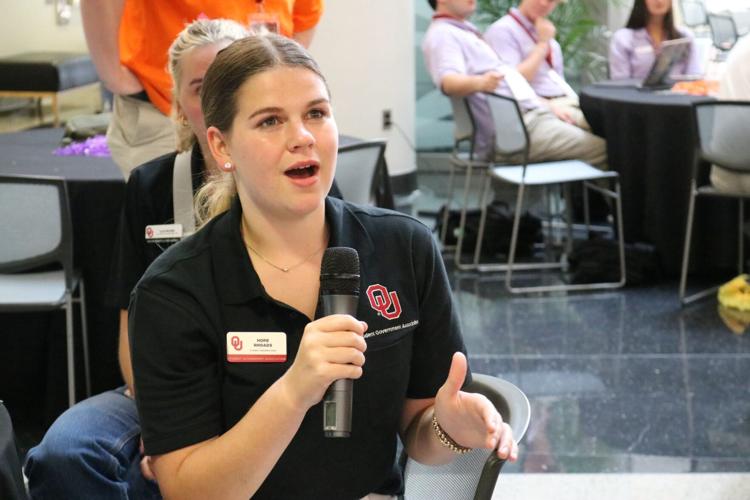
OU Undergraduate Student Congress Chair Hope Rhoads during the 2024 SEC Exchange, a three-day leadership conference hosted in Norman.
In her experience as a young leader, Rhoads said her male counterparts are often mistaken to be in charge when in the same room as her, a bias she thinks can be quelled by more representation in politics.
“I do think a lot of people still see males as being the only people in leadership roles, even if they're not trying to,” Rhoads said. “If we have a woman president, more girls will think, ‘That is something I can do. That is something that's possible for me.’”
Rhoads said for there to be more representation in political spaces, both men and women must cooperate. A Gallup analysis shows young women are becoming more liberal in comparison to their male counterparts.
“Young people are very, very liberal, but that's being driven almost entirely by women, people of color and LGBT identifiers,” Shortle said.
According to a Pew Research survey conducted in 2023, 40% of men younger than 50 who support Trump believe gains made by women in politics have been made at the expense of men.
Rhoads said just seeing a woman run for president is an exciting experience she believes will help motivate younger generations.
“I remember just being excited to see a woman running in elections because it's possible it could happen,” Rhoads said. “It hasn't yet, but I hope it does because I think that'll help break down a lot of barriers for women in politics.”
This story was edited by Peggy Dodd, Ana Barboza and Anusha Fathepure. Gretchen Schultz, Avery Avery, Grace Rhodes and Mary Ann Livingood copy edited this story.