
Editor’s note: This story has been corrected from print to reflect three Oklahoma Supreme Court judges are seeking retention, not reelection. This story is featured in OU Daily’s voter guide, which is available in print on racks across campus and Norman in mid-October. Check out the other featured stories at the bottom of this article.
State questions are laws or constitutional amendments on the ballot for the voters to decide. The right to vote on state questions is guaranteed in the state constitution. In November, Oklahomans will vote on two state questions.
Oklahoma’s state questions 833 and 834 will appear in the “ballot measures” section of the ticket.
These state questions are legislative referendums, meaning they were proposed by the state Legislature to be voted on by the public. State questions can also be sent to vote through initiative petitions proposed by residents.
Funding infrastructure improvements
State Question 833 seeks to amend the Oklahoma Constitution to allow municipalities to create districts that provide support and funding for public infrastructure initiatives.
Public infrastructure are systems or facilities that improve quality of life, including road maintenance, water supply and public parks. A district is a financing tool to fund these initiatives.
According to the resolution, 100% of surface property owners in a potential district must sign a petition agreeing to create it. The public infrastructure district would be governed by a board of trustees that has authority to issue bonds.
Every four years, the American Society of Civil Engineers creates a report card to grade America’s infrastructure. In 2021, the nation received a “C-,” an improvement from 2017 when it received a “D+.”
The report card states that infrastructure in Oklahoma is “deteriorating,” and 10.2% of bridges are “structurally deficient.” To fix drinking water issues, the state would need around $6.9 billion.
In 2021, the Biden administration passed the Infrastructure Investment and Jobs Act to fund infrastructure projects.
A fact sheet provided by the White House states that $6 billion in funding was announced for infrastructure projects in Oklahoma, including internet access, clean energy and transportation improvements.
The state has started 28 projects funded by over $119 million as of Sept. 19, according to the Department of the Interior.
Voting clarification
State Question 834 proposes amending the Oklahoma Constitution to clarify that only U.S. citizens may vote in elections.
According to the resolution, the constitution currently states that “all” citizens over the age of 18 who live in Oklahoma may vote. The amendment would change the language to clarify that “only” citizens may vote.
Proponents of the amendment say it protects the integrity of future elections.
“What we are doing is safeguarding the intent of the constitutional language for the future to avoid confusion,” Sen. Micheal Bergstrom (R-Adair) an author of the resolution, told Enid News and Eagle.
“Ensuring that only citizens can vote is not just about protecting our elections; it's about honoring the rights and responsibilities that come with citizenship,” Sen. Shane Jett (R-Shawnee) said in a press release.
Opponents of the amendment say the change is unnecessary and would sow doubt in election security.
“I failed to see where the confusion might lie when it is currently a felony to register to vote in the state of Oklahoma if you are not a U.S. citizen,” Sen. Carri Hicks, D-Oklahoma City, told Enid News and Eagle.
Noncitizens are already prohibited from voting in federal elections and can be charged with a felony as established by the 1996 Illegal Immigration Reform and Immigrant Responsibility Act.
Recently, Oklahoma tightened illegal immigration policy by passing House Bill 4156 in April, which makes entering the state without legal authorization to be in the U.S. a crime called “impermissible occupation.”
“The federal government has disregarded the safety and security of Americans by letting the influx of illegal immigrants at our southern border continue,” Sen. Casey Murdock, R-Felt, said in a statement.
The Department of Justice and an advocacy group called Padres Unidos de Tulsa filed lawsuits against the state in May. U.S. District Judge Bernard M. Jones settled the disputes with a court order that created a temporary hold on the law.
Attorney General Gentner Drummond filed an appeal of the court order with the 10th U.S. Circuit Court of Appeals in July.
Oklahoma is not the only state voting to solidify election language. Iowa, Kentucky, South Carolina and Wisconsin will vote on similar constitutional amendments in November.
The proposed constitutional language changes are nearly identical in each state’s proposed amendment.
“Voting is our greatest freedom as U.S. citizens, and we must ensure that our elections are not disrupted by illegal voting,” said Sen. Brent Howard, R-Altus, an author of the Oklahoma resolution, according to a press release.
Voting, ballot information
During a general election, many voters only vote for their presidential pick, leaving a majority of their ballots empty.
According to the U.S. Vote Foundation, over a third of submitted ballots are partially incomplete.
This phenomenon, known as “down-ballot roll-off,” is when voters vote for candidates at the top of their ballot but not the bottom, forfeiting their right to impact local decisions.
Incomplete ballots are still valid, and marked votes are counted.
Many voters are unaware of what ballot measures are being voted on, and they generally appear lower on ballots, according to Journalist’s Resource.
Local government services impact citizens daily. Public transportation, police, education and park services are more impactful than voters realize, according to the U.S. Vote Foundation.
A youth poll conducted in March by the Harvard Kennedy School Institute of Politics found 75% of Americans ages 18 to 29 are registered to vote this November.
Many first-time voters are college students, who can choose to register to vote in their home state or where they currently live.
STEPS, or Student Training & Education in Public Service, provides first-time voting guide describing how to register online, choose a party affiliation and cast a ballot. To register in Oklahoma, voters can visit the Oklahoma Voter Portal.
In Oklahoma, absentee ballots must be delivered to the County Election Board by 7 p.m. on election night, and most absentee ballot affidavits are required to be notarized and may require witnesses. In Oklahoma, notaries may not charge a fee to notarize an absentee ballot. Voters can visit the State Election Board website to learn about notarization requirements and locations offering notary services.
Early voting is available to all voters in Oklahoma. Residents can vote at a designated early voting location from 8 a.m. to 6 p.m. on the Thursday and Friday preceding the election.
Early voting is also available from 8 a.m. to 2 p.m. on the Saturday prior to a state or federal primary election, runoff primary election or general election and 8 a.m. to 6 p.m. on the Wednesday prior to the general election.
Votes must be cast in the county where the voter is registered. Voters can visit the Oklahoma State Election Board website to find the closest early voting location.
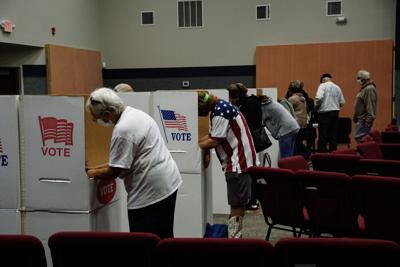
On election day, polls will be open from 7 a.m. to 7 p.m. Designated polling sites can be found on the OK Voter Portal website.
While some schools have canceled classes on election day, others have not, including OU. STEPS’ voting guide recommends students talk to professors and employers in advance about missing class to vote.
OU employees are allowed a two-hour window on election day to vote, unless they have enough time to vote before or after their workday. Eligible employees must notify their employers ahead of time and provide proof of voting, according to the staff handbook.
In order to vote, voters must bring a government or tribal photo identification; a voter registration card; or file a provisional ballot, which allows voters to cast a ballot that will later be counted if their registration can be verified.
USA.gov recommends voters bring notes, a voter’s guide or a sample ballot to their polling place to help them cast their votes.
State, local elections
Several statewide offices will appear on November’s ballot, including a seat on the Oklahoma Corporation Commission. The race includes Libertarian Chad Williams, Republican Brian Bingman and Democrat Harold Spradling.
Republican Marilyn Williams and independent Lisa Meyer will face off in the Cleveland County court clerk race.
Three judges on the Oklahoma Supreme Court are seeking retention: James E. Edmondson, Noma D. Gurich and Yvonne Kauger.
On the Court of Criminal Appeals, three seats are up for reelection: David B. Lewis, Scott Rowland and William J. Musseman.
Six seats on the Court of Civil Appeals are on the ballot: Timothy J. Downing, Robert D. Bell, E. Bay Mitchell, Brian Jack Goree, Thomas E. Prince and James R. Huber.
This story was edited by Peggy Dodd, Ana Barboza and Anusha Fathepure. Sophie Hemker, Avery Avery, Ryan Little, Grace Rhodes and Mary Ann Livingood copy edited this story.