
Editor's note: This story is featured in OU Daily's Best of Norman Guide, which is available online and in print. Racks can be found around Norman and campus. Check out the other featured stories at the bottom of this article.
Norman has dedicated itself to art and culture in the community, with a push for historical preservation, arts cultivation and education in the last 50 years.
Being a university town is an important pillar of Norman’s arts scene, with students adding to the push for artistic creation and expression. Norman Arts Council Executive Director Leslie Nottingham said Norman’s involvement in the arts stretches far back.
“I think (art) always existed here in Norman, and I think a large part of that’s due to the university,” Nottingham said. “We get all these fresh thoughts, these really dedicated people who are into education and learning, and they come and they don’t just join the university — they join our community as a whole.”
While the university has always supported Norman’s arts, Nottingham said there was noticeable change five decades ago, when the city began to form organizational support for the arts community.
“There was a great push in the ‘70s for a lot of communities to start arts councils, and that’s typically when you see them cropping up across the United States,” Nottingham said. “It’s the ‘70s where these things are starting to get established. There’s a need that people are reacting to.”
Norman Arts Council was one of those established, providing organizational and artist grants, offering arts education scholarships, supporting public art and developing and running MAINSITE Contemporary Art.
Following the Norman Arts Council’s establishment in 1976 came the guest tax, which Nottingham attributes to the art community’s growth.
“It’s that hotel tax that really gives us our main tenet and gives us the core of our mission,” Nottingham said.
The guest tax — paid by visitors on their short-term stays in hotels, motels and rentals — was first established in Norman in 1981, according to the council’s website. The Norman Arts Council utilized this tax to fund its various arts programs. The tax has increased multiple times since its establishment: in 2013, 2023 and again in 2026 to sit at a current rate of 10%.
Born and raised in Norman, Shari Jackson — executive director of The Depot, Norman Music Alliance and producer of Norman Music Festival — agrees with Nottingham that Norman has always been a thriving arts community, but that the guest tax incited widespread involvement.
“One of the things that really shifted the arts and made them explode over the last few decades was something that Norman, Oklahoma has that a lot of communities don’t, … the hotel guest tax,” Jackson said. “Creating that and creating a funding mechanism for the Norman Arts Council to be able to give that money to arts organizations trying to get up and running and create events for the community made it possible for some extraordinary growth in the arts.”
According to Jackson, the guest tax increased production quality of events and advertising for arts organizations that, prior to the early 1980s, were more casual.
“The formal part came with the money part. Before that it was a lot (of ) DIY, and we have this funny perception sometimes about free things not necessarily being as good as something that feels a little more expensive,” Jackson said. “Getting some money and being able to produce and being able to formalize some of the things in our art scene makes them a little more legit.”
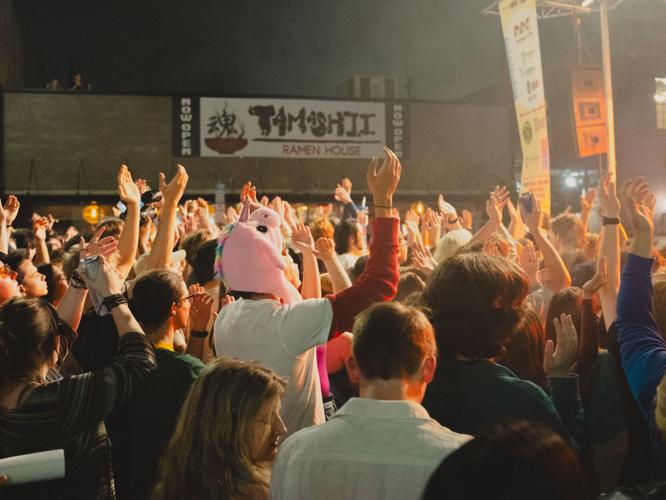
One of the most notable events within Norman’s arts scene is Norman Music Festival, a free three-day music festival that fills Main Street with tens of thousands of concertgoers each April. Founded by the Norman Arts Council in 2008, around 13,000 people showed up to the inaugural event — showing Norman’s love for live music and establishing the festival as an annual event.

Crowd at Norman Music Festival on Apr 24, 2026.
Norman Music Alliance was created in 2012 with the intention to support the festival effort and local musicians, and Jackson was appointed as its first executive director in 2015. Platforming more than 200 bands each year, composed almost completely of Oklahoman bands, the festival stays localized despite its massive growth.
Downtown Norman became the Walker Arts District in 2015, a certified cultural district for its dedication to supporting the arts, historic roots and events.
In the last decade, Norman has continued to be an advocate of arts and expression with help from members of the arts community — including artist, musician, photographer and creative director of Uncanny Art House, Chase Spivey.
Spivey has lived in Norman since 2000, and has been heavily involved in Norman fine arts since arriving— helping start a co-op gallery called Form and Function Lab in 2009, around the time of downtown Norman’s renaissance, with 2nd Friday Art Walks and Norman Music Festival.
This arts renaissance inspired Spivey to begin creating marker on Mylar — a shiny polyester film — drawings and paintings, which have been featured at MAINSITE, Uncanny Art House and at an Oklahoma Visual Arts Coalition Members Show.
One of Spivey’s longest gigs is capturing promotional content for local bands. Spivey has done photography, videography and drone work for Oklahoma- based groups Sisteria, rapper Jabee and his own bands — garage rock band Therogy and Ghost of Monkshood — as well as other groups on their record label. He was also responsible for campaign videos and a commercial for Mayor Stephen Tyler Holman.
Spivey continues to explore the arts, recently venturing into theater as a cast member of Sooner Theatre’s “Les Miserables” this fall, his first time singing on stage since being in Ghost of Monkshood.
Sooner Theatre has been a pivotal aspect of downtown Main Street for decades, as the region’s first talking picture movie theater and now as the community’s main performing arts center. The building closed in 1975 as the theater struggled, but was saved from demolition through community demand, reopening in 1982 as a rental theater space after restoration efforts.
Sooner Theatre became a nonprofit organization in 1976, beginning its first busy season of shows in the early 2000s. PR and development director of Sooner Theatre Nancy Coggins said the community has been incredibly supportive of their mission, as they’ve now grown to two spaces on Main Street.
“It’s not just the downtown community, the entire community of Norman. Everyone has been so incredibly supportive of the Sooner Theatre and our programming,” Coggins said.
This support is not just for Sooner Theatre, as Coggins said the community has a desire for cultivating a vibrant arts scene in Norman.
“I’m grateful that our community understands the importance of vibrant districts all over our city, and so the downtown district is just one of those,” Coggins said. “I’m grateful that it’s alive and well, and people are doing great things down here.”
Norman’s art scene is also inclusive. Spivey said collaboration across disciplines in the arts community in the city makes it easy for beginner artists to get their foot in the door.
“A lot of artists here work with each other on numerous different projects. There’s not a lot of infighting in the art scene here. There’s a lot of collaboration and building each other up and supporting each other, and I think that’s really cool,” Spivey said. “You don’t really see that in big cities as much, because … like in New York or something, you’re fighting for a finite amount of resources.”
Despite the steady growth of support for the arts community, those invested struggle with funding and exposure. Jackson said that when she was growing up in Norman, there was more funding specifically allotted for children to engage with the arts.
“I’m sad that’s not the case today, because we used to take field trips and get on buses and go to all these fabulous places in town,” Jackson said. “When I first started my career in the arts here in Oklahoma, I worked at the Sooner Theatre, and I worked for Cimarron Opera and it was a great joy of mine to be able to welcome all of the third graders to see an opera.”
This loss of funding will have resounding impacts on Norman, according to Spivey.

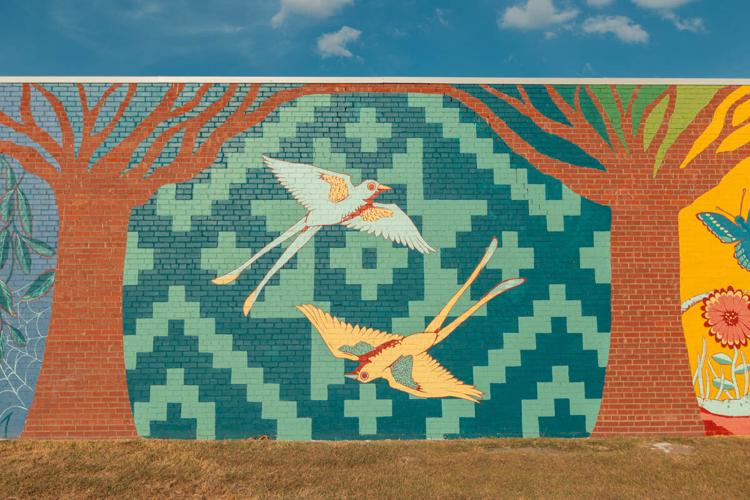
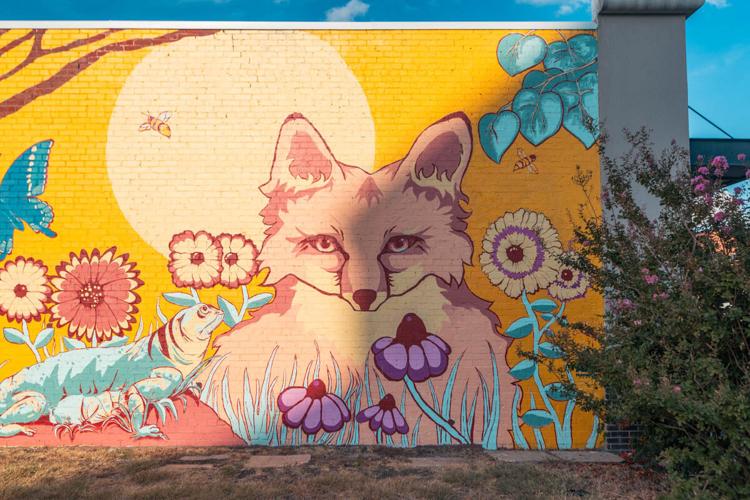
Mural on Main St. Norman on Sept. 24, 2026.
“Money drives the arts. Money drives the cultural heart of your city, …” Spivey said. “If you’re not investing in galleries and venues, then that culture that you love about your town will wither and die. So the only way to keep it going, the only way to keep Norman a town that we all love, is to invest in it.”
Nottingham believes funding the arts is a reimbursement into Norman.
“The arts community supports 600 local jobs, and it’s a $36 million economic impact in our community,” Nottingham said. “That’s just here in Norman. That’s not outside in the county. That’s just here inside the city limits, it’s a $36 million economic input impact and $6 million in taxes.”
This story was edited by Madisson Cameron. Lauren Brogdon, Larkin Bock, and Kennedy Johnson copy edited this story.


