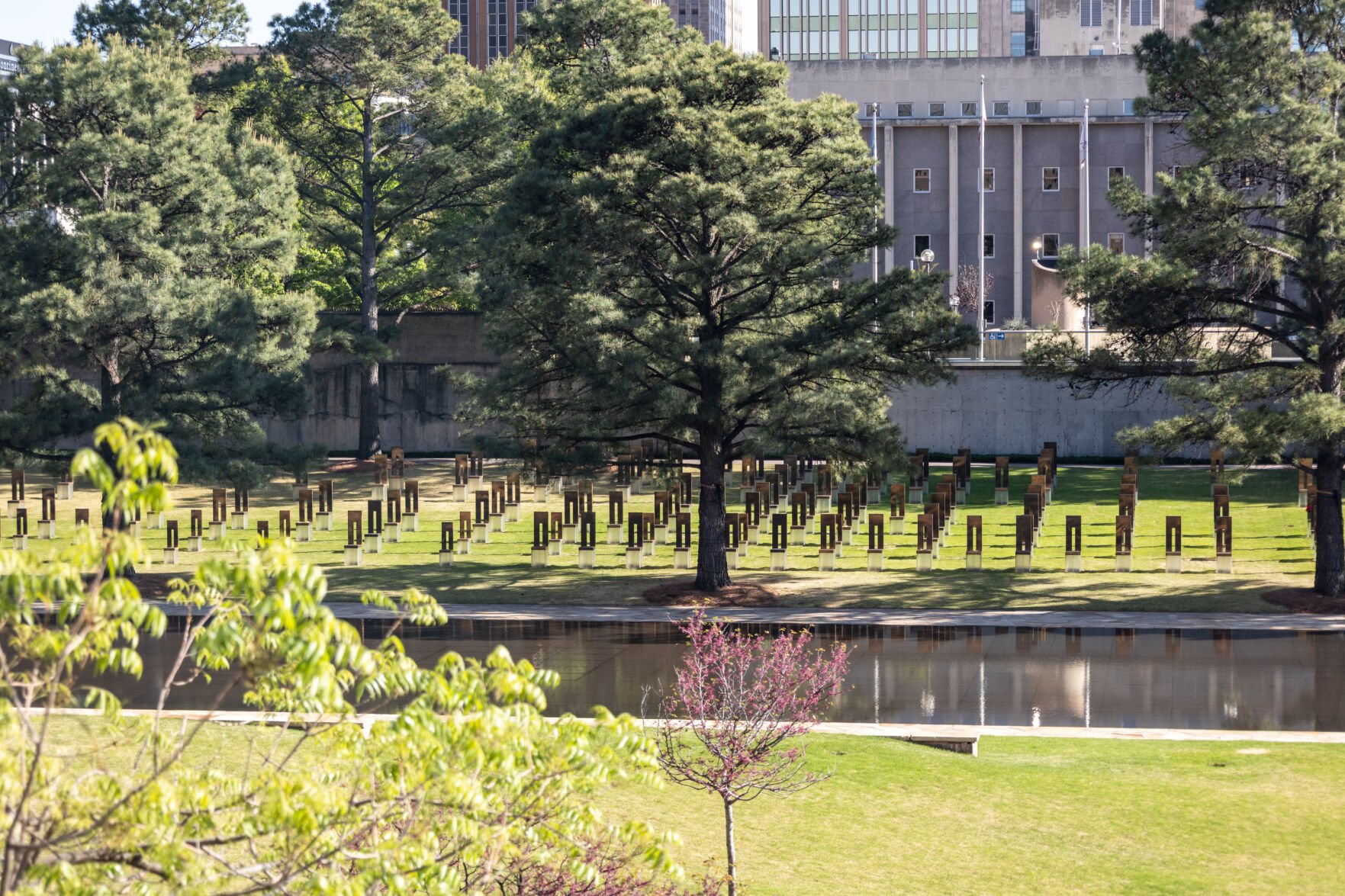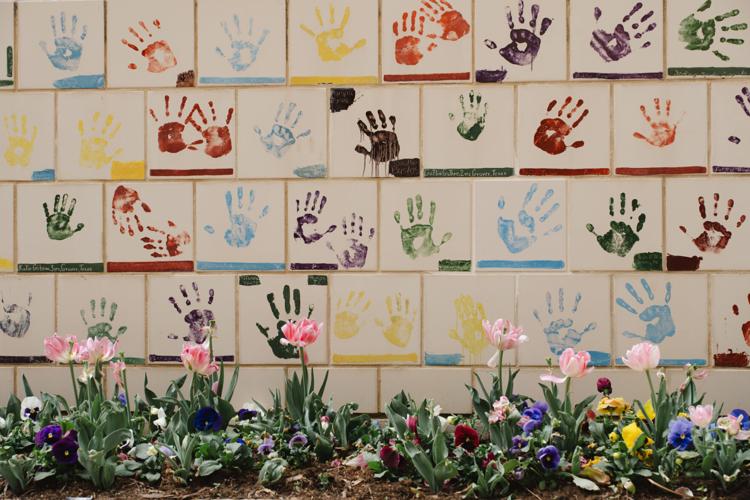
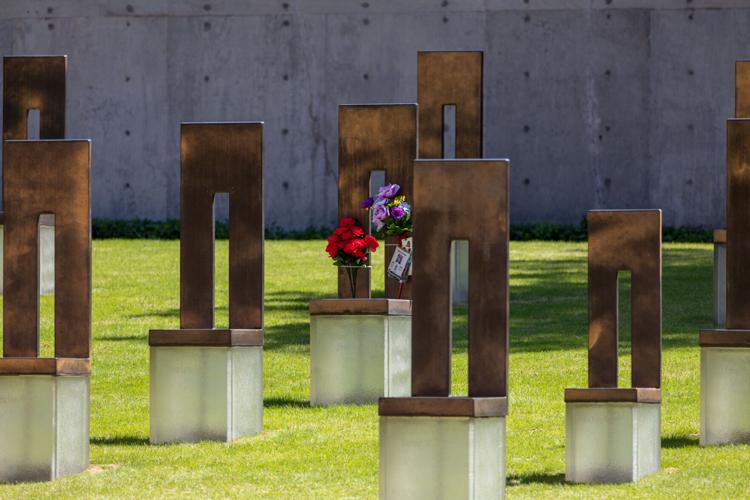


Oklahoma City National Memorial & Museum on March 30.
Editor’s note: This story is a part of a commemorative series marking 30 years since the Oklahoma City bombing, a domestic terrorist attack in which 168 people died. Several stories and multimedia projects commemorating this milestone will be published in the week leading up to April 19, the day the bomb detonated outside the Alfred P. Murrah Federal Building in 1995.
Thirty years after the Oklahoma City bombing, schools are tasked with teaching students about the attack and its impact, including the altruistic community response to the bombing, now known as the “Oklahoma Standard.”
The Oklahoma City bombing of the Alfred P. Murrah Federal Building on April 19, 1995, was the deadliest terrorist act in U.S. history until Sept. 11, 2001. The attack killed 168 people, including 19 children.
Upon its 30th anniversary, the bombing remains the most fatal domestic terrorism attack in U.S. history.
As time passes, many children do not have a direct connection to the bombing. Some students encounter it for the first time in an educational setting.
According to Oklahoma social studies academic standards, the bombing must be taught in third grade and Oklahoma and U.S. history courses. Students are expected to learn how Oklahomans exhibited the Oklahoma Standard in response to the attack.
The Oklahoma Standard promotes kindness and helping others without hesitation or expecting reciprocity. The standard lives on today as the model by which Oklahomans should live their lives, according to the Oklahoma Standard website maintained by the Oklahoma City National Memorial and Museum.
In Oklahoma history courses, students must analyze the causes and effects of the bombing, including response efforts and the creation of the memorial museum. U.S. history courses must discuss the “rise of terrorism” and its impact on the U.S., including the bombing and 9/11.
Jane Purcell, Norman Public Schools’ social studies curriculum coordinator, said all grades practice a day of remembrance on the bombing’s anniversary, though not required by state standards. According to Purcell, it’s up to teachers to decide how the bombing is incorporated into their lesson plan.
Three decades after the bombing, an important part of teaching the attack has become humanizing and relating it to students, which some teachers do by drawing from their own connection with the attack.
‘Their stories are honored and not forgotten’
Taylor Woodard was only 6 when the bombing happened. As she grew up, Woodard’s family, some of whom were part of the emergency response to the attack, told her their stories of the bombing.
“Once the memorial was created, we would visit those chairs, and I would see those names, and then they would share stories,” Woodard said. “As you grow and mature as an Oklahoman, you realize just how important that day was and continues to be.”
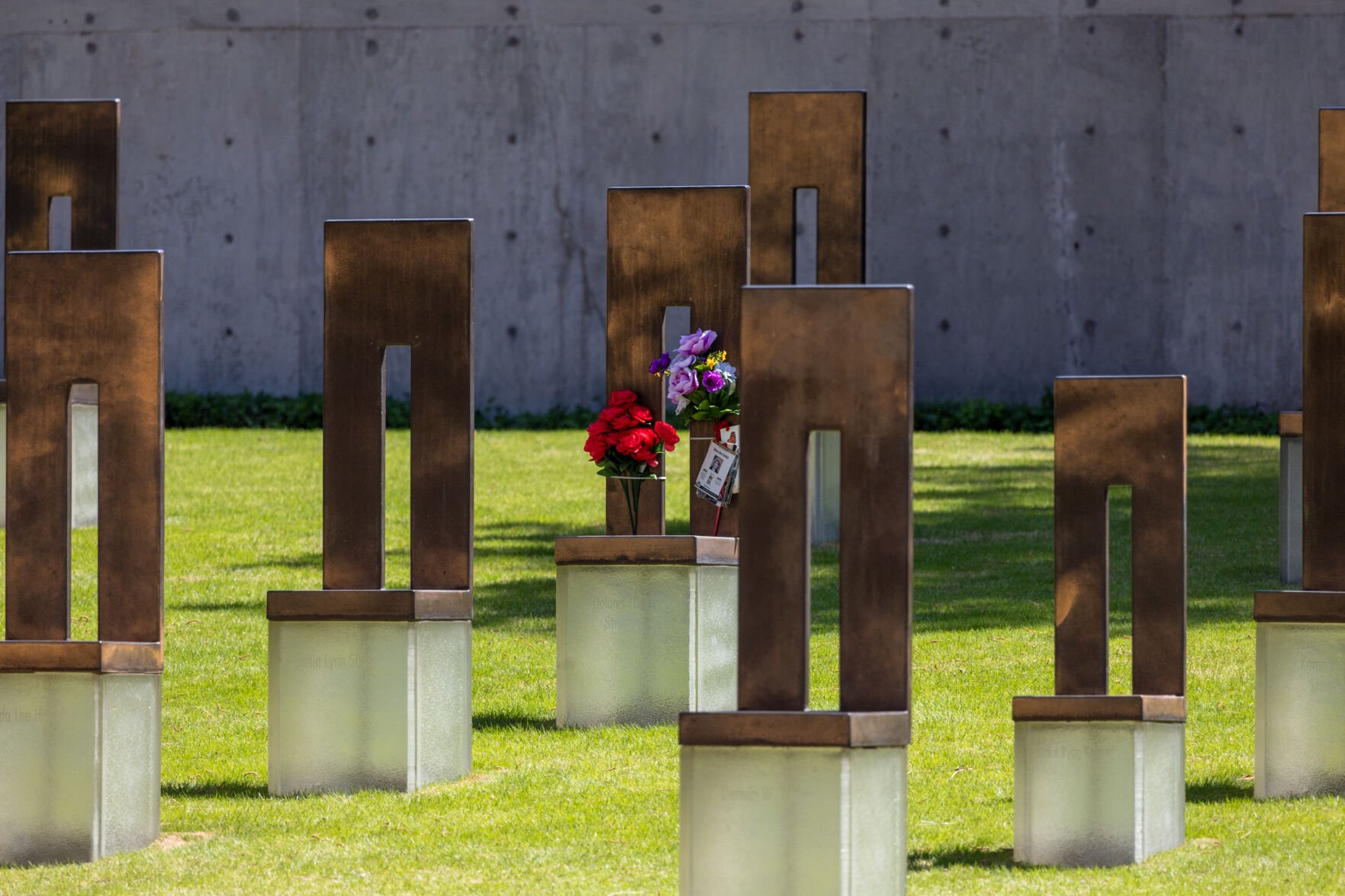
Chairs in the Oklahoma City National Memorial & Museum on April 11.
Woodard’s older sister, Tracy Phillips-Cothran, was a medical student at OU Health Sciences Center at the time, and she joined first responders at the scene of the bombing. Woodard’s father-in-law, Carl Woodard, was also part of the recovery effort as an Oklahoma City firefighter.
Now, Woodard teaches fifth grade reading and language arts at South Lake Elementary School in Moore. Woodard said her father, Warren Phillips — a former high school teacher — inspired her to use her classroom as an opportunity to teach students about the bombing.
Similar to many across the state, Woodard’s family knew victims of the bombing. Not wanting to relive the traumatic event, Woodard said the aftermath of the bombing was difficult for her father.
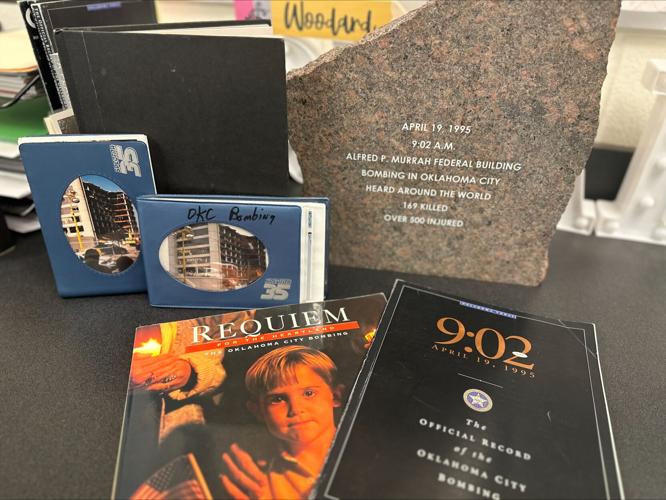
When he retired from teaching, her father passed down photos he took of the Murrah building after the attack. Woodard brings those photos to class each year to commemorate the bombing.
“It's not something that he relives very often,” Woodard said. “I think he knew that would be something we would really respect and revere as a family but also that I could use in the classroom.”
Woodard’s father-in-law was invited to take a piece of granite from the Murrah building before it was demolished on May 23, 1995. Several years ago, he split the chunk of granite into two pieces, one for each of his sons.
Woodard said her father-in-law doesn’t talk about that day much, but he has always been supportive of how she teaches the subject. Each year on the anniversary of the bombing, Woodard brings the piece of granite to school to show her students.
Alongside artifacts, Woodard incorporates children’s literature about the bombing into her lessons. She also uses the children’s book “I Survived the Attacks of September 11th, 2001” by Lauren Tarshis to help students distinguish the events.

Materials Taylor Woodard uses to teach her students about the Oklahoma City bombing.
When Woodard taught sixth graders, she said they were particularly interested in the FBI investigation of the bombing. This involved discussing domestic terrorism and the attack’s perpetrator, Timothy McVeigh, which Purcell said is difficult for students.
“Students really struggle with why Timothy McVeigh did this,” Purcell said. “Our little students are just so innocent, and even our older students are very kind and compassionate, and … they're pretty horrified by (the bombing).”
Woodard has also dedicated some of her lessons to the Oklahoma Standard and the community's response. By doing so, Woodard said she is honoring the stories of those impacted and teaching students to have pride in their state.
Woodard said students today often don’t have a direct connection to the bombing, which is why she crafts her lessons with care. For Woodard, it’s meaningful for students to understand the facts of the bombing and connect it with the community response.
“It's important for them to continue to learn about the people involved so that their stories are honored and not forgotten,” Woodard said. “Hopefully that will inspire them to be lifelong learners of history and want to learn more about those things that have impacted our state.”
Journey of Hope
The Oklahoma City National Memorial and Museum, in collaboration with the Oklahoma Department of Agriculture, created Journey of Hope, a project commemorating the bombing’s 30th anniversary. Journey of Hope is visiting all 77 counties in the state to teach about the bombing at middle and high schools.
Martha Beliveau and Kara Jones, museum outreach program managers leading the project, said educating young people about the history of the bombing is a passion of theirs.
“I was really intrigued by getting to travel all around the state to share this story with kids who might not have the opportunity to physically come (to the memorial) because their schools don't have the ability to transport them here or they live six hours away,” Beliveau said.
During assemblies, Journey of Hope sponsors a community member from the county it visits to speak about how they were impacted by the bombing, aiming to show students they’re not as far removed from the attack as they may think.
“We try to make sure that they know what connections their community has to the event, people who are impacted by the bombing who live in their community,” Jones said.
The museum’s 30th anniversary message is “A Day of Darkness, Years of Light.” To embody this message, Journey of Hope doesn’t shy away from the harm caused by the bombing and devotes focus to the support Oklahoma City received.
“This attack was meant to tear everybody apart,” Beliveau said. “Instead, Oklahomans came together and supported one another in the aftermath.”
Journey of Hope speakers have included first responders, journalists and teachers whose lives were changed by the bombing. The program traveled to Irving Middle School in October, where students heard from the school’s guidance counselor, Krista Genzer Doll.
Doll was 11 on April 19, 1995. Her mother, Jamie (Fialkowski) Genzer, left for work at the Murrah building as a loan officer for the Federal Employees Credit Union. Genzer died in the bombing.
“She was my everything, and then she was gone,” Doll said at the assembly. “My brother and I had to manage life without a mom, and it wasn’t easy, but together — with the help of our community, our family — we did it.”
Doll left students at the program with a question: “What legacy will you leave?” She challenged the students to embody the Oklahoma Standard and make a difference for those who may be struggling.
Having community members share their experience is extremely impactful on students, Beliveau said. She said hearing first-hand stories of the bombing’s effects can humanize the attack for students who may feel disconnected from it.
Some students in counties far from Oklahoma City may think the bombing did not impact their community, Jones said, but Journey of Hope’s goal is to show students otherwise.
“If we can find people like a first responder from one of the panhandle counties, I think it shows them that, yes, my community was impacted by this event despite the fact that I live five hours from the city,” Jones said.
Alongside humanizing the bombing, stories from the assembly have inspired some students to confront their own hardships. Beliveau said Journey of Hope has helped students emotionally open up, with many thanking and confiding in speakers after the program.
“It’s just powerful for somebody to be vulnerable with kids,” Beliveau said. “For somebody to be vulnerable and say, ‘This was the worst thing that has ever happened to me, and I saw counseling, and I saw support, and my community was around me,’ is meaningful.”

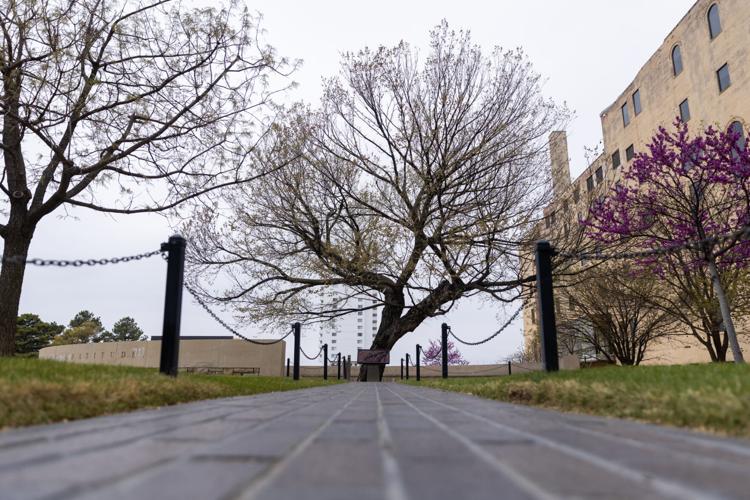
Oklahoma City National Memorial & Museum Survivor Tree on March 30.
The final act of each program is planting a sapling of the Survivor Tree, which survived the bombing and now serves as a symbol of resilience. Beliveau said having a symbolic reminder of the tree in each county serves as a physical reminder that all Oklahomans are forever changed by the attack.
Displaying the phrase “Spreading Our Branches,” a marker made of granite from the Murrah building is then placed at the foot of the sapling. At Irving Middle School, Doll’s three young children placed the marker in remembrance of those killed in the attack — among them, their grandmother.
“This is a full circle moment that there's still people living with April 19 every single day, but you can also find beauty and the resiliency of the human spirit as well,” Beliveau said.
‘It’s a tough time for schools’
In December, State Superintendent of Public Instruction Ryan Walters proposed controversial new social studies standards, which mention the Bible and Christianity dozens of times. The Oklahoma State Department of Education approved the standards in February by a 5-1 vote.
The Legislature must now vote on the standards following the board’s approval. Oklahoma House and Senate Democrats, the minority party in both chambers, filed a resolution in March to reject the proposal. If rejected, the standards would be sent back to the board for revisions.
Woodard said that, although teachers do not feel pressure from the state on whether or not to teach students about the bombing, many feel they must mainly focus on math and reading. Due to such pressures, teachers have experienced difficulties adequately incorporating social studies lessons, Woodard said.
“Outside pressure for state testing and scores focusing only on math and reading can have an impact on whether or not they bring in social studies topics,” Woodard said.
Having previously taught the subject, the shift from social studies is something Woodard said she felt in real time.
“There's a lot of ways you can weave subjects together, but it can be hard,” Woodard said. “Younger grade teachers definitely feel the pressure of performing, and so sometimes they can get that tunnel vision.”
To supplement schools in teaching about the bombing, the memorial museum offers lesson plans for educators. Beliveau said Journey of Hope adds to the lesson plans, helping schools that may not have enough time or resources.
“It’s a tough time for schools; there’s no question,” Beliveau said. “Our job is to hopefully make teaching about the bombing easier for schools and also help remind schools that this is a very unique, important lesson to teach their kids.”
This story was edited by Anusha Fathepure, Ana Barboza and Ismael Lele. Avery Avery, Gretchen Schultz, Ryan Little, Mary Ann Livingood and Grace Rhodes copy edited this story.
30 years later: OU, Norman communities reflect on Oklahoma City bombing
Comprehensive coverage on the legacy of the Oklahoma City bombing 30 years ago.