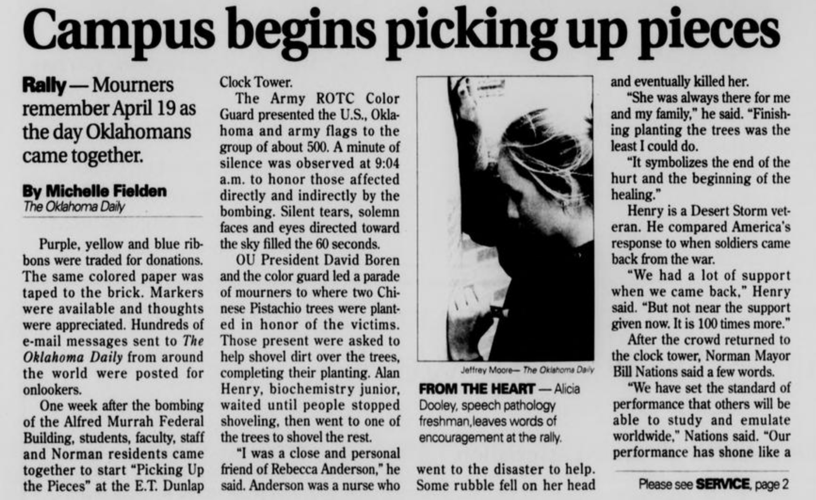


"Campus begins picking up pieces" by Michelle Fielden, now Michelle Strain, originally published in the April 27, 1995 edition of The Oklahoma Daily.
Editor’s note: This story is a part of a commemorative series marking 30 years since the Oklahoma City bombing, a domestic terrorist attack in which 168 people died. Several stories and multimedia projects commemorating this milestone will be published in the week leading up to April 19, the day the bomb detonated outside the Alfred P. Murrah Federal Building in 1995.
About 20 miles away from the Alfred P. Murrah Federal Building in Oklahoma City, the OU community felt the tragedy of the April 19, 1995, bombing. One student died in the blast while many more were near the scene or spoke to the Daily about the bombing in the immediate aftermath.
Thirty years later, OU alums reflected on how the bombing affected their lives. These alums spoke about post-traumatic stress disorder and the violence of the bombing while a coworker of Trudy Rigney, the only current OU student to die in the blast, remembered her for her perseverance.
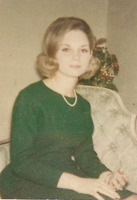
Trudy Rigney

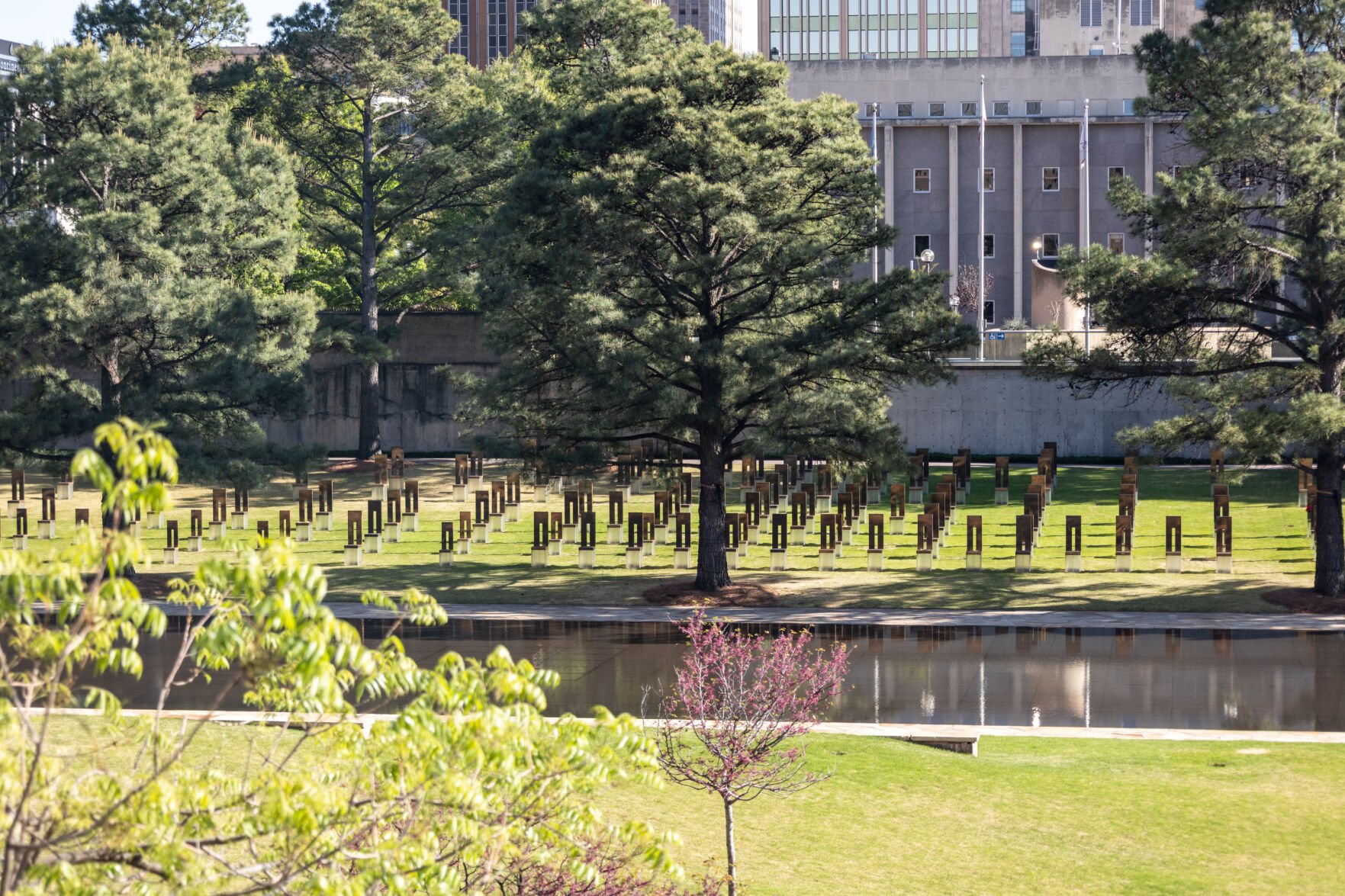
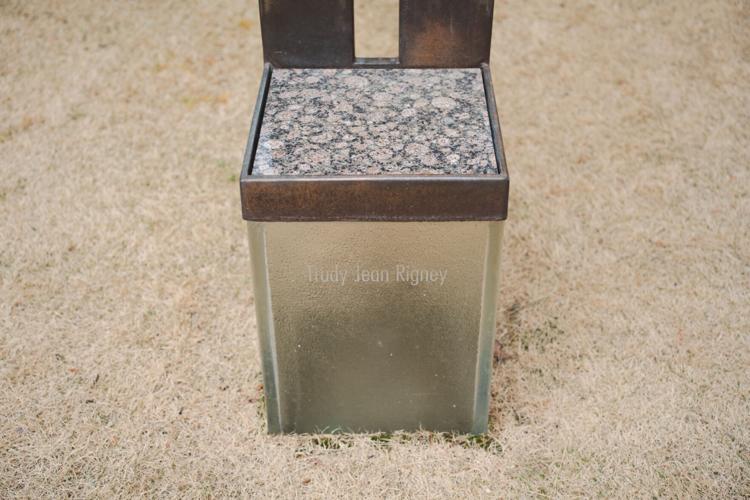
Oklahoma City National Memorial & Museum chair of Trudy Jean Rigney on March 30.
Trudy Rigney, an OU senior studying geography, was an intern at the Oklahoma Water Resource Board at the time of the bombing.
According to the April 21 edition of The Oklahoma Daily, now OU Daily, Rigney left the third-floor office of the Oklahoma Water Resources Board to make copies around 9 a.m. She went down to the second floor and crossed to the opposite side of the building, which was across the street from the Murrah building.
At 9:02 a.m., the bomb inside a Ryder truck parked outside the Murrah building exploded. An unnamed friend of Rigney told the Daily in 1995 the walls of the second floor fell in.
Joe Freeman, chief of the Oklahoma Water Resource Board’s financial assistance division at the time, was not Rigney’s boss, but he remembered talking to her when they crossed paths at work.
“I just got to enjoy visiting with her,” Freeman said. “She had a great personality, a great attitude.”
When the blast happened, Freeman was in a meeting on the west side of the Oklahoma Water Resources Board building. He crouched on the floor as he thought about how to get back to the south side of the building where his employees were.
Though Freeman can’t recall the exact order of the day’s events, he remembers going to the OU Medical Center after helping his employees evacuate the building through the stairwell.
It was there he realized Rigney had died.
“They had information taped up on a big wall trying to identify certain remains,” Freeman said. “I remember reading and saying, ‘OK, that was her.’ I assumed it was her from the description of the clothes. It really sounded like something I knew she’d worn before.”
The April 21 edition of the Daily reported Rigney’s identity was confirmed around 11 p.m. on April 19 after her coworkers recognized her pink and navy suit.
Freeman wants people to remember Rigney for her perseverance.
“She was going to school, she was working, she was raising a son,” Freeman said. “She had a lot on her plate and was looking forward to graduating.”
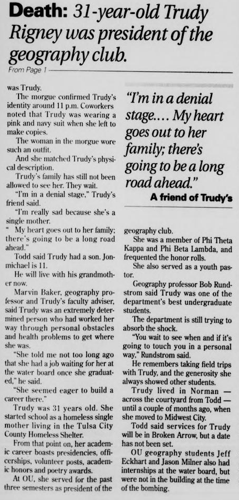
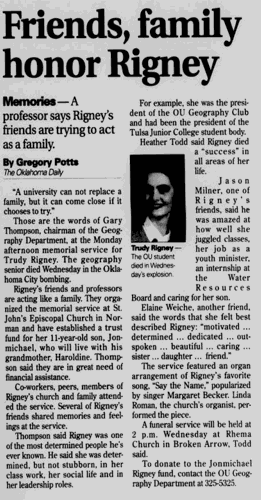
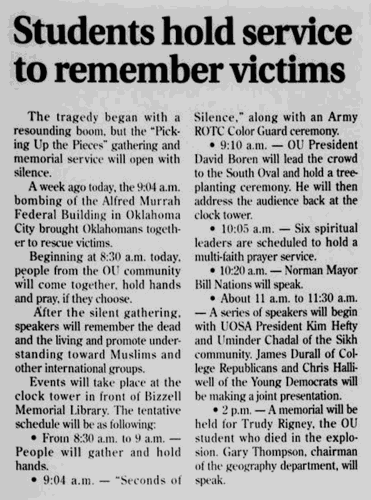
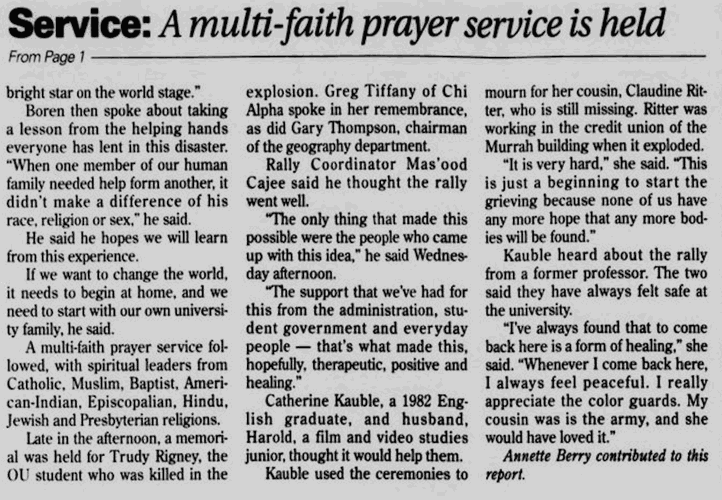
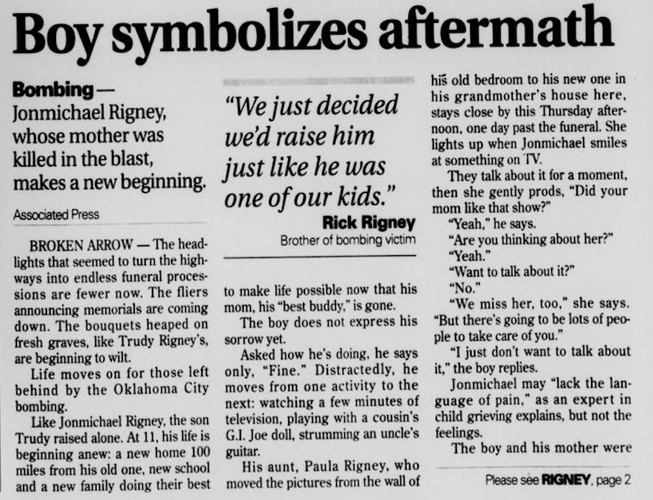
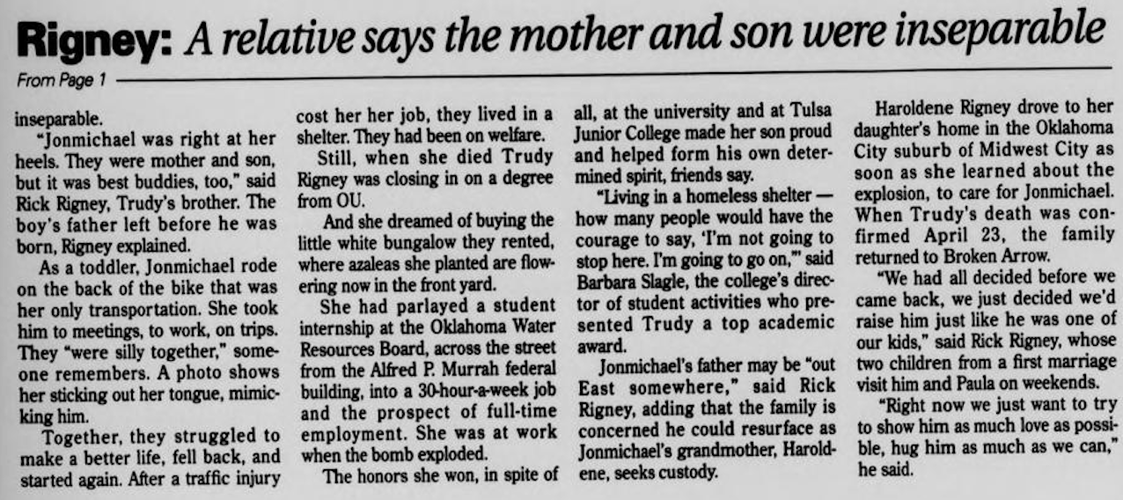
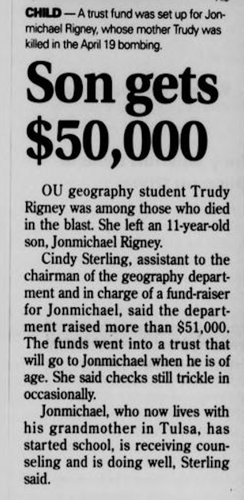
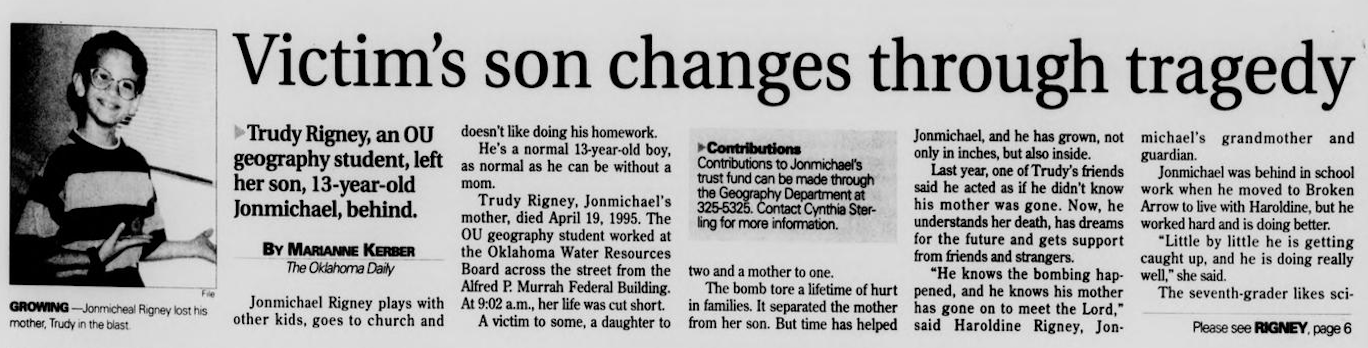
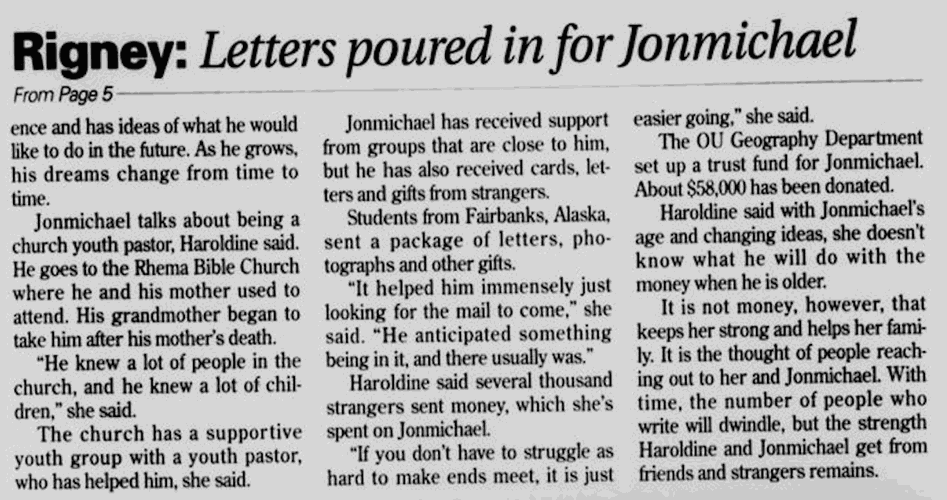
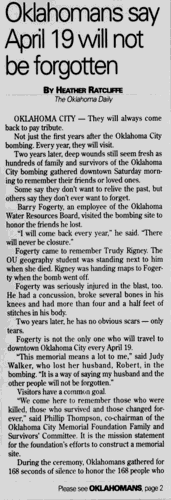
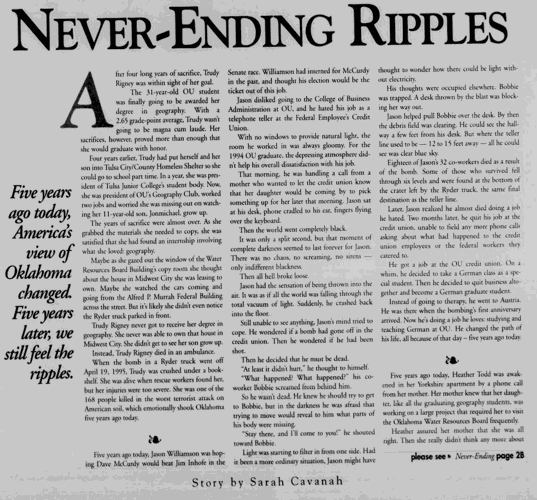
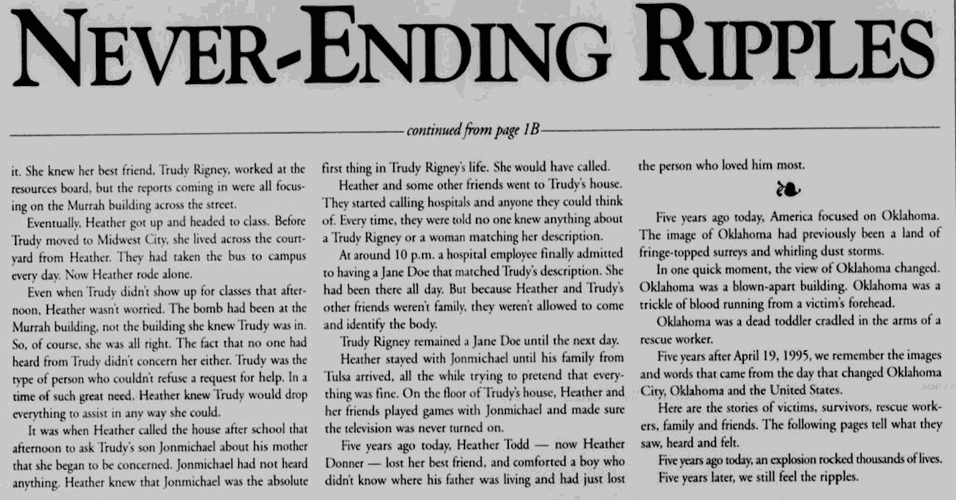
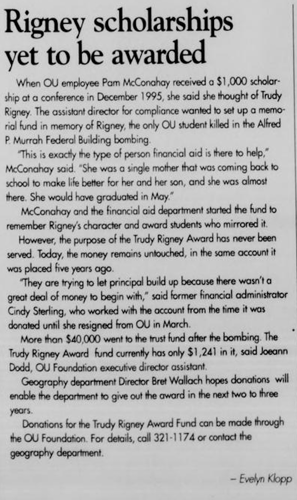
Coverage of Trudy Rigney in The Oklahoma Daily, 1995-2000
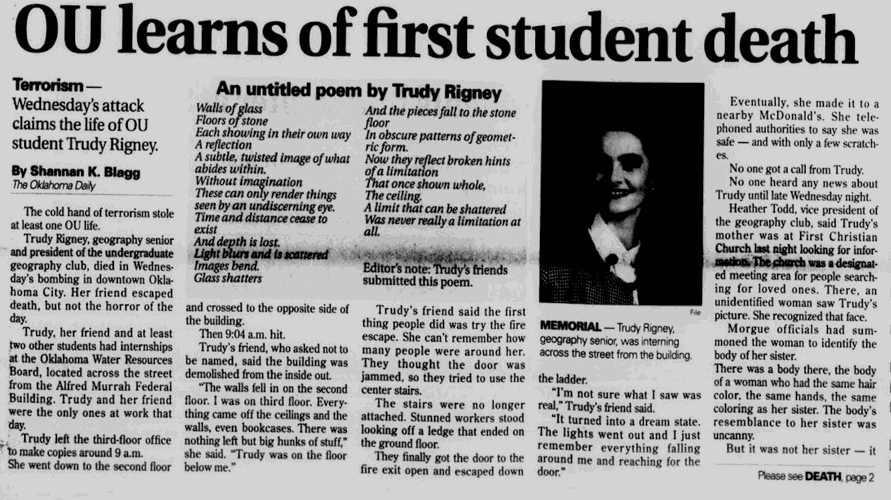
Rigney in the April 21, 1995 edition of The Oklahoma Daily
The first story about the death of Trudy Rigney, originally published in the April 21, 1995 edition of The Oklahoma Daily.
At 31, Rigney was set to graduate from OU in less than a month. She was president of the undergraduate geography club at OU and had served as student body president at Tulsa Junior College. She was a member of Phi Theta Kappa and Phi Beta Lambda and was frequently on the honor roll, the Daily reported in 1995.
Rigney worked her way up to her internship at the Oklahoma Water Resource Board after starting school while living in a Tulsa homeless shelter with her 11-year-old son.
After her death, a trust fund was established for her son, Jonmichael Rigney, whom Rigney had been raising as a single mother.
Jason Milner, one of Rigney’s friends, said he was amazed at how well she juggled classes, her job as a youth minister, an internship at the Water Resources Board and caring for her son, according to the April 25 edition of the Daily.
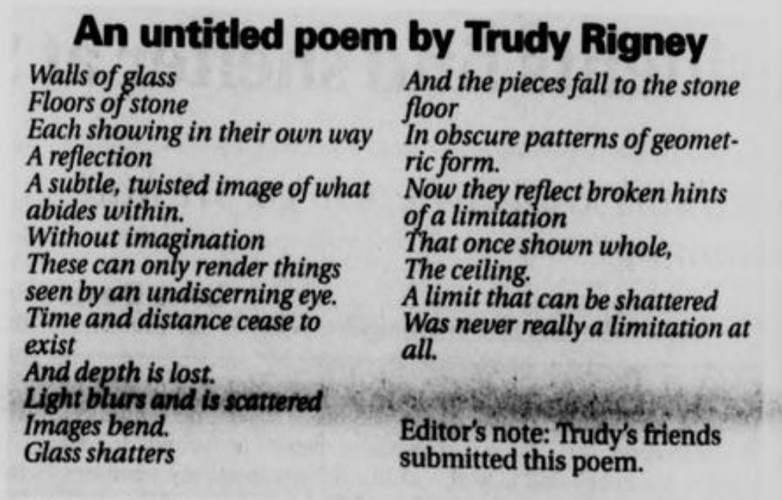
Rigney’s friends submitted a poem she had written, which originally ran in the April 21 edition of the Daily.

An untitled poem by Trudy Rigney, originally published in the April 21, 1995 edition of The Oklahoma Daily.
Saul Reid
Saul Reid, an OU economics junior at the time of the bombing, was in the Army ROTC program and was wearing his uniform when he heard the news.
“I stopped at a coffee shop on campus, and the clerk behind the counter noticed my camouflage fatigues,” Reid said.
He said the worker asked if he was going to help with the natural gas explosion in Oklahoma City.
It was the early days of the internet and cellphones were in their infancy, so Reid said he had no idea what the clerk was talking about.
“I remember saying, ‘Well, what are you talking about? What bombing?’” Reid said.
Reid said at first he believed the bombing was a natural gas explosion, but after watching local news coverage and seeing the widespread devastation from the bombing, he recognized it had to be a man-made disaster.
“I just felt like something was off,” Reid said. “When I saw the image of the building, I thought, … ‘This is a disaster over and above just a malfunction.’”
Reid said he didn’t personally know anyone affected at the time, but later down the line working in the Oklahoma City area he’s met many people who lost a loved one that day.
Reid believes on the 30th anniversary, younger generations of Americans should remember the tragic loss of life and be aware of the dangers of hatred.
“Watch out for the violent side of human interaction,” Reid said. “Be aware that there are violent people out there that will kill innocent strangers.”
Fred Blair
Asleep in his bed, Fred Blair woke up on the morning of April 19 to his window being blown out and shattered glass coating his bed.
The walls of his apartment collapsed, and from under the broken window, he was now able to look over into his roommate's bedroom from his bed.
“I thought a nuclear bomb went off,” Blair said.

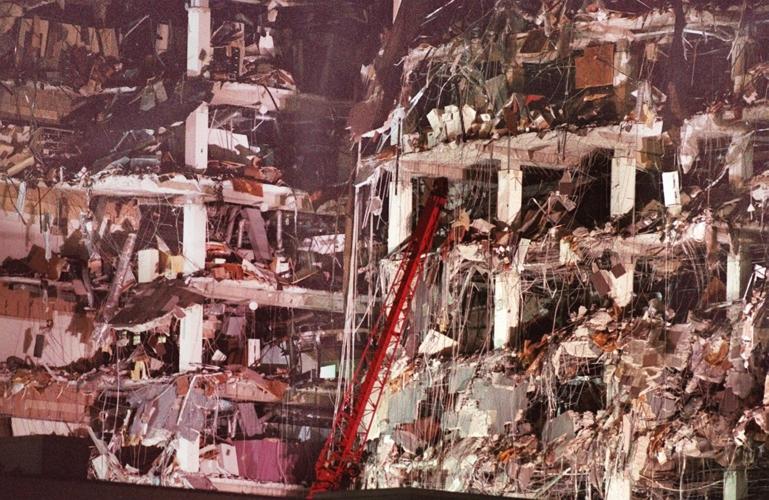
Night photo of the Murrah Federal Building after the April 19, 1995 bombing.
A third-year OU medical student at the time, Blair said he looked out the blown-out window of his 14th-floor Regency Tower apartment on Fifth Street and saw fires, smoke and collapsed buildings.
“It was like the end of the world,” Blair said. “It was a harrowing morning.”
While evacuating the building, Blair helped his neighbor out of her apartment. The power was out in the stairwell, and flashing emergency lights lit their way down.
“It was dark in the stairwell, and all the pipes were broken, so there was water running down the stairs,” Blair said. “It was really scary.”
Despite the chaos, Blair said he rarely thinks about that day.
“I don’t think about it very much, and the only time it really ever comes up is around April,” Blair said.
Around the 25th anniversary of the bombing, Blair said he was approached by a group from the National Library of Medicine conducting a study on the effects of the bombing on victims. When Blair described his experiences that day he began to panic.
“I had a pretty casual sense of what was going on that April 19th, but when I went into details of it, by the time I was done with the story I was having a full-blown panic attack,” Blair said. “I was really going through it all. I couldn’t breathe. I was crying, gasping for breath, and it dawned on me that that’s what real PTSD is.”
Though Blair said he doesn’t feel the events are present in his day-to-day life, he also does not want to relive them.
“I had never really given it any thought, but just bringing back that memory was debilitating,” Blair said. “It really was shocking.”
Blair currently lives in northern California and works as an OB-GYN. He wants younger generations to understand the fragility of life.
“We’re all just one morning away from somebody pulling some trigger on some major disaster,” Blair said. “Don’t take anything for granted.”
This story was edited by Peggy Dodd, Anusha Fathepure, Ismael Lele and Ana Barboza. Andrew Paredes, Sophie Hemker, Grace Rhodes, Avery Avery and Mary Ann Livingood copy edited this story.
30 years later: OU, Norman communities reflect on Oklahoma City bombing
Comprehensive coverage on the legacy of the Oklahoma City bombing 30 years ago.