

This story is featured in the spring edition of OU Daily's magazine. The magazine can be found on racks around campus and online at the end of February.
With a contentious presidential election coming in the fall, increased tension surrounding international conflict and divisiveness among politicians, Norman’s legislators face new challenges with deep partisanship and social media conflict heading into the second session of the 59th Legislature.
Kicking off the session, Gov. Kevin Stitt gave his sixth State of the State address, focusing on tax cuts, business, safety and education. His goal of making Oklahoma a top 10 state, he said, is only just beginning.
“In 2019, I addressed this body for the very first time,” Stitt said during his address on Feb. 5. “And I laid out a vision to make Oklahoma top 10 in everything we do. I said, ‘The Oklahoma turnaround starts right now.’”
Norman’s state legislators, made up of three Democratic representatives, a Democratic senator and a Republican senator, hope to make progress in a state with a Republican supermajority and little bipartisan collaboration.

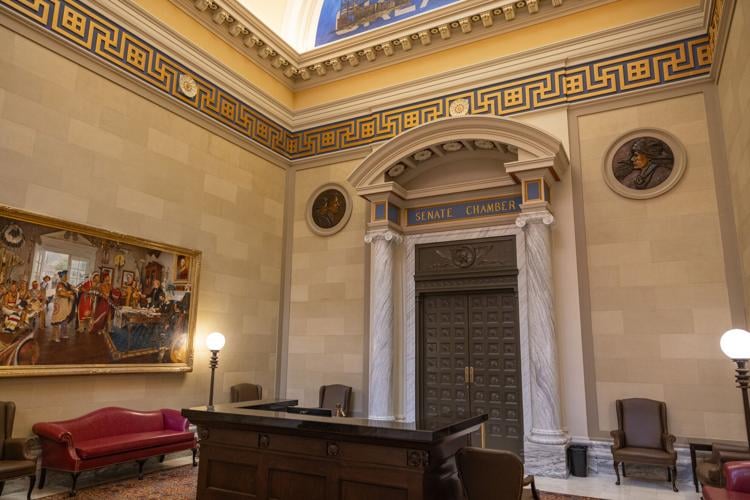
Senate chamber entrance inside the Oklahoma State Capitol.
Oklahoma’s political landscape
Larry Ferguson served in the Oklahoma House of Representatives for 20 years. Ferguson came from a family of newspaper publishers in rural parts of the state, including Cleveland, Pawnee and Hominy.
While serving in Oklahoma politics, Ferguson, a Republican, watched as the state’s Legislature was predominantly run by Democrats. The state’s governor flipped from party to party throughout his time as a representative.
Oklahoma politics look vastly different today, with the state’s top officials leaning increasingly more conservative and passing executive orders and laws coinciding with recent Republican ideology, partly influenced by the rhetoric of former President Donald J. Trump.
Stitt and his Republican counterparts in the Senate and House presented and passed one of the most restrictive abortion bans in the country, called for review and bans of diversity, equity and inclusion programming at universities and instituted conservative policies in schools.
Ferguson said Stitt has a “very one-sided attitude,” but the Legislature is better about being bipartisan on most topics. However, Ferguson said the Legislature is facing leadership issues and that problems arise when leadership isn’t getting input from the entire state.
“Your vote should represent the people that elected you, I don’t know how much of that’s going to happen when they get started,” Ferguson said.
Norman’s sole Republican delegate, Sen. Rob Standridge, said he hopes to see beneficial leadership changes in the Senate before his tenure is over, and one of the main areas he differs from his party’s values is regarding corporate welfare.
He listed an example of the money Oklahoma planned to give to the electronics company Panasonic to build a battery plant in the state. Standridge said the last thing Panasonic needs is more money.
“The difference today is that the Republican Party is in total disarray. We have people running for Republican seats that aren’t Republican,” Standridge said.
Ferguson said the Legislature is ultimately a battle between legislators from Oklahoma City and Tulsa and those from smaller towns across the state. The problem is they either don’t have leadership at all or they have too many leaders, Ferguson said.
“If your leadership doesn’t have a good input throughout the state and they’re not listening to people except those in their neighborhood, I think it creates a big problem,” Ferguson said.
The majority of core and East Norman is split evenly between Republican and Democratic voters, demonstrating a tangible polarity in the values of Norman residents. In the past four years alone, Norman has experienced partisan divisiveness in its own city council. Homelessness, police funding and the effects of a global pandemic brought local politics to the forefront of Norman residents’ minds.
Sen. Mary Boren (D-Norman) acknowledged Norman is a unique community compared to the rest of Oklahoma, and her district, which makes up core and East Norman, has different viewpoints and values that she strives to represent.
One of eight Democratic senators, Boren said she often struggles to find time to, first, be heard, and second, to agree with the 40 Republican senators.
“I kind of end up becoming a dissenting voice to a lot of things at the Capitol and I feel that's my primary responsibility in representing the people of Norman, … to be adept at articulating that dissenting minority, even marginalized perspective on issues that impact Oklahoma,” Boren said.
Standridge said the voters in his district, which encompasses the areas outside of OU and core Norman, know where he stands on policy and he has stayed the same in his values since he was first elected.
“Everybody in my district knows exactly where I'm at,” Standridge said. “There's some that disagree with me. I respect that and I do absolutely talk to and visit with every one of my constituents that want to talk to me and help them however I can.”
In the wake of his interim study on DEI, Standridge said his number one issue is to codify the removal of those programs from Oklahoma’s public universities. Standridge also said he is still working to protect children from obscene materials with legislation like Senate Bill 1056 from last session.
National political tensions are on the rise as well after the Oklahoma Republican Party approved a resolution to condemn and censure Sen. James Lankford (R-Okla.) for his bipartisan border bill negotiations.
The $118 billion deal would have provided around $20 billion for new migrant policies and immigrant restrictions on the southern border, while the rest of the money would be divided to provide humanitarian aid to Ukraine and Israel and support their war efforts along with other U.S. foreign interests.
Republican leaders in Congress condemned the bill and Senate Minority Leader Mitch McConnell (R-Ky.) said the bill wouldn’t go anywhere, with many Republicans planning to vote against it during the procedural vote. Trump expressed complete opposition to the bill and demanded Republicans reject it, also claiming that he never endorsed Lankford for reelection in 2022. On Feb. 7, the Senate blocked the border bill from advancing.
Senate Majority Leader Chuck Schumer (D-N.Y.) said the backlash on the bill is a “new Republican line on the border,” and that the goal posts for negotiations have moved because of this.
Increasing tensions in national politics could be attributed to the upcoming presidential election in November and Norman legislators discussed this as one of the reasons the country and the state are witnessing growing polarization.
Norman legislators cited social media as a factor contributing to political divisiveness. Legislators also acknowledged that Norman is a uniquely diverse community compared to the rest of the state.
Standridge said social media is extraordinarily divisive and blames it for the immature rhetoric in the U.S. at large.
“I put my policies there and people want to gripe at you or cuss at you. That’s not the right way to do it,” Standridge said.
Boren said the divisiveness caused by social media is lucrative. She cited how people engage more with toxicity on social media and that’s how the platforms sell ads.
“We know that divisiveness in politics is an easy way to raise funds and even to get elected or to keep power,” Boren said. “It’s an economic model that works within politics as well.”
Rep. Annie Menz (D-Norman), who represents Ward 5 and the Lake Thunderbird area of Norman, said she believes social media exacerbates political divisiveness because people are expected to have knee-jerk reactions, while Boren acknowledged the barriers that social media breaks down.
“Social media is new and it has broken down natural geographic barriers that people may have felt safe to stay in their own corners of the world,” Boren said. “People feel threatened when they can’t control their bubble and social media can penetrate that bubble.”
Rep. Jacob Rosecrants (D-Norman) said social media is a factor in the polarization of current politics. He said it’s now harder than ever to distinguish the truth because of social media.
“It’s on the voter to, unfortunately, have to dig through all this crap. That’s why I think it’s made such a negative effect on politics,” Rosecrants said.
Rosecrants, a frequent poster on social media platform X, formerly known as Twitter, said social media can help and hurt both everyday citizens and politicians.
“It’s an excellent way to get your voice out there without spending hundreds of thousands of dollars,” Rosecrants said.
The current legislative session is expected to feature heavy-hitting legislation and national talking points, given the looming presidential election. Many of the topics include mental health, policies aiming to better control the Oklahoma State Department of Education and immigration policies.
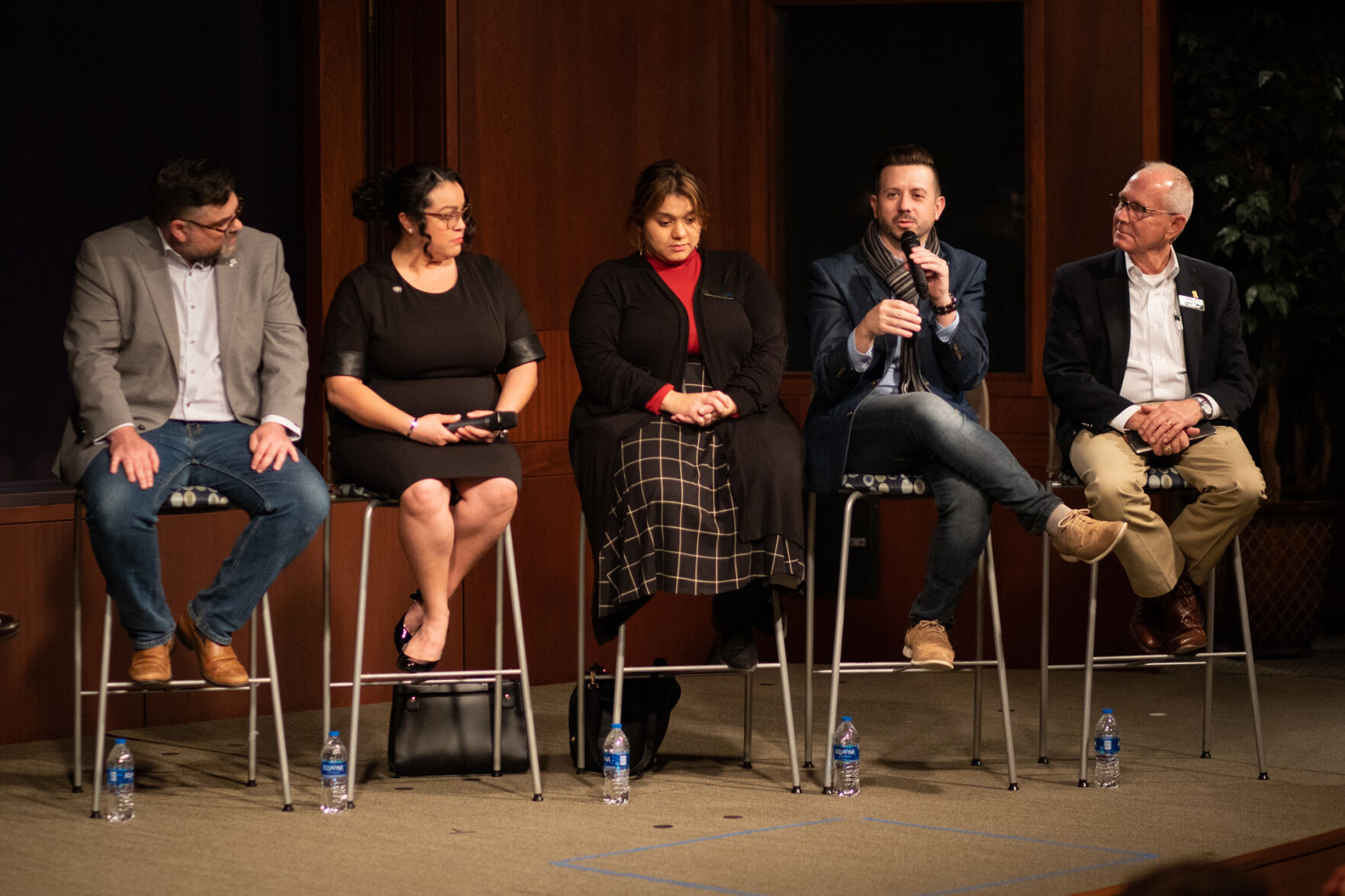
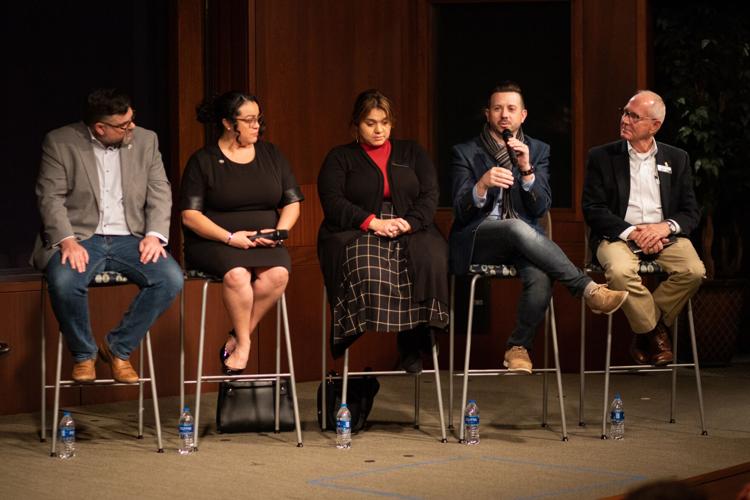
Oklahoma Rep. Jacob Rosecrants (D-Norman), Rep. Annie Menz (D-Norman), Norman City Council Ward 4 Councilmember Helen Grant, Rep. Jared Deck (D-Norman) and Norman Mayor Larry Heikkila during the Undergraduate Student Congress 2022 post election forum on Dec. 5.
Looking forward
Norman legislators discussed concerns with State Superintendent of Public Instruction Ryan Walters and leadership within the State Department of Education. Walters was elected in November 2022 and will be up for reelection in 2026.
Menz said one of the main topics this legislative session will deal with is crises in the state public education system, particularly actions taken by Walters.
Throughout Walters’ term, controversies with his leadership have been prominent, including a partnership with a right-wing nonprofit online education program PragerU, mismanagement of teacher sign-on bonuses and the introduction of a program to raise teacher salaries without increasing state funding to school districts.
“A big topic is going to be public education and trying to not just mitigate the disaster that is Ryan Walters, but also trying to put pieces back together that he leaves in his wake,” Menz said.
During the upcoming session, Rep. Jared Deck (D-Norman) is focused on accountability and wants to ensure the executive branch is held to the same standards as the Legislature, specifically the State Department of Education.
Deck cited the administration of the department as one of the main concerns of his district, which extends north of Highway 9 to Rock Creek Road at the district’s northernmost point, including OU and core Norman. Recently, multiple teachers across the state who were incorrectly awarded bonuses received letters demanding they give the money back to the department before the end of February. Kristina Stadelman, a mother of five and a special education teacher in the Oklahoma City metro area, was one of these teachers and joined a lawsuit to challenge the demands.
“The State Department of Education did not do a thorough job in the application process and has now asked some of those teachers to pay that money back, which will literally bankrupt some families,” Deck said.
Rosecrants, a former sixth grade social studies teacher, has been a representative since 2017, when he was inspired to run for office after becoming frustrated with Oklahoma’s education system. At the time, Oklahoma was in a near decade-long streak of the most funding cuts to education but had success with new assessment policies and programs for immigrant students to graduate high school.
In light of recent events with Walters and the State Department of Education’s misstep with teacher bonuses, Rosecrants said he views Walters and his rhetoric as a clear and present danger to Oklahoma public schools.
“Folks need to understand what is going on, and they need to see it in broad daylight rather than in the dark,” Rosecrants said.
Ferguson said the misuse of school funding across the state is a large problem.
In June, a state audit found that about 20% of grant funds meant for educational purposes were misused.
Ferguson said the disorganization of where funds are going for private and public schools is a concern.
“We need to take care of where they’re going,” Ferguson said. “If we spend all the money on private schools, then they’re starting to hurt public schools the majority of the students go to.”
Deck said he believes mental health will also be a focal point in regard to funding and expanding services across Oklahoma this legislative session.
In September, the Oklahoma Department of Mental Health and Substance Abuse Services announced the planned construction of a new mental health hospital in Oklahoma City to replace Griffin Memorial Hospital in Norman as the state’s primary mental health facility. The new hospital will feature 330 beds and is predicted to serve 275 adults and 55 adolescents daily.
In 2023, Menz authored House Bill 2724 that would create the Oklahoma Housing Authority Act and reward landlords under certain criteria, but the bill didn’t pass into law.
Menz said homelessness in Norman is a big concern she hears from constituents and is an issue spanning the U.S. The bill she advocated for would have provided a one-time bonus to landlords who keep Section 8 housing voucher tenants for a certain amount of time.
Section 8 housing is the primary federal program by the U.S. Department of Housing and Urban Development that helps low-income families and disabled and elderly individuals find safe, affordable housing.
She said this bill would have combated stigma by incentivizing landlords to accommodate individuals utilizing Section 8 housing, giving people more consistency and stability in their lives so they can get back on their feet.
“My bill specifically is angled toward landlords, incentivizing landlords to not only accept Section 8 housing vouchers, but to keep a good relationship with those tenants,” Menz said.
As Menz’s district includes Ward 5 and the Lake Thunderbird areas of Norman, her primary goal is to support and stand with those in her district who are fighting to keep their homes amid turnpike construction plans.
ACCESS Oklahoma is the Oklahoma Turnpike Authority’s plan to relieve Interstate-35 congestion via construction of new routes over the next 15 years. The plans include highways through rural Norman directly west of Lake Thunderbird and through areas of Moore, Newcastle, Noble and Slaughterville.
“I want to stand up for the people in my district who are fighting for their homes to keep the turnpike from getting built,” Menz said.
Boren said she expects to see more bills this session related to reproductive health care, such as bills aimed at preventing women from traveling out of state for reproductive care.
In 2022, over 2,100 pregnant Oklahomans traveled to Kansas or Colorado to receive abortion services. Boren said the anti-women health care rhetoric works for the current leadership in the state Capitol and mentioned the partisanship on the topic.
“It’s a great moneymaker. It’s a great way for them to keep power and it’s a great way for them to justify defunding government services,” Boren said.
Boren thinks there will be a new trend over the next five to 20 years regarding the growing impact of tribal sovereignty, citing the tribes’ success in lobbying to override several of the governor’s vetoes. Last summer, the Oklahoma Legislature overrode Stitt’s vetoes regarding tribal compacts on the sale of tobacco and motor vehicle licenses issued by tribes.
In Stitt’s State of the State address, he compared the tribal governments of eastern Oklahoma to that of the Navajo reservation in Arizona. Stitt said the jurisdiction across the state is confusing and clarification of law enforcement relationships between the state and tribes is vital.
Cherokee Nation Principal Chief Chuck Hoskin Jr. expressed disappointment in Stitt’s rhetoric during the address and said the governor is treating the tribes as problems that need to be solved. In an X thread after the address, Hoskin said the governor continues to waste resources on legal battles due to lack of communication and collaboration between the state and the tribes.
According to a statement by Hoskin, a statewide poll in 2023 suggested 80% of Oklahomans agree tribes contribute to the well-being of the state, compared to 53% two decades ago.
“At the legislative level, the tribes have the political power to get a supermajority to advance tribal sovereignty,” Boren said. “That has made the governor weaker.”
Entering the second session of the 59th Legislature, Norman's legislators confront challenges arising from deep partisanship and social media conflict. Acknowledging the state's Republican supermajority, legislators grapple with limited bipartisan collaboration.
The impact of social media on political divisiveness is recognized by lawmakers, who observe its role in amplifying rhetoric and hindering bipartisan efforts. The legislative session unfolds against a backdrop of national tensions and will address issues such as education, housing, health care and tribal sovereignty.
Ferguson said the leadership of both parties in Oklahoma is misrepresenting the concerns and values of their constituencies. He said the current leadership assumes that everything going on in Oklahoma is fine, but it’s not.
“I think elected people have lost some of their desire to stand up and take a position; they’re there, and they show up, and they vote however the majority is voting,” Ferguson said. “There hasn’t been any big leadership that has stood out.”
OU Daily's spring magazine:


This story was edited by Karoline Leonard, Anusha Fathepure and Peggy Dodd. Lily Battles, Avery Avery, Mary Ann Livingood and Nikkie Aisha copy edited this story.


