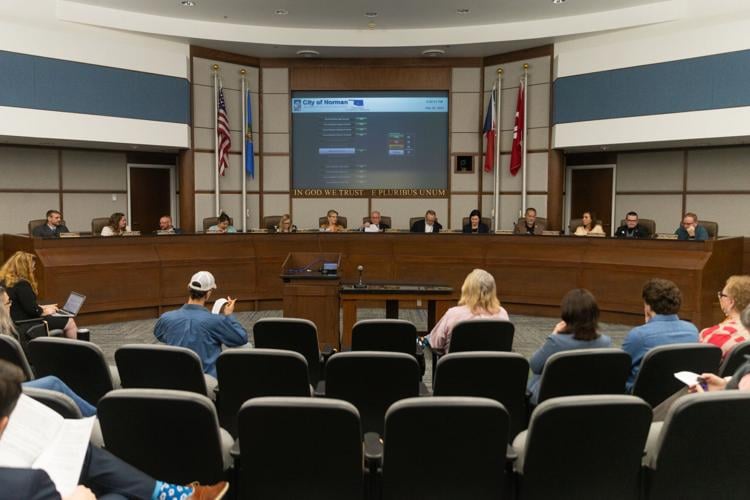

Sometimes labeled a “blue dot in a red sea,” Norman is no stranger to political division.
Compared to Oklahoma’s Republican supermajority, Norman’s voter base leans more Democratic, but city politicians often clash over local and national issues like homelessness and police funding. A global pandemic, an international social justice movement and efforts to uplift historically marginalized communities all highlight Norman’s connection to partisan politics.
Former Mayor Cindy Rosenthal is Norman’s first popularly-elected female mayor and second longest-serving mayor after Bill Morgan, who served first from 1965-69 and again from 1975-83. Rosenthal first joined council as the Ward 4 representative in 2004 and was elected as mayor in 2007 and served for three terms, announcing she wouldn’t seek reelection in 2015.

Former Norman Mayor Cindy Rosenthal.
Rosenthal said that partisanship hadn’t always existed in Norman, recalling that races slowly started to become more partisan during her tenure. She pointed to one incident in 2004 when a Republican party chair sent mailers that identified the political party of every candidate running that cycle.
Though that mailer didn’t resonate with voters the same way future political moments in Norman would, she said it was the first time she could recall a partisan appeal to the council. Rosenthal would also reflect on one proclamation that occurred during the third year of her first term, an event that would create partisan lines on council.
2010: GLBT proclamation
In September 2010, Norman City Council approved a proclamation designating the month of October as Gay, Lesbian, Bisexual and Transgender History Month after a four-hour discussion in a vote of 7-1. Gay marriage was not yet legalized in the state of Oklahoma and wouldn’t be until 2014.
A crowd of about 100 debated the proclamation, one resident arguing that the vote could be a slippery slope, as reported by The Norman Transcript. Other comments attacked the 2SLGBTQ+ community.
Rosenthal said the 2010 council proclamation motivated conservative voters to participate in local elections, leading to more partisanship. Partisanship has risen in Norman politics over the past 13 years, according to Rosenthal.
“There’s a certain group of Norman voters who are just very attentive,” Rosenthal said. “Then, there are others who can get motivated in time by specific issues, and they, generally speaking, don’t necessarily stay the course and remain engaged and involved.”
Ward 7 Councilmember Stephen Tyler Holman pointed to the 2010 proclamation as the first time he recalled stark partisanship in regard to council matters. Having grown up in Norman near the OU campus, Holman’s perception was a more progressive one.
Holman attended that 2010 meeting three years before he was elected to council. He was surprised to hear the passionate declarations against the proclamation, not realizing the broader Norman community’s politics weren’t as progressive as those closer to campus might be.
“There’s like a bubble within the bubble depending on where you live,” Holman said.
According to Holman and Rosenthal, the proclamation’s approval led to the 2011 election of three conservative-leaning candidates: former Ward 1 Councilmember Roger Gallagher, former Ward 5 Councilmember Dave Spaulding and former Ward 7 Councilmember Linda Lockett.
National controversies impacts local politics
During the time of the trio’s elections in 2011, a Republican national movement called the Tea Party Movement rose to notability. The national movement featured conservative activists focused on three pillars: free markets, fiscal responsibility and limited government.
In the 2013 city elections, Gallagher, Spaulding and Lockett lost their bids for reelection. Spaulding later made other attempts for political office, once in 2018 for Oklahoma House District 27 and again in 2022 for District 45. Spaulding lost both Republican primaries.
Nationally controversial topics routinely appear before council. In 2019, two council members turned their back to anti-abortion protests during public comment while considering declaring Norman a sanctuary city, an idea dropped in 2020.
Melody Rowlett, an OU political science professor, said national politics’ impact in local government is cyclical, so as national matters trend toward more cultural aspects, it becomes more locally centered.
“When we start talking about the basics like what books are supposed to be in schools, then these are things that are local in their very nature,” Rowlett said. “This culture war that’s currently a big part of national politics is why it’s hitting at the local level.”
Former Ward 3 Councilmember Alison Petrone, who served on council from 2019-21, pointed to state and national politics finding their way into local matters through the example of school boards. In Oklahoma, teachers have been threatened with having their licenses revoked and schools have faced a downgrade in accreditation.
“People are tired in this community of this national ugliness coming in and telling us to adopt those values when those are not our values here,” Petrone said.
Petrone lost her bid for a second term in the 2021 election to self-proclaimed conservative Ward 3 Councilmember Kelly Lynn.
Last August, then Oklahoma Secretary of Education and current State Superintendent of Public Instruction Ryan Walkers asked the Board of Education to revoke former Norman High School teacher Summer Boismier’s license after she allegedly violated House Bill 1775. Walters was campaigning for Oklahoma state superintendent at the time.
HB 1775, signed into law by Gov. Kevin Stitt in 2021, forbids public schools from teaching students that any person, due to their sex or race, is racist, sexist or oppressive in some fashion. Boismier allegedly violated this bill by posting a QR code to the Brooklyn Library Books Unbanned in her classroom.
Also last August, the Oklahoma State Board of Education voted to downgrade Tulsa Public Schools and Mustang Public Schools’ accreditation status after finding they had violated HB 1775, leaving them with the status of accredited with a warning.
The Tulsa complaint alleged that one course shamed white people for historical offenses and taught that everyone is racially biased naturally. Mustang’s investigation stemmed from a “privilege walk” activity in a leadership course, which reportedly made some students uncomfortable.
2020: COVID-19 and Unite Norman
Council dynamics were also shaken in March 2020, with the beginnings of COVID-19, shutdowns and mask mandates starting to rise across the globe. Stitt enforced a “safer at home” order that extended to the elderly and the immunocompromised populations, closed non-essential businesses and prohibited gatherings of over 10 people in March 2020. A statewide stay-at-home order was never implemented.
Then-Mayor Breea Clark declared a state of emergency and stay-at-home order for all Norman residents following the COVID-19 outbreak, with council approving a mask mandate in June of that year. In April, Stitt reopened the state for business.
In Oklahoma, 17 cities, including Norman, Oklahoma City, Stillwater and Tulsa had some kind of mask mandate enforced.
Norman’s mask mandate was approved 10 days before the council voted to reduce the police department’s budget increase by cutting $865,000 in an 11-hour meeting, still granting a raise from the previous year’s budget but not at the full requested amount.

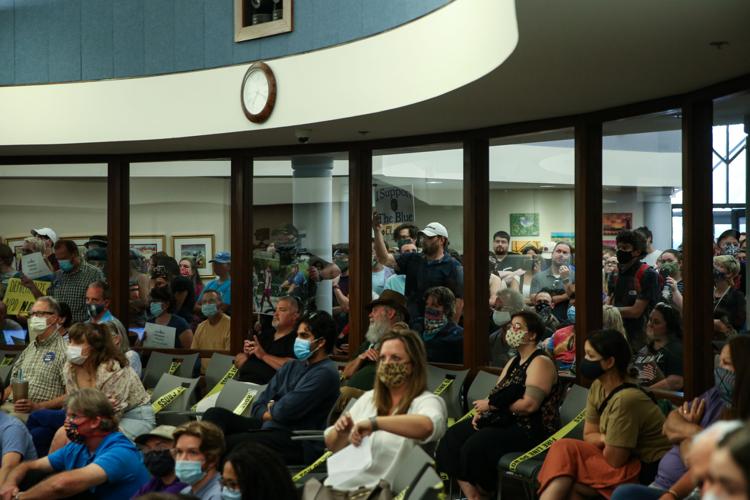
People fill the chamber and main halls of Norman City Hall during the city council special session on June 16, 2022.
The COVID-19 regulations sparked the creation of grassroots organization Unite Norman, with the budget vote leading the group to form a recall petition movement aimed at removing Clark, Holman, Petrone, former Ward 1 Councilmember Kate Bierman and former Ward 5 Councilmember Sereta Wilson.
Bierman said the difference between every issue before 2020 and Unite Norman was the level of anger surrounding the issue.
“Even some fairly controversial issues, like making Norman a sanctuary city, there was a lot of emotion around that, but it was not nearly to the same level as what happened in the summer of 2020,” Bierman said.
Unite Norman attempted to challenge the city’s mask mandate, along with filing five recall petitions in July 2020, with four failing to meet the required signature count.
Only Petrone’s petition succeeded after controversy surrounding the validation of signatures. Petrone filed a lawsuit alleging additional signatures were not verified, leading to her petition becoming invalid.
Two candidates ran and won under the endorsement of Unite Norman in 2021: Lynn and Ward 5 Councilmember Rarchar Tortorello. Lynn is no longer involved with the organization, according to a 2021 Facebook post.
Both lost their bids for reelection this year. Tortorello filed a petition for a recount after losing by 29 votes, though the end tally was unchanged. Tortorello told OU Daily the recount was his constitutional right and wanted to call to attention irregularities he claims were in mail-in ballots.
“I had every right to order a recount, which I knew wouldn’t change the outcome,” Tortorello said. “If my opponent had requested a recount, I would support his right and wouldn’t say anything controversial because that’s his right to do.”
The future of partisanship
Clark, who lost her bid for reelection in 2022 to self-proclaimed conservative Mayor Larry Heikkila, said she hopes the city can advance from partisanship, saying while the measure of American politics acts like a pendulum, Norman politics seem to move quicker, leading to a trend of one-term council members.
“Norman’s (politics are) like windshield wipers on high right now. It’s crazy how much it’s going back and forth,” Clark said. “I’m glad voters are kind of policing and holding elected officials accountable for their behavior, … but it slows us down (in) making progress in other important areas that are very much needed.”
Heikkila told OU Daily that cable news and other forms of national media spur polarization, leading to arguments about matters the city council cannot change.
During his first State of the City address, Heikkila highlighted political divisions as reported by The Norman Transcript. Heikkila said in the address he needs five “fiscally conservative, pro-growth, pro-business, pro-citizen voices” on council.
Heikkila told OU Daily he strives to remember the priorities of a city government, like ensuring emergency services, fixing roads and providing water and sewer services. With Norman’s city council undergoing the introduction of three new council members, Heikkila aims for less polarization.
According to Heikkila, as the outgoing council members who were inclined to cause division exit, the new members will be given a chance to improve Norman how they see fit.
Rosenthal recommended council members first listen to their constituents, be responsive to their concerns and hold them as the top priority. Rosenthal also advised building relationships and communication across party lines.
Rosenthal said Norman’s current government was chosen to de-politicize issues and emphasize professional management, ensuring the delivery of services to residents.
Norman City Council operates under a council-manager form of government, where an elected council serves as the primary legislative body and appoints a city manager to supervise typical municipal operations, draft a city budget and implement council policies.
This form of government usually involves nonpartisan elections, like Norman’s, in order to specialize local government, reduce inefficiencies and reduce the divisiveness of partisan politics out of city government, a standard Rosenthal said is important to remember.
“Voters don’t have a preference for a Republican-filled pothole over a Democratic-filled one,” Rosenthal said. “They just want their potholes filled.”
Clark also said she thinks less partisanship is in the council’s future, saying she hopes Norman can move on from the deep divides both the far right and far left caused the city.
“These are livelihoods. We’re at a level of government closest to the people,” Clark said. “We have the ability to effect the most positive change in the shortest turnaround time of any level of government in the United States.”
This story was edited by Alexia Aston, Karoline Leonard and Jazz Wolfe. Ansley Chambers and Nikkie Aisha copy edited this story.


