

This story is featured in the spring edition of OU Daily's magazine. The magazine can be found on racks around campus and online at the end of February.
As a graduate student at the OU-Tulsa School of Community Medicine, Saramarie Azzun spends an average of 16 hours in classes, 20 hours studying, four hours shadowing physicians at Tulsa medical clinics and two hours working at the nonprofit Take Control Initiative each week.
She said she hopes to become a family medicine physician, providing culturally relevant care to patients from disadvantaged communities.
But now, amid a wave of nationwide attacks on diversity, equity and inclusion initiatives in higher education, Azzun has the additional responsibility of running the Black Student Association at OU-Tulsa, an organization she created on Jan. 29 to carve out a space for Black students in the School of Community Medicine.
Azzun expects to spend at least five hours a week managing BSA, bringing her weekly workload up to 47 hours — seven hours more than the average full-time job.
"When I came (to OU-Tulsa) I was hoping for that support of DEI and in having them bring a community that looks like me together," said Azzun. "What the DEI ban did was place that burden on the students."
In the past year, OU campuses have been forced to comply with legislation restricting the use of DEI initiatives. In June, the U.S. Supreme Court handed down its decision in Students for Fair Admissions, Inc. v. Harvard, which prohibits universities from considering race as a factor in its admissions. In December, Oklahoma Gov. Kevin Stitt signed an executive order calling for a formal review of DEI in Oklahoma higher education to be completed by May 31.
On Tuesday, OU President Joseph Harroz Jr. sent a campus-wide email announcing that the Division of Diversity, Equity and Inclusion, which currently resides in Copeland Hall, will change its function and name to the Division of Access and Opportunity. In the email, Harroz reaffirmed that no one will lose their employment with the university due to the executive order.
For students like Azzun who are pursuing careers in medicine, this potential scaleback of university DEI programs and support has caused stress and sparked fears of decreased class diversity and academic success. This, Azzun added, could impact the quality of care their future patients will receive.
"As future physicians, we want to be able to treat a diverse patient population," Azzun said, noting some studies have shown shared identities between a patient and provider can lead to higher quality care as perceived by the patient.
"I think (a DEI ban) really disadvantages future patients and disadvantages anyone in that future field," she said.

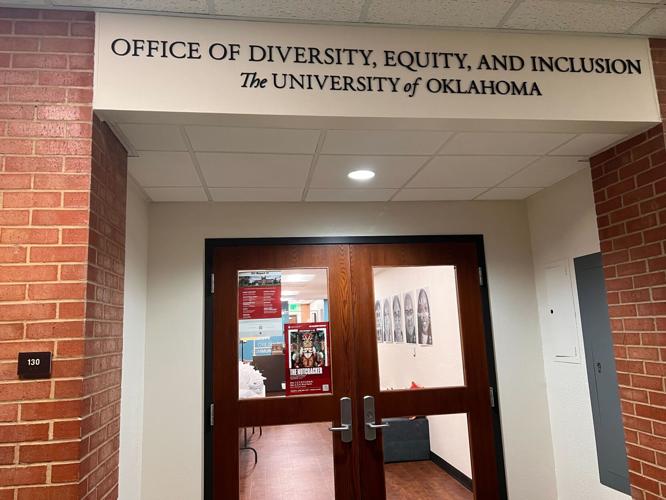
OU's Division of Diversity, Equity and Inclusion office on Dec. 13.
Impact of Stitt's executive order
In part, Stitt's executive order prohibits state agencies and higher education institutions from using state funds, property or resources to "grant or support diversity, equity, and inclusion positions, departments, activities, procedures, or programs to the extent they grant preferential treatment based on one person's particular race, color, sex, ethnicity, or national origin over another's."
OU released a statement after the order was announced reaffirming its commitment to "ensuring an education from the University of Oklahoma remains accessible and available to all."
However, the scope and specifics of how DEI will change at OU remain largely unclear.
"DEI (programs) are very important," said LaMauri Franklin, an undergraduate pre-med student and president of Black Girl White Coat, a volunteer and community-based student organization for Black women pursuing careers in STEM.
"If that were to be taken away, that would have a drastic negative impact on students who are pursuing any health field or any STEM field," Franklin said.
Franklin said DEI programs are a support system for students from disadvantaged backgrounds, cultivating a sense of community and providing resources for students to succeed in higher education.
According to a 2022 study by Springer Nature, social support is associated with positive outcomes in students’ well-being and academic achievement, with students engaging in higher levels of social support reporting lower levels of stress.
"With students being able to find community, it really helps with morale and mental health," Azzun said. "So removing that really does a disservice to those students and future patients they're going to treat."
DEI programs at the OU College of Medicine include: the Diversity Alliance Task Force, which seeks to leverage the transformative power of equity and diversity through pathway programs, mentorship, faculty recruitment, research and community engagement; OU MED REV UP!, a medical school readiness program for underrepresented undergraduate students; and SPARK, a summer program for high school students with an interest in medicine.

The OU Medical Center.
Diversity at all levels
In January, a report by the Washington Examiner revealed several medical schools allegedly tried to find loopholes in the Supreme Court decision banning affirmative action to maintain a DEI focus in admissions while still technically abiding by the law, according to records obtained by Do No Harm, an organization targeting DEI in medical institutions.
These schools include the University of Houston College of Medicine, the University of Toledo, Harvard University, Virginia Commonwealth University and the University of Louisville.
When asked if OU medical schools were similarly looking for ways to promote DEI through admissions, OU News wrote, "Oklahoma state law already prohibited the consideration of race, color, sex, ethnicity, or national origin in university admissions."
Oklahoma banned affirmative action through a state question in both university admissions and public employment in 2012. According to Ballotpedia, none of the state’s 13 public universities reported race as a consideration for admission.
Immediately following the Supreme Court decision in June, OU wrote in a statement to the OU Daily that the university doesn't include race as a factor in its admissions, instead considering four parts in a student's application: academic rigor and performance, engagement, an essay and letters of recommendation.
Still, according to the Office of Diversity, Inclusion and Community Engagement website, the OU College of Medicine is "committed to advancing diversity at all levels."
"(OU College of Medicine) recognizes that the inclusion of talented individuals from different backgrounds benefits medical education, patient care, population health, and scientific discovery," according to the website.
OU News referred to Harroz's December statement in response to a question on how the OU College of Medicine plans to continue this initiative in light of recent legislation.

In spring 2023, approximately 12% of students enrolled at OU Health Sciences Center colleges identified as Asian, 4% as African American, 8% as Hispanic, 2% as American Indian and 59% as white.
In 2020, 13% of active physicians in Oklahoma identified as Asian, 3.2% as Black or African American, 3.4% as Hispanic, 4.9% as American Indian or Alaska Native and 65.1% as white, according to an Oklahoma physician workforce profile.
"When there is a diverse population of health care professionals treating a diverse population of patients, I feel like we're able to better serve our patients, we're better able to show compassion, we're better able to show understanding," said Dawn Thejus, a chemical biosciences sophomore.
Thejus is the operations chair for the OU Minority Health Sciences Conference, an annual conference that brings marginalized high schoolers from across the state to learn about careers in medicine and connect with mentors and resources.
According to a report by the Association of American Medical Colleges, studies have found doctors who cared for patients of the same race received higher scores in patient satisfaction and Black patients are more likely to follow medical recommendations after visiting Black doctors. However, the health impact of these improved interactions remains unclear.
"The more diversity we have in our health care profession, the better we are able to treat our patients," Thejus said.
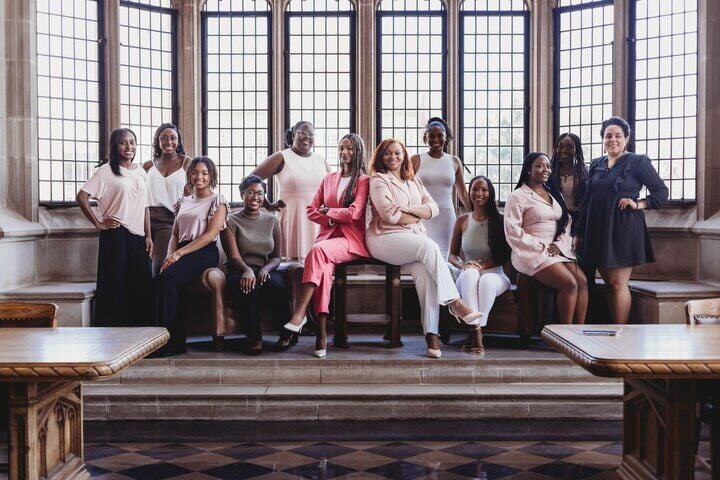
OU's chapter of Black Girl White Coat.
Added burden
Between the Supreme Court ruling and continued attacks on DEI in higher education, many students, like Azzun, have found themselves resuming the responsibility of fostering diversity and inclusion on campus. Registered student organizations are protected under Stitt's executive order.
"The University of Oklahoma School of Community Medicine is still not as diverse as I would like it to be," said Azzun, adding she is the only Black student in her graduating class at OU-Tulsa.
Realizing university DEI programs were restricted because of the executive order and an organization for Black students didn't exist at OU-Tulsa, Azzun created the OU-Tulsa Black Student Association in January. Azzun said BSA will begin recruiting members mid-February.
"I've had to go through hoops now to make a Black student organization," Azzun said. "And as much as I enjoy bringing people together, I do think it is a school's duty to do that. They shouldn't place that burden on students."
With DEI under attack by the state, members of the OU Minority Health Sciences Conference said they worry recruitment to OU and medical programs could be affected.
OU Minority Health Sciences Conference is an opportunity for marginalized high schoolers from across the state to learn about careers in medicine and resources offered at OUHSC colleges. Members said this is another way OU College of Medicine can help increase diversity within its student body and in the field of medicine.
"The whole goal of the conference is to provide the pathway (and) provide as many resources as we can to these kids and make it as accessible as we can," Thejus said. "But when they see that a big university like OU is also having to struggle with DEI programs, it makes it difficult for us to become more accessible to these high school kids."
Thejus said she attended the OU Minority Health Sciences Conference on Zoom in 2021 as a senior in high school and it helped her understand her options when it comes to pursuing a career in medicine.
"Everyone has their own story. So I think this conference is a reminder that there's no one, specific, perfect way to get where you want to get," Thejus said.
It has been two months since Stitt signed his executive order and students are still waiting to hear how the order will be implemented at OU. On Tuesday, in the email announcing a name change to the Division of Diversity, Equity and Inclusion, OU launched a website with frequently asked questions that will be updated.
Many students agree that any restrictions on DEI will have drastic consequences – both now and in the future – for students and patients.
"Without DEI, it's just honestly going to be a step backwards," Franklin said. "It's going to make it that much harder to change the issues within health care. It's gonna make it harder than it already is."
OU Daily's spring magazine:



This story was edited by Anusha Fathepure, Ismael Lele, Peggy Dodd and Karoline Leonard. Sophie Hemker, Grace Rhodes, Nikkie Aisha and Mary Ann Livingood copy edited this story.


