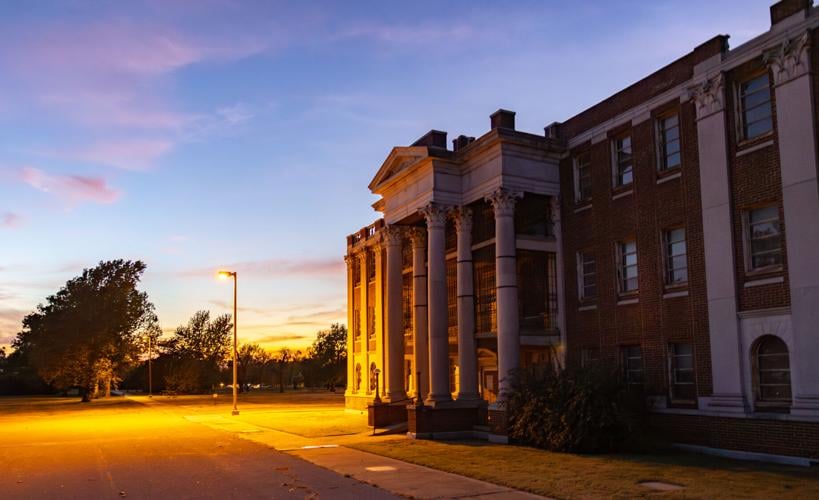
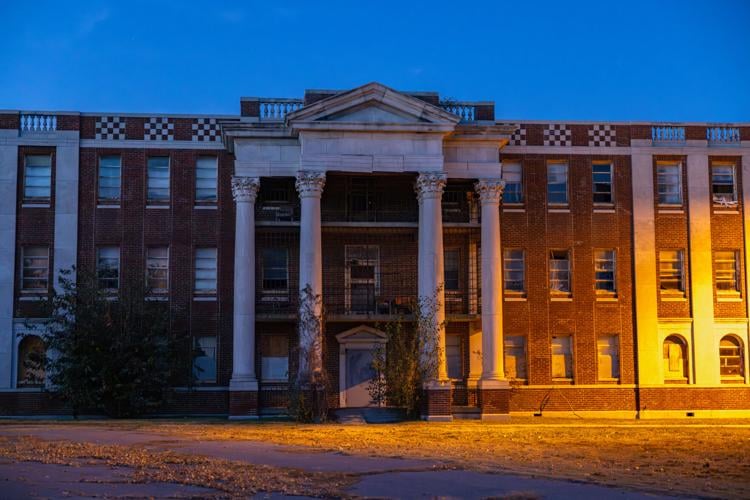


Griffin Memorial Hospital in northeast Norman. The property includes the location of Red Rock Behavioral Health Services and The Central Oklahoma Community Mental Health Center on Alameda Street.
Editor's note: This story is featured in OU Daily's winter magazine, which will be available in print in late-November. Check out the other featured stories at the bottom of this article.
Standing on the northwest corner of Main Street and 12th Avenue Northeast, Griffin Memorial Hospital’s brick buildings hold the history of Norman’s early beginnings. Most prominently, the hospital’s Hope Hall, built in the late 1920s, features tall white columns that once stood watch over one of the largest medical facilities in the state.
Neighborhoods to the west, coffee shops and fast food restaurants to the east and soccer fields to the north, most of the buildings on the extensive acreage are now closed or serve new purposes.
Standing on the property today, the sounds of cars speeding down 12th Avenue, families at Frances Cate Park and little league soccer games can be heard. But in the 1950s, the hospital heard patients working on dairy farms and Girl Scouts or one of OU’s sororities volunteering at the facility. The property was primarily surrounded by Oklahoma's natural landscape at that time.
Though not far from Norman’s original townsite, the development around Griffin Memorial Hospital grew alongside the city.
In a city just a year old at the time, High Gate College’s campus occupied the facility’s current land. Founded in 1890, the girls’ school educated the women of the area but soon found competition with nearby OU, which was founded the same year. High Gate College closed its doors after five years, making way for the Oklahoma Sanitarium Company.
1915 saw the establishment of Central State Hospital after the Oklahoma Sanitarium Company was sold to the state. In 1953, the complex was renamed Griffin Memorial Hospital.
The hospital currently has 120 beds and over 350 employees.
However, the future and legacy of the hospital’s campus have yet to be determined after the Oklahoma Department of Mental Health and Substance Abuse announced a brand new facility in Oklahoma City would replace Griffin Memorial Hospital.
In January, Oklahoma County Commissioners approved $1 million to support the hospital’s move, should the department decide to relocate to the state’s capital. In September, the move was officially confirmed and renderings of the Donahue Behavioral Health hospital were released. The new facility would hold 330 beds, serving 275 adults and 55 adolescents daily.
Its estimated economic impact is over $447 million within five years.
In the original press release, Carrie Slatton-Hodges, Oklahoma Department of Mental Health and Substance Abuse Services commissioner, wrote Griffin Memorial Hospital had outlived its functionality.
Moving from the state’s third largest city to its first, the new behavioral health campus will take Griffin Memorial Hospital’s title as the state’s primary mental health hospital. With it, leaves the question of what the over 220-acre property will house next amid Norman’s impending economic boom.
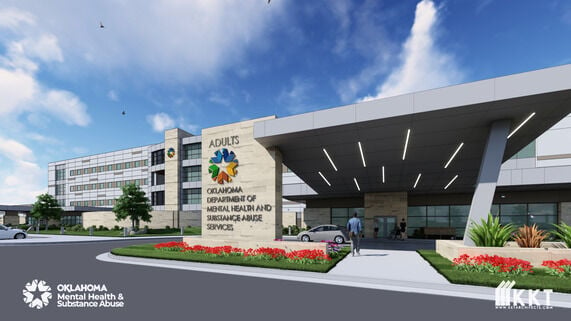
Renderings of the Donahue Behavioral Health hospital that will be constructed in Oklahoma City, replacing the Griffin Memorial Hospital.
Donahue, a psychiatric legacy
As the state of mental health will be left uncertain in Norman with the hospital moving about 24 miles north, the new facility’s name honors one of Griffin Memorial’s most influential doctors: Hayden Donahue.
Originally from El Reno, Donahue became the superintendent of Norman’s Central State Hospital in 1961 and served in that role until 1979. Before that, Donahue was the first director of Oklahoma Department of Mental Health and Substance Abuse Services in 1953 until departing in 1959. He later returned to the position from 1970-78.
Donahue began the psychiatric residency program and structured the children’s ward at Central State Hospital, according to his obituary in The Oklahoman following his death in 2002. The first federally funded comprehensive mental health center opened in Norman under Donahue's watch in 1969.
Renee Mixon worked at Griffin Memorial Hospital for over 30 years and now serves as the co-executive director of the Oklahoma Psychiatric Physicians Association. Mixon said that while she was at the hospital, the treatment was well orchestrated thanks to the work of Donahue.
“He put together a treatment program that was cutting edge at the time,” Mixon told OU Daily.
According to Mixon, Donahue’s treatment plan that was developed at Griffin Memorial Hospital involved putting together teams of professionals like psychiatrists, social workers, psychologists and therapists to develop personalized treatment plans. The end goal of Donahue’s treatment was for the individual to improve and return home and did not focus on institutionalizing patients.
When Mixon joined the Oklahoma Department of Mental Health and Substance Abuse Services in the 1970s, she said Donahue’s treatment was the norm. Paired with Donahue’s plan were advancements in psychiatric medications, which Mixon said allowed the length of patient stays to decrease from eight years to 21 days.
“They made a huge impact on treatment because instead of just a maintenance type of medication, it became a treatment modality, which made the person … wake up and be able to then take an active part in their treatment process,” Mixon said.
Before Donahue’s treatment program, Mixon said treatment mainly focused on “warehousing” patients, the practice of confining patients with mental disorders to large institutions for long-term care. Mixon emphasized that patients were treated kindly, but there just wasn’t enough knowledge at the time to properly serve mental health needs.
Bonnie Campo, director of public relations at the Oklahoma Department of Mental Health and Substance Abuse Services, wrote in an email to OU Daily that department leadership made the decision to name the new hospital after Donahue. Campo wrote that a building on the current Griffin campus is already named after Donahue.
“The new Donahue facility will honor our history and the service of (the) current campus, while carrying that service into the future,” Campo wrote.
Donahue would follow the footsteps of Dr. David Wilson Griffin, the hospital’s current namesake, who had begun revising mental health care while running Central State Hospital.
Mixon said Griffin did not believe in classifying patients as “violently insane,” making one of his first moves to remove the sign in front of Central State Hospital that read “Norman Institute for Violently Mentally Insane.”
Under Griffin, the hospital’s campus expanded to over 30 buildings and three farms, according to the Oklahoma Department of Mental Health and Substance Abuse Services website.
“He believed in humanity and compassion, and his staff also believed in humanity and compassion, to the extent of the knowledge of medicine that they had during the 1920s and the 1930s,” Mixon said.
At the time, Griffin and his staff would conduct treatments like insulin shock therapy, where patients were given increasingly large doses of insulin to induce low blood glucose and coma, according to Mixon.
The idea was to shock patients out of their conditions and was largely discredited in the 1960s.
He also practiced wet sheet pack therapy, where patients were wrapped in a wet sheet, followed by several dry blankets, to encourage hyperthermia and sweating. According to reporting from The Washington Post in 1989, most hospitals stopped using the therapy in the 1950s.
“They did the best they could, but as medicine progressed, the treatment at the hospital progressed,” Mixon said.
Mixon said the psychiatric progress and work of staff and patients at Griffin Memorial Hospital should be remembered as pioneering mental health treatment and the acceptance of psychiatric disorders.
“It’s not a closing, but it’s a new beginning for the facility. It will continue to change as the treatment of mental illness continues to evolve,” Mixon said. “It was the gold standard, and I hope it continues to be the gold standard.”

Griffin Memorial Hospital in northeast Norman. The hospital sits on 224 acres, but the state is planning to sell over 700 acres of land in east Norman.
Future of Griffin
Officials from the city, Cleveland County and the Norman Economic Development Coalition started meeting with hospital leadership in April 2022 regarding the move, according to NEDC President and CEO Lawrence McKinney.
McKinney wrote in an email to OU Daily, that initial conversations centered around keeping Griffin Memorial Hospital in Norman, but Oklahoma County and Oklahoma State University started incentivizing the state to relocate it to Oklahoma City.
“Norman, other than (tax increment finance districts), does not offer any other kind of incentive to be competitive with other communities,” McKinney wrote. “It’s a glaring disadvantage that this particular project illuminates.”
In September, the Norman Transcript confirmed in an interview with Mayor Larry Heikkila that the city did not submit a bid to keep Griffin Memorial in Norman.
Rep. Jared Deck (D-Norman) is the legislative representative for Griffin Memorial Hospital. Deck told OU Daily that the hospital should be remembered as a foundational part of Norman, given its history of employment and its health care developments.
Deck said one of the most important things to remember for the Griffin Memorial Hospital move is to avoid gaps in services for patients. According to Deck, when the hospital leaves Norman, there will be gaps in in-patient treatment locally, though such services will be available in Oklahoma City.
Deck said that, for himself and other members of the Norman delegation, access to mental health services is a priority.
“Our patients come first; our employees come next because our community depends on it,” Deck said.
Griffin Memorial Hospital sits on 224 acres of land, though the state will sell over 700 acres located in East Norman, according to Campo.
The expansive property encapsulating Griffin Memorial Hospital includes the location of Red Rock Behavioral Health Services, which has an adult crisis unit on Griffin’s campus. The Central Oklahoma Community Mental Health Center on Alameda Street is housed on the property, though Campo wrote it will be excluded from the sale.
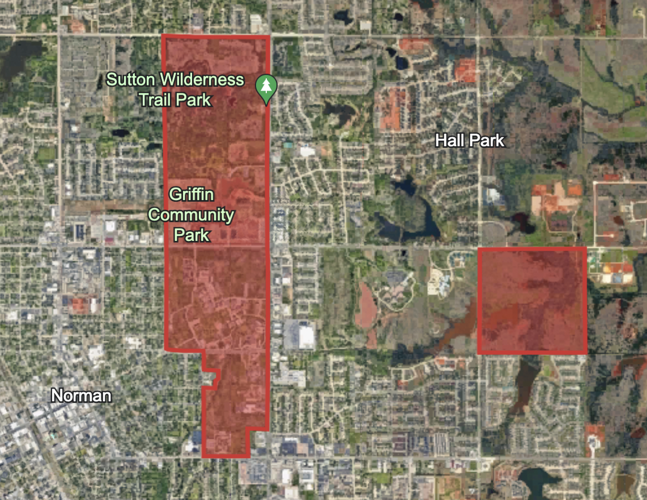
The property for sale also includes the Cleveland County Health Department, Le Monde International School and Sutton Wilderness Trail Park. The property does not include the nearby Food and Shelter. The Norman Veterans Center and the J.D. McCarty Center for children with developmental disabilities are also not included in the sale, though that property is also owned by the state.

A map showing the state's property that will be for sale. The property includes Griffin Memorial Hospital, the Cleveland County Health Department, Le Monde International School and Sutton Wilderness Trail Park.
It is not known as of November if these services and businesses will be relocated elsewhere in Norman or keep their property.
As for employees, Campo wrote that everyone currently employed at Griffin Memorial Hospital has been assured their employment will continue at the new Oklahoma City facility. Campo wrote that the department will need more employees to run the larger hospital.
McKinney wrote that as Griffin Memorial Hospital employees move their work to Oklahoma City, new jobs could be coming to Norman. According to McKinney, a new outpatient health facility could potentially be built.
For comparison, Central Park in New York is just under 140 acres larger than the property for sale. The entire campus of the University of Central Oklahoma is 210 acres, while the University of Texas at Austin takes up 431 acres.
McKinney wrote that should private sector enterprises purchase parts of the land, the area would become taxable property. The land must be sold in order to pay for the Donahue facility, McKinney wrote.
“Once it is sold, as the state is requiring, I believe we will see hundreds, if not thousands, of higher-paying private-sector jobs over the next decade,” McKinney wrote.
McKinney said the most glaring loss of the land sale could be the newly built soccer fields across from the hospital, funded by Norman Forward dollars. Because those fields are currently under leases, should the land be sold to a single buyer as expected, all leases would be void and would have to be renegotiated, according to McKinney.
Kathryn Walker, city attorney, wrote in an email to OU Daily that the city wants to protect its existing interests — like Griffin Park and the Sutton Wilderness Trail Park — but the relocation of the hospital presents a unique redevelopment opportunity in East Norman.
Historically, there has been an assumption in Norman that the west side of town sees more development and business opportunities, while the east remains mainly rural.
Norman City Council must approve any zoning and platting requests of the property by any future private developers.
As conversations with the state are ongoing, Walker wrote she couldn’t provide any specific updates regarding the land, but is hopeful the interests of the city can be protected.
NEDC believes the city or county should own the land and present a master plan for the area before selling plots to private entities, McKinney wrote.
“A master plan that solicits input from east side residents will be critical to the long-term success of whatever development is proposed,” McKinney wrote.
Read more stories from winter magazine:




This story was edited by Karoline Leonard and Taylor Jones. Grace Rhodes, Mary Ann Livingood, Avery Avery and Nikkie Aisha copy edited this story.


