


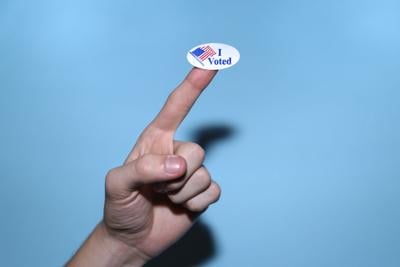
This story is featured in the spring edition of OU Daily's magazine. The magazine can be found on racks around campus and online at the end of February.
When young voters hit the polls for the first time in 2020, they watched the United States undergo one of the most controversial and polarizing elections in recent history. In the race, political engagement reached historic heights with the highest voter turnout in history since 1900.
The end result of the race between former President Donald J. Trump and current President Joe Biden didn’t mitigate partisan tensions. As college-age voters gear up for the 2024 election, partisanship has only grown and trust in candidates continues to dwindle, leaving the younger generations with a melancholic view on national politics.
In total, 40.8 million people aged 18-27 will be eligible to vote in 2024, 8 million of which will vote for the first time, according to the Center for Information & Research on Civic Learning and Engagement. In 2020, about 50% of young voters across the nation voted in the presidential election, but in Oklahoma, this number was 34%.
As of February, Biden and Trump are the likely front-runners to compete in the general election. Despite their initial race resulting in the highest voter turnout this century, both Biden and Trump stand as two of the most unpopular candidates in the nation's history, a sentiment that has grown in recent months and could affect the turnout in younger demographics.
“That's really fueling the divide that we're seeing because there are so many people that maybe don't identify with either of those two or are outright disgusted by the both of them that they're left out there,” said Cale Greenroyd, treasurer of the OU College Republicans.
When Biden emerged as the Democratic candidate in 2020, Trump struggled to address national concerns regarding the COVID-19 pandemic and the protests in response to the murder of George Floyd.
Trump launched another bid for reelection on Nov. 14 and he has remained the front-runner to win the Republican primary. Since the race for the Republican primaries began in September, Trump has declined to participate in any debate against his competitors due to polls consistently indicating he will represent the Republican Party.
Candidates like Florida Gov. Ron DeSantis and former South Carolina Gov. Nikki Haley made efforts to oust Trump but have only made marginal gains in their attempt at swaying the party from Trump's influence. However, Haley has yet to give up as she continues to gain traction with younger voters by offering them a moderate alternative to Trump.
With DeSantis out and Haley struggling to make significant gains, polls indicate that the first presidential rematch since 1956 will possibly take place in this year's upcoming election between Biden and Trump, showcasing a trend of limited choices as more young voters continue to reach voting age.
Trump defeated former Secretary of State Hillary Rodham Clinton in the 2016 election, winning the electoral college 304 to 227 despite losing the popular vote by 2.86 million. The 2016 election, in contrast to 2020, had one of the lowest voter turnout results of the past 20 years.
In order to win the presidential election, a candidate must win 270 electoral votes. Each state is allocated a set number of electoral votes depending on the number of senators and representatives it has. A candidate wins electoral votes by winning in a state via a popular vote.
Of voters aged 18-29, 58% voted for Clinton in 2016, 72% voted Democrat in the 2018 midterms, 59% voted for Biden in 2020 and 63% voted Democrat in 2022.

Among registered voters who chose not to vote in 2016, 25% said it was due to their dislike of the candidates or campaign issues. It is the same voter apathy that people believe contributed to Trump's win over Clinton that many fear will rear its head again in 2024.
Since losing in 2020, Trump has faced dozens of legal charges ranging from attempts at overturning the 2020 election, possession of classified documents at his Mar-a-Lago estate, falsified business records and civil cases involving accusations of sexual abuse.
In December, CNBC reported Biden reached an approval rating of 37.7%, the lowest rating of any president at that point in their first term since 1948. Many have attributed the low rating to the Biden administration’s failure to deliver on promises such as student loan forgiveness, protections for bodily autonomy and unethical foreign policy during its first three years.
“It's not going to be a landslide or anything like that,” Alex Ignatow, vice president of the OU College Democrats, said. “Young people are going to have an important role this time around, like a very important role, but it really just depends on their choice of whether they want to go and vote or if they want to sit it out.”
Young voters have increasingly grown agitated by the age of the politicians in office, questioning their ability to effectively serve as commander-in-chief and other positions of power. Biden, 81, is the oldest president in the nation's history, a title he held when he took office at 78. Trump is 77 and was 70 when he took office in 2016.
“People really aren't happy that we're gonna have another Trump-Biden rematch,” Anthony Diulio, chair of the OU College Republicans, said. “We're pretty much sleepwalking into it.”
Young voters and the two-party system
A New York Times poll released in November projects Nevada, Georgia, Arizona, Michigan, Pennsylvania and Wisconsin to be the most pivotal states in the election. The poll that was updated in December shows that Biden is losing five of the six swing states, with Wisconsin as the sole exception.
Michael Crespin, an OU political science professor, said battleground states help determine the winner of presidential elections because they don’t typically stick to one party each election cycle. The uncertainty of swing states results in lots of money poured into campaigning by candidates in an effort to secure more votes.
“You're gonna have some states where it's gonna be close,” Crespin said.
Nate Cohn, New York Times chief political analyst, reported in November that, among battleground states, Nevada shows the most cause for alarm for Biden as he is showing weakness among young and non-white voters.
Biden's weakness with young voters, especially those of color, is not a trend unique to Nevada, but can be observed nationally as well. Across the country, young voters who may have never voted in a presidential election, are fatigued with the deep political division in the U.S.
A survey of over 4,000 young adults conducted by the Institute for Citizens & Scholars in August found that 57% of voters aged 18-24 are dissatisfied with American democracy and 33% have no intention of participating in the presidential election.
Historically, minorities and young voters have shown up to the polls in support of Democratic candidates, but Biden's presidency has done little to combat voter apathy. Of the 40.8 million eligible voters aged 18-27, 45% are people of color, according to the Center for Information & Research on Civic Learning and Engagement.
Just over half of the 40.8 million voters aged 18-27 are white, 22% are Latino, 14% are Black, 4% are Asian and 4% are multiracial. Of the newly eligible voters 18-19, 53% are white, 23% are Latino, 13% are Black, 5% are multiracial and 4% are Asian.
Abraar Hassany, a Pakistani-American, junior pre-med student and socialist organizer at OU, said he and other minorities are not only uninterested in Biden, but the Democratic Party as a whole.
The reason why Democrats may be losing a portion of their voting demographics varies depending on race. According to the New York Times survey, Black and Latino voters are becoming increasingly frustrated with the current state of the economy. According to Hassany, Arab and Middle Eastern voters are hesitant to vote due to Biden's foreign policy in the Middle East.
“The Democrats have never been our party. They have been something we've had to attach ourselves to because, I mean, this is a two-party system, and the Republicans have been just demonstrably worse,” Hassany said. “And that's such a common thing among, I think, minority groups in America having to tether yourself to the Democrats.”
Crespin said each age bracket has been increasing in voter turnout, but younger voters have historically turned out in low numbers, usually because young adults have to balance school, work and other commitments.
In 2022, 40.1% of Oklahoma’s eligible voter base participated in the election that decided the state's governor and superintendent of public instruction, 6.5% lower than the national average. Among voters aged 18-24, 20% participated.
Young voters, who may be hesitant to show up for Biden, have seen the past three years of his presidency result in the overturning of Roe v. Wade, both failed and successful attempts to forgive student loan debt and a ban on affirmative action nationwide. All while billions of dollars in military aid was and is being sent to foreign conflicts such as the war in Ukraine and the Israel-Hamas war, furthering the divide and polarization between young voters.
In the past few months, college campuses have seen protests both in support of Israel and Palestinian resistance, which has put universities at crossroads regarding who to publicly support. Harvard University’s president recently resigned after accusations of tolerating antisemitism on campus. Her resignation served as an example of administrators struggling to navigate rising tensions on college campuses.
Affirmative action has been banned in Oklahoma since 2012, and there have been recent restrictions and pushback against diversity, equity and inclusion programming in Texas and Oklahoma as well as hard-core conservative legislation in Florida with the banning of critical race theory.
As conservative legislation continues to pass, the notion that the wants and needs of young voters will not be met whether it be a Republican or Democrat standing at the head of the nation has only gained credibility.
“I say your typical young voter might be like, ‘OK Trump, he doesn't represent me at all, but kind of neither does Biden, so maybe I'm just gonna stay home and not turn out,’” Crespin said.
While Norman may not be as conservative as more rural parts of the state, the Democratic Party is doing little to sway young voters in Oklahoma. Registered independents in Oklahoma aged 18-24 are currently outnumbering registered Democrats of the same age range by over 16,000.
Crespin said because Oklahoma is a red state, its electoral votes almost always go to the Republican candidate, making voters who are independent or Democrat more inclined not to vote in the presidential election.
“The general trend is just toward depoliticization,” Hassany said. “Biden's presidency as a whole, which has been up and down, has transformed people toward maybe a little bit more of a working class orientation. But what we're not seeing is that happening at the federal level.”
At OU, both Democratic and Republican student leaders expressed their reservations about a rematch between Trump and Biden, a contest that they believe has contributed to a trend of voter disengagement.
Both members of the OU College Republicans and College Democrats acknowledged the growing resentment for the two-party system.
“While I have my personal feelings about Joe Biden, I think that regardless, he is still the best candidate for presidency,” Colin McPherson, chief of staff of the OU College Democrats, said.
Diulio told OU Daily that he was a staunch supporter of DeSantis and would have also preferred a Democratic candidate other than Biden to run against him. Despite this, Diulio said he believes in Trump and his ability to enact policies such as the Abraham Accords, reworking the North American free trade agreement and his stance on immigration.
“I do think that Trump was a very good president. We can disagree on his rhetoric, but I think policy wise, he was very excellent,” Diulio said.
In terms of how the organizations’ leaders view political counterparts, both expressed strong beliefs that the opposing party is trending toward extremism.
McPherson said moderate Republicans have become complacent in reaction to Republican extremism out of fear of being alienated from their party, which has allowed Republicans to continue to exacerbate social issues and increase polarization.
On the other side, Diulio believes the Democratic Party has not properly addressed social concerns regarding what is taught in schools, as well as issues in foreign policy.
A growing sentiment among students who are not aligned with either side is that Democrats and Republicans are two sides of the same coin.
“The Democratic voting base and the Republican voting base is quite different,” Hassany said. “And they see themselves differently. Whereas the Republicans and Democrats as politicians are incredibly similar, especially within the last 30 years, or 40 years,” Hassany said.
Israel-Palestine
According to Crespin, presidential approval ratings can be seen more as a measure of the present-day partisanship between parties rather than a strong determiner of who may win or lose.
As of January, Biden has an approval rating of 39.8%, a number that has been trending downward in recent months. And with rising tensions in the Middle East, members of Generation Z have questioned Biden’s handling of the Israel-Hamas war.
On Oct.7, Hamas, a militant group that controls the Gaza Strip, attacked and killed over 1,200 Israeli residents and kidnapped over 200 hostages. Hamas breached the Israeli-made blockade on Gaza’s borders and engaged in a ground attack in response to a conflict that spans decades.
Since Oct. 7, the U.S. has sent billions of dollars in military aid to Israel in an effort to eliminate Hamas and retrieve Israeli hostages taken into Gaza. Israel has faced accusations of war crimes in their pursuit of Hamas leaders through the use of collective punishment on the citizens of Gaza.
South Africa recently went to the International Court of Justice to accuse Israel of genocidal intent toward the Palestinians in Gaza. South Africa has historically been sympathetic to Palestinians due the country's history with apartheid.
According to Save the Children, a global organization that promotes the rights and protections of children, almost half of Gaza’s population is made up of children. On Jan. 21, PBS reported that over 25,000 Palestinians have been killed since Oct. 7.
A study conducted in November by Hart Research Associates/Public Opinion Strategies in conjunction with NBC News found that 70% of registered voters aged 18-34 disagree with Biden’s handling of the Israel-Hamas war.
“(Israel and the U.S.) label this terrorism and then engage in some kind of brutal counterterrorism operation that involves the absolute no distinction between civilians and combatants,” Hassany said. “To the Israelis, this isn't the Israeli-Hamas war. This is the Israel-Palestine war.”
College campuses saw a surge in protests against Biden’s support of Israel, alongside calls for a ceasefire.
On Oct. 19, Imad Enchassi, a Palestinian who grew up as a refugee in Lebanon, spoke at an event held by the OU Muslim Student Association about the Israel-Hamas war. There, he told OU Daily how his life has changed since Oct. 7.
“I had family; they're dead. Four of them died yesterday (Oct. 18). A father, a mother, a son and a daughter-in-law, all four of them were found dead under the house,” Enchassi said. “They're not terrorists. They're not. They're just ordinary family that took refuge in their house and, you know, what Israel would call collateral damage.”
In recent elections, young voters have voted Democrat. According to an NBC News exit poll in 2020, Biden led Trump 60% to 36% among voters aged 18-29. That margin has greatly decreased in recent months, with the New York Times reporting in November Biden leads Trump 47% to 46%.
“Biden has to live in the political world where he knows like, ‘Alright, I might lose some of the young voters on the far left. They don't turn out as much. So I gotta move to the middle and think about (the) people who are there,’” Crespin said.
Crespin said defeating the presidential incumbent has been a rare feat and even now, with support for Biden trending downward, Trump would need to earn more votes than he did in 2020 to retake the White House.
Though Trump may have made gains in the young voter base, the change has had less to do with any conservative shift, but rather a growing sense of discomfort with the Democratic Party and its hesitancy to call for a ceasefire in Gaza.
“I do think that is alienating younger voters, but I don't think that should be something that stops younger voters from getting involved in politics,” McPherson said. “People should, you know, really push themselves to develop a comprehensive knowledge of our political landscape.”
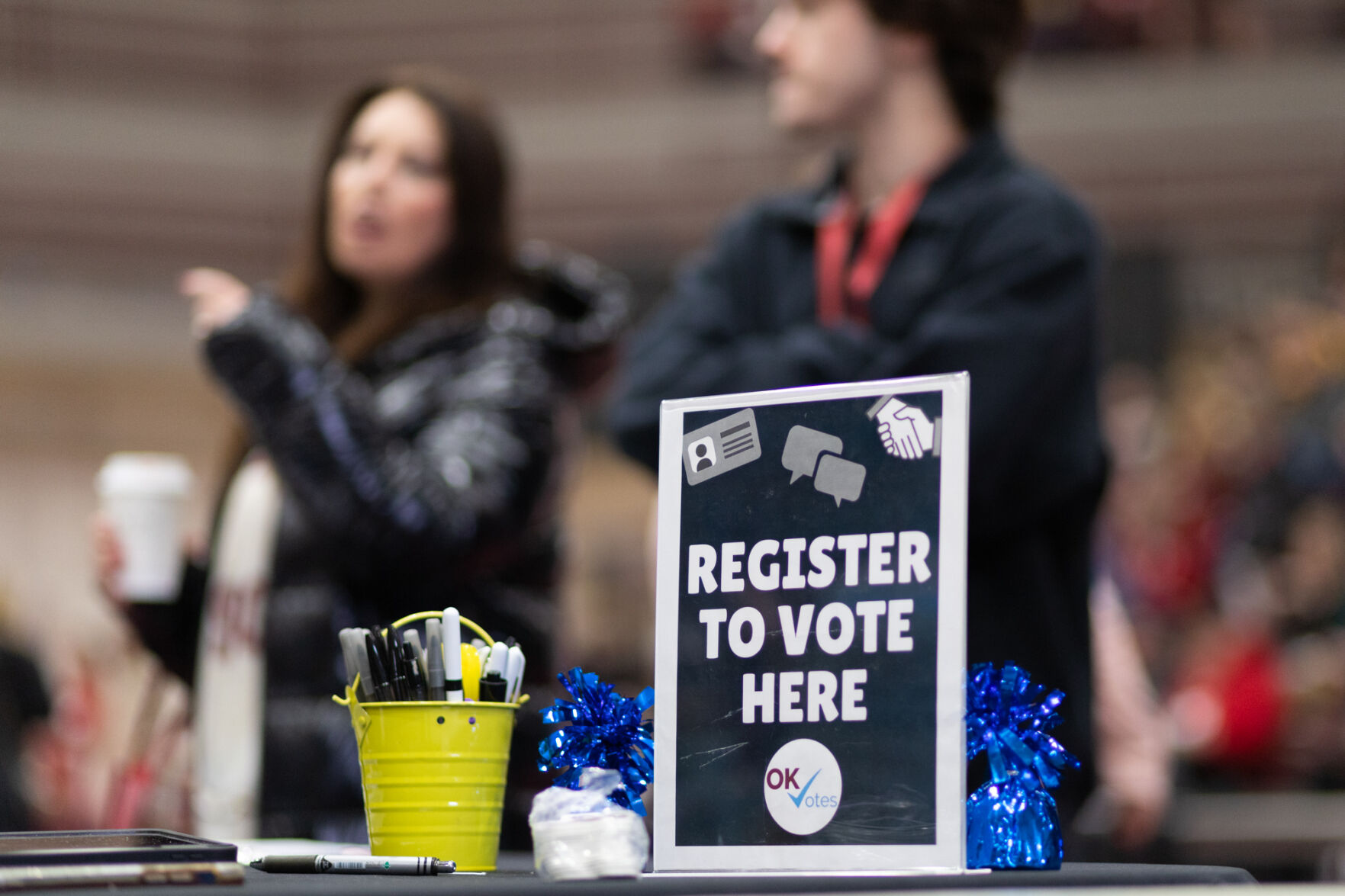
Oklahoma Votes sign during OU's Admitted Student Day on March 24, 2023.
Voter engagement
Crespin advised young voters not to disregard the voting process even if they view both candidates as unfit for the job. Instead, he said, look at what else may be on the ballot for the election, such as seats in Congress.
“You can pick and choose what you want to vote (for),” Crespin. “The presidential ballot, we say, is at the top of the ticket because it's literally the first thing on there, it's at the top, and, like, everything else just follows.”
McPherson was adamant about voting and paying attention to political positions other than the president. They said when it comes to Biden's failures, such as student loan forgiveness and protections against bodily autonomy, Biden’s attempts at upholding campaign promises were thwarted by Congress and a conservative majority in the Supreme Court.
“We are focusing so much on what the presidential election looks like that we're not looking enough into who is running for Congress, who are these people that are trying to become our representatives, become our senators,” McPherson said.
Crespin said it's common that people will vote for the president and ignore everything else on the ballot. Other elections, such as midterms and local positions, are also often ignored.
Hassany explained that for many young voters with foreign families and backgrounds, local politics is not something they pay attention to, but when it comes time to decide a new president, eyes are drawn because presidents have the power to affect their families that may reside across borders.
Elections are drawing closer as the political divide among parties increases and young voters and minorities grow more hesitant to participate in a system they believe does not work in their best interest. All the while, efforts to promote civic engagement have hinged on the idea that the lesser of two evils is one's only choice when it comes to voting.
“The number one thing we have to do is fix this depoliticization issue we've been talking about, and that is not something individuals do. That is something that is a product of larger societal trends,” Hassany said.
OU Daily's spring magazine:



This story was edited by Peggy Dodd, Anusha Fathepure and Karoline Leonard. Ryan Little, Avery Avery, Mary Ann Livingood and Nikkie Aisha copy edited this story.


