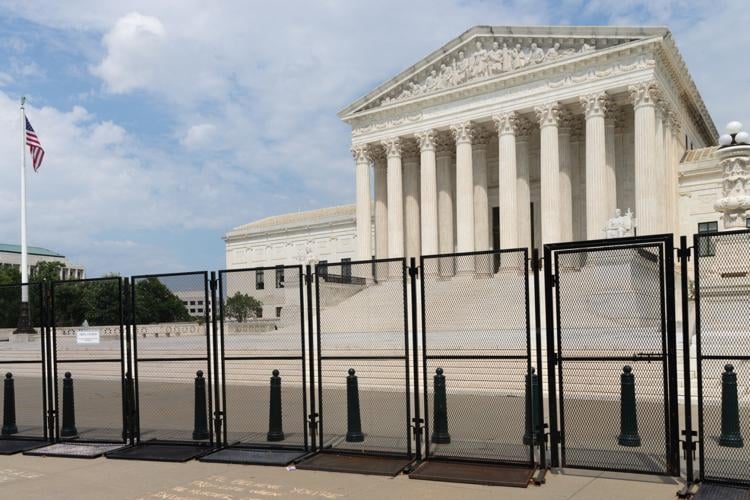
The U.S. Supreme Court struck down affirmative action on Thursday, forbidding the consideration of race in college admissions in a decision that in part cited OU.
Affirmative action was intended for universities to factor race into admissions decisions.
The case centered on the admissions programs at Harvard and the University of North Carolina. In 2015, 109 of 577 public four-year universities reported the consideration of race in their admissions, according to Ballotpedia.
The ruling will affect universities nationwide. The court voted 6 to 3, with liberal members dissenting. Judge Ketanji Brown Jackson recused herself from the Harvard case as she served on the university’s board of overseers, but still dissented.
The decision mentions OU as it notes the court looked at McLaurin v. Oklahoma State Regents for Higher Education when making its decision.
"As the Court subsequently recognized, even racial distinctions that were argued to have no palpable effect worked to subordinate the afflicted students," the decision written by Chief Justice John Roberts Jr. reads. "By 1950, the inevitable truth of the Fourteenth Amendment had thus begun to reemerge: Separate cannot be equal."
Oklahoma previously banned affirmative action through a state question in both university admissions and public employment in 2012, one of eight states in the nation. According to Ballotpedia, none of the state’s 13 public universities reported race as a consideration for admission.
"The University of Oklahoma is aware of the recent Supreme Court decision and remains committed to serving all students from Oklahoma, the region and the world," the University said in a statement to OU Daily. "OU does not include race as a factor for admission into the university. The university considers four parts to a student’s application: academic rigor and performance, engagement, an essay and letters of recommendation.
"The University of Oklahoma will continue to use the Lead On strategic plan as the guide for today and in the future. ... The core message behind our strategic plan is 'We Change Lives.' At OU, we increase access for everyone by dismantling obstacles that impede success."
George McLaurin was the first Black student at OU. When he first applied earlier in 1948, he was denied based on his race. McLaurin went to court with the issue, and in a Sept. 29, 1948, verdict, he was victorious when a federal court ruled that denying him admission was unconstitutional.
The Oklahoma State Regents ordered his admission Oct. 11, 1948, but with this victory, McLaurin was still far from an integrated education — his case was still to undergo another appeal that would not grant him that victory until 1950.
While McLaurin’s exclusion from OU was deemed unconstitutional, segregation at OU was still lawful. Thus, his education at OU was separate and unequal — he learned in a closet looking out over the room where his white classmates sat; he dined at separate tables at separate times; he used a different table in the library to study.

George McLaurin sits segregated from white students in 1948 classroom at OU.
In concurring opinions, Justices Clarence Thomas, Neil Gorsuch and Brett Kavanaugh also cited OU and McLaurin.
“Parties consistently attempted to convince the Court that the time was not right to disrupt segregationist systems. See Brief for Appellees in McLaurin v. Oklahoma State Regents for Higher Ed., O.T. 1949, No.34, p.12 (claiming that a holding rejecting separate but equal would necessarily result … [i]n the abandoning of many of the state's existing educational establishments and the crowding of other such establishments),” Thomas wrote. “We cannot now blink reality to pretend, as the dissents urge, that affirmative action should be legally permissible merely because the experts assure us that it is ‘good’ for black students.”
In her dissenting opinion, Justice Sonia Sotomayor cited Amici Curiae 4,9, 11-13 which states, “freshmen enrollees from underrepresented minority groups dropped precipitously,” in California public universities after the state amended its constitution to prohibit race-conscious college admissions in 1996.
Sotomayor also cited Amicus Curiae 21–24, which noted similar trends at the University of Michigan from 2006, the last admissions cycle before Michigan’s ban on race-conscious admissions took effect.
“Id., at 24–25, explaining the university's experience is largely consistent with other schools that do not consider race as a factor in admissions,’’' Sotomayor wrote. “Including, for example, the University of Oklahoma’s most prestigious campus.”
Prior to the court's decision, OU professor emeritus and civil rights activist George Henderson said that beyond what it decides, the university must do what the court rules in terms of achieving equal opportunities.
“The University of Oklahoma’s commitment to affirmatively provide equal educational and employment opportunities to underserved students, faculty and staff is a promise made by every president and regents beginning with George Cross,” Henderson told OU Daily. “It is a morally and socially correct commitment that goes beyond what the Supreme Court decides. Therefore, it is imperative for each layer of our administration to make systemic adjustments to do that work.
“It ought to never have been given exclusively to any single unit of the university, such as DEI. If we are a family, as some administrators often say, then all members of the OU family must ultimately help create one university with equal opportunities for all persons based on their abilities, not rhetoric.”