
Editor’s note: This article quotes two sources, whose identities are known to The Daily and who have been granted anonymity for fear of imprisonment and the endangerment of their family. These sources are denoted by an asterisk and pseudonym.
The Peoples’ Friendship Arch was erected in Kyiv on Nov. 7, 1982, along the Dnieper River to commemorate the reunification of Ukraine and Russia under the USSR. Activists painted a large crack at the top of the arch four years after the annexation of Crimea in 2014, and, on April 25, 2022, efforts began to dismantle and alter the monument after two months of Russia’s invasion of Ukraine.
The OU College of International Studies worked to unify the two groups by holding a lunch for its Ukrainian and Russian students so they could get to know the college and connect with counseling, legal and financial services.
“If we needed anything, we could always go to them and … they’d try to do anything they (could). They’re eager to help, and I feel that support,” Russian student Sasha Ivanov* said.
Ivanov said she knows there is distrust toward Russian citizens because of the invasion of Ukraine, but she urges people to recognize most civilians, like herself and her parents, were caught completely off guard.
“I feel like I’m part of history right now, and it’s so not what I thought would happen with me or my family,” Ivanov said. “Sometimes, I wake up and I feel like, ‘Yeah, that's happening,’ and I’m in this (weird) stage. Other times, I wake up, look at the news and I just cannot believe it, but it’s real.”
Ivanov said her family is OK and safe, but they are just “regular people” and there is nothing they can do other than to sit and try to live through the financial ramifications of the invasion, like foreign companies pulling out of Russia.
She said the information that is coming from this conflict is virtually incomparable to other modern wars because of social media, which has only added to her feeling unbalanced, and said the constant updates are “stressful” and “bombarding” her.
“Despite the fact the (Russian) government tries to eliminate (social media sites), it’s just impossible, especially being in different countries and having access there,” Ivanov said. “It gives you more clarity to the situation as much as more disinformation in the situation (at the same time). It’s a mixed feeling.”
Russian student Peter Smirnov* said what is happening in Ukraine is “a complete atrocity” and “extremely senseless.”
“Destroying cities and killing people, it’s just unimaginable in the (first) quarter of the 21st century,” Smirnov said. “There is no sense, there is no goal, and that’s what scares me the most. It’s not just about the war itself, but (also) killing people and destroying these beautiful cities and ruining people’s lives.”
Smirnov has both Ukrainian and Russian heritage, and he said it’s not something he has ever thought about before until the invasion. He said he currently has an inner conflict making him question his place in Russian society, and is moving to associate more with his Ukrainian heritage.
“I’m kind of sad, maybe even ashamed that I need to distance myself. I have to face this process going on in my head,” Smirnov said. “When your country performs such an atrocity, and people agree with it, you hope it’s not the majority. When there is the image of, ‘It is the majority,’ you start to question who you are in this nation, in society and, of course, you want to kind of distance yourself from it.”
Smirnov said he hopes Russia’s invasion of Ukraine will lead to the downfall of the ideology the Putin regime tried to implement, which emphasized ideals such as national pride.
“The quicker the war will stop, the quicker we will be able to stop the downfall of society,” Smirnov said. “In authoritarian regimes, they need some support from society, so they will try to make society more radicalized. I hope that they won’t go that far.”
He said he remembers when it seemed like Russia would change.
Smirnov said Russia’s introduction into the western world occurred when its first McDonald’s location opened on January 31, 1990. With the fall of the U.S.S.R. just under two years later, he said something as simple as a McDonald’s gave Russians a taste of a western and global lifestyle.
But now, McDonald’s is gone, Smirnov said.
“Other goods came to the Soviet Union and, of course, people were overwhelmed with that. Then, they had positive thinking, like, ‘Everything’s changed, everything will be better.’ Now McDonald’s has gone, and that’s a symbol of how our economy, how society, how everything is flushing away,” Smirnov said. “All the companies and services that became an inalienable part of our lifestyle that are leaving Russia is just dark and symbolic irony.”
Russia has introduced increasingly stricter legislation throughout the past two months. For example, Ivanov and Smirnov could face up to 15 years in prison for criticizing Russia or saying the words “war” and “invasion” in the context of what is happening in Ukraine.
Ivanov said her anonymity is a precaution since she is still in the U.S. studying. She fears for her family’s safety.
“Probably nobody would track me and just put me in jail, but you never know, you know?” Ivanov said. “It may be (that in the U.S.), I’ll probably not be in danger, but since my family is there, it can put them in an uncomfortable situation.”
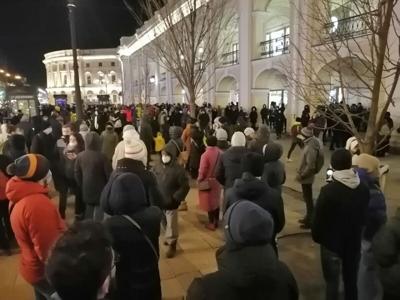
Smirnov said protesters face repercussions days and even months later, which cause many people to act — or to not act — out of self-preservation.
“Observing how eager (the police) are to hunt down people for even calling the war ‘a war.’ … They literally come down on people for that,” Smirnov said. “In such circumstances, it’s better not to say anything. It will be just a sacrifice of your life without any actual effective outcome of your actions.”
Currently, Russia is in the process of releasing a new definition of “foreign agents,” a label first introduced in 2012 and originally reserved for independent journalists, press, bloggers and activists because they received foreign funding, which is considered to be political engagement. Foreign agents are required by law to identify themselves and pay audits and steep fines.
The Freedom of the Press Caucus wrote this is an effort to “choke off discussion and investigation into corruption.”
Smirnov said this new definition will include people with any foreign influence, which is inherently left vague so it could describe a wide range of people. He said it is a matter of when, not if, this new law will be released, and that, when this happens, anyone could be labeled as a foreign agent.
“I can compare this label to the term ‘the enemy of the nation’ in the Soviet Union,” Smirnov said. “In the worst days of repressions, they were labeling people and executing them (during The Great Purge) for suspicion of not accepting the communist ideology.”
Despite this, he said he doesn’t regret having his opinions about the invasion of Ukraine, but he knows it would be much more difficult if he was back in Russia.
“That’s the reality. You have to be paranoid about talking to people at home,” Smirnov said. “My parents are paranoid. Even if I express my thoughts here, just verbally among people in public, (even) that scares me.”
Smirnov said he can assess people’s attitudes, but it is still difficult to truly discern what the majority of Russian citizens are thinking because of the lack of public expression.
The last thing he said he wants to do is to throw dirt on his country, but a combination of poor education and efficient propaganda can make people believe the principles of the war
“It’s safer to express a positive attitude towards war,” Smirnov said. “You hear (positive comments) on a much bigger scale than comments about (how the war) is bad. I have people in my social circle who have expressed (the invasion was) the right thing, and that’s shocking to me.”
Both Ivanov and Smirnov said being able to express their opinions in the U.S. but still feeling the need to conceal their identity behind a pseudonym is not ideal.
Ivanov said she would be lying if she said she wasn’t happy to be in the U.S., because it’s her dream to study here, and she is content in pursuing her dreams. However, she said she can’t fully distract herself from what is happening in Ukraine and constantly reads the news or talks with her family.
Her family is constantly on her mind, she said, because they are going to have to live with the consequences of the Kremlin’s actions.
Ivanov said it’s not something she can be proud of, even though she doesn’t have that much of an influence on the situation. She said she loves her country and its people, but the fact that Russians are always perceived as aggressors bothers her.
“I have found it hard to live with at the moment because I haven’t established myself here,” Ivanov said. “I portray this good, real image of Russians, (of) people who are smart and they have a lot of good qualities, but, at the same time, what’s happening over there contradicts this image.”
Ivanov said she knows Russia-phobia is real and has been amplified because of the events in Ukraine, but she said she has been treated with nothing but kindness since she arrived in the U.S. and is grateful for the community.
“The support I have is immense, and it’s been like that since I arrived here,” Ivanov said. “I know that I can reach out to people and they will help, and that’s what matters. I have a Russian (and) Ukrainian community, and my friends and professors who are really understanding and I can always talk to people.”
Smirnov said he also has yet to experience any negative attitudes directed toward him because of his identity as a Russian international student.
“When everything started, I expected that there would be some of this stereotypical attitude like everyone is connected to the situations, but people have given me huge support — from OU as an organization to professors on their behalf, (as well as) students,” Smirnov said. “I extremely appreciate that approach and that kind of caring attitude.”
He said he is glad western media makes attempts to divide Russian citizens and society from its government by calling it ‘Putin’s War.’ Even if people are willing for change and to be a part of the global world, he said the system suppresses people.
“Don’t be mad at Russians,” Smirnov said. “Support and emphasize Ukrainians, but don’t hate Russians in general. Despite everything, I still believe the majority express a negative attitude towards the war. It takes a lot of bravery to sacrifice everything in your life to make a generalized tweet that ‘War is bad, and peace is good.’”
Smirnov said he hopes Russia’s invasion of Ukraine will end soon and there will be fewer deaths so they can rebuild relationships and friendships.
He said there is a unifying saying for Ukraine, Belarus and Russia, which he hopes people will remember as the invasion continues.
“Слава Украине, жыве Беларусь, свободу России,” Smirnov said, which roughly translates to ‘Glory for Ukraine, life for Belarus, freedom for Russia.’


