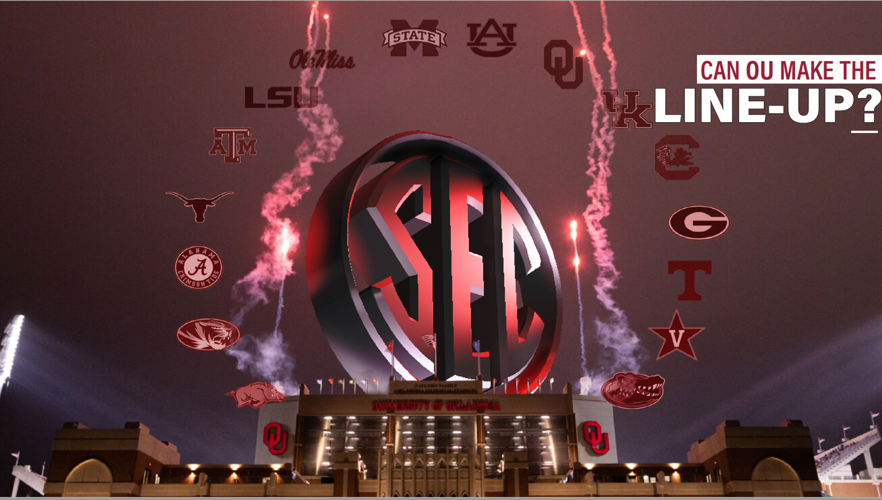


The SEC logo hovers over Gaylord Family-Oklahoma Memorial Stadium and is surrounded by the logos of SEC schools, including Texas, which will transition into the SEC with OU in 2024.
Spurred by a refreshing collaboration between the City of Norman and OU that he has not seen before during his 30 years in town, Norman Chamber of Commerce President Scott Martin accepted a mission from Sooners athletic director Joe Castiglione about a year ago.
OU’s chief athletic officer understood the effects of the university’s looming transition to the Southeastern Conference needed to be analyzed holistically. City and university leaders hope the SEC craze will bring opposing fans — and their revenue — pouring into Norman as they plan their weekend around the athletic competition of their favorite college team.
“This is way more than just what happens inside the stadium, arena (or) on the diamond,” Martin said, quoting Castiglione. “It's the impression that a fan or visitor gets when they land at Will Rogers and drive in off of North Flood, Robinson, Main, Lindsey (or) wrap around (State) Highway 9 — however they get into town and hit the university.
“It's where they stay. It's where they may go to eat, it’s where they go shop, how they move around and how easy it is for them to find things in Norman.”
Under the banner of Team Norman, a collective of community leaders dedicated to preparing for the SEC move in OU sports and the city, Martin created an SEC site visits subcommittee comprised of Norman officials, economic development specialists and marketing strategists who journeyed to three SEC schools — Arkansas, Alabama and Kentucky — during their home football weekends that coincided with Sooners road games last season.
Those schools and municipalities were selected given their similarities to OU and Norman, though comparisons made weren’t always “apples to apples.”
Arriving in SEC country on Fridays, the Normanites would meet with their contemporaries in city government, public service, commerce and marketing about development and infrastructure. They also toured those cities' versions of downtown and Norman’s Campus Corner, analyzing both historic and modern attractions. On Saturdays, they attended the universities’ football games while gathering information about hospitality, tailgating and other fan experiences.
Hoping to fit in among the SEC crowds, Martin even acquired free Razorback, Crimson Tide and Wildcat hats from Top of the World, the nation’s largest supplier of collegiate headwear, which is headquartered in Norman. Some of the caps were worn by the Team Norman committee during the visits, while some were given as thank-you gifts to their counterparts.
In an hour-long interview with OU Daily, Martin shared the compilation of his observations from the trips in an 80-slide PowerPoint presentation, while others who participated shared their findings through additional interviews and emails.
Their broad consensus is Norman and OU have much to accomplish in improving amenities and entertainment for fans, updating city infrastructure for their arrival and the continued well-being of current residents and creating cooperative branding between the city and university.
However, the quest to be comprehensively ready for, and adapting to, the SEC in the next few years makes for fascinating times.

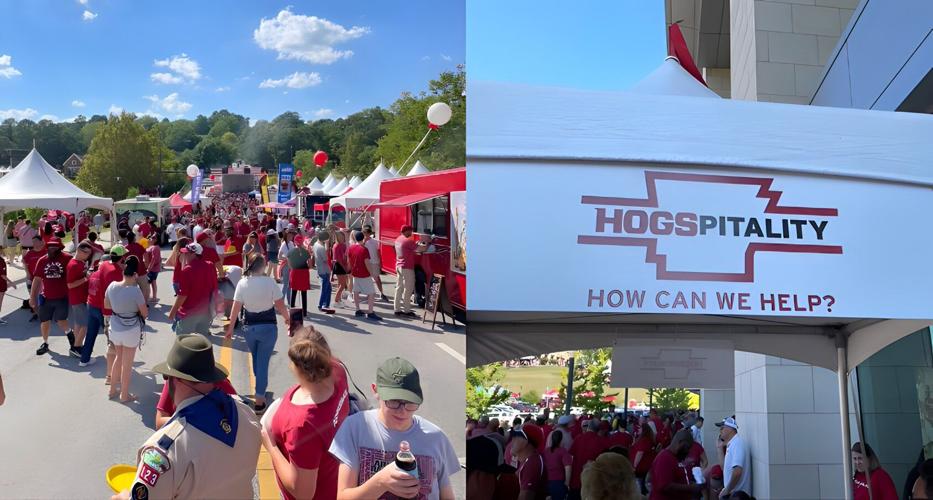
Left: Arkansas fans tailgate ahead of the game against Missouri State on Sept. 17, 2022, in Fayetteville, Arkansas. Right: A sign at the hospitality area outside Donald W. Reynolds Razorback Stadium on Sept. 17, 2022.
Sept. 16-18: Fayetteville, Arkansas
During their 240-mile car ride northeast to Arkansas’ second largest city, the contingent of Martin; Dan Schemm, Visit Norman director; and Norman City Manager Darrel Pyle witnessed beauty far surpassing the flatlands of Oklahoma as they drove through the rolling hills and Ozark Mountains.
“It's (similar) to the Tulsa area, and very green, lush and beautiful,” Martin said. “Norman, we're flat here, and that’s what it is. And the trees we have, frankly, (OU’s first president) David Ross Boyd helped contribute to, and so it just looks different.”
Schemm was enamored with the local bike trails, which have grown in popularity since the COVID-19 pandemic, and said Visit Norman and Norman Economic Development Coalition have since partnered to create a mountain bike trail plan for Lake Thunderbird, hoping to attract riders from Arkansas and Tulsa.
Upon touring Fayetteville itself on Friday, Martin particularly enjoyed the town square, which was replete with local art. The former post office, built in 1911 at the center of the square, has been refurbished into a popular local restaurant, Cheers at the Old Post Office.
The Fayetteville Chamber of Commerce also offices on the square. It includes digital fabrication and robotics labs, evoking the academic spirit of the late Sen. J. William Fulbright (D-Arkansas), who was raised in Fayetteville, becoming Arkansas’ student body president and a four-year football star for the Razorbacks from 1921-24.
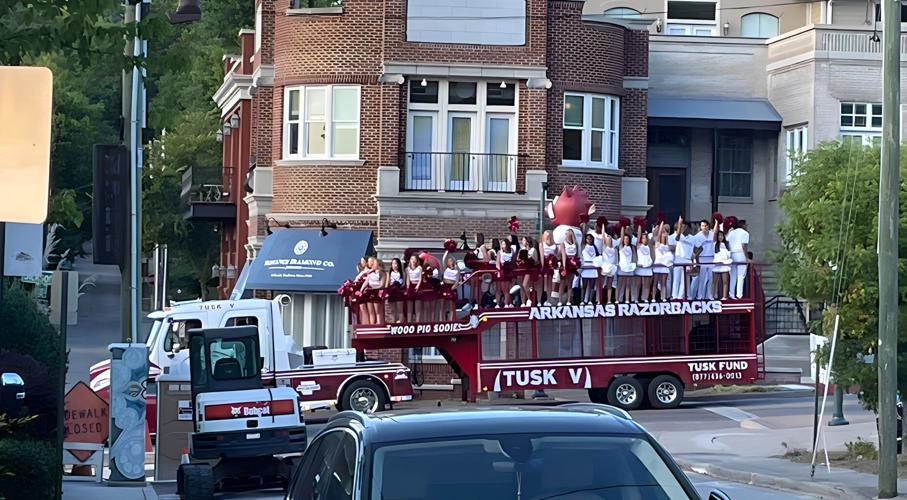
Less than half a mile north of the town square’s center lies Dickson Street, Fayetteville’s equivalent to Campus Corner, lined with unique shops and restaurants. There, the Normanite visitors witnessed a semitruck pulling an elevated deck trailer full of cheerleaders.
The caravan stopped at every block to lead fans in “Woo Pig Sooie” and other cheers. It was Parents Weekend at Arkansas, so Martin didn’t confirm if that happens on Dickson Street every week, but it was entertaining nonetheless.
“It was great, I mean, kudos to them,” Martin said. “They're getting all their alumni and students, they were all riled up, which I thought was awesome. That was kind of like, ‘Oh yeah, we need to be doing things like that.’ Because you don't see that on Friday night (in Norman).”
Hospitality was a recurring theme in Fayetteville. When the owner of the VRBO the group rented found out they were from Norman, he bought them an OU and Arkansas-themed cookie cake.
On Saturday morning, Martin, Schemm and Pyle returned to town square, where they soaked in the “primo” weather and explored the year-round Fayetteville Farmers Market. Reflecting on the massive street sale, Schemm said he thinks Norman can achieve a similarly robust farmers market now that the event has been moved from the Cleveland County Fairgrounds to The Well, a wellness center off Main Street.
Later, the trio watched Oklahoma’s 49-14 win at Nebraska on television while eating lunch at Walk On’s Restaurant and Sports Bistreaux. The Cajun-themed bar — founded near LSU’s Tiger Stadium and fronted by former New Orleans Saints quarterback Drew Brees — is reportedly coming to Norman.
Walking around campus ahead of the evening kickoff, the group marveled at “Hog Heaven,” the 500-spot RV park across the street from the Razorbacks’ baseball complex.
“What we learned is that SEC fans, they love to RV. They travel well,” Martin said. “You've probably heard or read that the ticket requirements for opposing schools in the SEC is more than the Big 12. So Arkansas, when they come to OU, the number of tickets that we have to give to them is more compared to a similar opponent in the Big 12. And they don't turn them back in.
“They show up, they travel, and even from long distances. And they were like, ‘yeah, really, for us, a lot of people roll in on Monday, and they stay the entire week in their RV,’ kind of thing. We don't have enough permanent RV spots (in Norman), so that's something we're working on.”
Martin said Riverwind Casino is being explored as potential additional RV parking for OU home games.

Arkansas cheerleaders ride down Dickson Street in Fayetteville, Arkansas on Sept. 16, 2022.
Among other sights on Arkansas’ campus, the group passed by Inn at Carnall Hall, a boutique hotel that opened as a girls dorm in 1905, was saved from demolition by community preservation support in 2001 and refurbished in 2018. It overlooks Old Main, the oldest building on campus and one of the most recognizable university symbols.
Regarding newer developments, they were impressed by Arkansas’ student-athlete success center, opened in 2015. The facility was backed by a $10.65 million gift from Dallas Cowboys owner Jerry Jones, an offensive lineman on the Razorbacks’ 1964 national championship team for which legendary OU coach Barry Switzer was an assistant, and Jones' wife, Gene, a fellow alum.
Outside Donald W. Reynolds Razorback Stadium, the Norman visitors meshed with the tailgating experience, the hub being HogTown, a pregame destination on Maple Street that boasts a live music stage. Martin liked the warm welcome of the “Hogspitality” sign posted at the help area outside the stadium.
Once inside, Martin tried to play along while sitting next to a friendly lady who was displeased by Arkansas’ struggles against FCS Missouri State, though the Razorbacks did win 38-27 before 74,133 fans. Funnily enough, Schemm sat next to a man who grew up in Norman and still lives in Oklahoma, but whose daughter attends Arkansas.
Razorback Stadium boasts more suites than Gaylord Family-Oklahoma Memorial Stadium, Martin said, and he was also impressed its student section stayed full throughout. He also noted the sizable Walmart signage in the corners of the north end zone, indicative of the university’s partnership with the Arkansas-based retail giant.
Walmart, Tyson Foods and J.B. Hunt Transport Services are all major donors for Arkansas, but their contributions are predicated on Fayetteville’s collaboration with Bentonville, Springdale, Rogers and other communities in northwest Arkansas, creating a familial regionalism that shares the wealth. In Martin’s estimation, Fayetteville has been very successful at working with its neighbors.
Perhaps the greatest difference between Fayetteville and Norman is that Fayetteville is the “big boy on the block,” whereas Norman is often perceived as the second seat to Oklahoma City. Martin emphasized this as a potential rationale for why Dickson Street was more flavorsome than Campus Corner.
But, being smaller has its advantages too. Martin believes Norman can lean into its proximity to Oklahoma City, especially early in the SEC timeline when development is still in progress.
“You've got a great airport there, and then, if and when our hotel rooms fill up, well, you don't have to travel very far for options,” Martin said. “I think for the visitor, they're not gonna know the difference. … Have you ever been to OU-Texas in the last four years? You may not have even stayed in Dallas. You may have stayed in one of the suburbs. Similar kind of environment or situation there.
“Now, … we are meeting with our hoteliers and saying, ‘OK, here's an opportunity,’ and many of them are very interested in building new facilities with additional rooms. But I've said it a while now: ‘You don't build a church for Easter and Christmas. You can't build a hotel for six or eight home football games.’ You gotta make it for year round. And so they will methodically expand, and I know we'll get more hotels in the near future.”
And, as Norman adapts to the SEC transition, a Walmart-level regional partnership could certainly be on the table.
“OU’s brand is national,” Martin said. “We shouldn’t sell ourselves short. I suspect just about any business in Oklahoma that has the capacity would like to be associated with the OU brand. … We need to lean into our regional partners to meet the demand of SEC guests.”

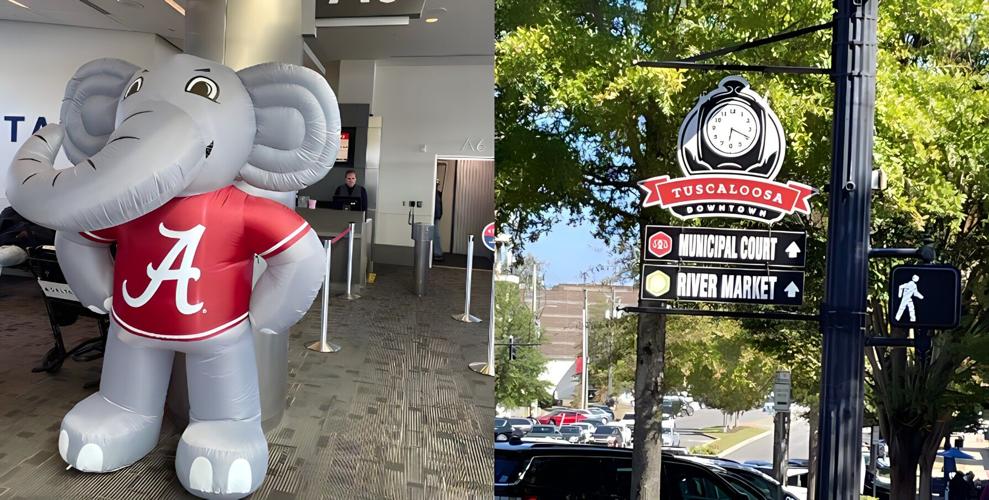
Left: An inflatable of Crimson Tide Mascot Al the Elephant at Birmingham-Shuttlesworth International Airport on Oct. 21, 2022. Right: A wayfinding sign in Tuscaloosa, Alabama.
Oct. 21-23: Tuscaloosa, Alabama
An inflatable replica of Crimson Tide mascot Big Al the Elephant greeted Normanites visiting Tuscaloosa as they stepped off their plane at Birmingham-Shuttlesworth International Airport.
Tuscaloosa has only a municipal airport, Tuscaloosa National, akin to Norman’s Max Westheimer, so many SEC fans fly into Birmingham, then make the hour drive to games. For Martin, the early takeaway from the trip was to market OU at Will Rogers World Airport in Oklahoma City as the University of Alabama is promoted in Birmingham.
“This was great,” Martin said of the blow-up mascot. “We don't do anything like this at Will Rogers, but imagine if you had a Boomer (or) Sooner and Pistol Pete right there. They’re our two reasons people come to Oklahoma.
“And I've recently met with the Oklahoma City Chamber president, and we were talking about this, and so I think they're going to connect me with the airport director and kind of say, ‘Hey, here's an opportunity and something you could do, potentially.’”
From the airport, Martin; Lawrence McKinney, Norman Economic Development Coalition president; his wife, Elizabeth; and Ward 2 Norman City Councilmember Lauren Schueler proceeded to University Boulevard. The four-lane main street runs through downtown Tuscaloosa, into The Strip — their Campus Corner counterpart — and right onto campus.
Throughout Tuscaloosa, Martin saw signage that was co-branded between the city and university, embracing crimson wherever possible to guide and inform visitors while reinforcing the Crimson Tide's gridiron dominance.
Downtown, he and company visited the Tuscaloosa Transit Authority’s major hub which definitely left an impression to aspire to. Schueler said the City of Norman will soon be converting the old Arvest Bank on the corner of Porter Avenue and Comanche Street into a new transit hub, while also creating new bus routes and building new stops.
Martin also noticed several apartment complexes in the area, believing Norman is deficient in affordable multifamily housing. The federal building and city hall — in a historic post office — were among other downtown Tuscaloosa landmarks that stood out. Attractions included the Children’s Hands On Museum, a barbershop called Crimson Cuts, owned by an Alabama student and a new visitor center.
While Norman deploys a council-manager form of government, Tuscaloosa adheres to the strong mayor form, with its mayor as a full-time employee who runs the city. Walt Maddox, 50, has been the mayor of Tuscaloosa since 2005. Word on the street is he’s jealous of the OU water tower in the engineering quad of campus that occasionally appears on TV broadcasts of Sooners football games.
In enlightening meetings with Maddox and other city officials, chamber of commerce employees and the convention and visitors bureau, the Normanites learned that, despite just 95,000 residents in Tuscaloosa to Norman’s 130,000, Tuscaloosa’s average economic benefit on a game day weekend is $30 million. Norman’s is only $11 million.
Furthermore, the prosperity in Tuscaloosa helps it employ 295 sworn police officers to Norman’s 151, according to Pyle, and the total impact is seen in its 1,400 public service employees to Norman’s 900.
“It's also fire, it's also our planning department, who's going to have to deal with the spur and growth and development as all of these applications come in,” Schueler said of the need to increase public service staffing in Norman.
“Can they handle that influx of things? What about our public works, who are thinking about road construction and moving people throughout the city while they're here? Thinking about our stormwater utility, as that comes alongside development.”
Discussions with city officials about water utility, in particular, provided great insight for Schueler. She said Norman City Council has been holding somewhat contentious conversations about water utility connection fees and the potential that developers would begin paying the city up front to increase capacity for new developments. Developers have been indicating the fees are too high, she said.
However, Tuscaloosa officials provided the perspective that, within the last five years, as major development occurred, they didn’t enforce connection fees, which they now consider a major detriment to their ability to upgrade water treatment facilities and maintain water and sewer lines.
“We saw a different perspective, I would say, in an equally conservative place that is pro-development, pro-growth and pro-business, saying that actually it was not good for the city to have no connection fees,” Schueler said. “And so it gave me good information to have that we are still standing on solid ground to make sure that we are in a position to be able to continue to upgrade our water treatment facility, our wastewater facility and things like that as this new development comes online.
“I think that's going to be a really key piece in being able to fund the continued service and make sure that we are not lacking in service and being able to provide those basic utilities for our residents.”
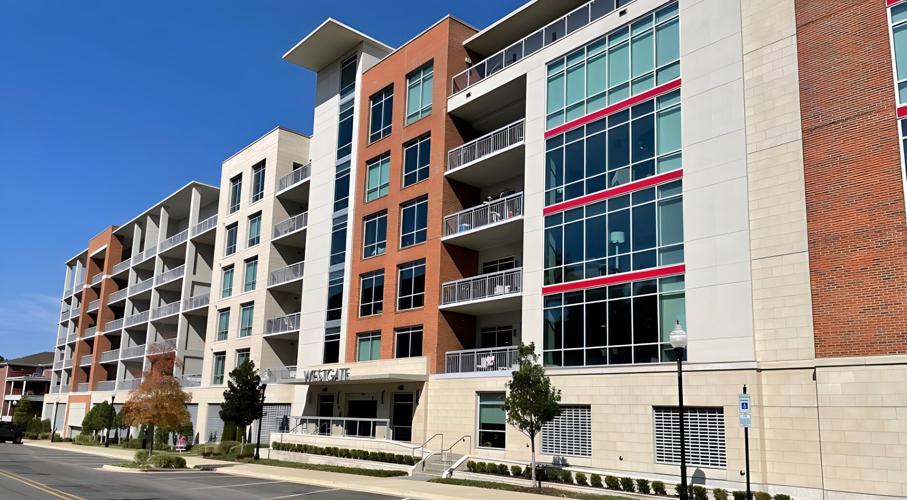
The Team Norman party proceeded to The Strip and checked out Alabama Express, a Crimson Tide apparel megastore to contend with Balfour of Norman on Campus Corner. Martin also snapped a picture of a less-than-5-year-old condominium complex near Bryant-Denny Stadium that prices its units between $1-2 million, appealing to Alabama's wealthiest fans.
Martin said Norman and OU would really benefit from a similar development at a lower price point near Oklahoma Memorial Stadium.
Tuscaloosa, Alabama
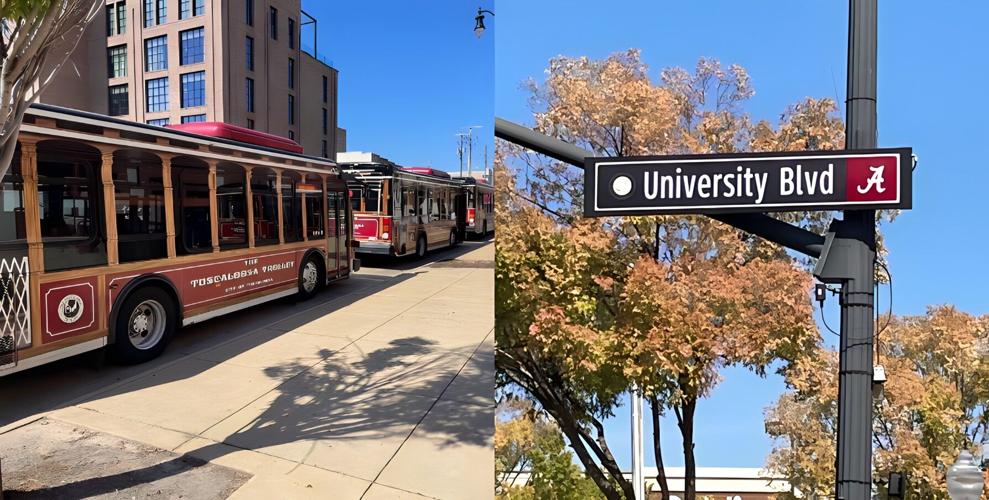
Left: The Tuscaloosa Trolley at the Tuscaloosa Transit Authority's main hub in Tuscaloosa, Alabama. Right: A sign marking University Boulevard in Tuscaloosa, Alabama.
It was homecoming week at Alabama, so the Norman delegation observed a lengthy parade. They also marveled at the sparkling residencies of a Crimson Tide Greek system that, at about 10,000 students, doubles OU’s fraternity and sorority engagement.
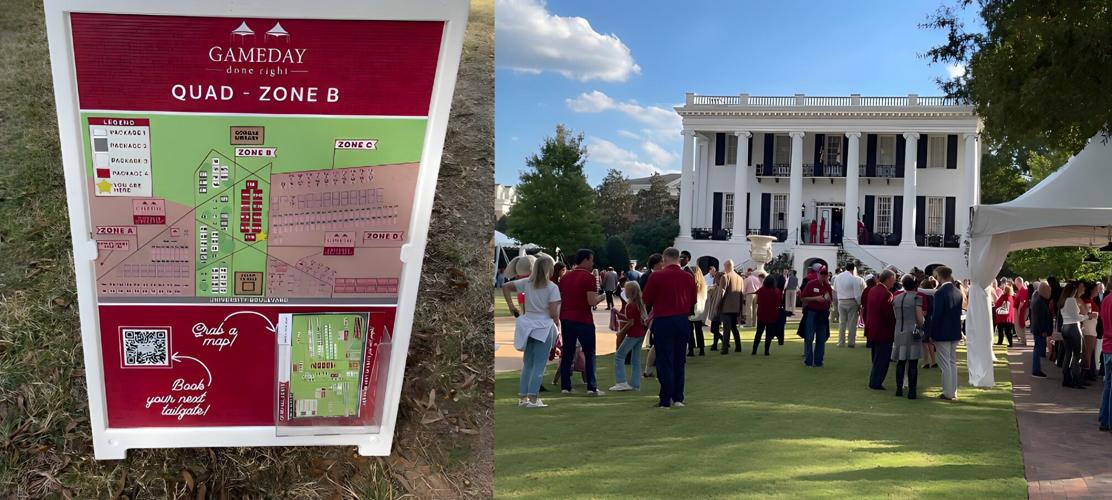
But they were most impressed by the magnitude of Alabama’s tailgating, so expansive it necessitates a map. The majority of tailgating, free and private, takes place on The Quad — 22 acres containing most of the campus’ original buildings, such as the iconic Denny Chimes bell tower.
For the paid tailgating, a contractor sets up and serves amenities, similar to what OU offers on the northeast corner of Lindsey Street and Jenkins Avenue, but Martin said Alabama’s version was closer in quality to a PGA Tour chalet.
“(It’s) so much better than OU’s because of the way they've structured it,” Lawrence said. “And everybody has a tent. I mean, everybody from the engineering department to the cheerleaders.”
Add university president Stuart Bell to that list. He hosts a tailgate outside the President’s Mansion, a Greek revival house built in 1841, saved from Union army razing during the Civil War by university first lady Louisa Frances Garland.
Martin has since joked with OU President Joseph Harroz Jr. that he’s “missing out” on hosting a party at the Boyd House, but on a more serious note, showed OU’s chief decision maker some things they could easily do to improve the tailgating experience in Norman. Harroz told Martin he's examining some of those opportunities.
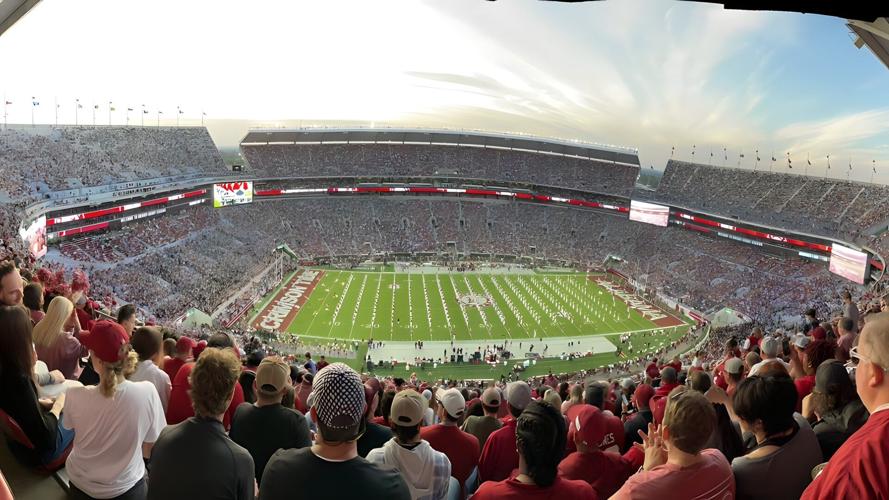
In Bryant-Denny’s north end zone plaza, the university erected statues of Wallace Wade, Frank Thomas, Bear Bryant, Gene Stallings and Nick Saban — the five coaches who have led it to national championships.
Martin said the Saban statue has occasionally been maligned because of strange proportions such as oversized feet. It has also been the victim of pranks by fans from LSU (more than once), Tennessee and Ohio State.
OU competes well on the greens of immortality with Heisman Park, adding its seventh statue at April’s spring game, and the four coach sculptures in its south end zone courtyard.
Chamber of Commerce president Jim Page arranged for the Team Norman quartet to watch Alabama’s Walk of Champions from a concourse in the stadium two hours before kickoff. It held its own with OU’s march of the same name. Saban and the Crimson Tide — Thunderstruck by AC/DC blaring — strolled toward the north end of the stadium past visiting recruits and their families and into the tunnel that leads to their locker room.
While the atmosphere outside the stadium wowed the Norman contingent, they walked away believing OU’s in-stadium presentation was far superior to Alabama’s.
Bryant-Denny, with over 100,000 seats, has four smaller video boards to Oklahoma’s two large screens, which made watching replays difficult, especially as the Team Norman bunch sat near the top of the stadium. Alabama had nothing that compared to the Sooners’ graphics and sounds, especially the pregame hype video that always closes with the declaration “There’s only one Oklahoma.”
In lieu of fireworks, the Sooner Schooner jaunting across Owen Field and RUF NEKS blasting their shotguns, Martin hoped he’d see the crimson LED light show Alabama debuted in 2019, but for reasons unclear, that never occurred. OU installed new LED lights capable of special presentations last season, which were very well-received.
The Crimson Tide defeated Mississippi State 30-6 in front of 100,077, even if it wasn’t the flashiest of experiences for fans.
“They've got a great band, bigger than ours, and they did some cool stuff, which was neat,” Martin said. “I mean, it was a neat experience. … I think ours is just as good, if not better. Now, we need to win more games. Maybe that's the difference.”
Lexington, Kentucky
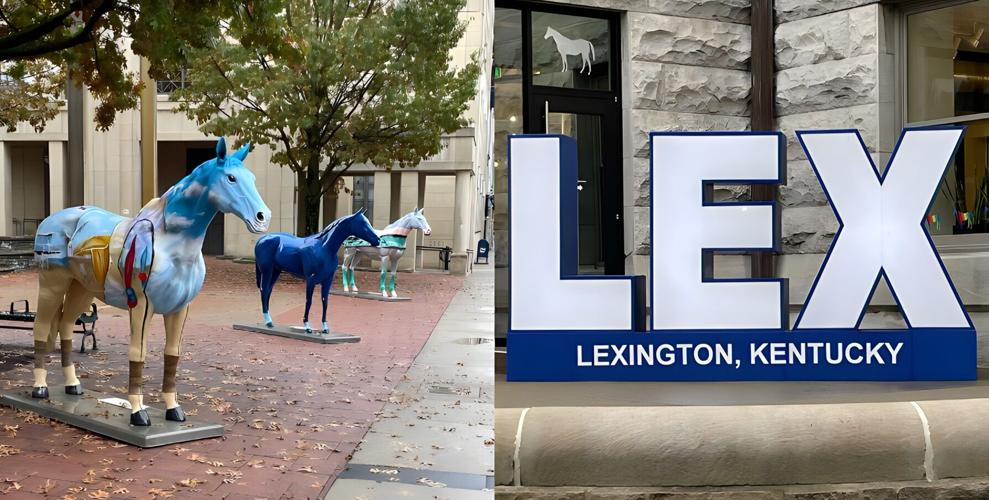
Left: Painted horses from the Lexington Arts and Crafts Society's Horse Mania in downtown Lexington, Kentucky. Right: A sign in downtown Lexington, Kentucky.
Nov. 11-12: Lexington, Kentucky
According to Martin, the top five economic drivers in Kentucky are horses — evidenced by the “beautiful bluegrass horse farms” on the way to Lexington — bourbon, Toyota, Kentucky basketball and then Kentucky football. It’s possible Kentucky basketball is more profitable than Toyota, Martin joked, but the horse and bourbon industries are definitely the leaders.
Given its 322,000 population and 285 square miles, Lexington felt more like Tulsa than Norman, Martin said, but there were still sites to see and observations to extract for Team Norman. Martin, Schemm, Pyle, Norman Ward 7 Councilmember Stephen Holman and Ward 8 Councilmember Matt Peacock staffed the trip.
The Kentucky convention visitors bureau spoke to the guests from Norman about creative ways to inform visitors before they arrive about historic sites, hoping to help amplify the history of Norman.
The public library impressed, the visitor center was inside an old building and, sampling some of the history Lexington has to offer, the group drove past the law office of former U.S. Speaker of the House Henry Clay.
“I'm really into historic preservation and old buildings and old downtowns and things like that,” Holman said. “They had a lot of great examples of restoration, and reuse of buildings and higher-density housing options in their downtown campus area.”
Holman noted Lexington is surrounded by land restricted for the development of horse racing and farms, so the city has been forced to “address growth without encouraging sprawl.” He said Lexington created some unique “urban density projects” that Norman could emulate, especially as OU prepares for potentially higher enrollment and residency with the SEC move.
The public art scene in Lexington revolves around, of course, horses. Every decade the Lexington Arts and Crafts Society produces an event called Horse Mania. Artists paint horse statues that are auctioned off for charity and displayed around downtown Lexington.
“As you're a visitor coming to a community, those art pieces are really eye-catching,” Schemm said. “And if they're tactile, and something you can go up to and take pictures with, and blog about or put on your stories and reels... we need more of that here in Norman so that they turn into kind of brand ambassadors for our communities.”
If Tuscaloosa was an introduction to the importance of town and gown co-branding, Lexington was a full-on master class.
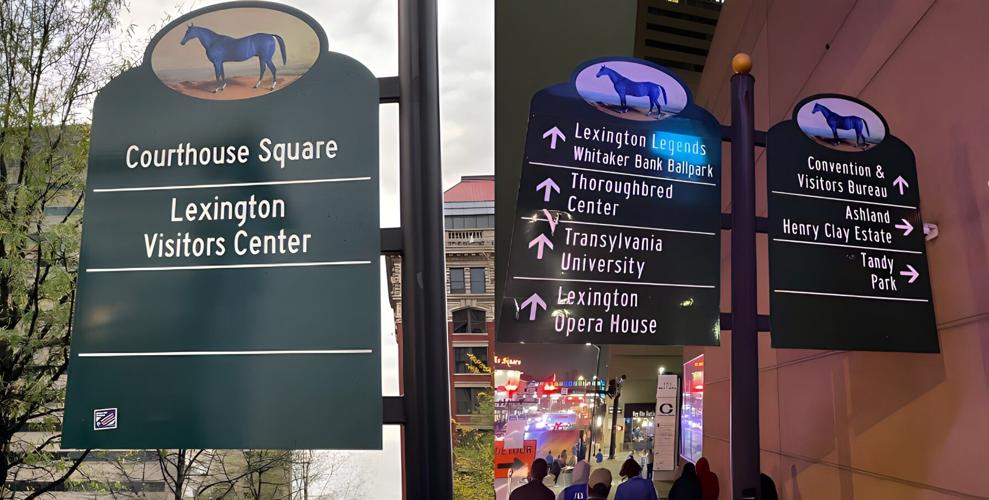
A few years ago, Lexington decided it needed a community brand. Public relations experts helped select "Big Lex" the Kentucky Blue horse, an adaptation of Edward Troye's painting of the famous race horse Lexington. Now it’s on everything, from signs and banners to pins, stickers and buttons and even the free socks the Team Norman crew received from their hosts.
“It's so simple, but perfect,” Martin said. “It marries who they are. There's no bourbon in there, but still, it marries who they are, and it's awesome.”
On Friday night, Team Norman stayed downtown to catch a Kentucky basketball game at Rupp Arena. Despite an uninspiring nonconference matchup against Duquesne, the blueblood Wildcats’ 22,000 seat arena was brimming with fans throughout the 77-52 win. Recorded attendance that evening was 20,014. Pyle said it was a game day experience that gave Oklahoma something to aspire to achieve.
LexLive, across the street from Rupp Arena, is a multistory entertainment venue housing movie theaters, an arcade, bowling alley and sports bar.
On Dec. 14, Team Norman distributed an up-to-156-question survey to Norman residents gauging interest in a potential new basketball arena and entertainment venue — similar to Lexington’s arrangement — in the University North Park district. A previous proposal for such a development failed in 2017.
The survey corresponds with a feasibility study that includes an architect examining the potential district’s interaction with existing developments in University North Park and the potential economic impact of adding a new attraction, according to Castiglione. Full analysis of the survey and feasibility study is expected to be completed by mid-June.
Kentucky basketball and football

Left: Inside Rupp Arena during the Kentucky Wildcats' game against the Duquesne Dukes on Nov. 11, 2022, in Lexington, Kentucky. Right: LexLive, an entertainment venue in downtown Lexington, Kentucky.
Schueler said the most important future conversation will revolve around the funding and operation of the facilities. She noted, while the city is helping build Norman Forward projects like the Senior Wellness Center and the Young Family Athletic Center, it is contracting out management of those venues.
She said, based on the previous proposal, she would not support using city funds and resources to build and operate a potential new basketball arena, putting the onus on OU and developers.
Before getting to that discussion, Team Norman leadership is hoping the community will first decisively indicate interest in a new home for OU basketball and other events in a more compelling place than the remote Lloyd Noble Center.
“That certainly is something we're missing with Lloyd Noble,” Schemm said of the draw of LexLive and comparable venues. “You can go to the game, but there just is not a reason to come early and spend money or stay late after the game and spend your money. You get on Highway 9 and then head home in whichever direction you're going. Granted, it's 20,000 people for a basketball game, which we're not going to get to, but those folks were all there early, they were spending money and they were shopping and eating and dining. And they stayed late after the game and did the same thing. And so we're not capturing those dollars of visitors coming to the games right now.
“So if something were to happen, like an entertainment district, it would be a tremendous draw, and I think enhance people's desire to come to basketball games and gymnastics and other things. Because you want to go out, and the game is part of the draw, but then what else is there to see and do and how do you get people out of their house? So you gotta have something like that, and these communities did.”
The night at Rupp Arena also lent information about city infrastructure. The Normanites met with the police department and toured their mobile command center, seeing what resources the Norman Police Department might need to handle larger and more intense fanbases.
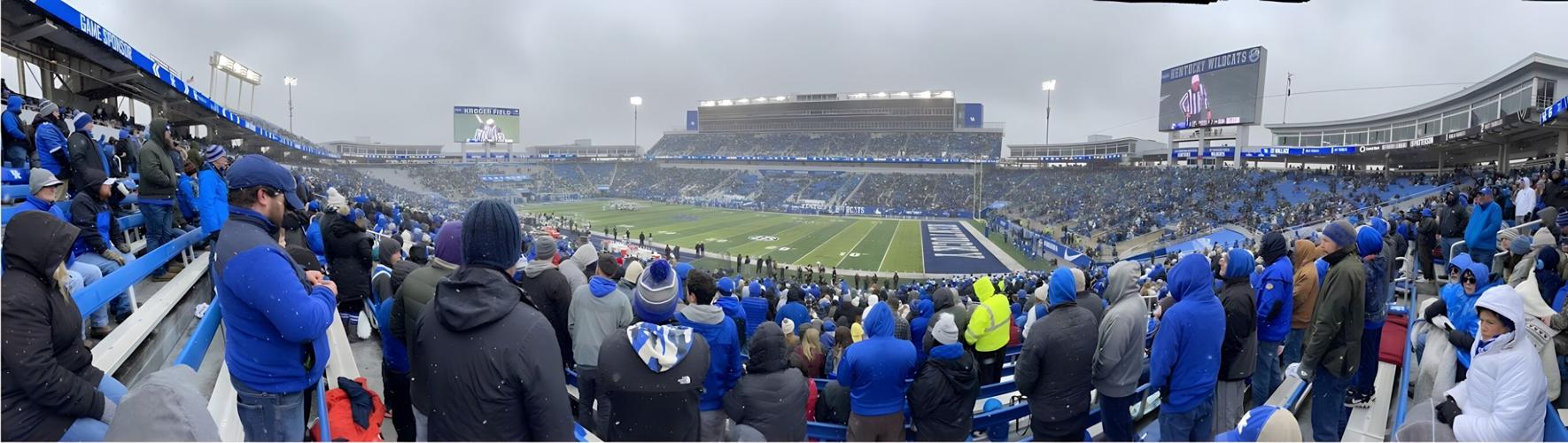
On Saturday, the Team Norman company bundled up and traversed through the snow to Kroger Field, which holds only 61,000 to Oklahoma Memorial Stadium’s 86,000.
Schemm noticed there were no metal detectors or lines entering the stadium. It never filled up that afternoon, capping at 57,474. Many left at halftime as Mark Stoops, brother of Hall of Fame former OU coach Bob Stoops, and the Wildcats were upset 24-21 by SEC bottomfeeder Vanderbilt.
A recurring observation on the site visits was that the proverbial party on an SEC game weekend starts on Thursday or Friday and carries through Sunday.
While it didn’t exactly work for Kentucky, although the Saturday weather played a part, one potential way for OU and Norman to create a similar experience is, like Kentucky, scheduling more consecutive basketball and football games.
“We see it all the time in spring sports,” Martin said. “I'm following OU athletics on social media, and right now, every weekend … they jam pack it, right? So you can be doing softball, basketball, gymnastics, track and field all on one weekend in Norman. So when you do it in the spring, we probably need to consider more of that in the fall, too.
“I don't feel like there's as many sports in the fall, so it's probably mainly just basketball and football, and that basketball game was early in (Kentucky’s) season, right? But, it then probably gives people even more purpose to be here on a Thursday or Friday, so that makes a lot of sense.”
Other ideas for maximizing game day weekends include enhancing live music and public art, commissioning OU pep rallies and improving parking.
Most intriguing, too, is the possibility of revamping Campus Corner. Schueler emphasized her hopes that redevelopment could be accomplished without damaging the historical integrity of the district. Martin said he hopes any changes would help maintain a distinctive motif.
“It's unique to Norman, to OU, and the cool thing is, it’s right across the street from the campus, but it probably needs some enhancement,” Martin said. And so there's discussions right now taking place. … ‘If you were to have a different dream for Campus Corner, what would that be?’ You don't want cookie cutter. It still has to be unique and cool. Because none of these three that we went to, they didn't look alike at all. And it's not about having a national chain. It's about a uniquely Norman restaurant, store, whatever. And so there's things there that I think we probably need to do and explore more.”

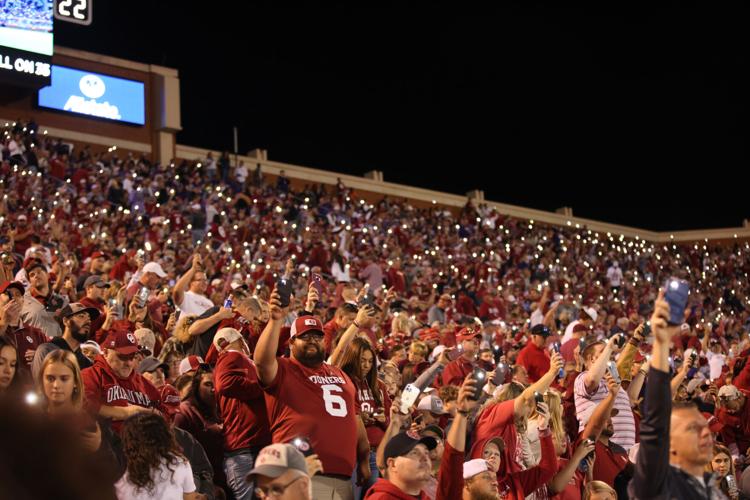
Fans light up the stadium during the homecoming game against TCU on Oct. 16, 2022.
Yesterday, today and tomorrow: Norman, Oklahoma
Castiglione suggested the site visits team also scope out Columbia, Missouri; Athens, Georgia; and Oxford, Mississippi, but Martin wasn’t able to line up visits to those municipalities that coincided with OU away games last fall. Some people who wanted to go on SEC trips also did not want to miss a Sooners home game.
More visits could happen this fall, Martin said, but “the die has somewhat been cast” now that Oklahoma and Texas have negotiated their exit from the Big 12 to 2024 versus 2025.
The focus of city and OU leadership has shifted to using the knowledge it obtained from Fayetteville, Tuscaloosa and Lexington to prepare Norman for the SEC. Team Norman and its SEC Readiness Subcommittees will play a significant role in that, as will city government, private sector leadership and developers.
In terms of infrastructure, widening Jenkins Avenue from Imhoff Road north to Lindsey Street and adding a roundabout in that stretch will help improve traffic around OU’s new softball complex, set to open in 2024. Plans are also in place to provide a new entry into downtown by extending James Garner Avenue northward to a roundabout that would connect it with Flood Avenue and Robinson Street.
Schueler added that Gray Street, currently one way, will become two-way with pending upgrades. The ultimate goal is to improve accessibility to downtown. Improving the connection between downtown and Campus Corner also holds future importance.
At Max Westheimer Airport, upgrading the terminal and lengthening and thickening the main runway is of interest, especially as OU upgrades its flight school and Norman Public Schools nurses its new flight academy from infancy to prominence.
During a recent trip to Washington, D.C., to meet with Oklahoma’s federal delegation, Martin raised the need for airport improvement to U.S. House Rep. Tom Cole (R-Okla.), who is now prioritizing federal funding for the renovations.
Such developments only serve to further the economic impact the SEC could produce. Norman likely won’t touch Alabama’s $30 million in average economic impact on a game day weekend, Martin said.
But what if it elevated from $11 million to $20 million?
“What that means to the city, to our businesses, to families that live and work here, I mean, that's significant,” Martin said. “College athletics already is big at OU, and I think it's only gonna get bigger. … We're not chump change here. We're frickin OU.”
Regarding marketing, the Norman Chamber and Visit Norman are already working with the city to improve signage along Interstate 35 and adding alternating OU and Welcome to Norman banners on Main Street from the commerce building west to 24th Street, and on Lindsey Street from Berry Road to 24th Street.
Martin and Schemm said, in the past, the community hasn't fully embraced its identity as a university town. They are hoping that will change with the collective branding that was prevalent in the SEC towns they visited.
So, is there a “Kentucky Blue horse” in OU and Norman’s future?
“There could be,” Martin said. “Why not, right? If we're all doing our own thing, then it kind of diffuses the overall impact, so we need to be thinking a little bit more unified.”
This story was edited by Jillian Taylor, Karoline Leonard and Colton Sulley. Teegan Smith and Nikkie Aisha copy edited this story


