
In January 2019, Nick Watts’ life forever changed after contracting the common flu.
Nick, 23, was an OU Law student with several debate accolades and was a former debate coach for Harvard University. He spent the last years of his life navigating college before he died of a heart attack in 2021 as a result of developing Guillain-Barré syndrome.
Usually triggered by infections like the flu, the nerve disorder causes the immune system to attack the peripheral nervous system, which includes the nerves in the limbs. It leaves people with little to no mobility in their limbs or, in the most severe cases, full-body paralysis.
Nick used a wheelchair after his diagnosis in 2019 and relied on his parents for transportation from Edmond to Norman, to get dressed and to move around. He struggled to access OU’s facilities and make it to class on time because he didn’t have accommodations that effectively suited his disability.
Nick’s mother, Bev Watts, said she wished her son’s disability was addressed more individually to better accommodate his unique needs. It’s a frustration over 130 students, faculty and staff — varying from people with and without disabilities — shared through an OU Daily accessibility survey, where they reported challenges in receiving case-by-case accommodations.
Nick kept a strict restroom schedule because Guillain-Barré syndrome made it difficult to know when he needed to go. At the time, Bev said the law school had one accessible facility on the top and bottom floors.
Bev said a major part of her son's accessibility challenges at OU was that people without visible disabilities would stay in the accessible restroom stalls for extended periods. Nick had to wheel himself in and out of the restroom and back to the elevators several times before he found an available accessible stall.
Several of Nick’s professors had no exceptions for tardiness, meaning he was often penalized for being late. He was dropped from his secured transactions course two weeks before finals because of tardiness caused by his restroom complications.
Bev, her husband and several of their lawyer colleagues wrote letters to everyone they could think of, including OU administration.
Despite the family's efforts, OU’s law school and its Accessibility and Disability Resource Center struggled to find a compromise due to the ADRC's policy on involvement in tardies and absences, which allows professors to determine procedures for their classrooms. This means the ADRC cannot intervene if students with disabilities face difficulties meeting attendance requirements if the professor doesn't accommodate them.
For students to receive disability or accessibility accommodations at OU, they must directly coordinate with their professors and the ADRC. This helps all parties set expectations and ensure students are held accountable for attendance, classwork and informing professors of relevant issues tied to their disability, according to the ADRC’s website.
Bev said her main frustrations lie with the ADRC’s policy on absences and tardies and a lack of disability awareness on campus. She said many people don’t understand how difficult life becomes for people with sudden-onset mobile disabilities.
“We didn't have years and years of dealing with disability offices and accessibility issues. It was all new to us,” Bev said. “The thing isn't set up for people that have a sudden or drastic change in a condition.”
Two years after Nick’s death, accessibility problems at OU persist as individuals with lifelong and sudden onset disabilities in the community advocate for solutions like accessible doors, closer parking and increased community awareness.
Will Kurlinkus, an associate professor in the English department, tweeted Feb. 20 that some students have difficulty accessing his classroom in Cate Center 2. The building was remodeled roughly six years ago to include accessibility buttons, but Kurlinkus wrote in an email to OU Daily that the layout isn’t functional.
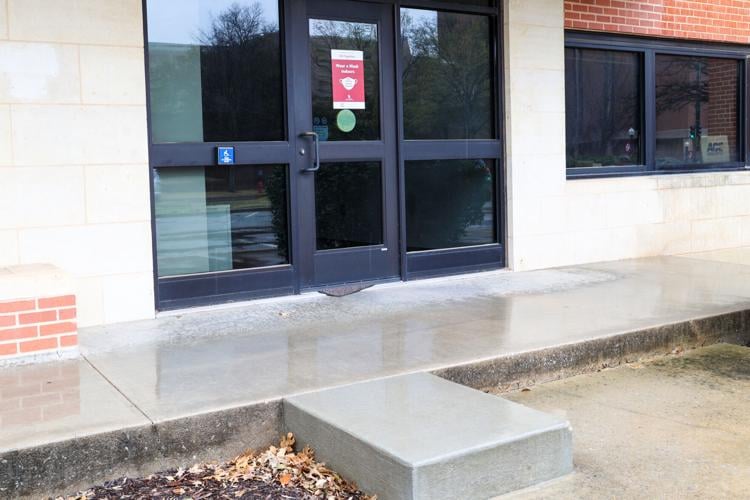
Kurlinkus wrote there aren’t ramps leading to some accessibility buttons, meaning some students and faculty can’t open the doors. He had to give his personal phone number to students so they could enter the building.
According to the Americans with Disabilities Act, accessible building ramps must be at least 36 inches wide, with a 1-to-12 ratio slope. Ramps also must be no longer than 30 feet long without adding a rest landing.

Cate Center Two has accessibility buttons at the doors, but these buttons are not easily accessible by ramp.
In 2020, the OU Student Government Association compiled a list of ADA requirements that OU’s Norman campus buildings didn’t meet. The document was later sent to administration.
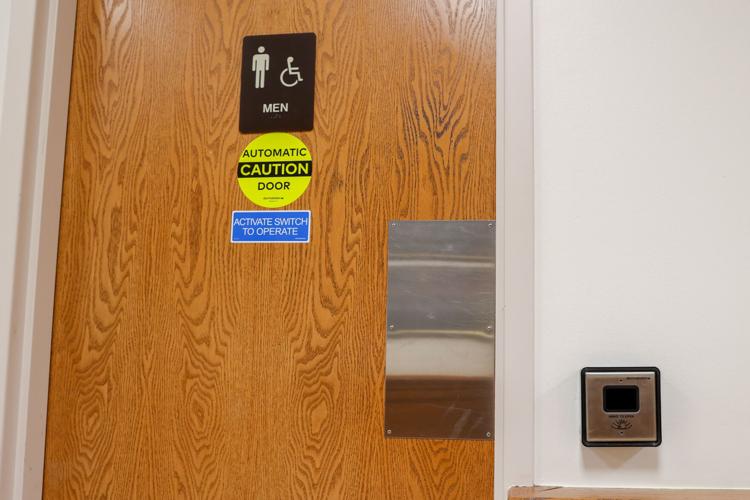
SGA split each building into two categories: structural issues and mechanical issues. It encouraged the university to reconstruct buildings with structural issues and detected areas that needed maintenance on buildings with mechanical issues. This would include updates to handicap buttons and automatic doors.
SGA found that George Lynn Cross, Dale, Copeland and Collins halls all lack handicap-accessible stalls on their basements and second and third floors.
Despite SGA’s encouragement of campus-wide improvements, students and faculty still feel the issue of a lack of accessibility is persistent on campus.
Some respondents to OU Daily’s survey included people without disabilities who observed how difficult it is for people with disabilities to use things like ramps and elevators at OU. Others responded with personal struggles surrounding invisible disabilities.
Invisible disabilities are physical, mental or neurological conditions not outwardly visible, according to the Invisible Disabilities Association. They can include mental health issues, learning disabilities, chronic pain or hearing impairments.
These disabilities can be equally debilitating, but some doubt their validity because they aren’t easily seen, according to the group.
OU offers various resources for invisible disabilities upon application, such as extended testing times, interpreter access and note-taking assistance, according to the ADRC’s site.
Up to 26 percent of adults in the U.S. have a disability, according to the CDC. This includes people with invisible disabilities: 10.9 percent report a cognitive disability, 6.4 percent can’t run errands alone, 5.7 percent have hearing impairments, 4.9 percent are visually impaired and 3 percent have trouble dressing or bathing themselves.
Lex Sharperson, a drama, dramatics and theatre arts freshman, wrote to OU Daily through its survey about how persistent knee pain impacts their experience at OU. They wrote their invisible disability was compounded by steep and narrow access ramps on campus that were difficult to use.
Sharperson wrote they often face challenges accessing resources at OU. They said, in most cases, OU only considers visible disabilities and, even then, the university only focuses on first-floor access in buildings.
Sharperson wrote certain campus buildings aren't maintained or designed with invisible disabilities in mind, particularly for people with sensory concerns.
“The fine arts center (proves a good example) of (this), with the sudden noises from the air conditioning machines and the lights,” Sharperson wrote.
Alyssa Di Iorio, a construction science freshman, responded similarly, writing that parking is an issue because she gets hot flashes from walking for too long. She said this has prevented her from attending classes on several occasions.
OU offers disability parking passes for those who qualify. Both the OU parking pass and the state-issued disability parking permit must be visible to avoid receiving a violation, according to OU Parking Services.
Aloe Marshall, a sophomore, wrote in the survey that his professors and the university seldom offer opportunities for students to take mental health days.
“Accommodations for mental health in classes should be more focused on, as mental health is a struggle that many people experience on campus,” Marshall wrote.
OU professors are required to list resources for mental health services in their syllabuses. They aren’t required to make accommodations for mental health unless the student, professor and ADRC have discussed arrangements, according to ADRC’s site.
OU and other Big 12 universities, like the University of Kansas and Oklahoma State University, offer accommodations like assistive technology and interpreter access for students registered with their disability resource centers.
Assistive technologies at KU include free student access to typing assistance, text-to-speech programs and writing aids. They also offer resources for mobile disabilities that help students with transportation to and from campus and extensive classroom and housing accommodations.
At OSU, students can access similar resources like assistive technology, accessible transportation, interpreter access and a form to file grievances.
For KU and OSU, website links to resources and applications are available. OU’s ADRC reports having similar resources for learning disabilities, but the website does not feature links. It also accepts accommodation complaints through OU’s Institutional Equity Office.
According to its site, students must first register with the ADRC with official documentation to receive accommodation access. Then the ADRC will work with applicants to “identify appropriate accommodations through an interactive conversation.”
Sharperson wrote that working with the ADRC can be too complicated, and its resources need to be streamlined and explained.
In February, OU’s Division of Diversity, Equity and Inclusion, which houses the ADRC, told OU Daily the university follows ADA guidelines completely.
Several students, parents and faculty said they believe being ADA-compliant isn’t enough when it comes to accommodating people with disabilities.
For Nick, the need for accommodations happened fast, and his parents realized the need for the OU ADRC to offer more resources.
Bev said the ADRC needs to consider each student on a case-by-case basis, update necessary facilities used by mobility-impaired people and educate OU students and professors on accessibility issues so they can also be more empathetic.
Bev also said the ADRC office needs to distinguish between invisible and visible disabilities to counteract policy issues. She said she understands both disabilities are valid, but an overarching policy is difficult to apply to everyone that comes through the ADRC office.
Bev wrote to OU Daily that, despite help from his family and other resources, Nick was unable to successfully navigate OU’s campus.
"We wanted him to continue with school. He wanted to continue school,” Bev said. “We did the best we could, and the (system) worked actively against us."
Summer 2023 Crimson Quarterly


This story was edited by Alexia Aston, Karoline Leonard, Jillian Taylor and Jazz Wolfe. Francisco Gutierrez and Grace Rhodes copy edited this story.


