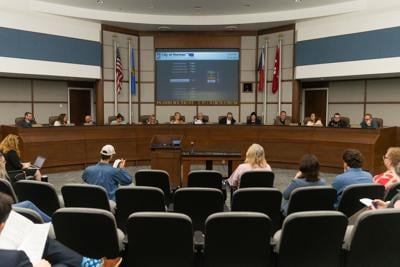

Norman City Council considered Flock Safety camera installations and continued its discussion regarding a potential water rate increase during a study session Tuesday evening.
Hector Soliman-Valdez, Flock Safety’s community affairs manager, said Flock Safety operates in over 1,400 communities and police departments nationwide.
According to Valdez, Flock Safety currently operates in a dozen departments in Oklahoma. He said within the first two months, Tulsa recovered 28 stolen vehicles and six stolen guns with assistance from Flock Safety’s cameras.
Valdez said Flock Safety cameras alert law enforcement about stolen or wanted vehicles within 20 seconds while adhering to all state laws. Valdez said Flock Safety’s technology is designed to gather evidence about vehicles and not people, claiming data would not be stored beyond 30 days for privacy.
Flock Safety’s footage can only be shared with legal services while being completely owned by the city and that all information not associated with crime is automatically deleted and unrecoverable.
Valdez said their cameras would be $2,500 per year for 13 cameras in 13 different locations in the city, including installation and maintenance software upgrades.
Ward 4 Councilmember Helen Grant said Flock Safety’s inability to provide an exact error rate on the system was an issue. Jamie Shattuck, Norman Police Department major, explained any mistakes in Flock Safety’s camera system would be a result of human error.
“We can’t use only the camera system. It only gives us the starting point to locate the correct vehicle,” Shattuck said.
Ward 5 Councilmember Rarchar Tortorello said he was skeptical of the equipment's resistance to severe weather.
Jim Fink, Flock Safety territory sales manager, explained that the company’s equipment can withstand up to 95 mile per hour winds.
Tortorello asked about the 30-day data retention policy and if the window was in control of the city. Valdez explained how the city would have to vote for an extended window, but it would increase costs.
Ward 1 Councilmember Austin Ball was concerned about the privacy aspect of the cameras and wanted to make it clear to the public what the intentions of installing Flock Safety’s cameras is.
Valdez said Flock Safety could collaborate with police to help inform the public about what their systems are doing and to emphasize that they are crime prevention tactics.
Ward 7 Councilmember Stephen Holman shared similar concerns with Ball in regards to privacy, though he believes there is value in Flock Safety’s system.
Fink offered the council a 45-to-60 day demo program with no obligation. He said Norman could remove Flock Safety if it did not yield the desired results and informed the council the company would have a price increase by April.
The council concluded decisions regarding Flock Safety are not of immediate concern, but if its opinions were to change, council would decide later and have the cameras installed by July.
The council also discussed increasing Norman's water rate. Three alternative plans were presented to the council for potential rate increases, but council members ultimately favored a fixed charge recovery plan referred to as "Alternative 2," which would increase Norman's base charge fee from $7.50 a month to $12.40.
Alternative 1 would increase the rate to $9.20 and Alternative 1A would increase it to $10.20.
Alternative 2 would increase Norman’s water rate from $24.25 per 5,000 gallons. The rate would increase to $29.00 for Alternative 1 and $29.70 for Alternative 1A. All rate options would move Norman’s water rate above Tulsa’s, which is currently at $27.93.
Per 10,000 gallons, Norman’s current water rate of $44.75 would increase to $52.20 for Alternative 2.
For non-residential property, rates would increase from $6.90 to $10.90 for Alternative 2. Per 10,000 gallons, it would increase from $44.00 to $57.80.
Councilmembers Grant and Tortorello both said they were in favor of Alternative 2 due to its “stability.”
“It has almost been nine years since the last water rate increase,” Holman said. “I would just encourage our residents to understand that we don’t ask for it unless it's absolutely needed.”
The first reading for the special election and proposed rate change ordinances will be on March 28, the second reading will be on April 11 and the water rate election will be on June 13.
This story was edited by Alexia Aston, Karoline Leonard and Jazz Wolfe. Alexandra Powell-Lorentzatos and Nikkie Aisha copy edited this story.


