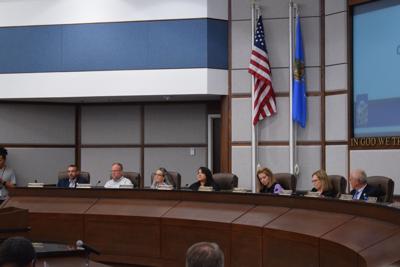

Norman City Council postponed voting on the Rock Creek Entertainment District phasing plan, and approved rezoning for North Norman Village and a contract amount reduction to pause the demolition of the Lindsey Street water tower at its regular meeting on Tuesday.
Council also heard updates to the AIM Norman land use plan at its conference meeting.
Rock Creek Entertainment District phasing plan
The news: Council postponed voting on the phasing plan for the Rock Creek Entertainment District to May 20.
The phasing plan, which is included with the agenda, outlines the development timeframe and investment amounts for the different parts of the project. Anticipated investments total over $622 million, though costs may vary by up to 15%, according to a staff report.
According to the plan, the $325 million venue is proposed to be built from Nov. 1, 2026, to Dec. 31, 2029. Additional expected infrastructure costs total over $39 million.
According to the staff report, the Rock Creek Entertainment District economic development agreement requires that a phasing plan be submitted before March 15 and considered within 30 days after it is received.
On March 7, the Cleveland County Board of Commissioners approved the economic development agreement in a special meeting. Storme Jones, Cleveland County director of communications, told OU Daily after the meeting that the board had to approve the agreement before March 15 due to phasing plan deadlines but legal obstacles would stop the agreement from advancing.
The report also notes the ordinance to create increment districts four and five is suspended due to Allison et al. v. McCoy-Post et al., the protest challenging the referendum petition. On Feb. 21, Cleveland County Judge Jeff Virgin ruled the referendum petition was insufficient, ordering it to be struck from a public ballot.
Tax increment districts four and five are planned for the University North Park area, and would allocate 100% of sales tax and 100% of ad valorem tax to $600 million in project costs and tax services for 25 years.
On March 27, the Oklahoma Supreme Court maintained jurisdiction of the case and placed it on a fast-track docket, according to the staff report. The report states the Oklahoma Supreme Court is expected to make a decision before July 1, 2026.
“If the Court reverses the district court’s ruling and an election cannot be held before July 1, 2026, the Phasing Plan will have to be amended if the electorate approves the increment districts after July 1, 2026,” the report reads.
What they’re saying: Ward 4 Councilmember Helen Grant asked what the repercussions might be for delaying the vote on the phasing plan.
City Attorney Rick Knighton said if council delays the item, the city would enter a default on the contract. He added the city would have 30 days to consider the phasing plan
“If you postpone this item until May 20 … I would anticipate you will get a notice of default contract that would give you until the 24th,” Knighton said. “So if you were to come back on the 20th and consider the matter, then that would not result in default in this contract.”
Knighton said considering the phasing plan is a separate issue than the petition case.
“I understand there is some concern about the pending issue with regard to the referendum petition. My comment on that would be that's a totally separate issue … it's not going to impact how that case gets resolved,” Knighton said.
Grant said they would approve postponement although the Oklahoma Supreme Court may not decide the case before May 20.
“I've had constituents reach out asking for us to not approve it, and that does not seem to be something that we can do,” Grant said. However, I am comfortable postponing as a body, we postponed on outstanding legal decisions, although I recognize by May 20, we still may not have a decision from the Oklahoma Supreme Court.”
Grant asked what the repercussions would be of terminating the contract. Knighton said if the city breached the contract, there would be damages, adding the city did not have the ability to unilaterally determine the contract due to multiple parties being involved.
Council opened a public hearing to discuss the postponement of the phasing plan.
Evan Dunn, Ward 4 resident and founder of uThrones, said he would like council to consider the plan and abstain from postponing the vote.
Rob Norman, attorney for Cheek and Falcone, said he believes Knighton is incorrect on the legality of considering the phasing plan. Norman represented the respondents in Allison et al. v. McCoy-Post et al.
“I would say, constitutionally and jurisdictionally, the most you can do is postpone indefinitely until the referendum process is over. That is it,” Norman said. “They're trying to undermine the referendum petition process of putting this to a vote. It's that simple.”
Stephen Ellis, OU philosophy professor, said council should wait to consider the phasing plan due to the case’s complexity.
Pamela Post, one of the residents who filed the petition referendum on the Rock Creek Entertainment District, asked council to allow residents to vote on the tax increment finance districts.
“We do not stand to benefit from our actions in this we are here to benefit the citizens of the city of Norman and their residents,” Post said. “I am asking you, as one of the people who is on the court case that you let the Supreme Court go through and validate our claim that citizens of Norman have the right to vote on this financing.”
Paul Arcaroli, another resident who filed the referendum petition, said he wants council to delay considering the phasing plan until the Oklahoma Supreme Court has decided on the petition.
“This town has been very good to me, and I am dedicated to giving back,” Arcaroli said. “This here is my dedication. This is costing a lot financially, emotionally, physically and I’m not giving up, and I expect every one of you not to give up. I hope you do the right thing anyway.”
Ward 8 Councilmember Scott Dixon asked Knighton if his job was to protect the city from legal trouble, to which Knighton affirmed. Dixon said if the city were to take Norman’s advice to postpone the vote until the petition is decided by the Oklahoma Supreme Court, it could find itself in more legal trouble than if it took Knighton’s advice.
“Mr. Norman made a wonderful presentation, but he's an activist that's representing people that don't want this project to be successful. So he's not necessarily operating in the best interest of the city of Norman and the city council,” Dixon said. “So if we take his advice, we can get in trouble, more so than if we take Mr. Knighton’s. (Mr. Knighton’s) job is to protect the city. Mr. Norman’s job is to advocate for his clients, and his clients are not us.”
The vote: Council voted to postpone considering the phasing plan 5-4.
Mayor Larry Heikkila, Ward 1 Councilmember Austin Ball, Dixon and Ward 6 Councilmember Joshua Hinkle voted against the postponement.
Ward 7 Councilmember and Mayor-elect Stephen Tyler Holman, Ward 2 Councilmember Matt Peacock, Ward 3 Councilmember Bree Montoya, Grant and Ward 5 Councilmember Michael Nash voted in favor of the postponement.
Lindsey Street water tower
The news: Council approved a final payment to G&L Tank Sandblasting and Coatings LLC for Robinson Street water tower resurfacing and a contract amount reduction to remove items to demolish the Lindsey Street water tower.
The reduction totals $312,958, reducing the contract amount from $812,200 to $499,241. The final payment for the Robinson Street water tower resurfacing totals $43,051, according to a staff report.
According to the staff report, the city is investigating if the Lindsey Street water tower can be preserved. In November, the city made sufficient progress in exploring preservation options and determined that demolition should halt for the time being, the report notes.
According to a letter from Joe Seiter, vice president of WindForce Engineering and Inspection, the final inspection, disinfection and sod repair for the Robinson Street water tower project was completed on March 18.
The vote:Council unanimously approved the final payment and contract amount reduction in the consent docket.
Public hearing for fiscal year ending 2026 budgets
The news: Council held a public hearing for the fiscal year ending 2026 operating and capital budgets.
Last Tuesday, Budget Manager Kim Coffman presented the proposed fiscal year ending 2026 budget to council during its study session meeting.
The budget book, which is available online, projects a total revenue of $316.9 million in fiscal year ending 2026. The largest shares of the projected revenue are attributed to general sales tax and user fees and charges, which are anticipated to contribute 29.8% and 22.7%, respectively.
According to the budget, nearly $102.9 million in sales tax revenue is projected for fiscal year ending 2026.
Projected expenditures for fiscal year ending 2026 total $295.2 million, which is primarily attributed to public safety at 23.7%, strategic support and criminal justice at 15.2%, water at 13.3% and capital improvements at 12.1%.
According to the budget book, the total general fund revenue is projected at $107 million for fiscal year ending 2026, being primarily attributed to sales tax at 64.7%.
Total general fund expenditures are projected at $111 million for fiscal year ending 2026.
Norman Police Department’s expenditures total $31 million or 28% of total general fund expenditures, which is the largest share of expenditures by department. The Norman Fire Department is listed as the second largest share of general fund expenditures at 19.7% or $21.9 million, and public works is listed as the third largest share of general fund expenditures at 19.3% or $21.4 million.
A presentation included in Tuesday’s agenda also includes the projected total expenditures and revenues and the projected general fund expenditures and revenues.
What they’re saying: Kim Coffman, budget manager, said the budget is comprehensive and is more than a financial plan.
“It is in essence, a comprehensive policy document, one that reflects the values, priorities and strategic vision of our city,” Coffman said. “It also functions as an operational guide that holds departments accountable and as a vital communications tool that transparently illustrates how public resources are allocated to support the community's goals.”
Rob Norman, attorney at Cheek and Falcone, emphasized the city’s use of sales tax and noted the two tax increment finance districts proposed for University North Park. He said the budget should be considered under the context of the TIFs and asked what projections look like up-to 2031 when considering the TIFs.
“I couldn't help but note the part about 65% of our revenue being reliant on sales tax, and the city being so reliant on sales tax, we have to do everything we can to protect those sources,” Norman said. “When we start losing $1.2 million per year because money is being diverted into the arena TIF … now that's what we're trying to stop, and I'm confident we will get a vote on that. But I think those projections and where we're headed in spending more money than we're bringing in need to be addressed in that context.”
Stephen Ellis, OU philosophy professor, argued the city should not discuss the budget due to Ward 1 Councilmember Austin Ball, who recently pleaded no contest to charges of embezzlement and making false statements in campaign expenditure reports.
“None of this is stuff that we should really be discussing here when there's an actual vacancy in the Ward 1 – a council member who violates their oath of office by pleading no contest to a charge of false certificate,” Ellis said.
Last week, Ellis submitted a petition to the Oklahoma Attorney General’s Office to investigate Ball.
Cynthia Rogers, OU economics professor, said the city should protect the sales tax base, citing a flat tax rate in the budget.
“We really need to be very mindful of protecting our sales tax base everywhere and I don't think we can fool ourselves into thinking that we can outperform the regional marketing,” Rogers said. “Not very optimistic, although I think it's pretty reasonable. We might need to find some more places to make some cuts or to hide, to hedge so that we don't have to dip into our reserve funds.”
North Norman Village
The news: Council approved rezoning on final reading and a preliminary plat for North Norman Village, a mixed-use community planned for the southwest corner of West Indian Hills Road and Interstate 35.
According to a staff report, the property consists of over 130 acres, and the development would include 177 single-family residential lots, 1,250 multifamily apartment units, 268,100 square feet of office space, 268,100 square feet of commercial retail space and a convenience store.
Apex Properties LLC is the applicant and Rieger Sadler Joyce LLC is the representative.
According to the Oklahoma Secretary of State website, Apex Properties was formed in 1993. In the proposed site map for the development, Apex Properties’ address is listed as 2021 S. Santa Fe Ave. in Moore.
Council approved rezoning on first reading at a special meeting last Tuesday.
The agenda also included a protest letter from Bob Stoops, former OU football head coach, and his wife, Carol, who wrote that the development would alter the character of the community where their home lies. The protest letter, which is dated March 12, was also included in council’s special meeting agenda last Tuesday.
“My family and I purchased and built our home with the intention of enjoying a rural, residential lifestyle, with single-family dwellings situated on large lots and acreages, …” the letter reads. “Specifically, I am concerned about potential declines in property values and the associated risk of increased crime rates, along with other negative social implications that may arise from such a dense and mixed-use development.”
What they’re saying: Sean Rieger, attorney with Rieger Sadler Joyce LLC, said he does not believe the planning commission had a negative comment about the project.
The vote: Council approved a preliminary plat and rezoning for North Norman Village 8-1.
Ward 5 Councilmember Michael Nash voted against the preliminary plat and the rezoning.
Contract for urban reconstruction project
The news: Council approved a $940,547 contract with Ellsworth Construction OKC, LLC for the fiscal year ending 2025 urban reconstruction project.
According to a staff report, roadways in three streets are constructed of concrete in poor condition: South Pickard Avenue from West Imhoff Road to 2719 South Pickard Avenue; Oakbrook Drive from Fairfield Drive to South Pickard Avenue; and North Base Avenue from West Main Street to Kansas Street. The report adds the project intends to remove pavement and curb, stabilize the subgrade, and place new concrete panels.
Ellsworth Construction OKC, LLC submitted the lowest bid among six others, and is lower than the engineer’s estimate of $2.3 million, according to the report.
The vote: Council unanimously approved the contract in the consent docket.
AIM Norman land use master plan
The news: Council heard a summary of the AIM Norman master plans during a conference meeting.
AIM Norman is a 25-year area and infrastructure master plan composed of seven areas: land use, water, wastewater, stormwater, housing, transportation and parks. The document provides recommendations for Norman’s future development.
Amy Haase, community and regional planning principal of RDG Planning and Design, said the project’s housing strategy focuses on policies to achieve housing mix and pricing needed in the future.
According to Haase, the plans provide context for the housing units needed to meet the AIM Norman population forecast. The forecast projects a population of 185,759 residents, including students, at a 1.5% growth rate, and a need for 23,225 additional housing units by 2045, according to Haase’s presentation.
Bret Cabbiness, senior engineering project manager at Garver, presented the transportation plan summary.
Cabbiness said the transportation plan includes an emphasis on active transportation, including sidewalks and trails that connect around the city.
“What you see here is really a new backbone, (a) major investment in active transportation that encompasses the entire city,” Cabbiness said. “Basically, if you want to get on a bike in northwest Norman, and you want to go all the way out to the lake on your bike, you're going to be able to do that with this plan.”
According to Cabbiness, the plan also includes safety for roadways, which entails adding road widenings, sidewalks, trails and protected turn lanes.
Regarding land use, Haase said the land use map includes seven character areas: core neighborhoods, classic neighborhoods, suburban neighborhoods, corridor areas, 2045 corridor areas and rural areas. Land uses also include reserve areas, which intend to “conserve existing portions of land for future urban densities.”
“The intent here is: ‘How do we preserve and protect these areas for the future?’ We don't see development occurring in these areas during the life of this plan, but that doesn't mean we don't know that they will, that that could never happen. We're not going to make that assumption,” Haase said. “Therefore, we want to look at ways that we can preserve and protect.”
The land use plan also includes protections to Lake Thunderbird, according to Haase.
Norman City Council has heard multiple presentations on the various segments of the plan, including the water and wastewater plans, housing and land use plans, and the transportation plan.
Norman City Council is expected to consider the AIM Norman comprehensive plan on June 10 and June 24. The city of Norman website features a list of upcoming public meetings pertaining to AIM Norman.
Last week, the city held a media event to discuss the project as it nears completion. According to a flier from the event, the land use plan intends to guide future land use policies to meet community needs and desires.
What they’re saying: City Manager Darrel Pyle said it is logical to include students in the population estimates.
“Even if it's not 12 months, if it's only eight months or nine months when they're here, they're using all of the infrastructure that the city has available,” Pyle said. “So it does make sense that your student population is in there, because when they're here, we're providing them all the same services as our residents.”
Council argued about the projected growth rate and housing need projections.
Ward 5 Councilmember Michael Nash questioned the use of exponential growth as opposed to linear growth. He said the projection could push unnecessary growth and create a surplus of housing.
“If we're going to be wrong, it's good to overestimate so that we're prepared without our pants down, but when we get to a certain point of being too wrong, well, now we're inviting too much,” Nash said. “We're too lenient in the language, we're too lenient in the policies, and we can't take that back.”
Mayor Larry Heikkila responded, saying it would be preferable to overestimate growth than underestimate it, citing the growth of Galveston in the 1990s.
“To actually overestimate and have more capacity than what we need is a benign problem,” Heikkila said. “It's better to have a six-inch main that's only got four inches of water in it than it is to force eight inches.”
Heikkila said the character area map protects rural areas for the next 25 years.
“This is a methodology to prevent town from bleeding into country. We want to protect that country,” Heikkila said. “That's what character area is for. It's to make sure that the city doesn't come out and get in the way of country living.”
Nash argued against Heikkila.
“It kind of looks like a way to make sure that people can't divide their parcels to 10 acres for their, say, kids … and to keep them as large, continuous parcels so that when it is opened up to lots of development, developers will have large contiguous properties to choose from,” Nash said.
Ward 4 Councilmember Helen Grant said they feel comfortable in the AIM Norman comprehensive plan. They also asked how council might review the master plan after its approval. Lora Hoggatt, planning services manager, said annual reviews will be conducted including new census data.
“Glad to hear it, so there is a pathway forward if numbers change and circumstances evolve,” Grant said.
Pyle said in the future, each of the plans will require attention individually, as opposed to requiring attention at one.
“We went all in on ‘comprehensive,’ all 2,400 pages of it … recognizing that each one of those plans will have a slightly different absorption or adherence rate by what's going on out there in the real world,” Pyle said. “We would envision that 10 years, 15 years, 20 years from now, we don't bring you back another request to do them all at the same time … we'll be able to budget for it without having to bite off a million and a half dollars worth of resource to be able to do them in smaller chunks, but ensure their consistency throughout the whole document.”
Heikkila thanked the AIM Norman planners.
This story was edited by Ismael Lele.


