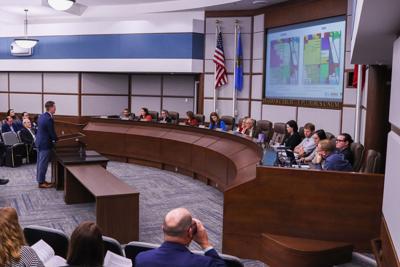

Norman City Council discussed updates regarding the AIM Norman water and wastewater master plans at its study session meeting on Tuesday.
AIM Norman water and wastewater master plan updates.
The news: Council heard updates regarding the water and wastewater master plans for the AIM Norman Master Plan.
AIM Norman, or the Norman Area and Infrastructure Master Plan, is a comprehensive, 25-year area and infrastructure master plan composed of seven areas: land use, water, wastewater, stormwater, housing, transportation and parks. The city is also updating its comprehensive transportation plan, stormwater master plan, water master plan, and wastewater master plan in coordination with AIM Norman.
According to a presentation by Cole Niblett, Oklahoma water team leader at Garver, an employee-owned engineering, planning, and environmental services firm, the water master plan is designed to bolster water supply resources and deliver safe drinking water to users.
The presentation adds the wastewater master plan involves the water collect system and water reclamation. Water is collected through gravity mains, lift stations and force mains, and reclaimed at the water reclamation facility.
Master plans are developed through four tasks, according to the presentation: baseline development, an existing system assessment, an evaluation of alternatives and plan development, which is followed by recommended approval from council.
The presentation notes performance under current average and maximum day conditions are “generally good” throughout the distribution system.
The presentation notes Lake Thunderbird supplies 69% of Norman’s water demands.
The presentation adds that an analysis identified a possible water supply gap of nine million gallons per day (MGD) by 2045. According to an overview of Norman’s water reclamation facility on the city’s website, the facility has a flow capacity of 17 million gallons per day. According to Niblett, the water reclamation facility is rated for 16 MGD and is in “relatively good” condition.
The presentation lists 14 potential water supply alternatives of differing economic viabilities. The most expensive alternatives include stormwater capture at around $300 million per MGD, Lake Thunderbird spillage at over $100 million per MGD, a new in-basin reservoir at $110 million and direct potable reuse at over $50 million, according to the presentation. The least expensive alternatives include “Oklahoma City wholesale,” Canadian River alluvium wells and new groundwater wells.
Alternatives were selected based on a monetary and non-monetary scoring system, the presentation notes.
Listed non-monetary criteria for selecting alternatives include reliability, implementability, environmental impact, drought resistance and public acceptance, among others. The presentation adds the criteria allows for project cost to not be the main driver of alternative selection.
Preferred alternatives factor in both lower costs and higher non-monetary values, which include “OKC wholesale,” new groundwater wells with disinfection only, indirect potable reuse for Norman’s water reclamation facility and new groundwater wells with treatment, according to the presentation.
Three sources of water supply considered most feasible and flexible for meeting future demands include increasing purchase volumes and beginning a second connection of finished water from Oklahoma City, creating additional wells and centralized treatment on the Garber-Wellington Aquifer, and reusing water through indirect potable reuse on Lake Thunderbird and direct potable reuse.
Niblett said data suggests the Garber-Wellington Aquifer is “resilient” and has not been impacted by the city’s groundwater wells.
“It's a proven water supply. Norman's been using that for years (and) had very good, good luck with water supply,” Niblett said.
Niblett said creating another connection with Oklahoma City would be easily implementable, yet could create less water independence as it would be directly controlled via factors outside the city.
“We have an existing connection right now, it’s almost as easy as opening a valve, so to speak,” Niblett said. “With our existing OKC connection, we could go get an additional 5 MGD of supply right now with no capital improvements … with additional capital improvements, we can get more capacity.”
Regarding wastewater, the presentation notes key areas for improving the existing water collection system include trunk mains in the core service area. “Several” localized areas have potential capacity constraints, according to the presentation. The presentation includes a recommendation to conduct sanitary sewer evaluations to identify inflow sources and necessary rehabilitation, or upsizing projects.
According to the presentation, an expansion of the city’s water reclamation facility is the most cost-effective alternative for wastewater reclamation.
The presentation lists total, 20-year capital improvement project costs for water services at $615.7 million and total, 20-year capital improvement projects costs for wastewater services at $478.8 million.
“That is not only our capital construction costs, but any ongoing operations and maintenance upkeep costs over a 20-year period brought back to a net present value,” Niblett said.
What they’re saying: Niblett said he does not expect to receive additional groundwater wells in Lake Thunderbird.
“That allocation is capped. We're not expecting to get more water rights out of Lake Thunderbird,” Niblett said. “We're running out of what has typically been, or historically been considered, the low-hanging fruit as it relates to water.”
Mayor Larry Heikkila said he appreciates the work done regarding AIM Norman’s water and wastewater master plans, adding his grandfather emphasized to him the importance of not wasting water.
“Water is still gold. We can't live without it. We have a certain amount we have to drink per day,” Heikkila said. “I appreciate you guys working on this so hard, because it's expensive, but we gotta make the right decision.


