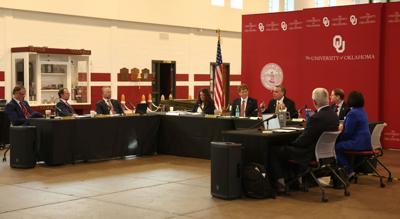
The OU Board of Regents saw the upcoming academic year calendar, approved athletics contracts and made changes to an alcohol abuse and drug use policy at its Wednesday meeting.
2027-2028 academic calendar
The university presented the 2027-2028 academic calendar to the board, which moves the start of classes a week earlier than this year.
Fall semester classes will begin on Aug. 16, 2027, and the semester will conclude on Dec. 10, 2027. Winter break will last from Dec. 10, 2027, to Jan. 18, 2028.
The spring semester will begin on Jan. 18, 2028, and the semester will conclude on May 12, 2028.
Last fall, an overlap occurred at OU when commencement was scheduled for the same weekend as the first home games of the College Football Playoffs, which OU played in. Provost André-Denis Wright told OU Daily after the meeting that the overlap played a role in the decision.
Wright added that beginning classes during the third week of August aligned OU’s calendar with other universities across the country.
“When we looked around the AAU schools and the SEC schools, they all sort of have a standard third week in August and so we’ve adopted best practices that they follow in the SEC and the AAU,” Wright said.
This was an information-only item.
Renaming the Health Campus
The board unanimously approved renaming the academic health campus the “Harold Hamm Health Campus” after Hamm made a $150 million donation to the university, the single largest gift in university history.
Of the $150 million, $100 million will be allocated to the renamed campus and $50 million will go toward research at the Harold Hamm Diabetes Center.
According to the agenda, more specifically, the donation will work to support biomedical research, strengthen faculty recruitment and retention, improve research infrastructure and expand educational opportunities for future healthcare professionals.
The agenda states the OU Naming Committee met in October and approved the recommendation to the board. The agenda states the name will remain in effect in perpetuity.
OU President Joseph Harroz Jr. said Hamm’s gift is viewed as an investment in the university and the future health of Oklahoma.
“It’s critical as our state comes to understand what an academic health system can do to lift a state; it’s not just handling the most complicated cases that are out there, but also providing care that no one else will provide,” Harroz said.
Read more:

Athletics contract changes
The OU Board of Regents unanimously approved athletics contract appointments, changes and terminations.
The board also approved the hiring of Latricia Trammel as associate head coach of OU women’s basketball. Trammel spent nearly a decade in the WNBA in various roles, including as head coach of the Dallas Wings for two seasons, according to SoonerSports.
The board reviewed contracts for the following:
• Nicholas Crowell, head men’s tennis coach. Crowell’s heading into his eleventh season as head coach and has led OU to 10 NCAA tournament berths.
• Skip Johnson, head baseball coach. Johnson, entering his tenth season, coached the Sooners to a NCAA national title in 2026.
• KJ Kindler, head women’s gymnastics coach. OU women’s gymnastics has seen eight national championships under Kindler’s leadership.
The board reviewed the termination of former OU football offensive coordinator Ben Arbuckle. Arbuckle was fired Nov. 2, just after the Sooners lost to South Carolina.
The board reviewed the resignation of Toby Baldwin, associate athletics director. Baldwin spent over 17 years at OU, serving over 13 of those as director of compliance and then several years as the executive associate director of athletics for name, image and likeness, or NIL, and operational advancement, according to his LinkedIn.
Four-year PhD goal
Board Chair Rick Nagel said the university hopes to soon finalize a goal of allowing doctoral students to complete their degrees in four years.
Wright said OU doctoral students currently take about six and a half years to finish. Doctoral students in Europe typically finish in four years and in Australia in three, he said.
Wright said the goal is partly driven by international students, who make up many of OU’s STEM doctoral programs. He said there has been discussion at the federal level of limiting international students’ stay to four years.
“If the majority of our STEM programs are made up of international students who can only come for four years and it takes six and a half years to complete a degree, the math doesn’t work,” Wright said.
The Department of Homeland Security proposed a rule in July that would set fixed terms of up to four years for international students’ visas.
Read more:

Wright said most Association of American Universities institutions require 45 to 60 credit hours for a doctorate, while OU requires 90. The change mostly affects coursework, and programs can decide how many credits go toward dissertation research, he said.
“It’s about giving students that flexibility,” Wright said.
Harroz said the university is looking at reducing doctoral programs from 90 to 60 credit hours where appropriate and hopes to bring the proposal to the board’s next meeting.
Harroz said the effort is one of three ways the university is trying to shorten time to degree “without negatively impacting academic rigor.”
The other efforts include cutting degrees that exceeded 120 credit hours down to 120 and offering 90-hour bachelor’s degrees where appropriate, he said.
Legacy Capital Financing Act
The board unanimously approved memorandums of understanding with the Oklahoma Capitol Improvement Authority to receive funding authorized by the Legacy Capital Financing Act for construction and other projects related to residence hall facilities and Price College of Business.
During its 2026 legislative session, the Oklahoma Legislature authorized the corporation to distribute $40 million in Legacy Capital Financing Act funds to OU to construct, refurbish or expand residence hall facilities and classroom buildings, according to the agenda.
The $40 million will be split equally between projects related to residence halls and Price.
The university must return the money to the Legacy Capital Financing Fund annually over a 20-year period unless the Legislature suspends or restructures the university’s repayments, the agenda states. Each annual repayment shall be equal to 1/20 of the amount distributed to the university, or $2 million a year.
University housing is about 97% occupied, and continued enrollment growth could strain capacity, Regent Kenneth Waits said during the Administration, Finance, Audit and Risk Committee report.
Consolidating vice presidents
The board unanimously approved a policy change that consolidates the positions of two vice presidents into one.
According to the agenda, the revisions would consolidate the duties previously assigned to two vice presidents for administrative affairs under a single vice president for administration and finance. The agenda states the revision reflects a change in the governance structure at the administration and finance level.
Alcohol abuse, drug use policy revisions
The board unanimously approved revisions to the regents’ Prevention of Alcohol Abuse and Drug Use On Campus and In the Workplace policy.
The proposed revision was prompted by House Bill 3127, which went into effect Nov. 1 and establishes zero-tolerance drug and alcohol standards for employees in “safety-sensitive positions,” according to the agenda.
The revision replaces the existing provision with language that expressly establishes the zero-tolerance standard, the agenda states, and clarifies that violations may result in disciplinary action, including termination.
Campus Master Plan addition
The board unanimously approved ratifying the interim approval of a contract for additional funds for the development of a comprehensive Campus Master Plan. The amount would not exceed $800,000 or a total of $1.8 million to design firm Ayers Saint Gross, according to the agenda.
The plan will guide campus development, investment and decision-making over the coming decades, the agenda states, and will assess existing facility conditions, future growth and campus experience.
OU is seeking to expand the original project in two ways: through a Housing and Development Scenarios Study and a Campus Signage & Wayfinding Study.
While discussing campus growth in an exclusive interview with OU Daily in September, OU President Joseph Harroz Jr. said the university will have the full plan in the next year.
“(We) engaged a group called Ayers Saint Gross, and they're national experts with universities of our size and larger, around ‘How do you plan out the design of, and the flow of a campus to make sure it works the way you want it?’” Harroz said in September.
Read more:


