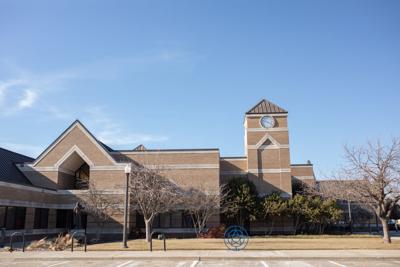

The city of Norman held a media event at city hall on Thursday to discuss the AIM Norman comprehensive plan as it nears completion.
Topics discussed included community engagement, protections for Lake Thunderbird and the future of the plan.
Tiffany Vrska, city chief communications officer, Shannon Stevenson, assistant city manager Jane Hudson, community development and planning director, Destiny Andrews, municipal planner, and Lora Hoggatt, planning services manager, were in attendance.
AIM Norman
AIM Norman is a 25-year area and infrastructure master plan composed of seven areas: land use, water, wastewater, stormwater, housing, transportation and parks. The document provides recommendations for Norman’s future development.
According to Vrska, the plan has been in development for over one-and-a-half years and is intended to be flexible.
Multiple steering subcommittees, which are composed of Norman residents from every ward, are dedicated to different segments of the plan. In March, the AIM Norman Steering Committee unanimously approved draft plans.
Norman City Council has heard multiple presentations on the various segments of the plan, including the water and wastewater plans, housing and land use plans and the transportation plan.
Norman City Council is expected to consider the AIM Norman comprehensive plan on June 10 and June 24, according to Vrska. The city of Norman website features a list of upcoming public meetings pertaining to AIM Norman.
Stevenson said while she has worked for 20 years for various cities in North Texas, she has never seen a project like AIM Norman.
“There's not one other city that I'm aware of that has ever taken on this level of planning, long-range planning, all at one time. Normally … a city would update maybe just their wastewater plan or their transportation plan, but never all of them collectively at the same time,” Stevenson said. “This really is a unique situation that Norman has chosen to take on … it's been amazing to see the results.”
According to fliers given to the media, AIM Norman consists of seven different areas of city planning with outlined goals.
The land use master plan intends to guide future land use policies to meet community needs and desires. Andrews said the plan’s character area map divides Norman into seven different sections based on priorities for looks and aesthetics, while the land use map outlines different land use types in various colors.
The transportation master plan is designed to offer diverse travel choices and prioritize investments in safety.
The housing plan is based on a projection by RDG Planning and Design, which uses U.S. census data to predict a population of 185,759 residents in Norman by 2045. According to the city’s flier, Norman will have a demand for 23,226 homes. Listed goals within the plan include rewriting zoning ordinances to achieve efficiency, adding diversity in housing options, increasing affordable housing and promoting infill for existing neighborhoods.
“A safe, comfortable, and attainable home for all is critical to Norman’s future success,” the flier reads. “Rising home prices contribute to housing challenges. The recognition of poverty and unhoused populations in Norman is growing, while limited student housing options strain existing neighborhoods.”
The wastewater plan intends to evaluate existing wastewater collection and improve collection system efficiency, according to a flier. Goals for the water plan include promoting sustainability and conservation, strengthening the water system to withstand emergencies and upgrading the water supply to meet future demand. A flier notes new groundwater wells, purchasing additional wholesale water and potable reuse are considered the most feasible options by the city to meet demands.
The stormwater plan intends to protect runoff water quality to Lake Thunderbird, prioritize community awareness of stormwater quality and flood risk, and other stormwater projects that include collaboration with all stakeholders.
Objectives of the parks, recreation and culture plan include maintaining the park system, supporting organizations that contribute to art and culture, and protecting natural resources. Additional priorities include creating a trail system master plan, protecting Lake Thunderbird and updating policies to support the parks and recreation department.
Lake Thunderbird
According to Hoggatt, protections to Lake Thunderbird weren’t dictated by the Oklahoma Turnpike Authority’s ACCESS Oklahoma turnpike plans, which intend to build two turnpikes through East Norman. Hoggatt said protections would be included regardless of ACCESS Oklahoma.
“Turnpike or no turnpike, the lake is still a top priority for protecting water and floodplain areas and all of that,” Hoggatt said. “That was probably more of a consideration in the land use decisions than if the turnpike comes around.”
Hudson said the land use plan notes planners were uncertain of the location of the OTA’s South Extension turnpike while developing AIM Norman but noted what the turnpike could entail.
“We need to at least show it and not completely ignore it … the plan would not be responsible to not show it,” Hudson said. “The committee themselves, they didn't necessarily change what they were thinking, as far as that area.”
Community engagement
According to Hudson, there have been over 24,000 visits on the AIM Norman website. City staff calculated over 100 meetings were held for the plans.
Hoggatt said over 3,000 residents responded to surveys, which covered different topics each month.
“(Residents) were heavily involved, more than I've seen in many other plans and communities,” Hoggatt said.
Hudson emphasized the project is resident-led with committees composed of residents.
“The people that we had seemed to be long-term residents, very familiar with how the community has grown over the years, and to me, that made a huge difference,” Hudson said. “They really are deeply invested in how this plan comes out and I thought that was incredible. You don't see that all the time.”
Stevenson said throughout her career, she has not seen Norman’s level of community engagement.
“The community’s level of involvement and engagement was so overwhelming and so much more than what I had ever seen or experienced in North Texas … I was just really shocked at the civic engagement of the citizens in Norman,” Stevenson said. “It's really refreshing and encouraging. It really does make it a community plan, because there was so much involvement and thought put into this.”
Future
Hudson said AIM Norman will lead to greater growth and progress in Norman.
“What we have determined here, what council will vote on, this will impact the direction that the city goes in the future,” Hudson said. “Being able to have this blueprint of the direction that we need to go will really benefit the community overall.”
According to Hudson, the city will create annual reports that track the plan’s growth.
“It's very important for us as staff and as a community to keep an eye on this and see the direction of the growth, and if we do need to make any changes as we move forward,” Hudson said.
This story was edited by Anusha Fathepure, Ana Barboza and Ismael Lele.


