
Editor's notes: This story's headline was updated at 2:16 p.m. to correct the spelling of substation.
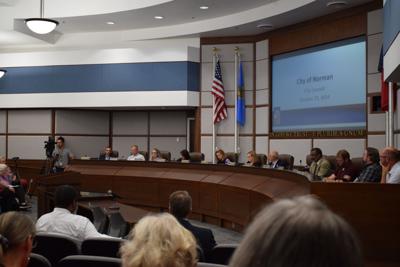
Norman City Council approved a series of tobacco-related ordinances and postponed voting on an electrical substation in Ward 5 at its regular meeting on Tuesday.
Ward 1 Councilmember Austin Ball was not present for the special or regular meetings.
Electrical substation
The news: Council postponed voting on a special use for a public facility to develop an electrical substation for Western Farmers Electric Cooperative, an electric distribution company based in Anadarko, Okla.
A staff report notes the project will be located north of Etowah Road on 72nd Avenue S.W. in Ward 5 and will measure 2.75 acres, while the property is 98.3 acres.
Fellers, Snider, Blankenship, Bailey, and Tippens, P.C. is listed as the applicant.
The staff report adds some residents have expressed concern about the substation encroaching on their properties at a pre-development meeting on Oct. 24. According to the report, the applicant was unable to answer whether the substation complied with the Federal Energy Regulatory Commission, along with questions regarding noise, drainage and obstruction, and said the 2.75 acre measurement was not finalized. The report adds the city is unaware if a second meeting occurred though it was agreed to.
Pike Off OTA protested the resolution; On Monday, a screenshot of the ordinance was posted to Pike Off OTA’s Instagram, along with an invitation to assemble at city hall for a “red light stop night.”
“Bring all your noisy neighbors,” the caption read.
According to the staff report, the Norman Planning Commission unanimously voted to decline recommending the adoption of the ordinance 0-7 on Nov. 14. On Jan. 23, Joe Krodel, a representative of the applicant, requested to postpone the ordinance to Feb. 25, according to the report.
Patrick Grace, CEO of Western Farmers Electric Cooperative, said he wanted to clear up questions the planning commission had, adding the proposed substation will not look like the cooperative’s switching substation in west Norman.
“We have a few of those, and they're scattered around, but this is your run-of-the-mill substation, but there's a couple dozen in Norman,” Grace said. “I really want to cast this mental image then try to erase the mental image of what's out west, because that 40-acre substation switching site, or transmission switching site, is not what we're talking about.”
Grace said substations can coexist near residential areas.
“It's not uncommon for substations to go near residential neighborhoods,” Grace said. “Usually, it happens the other way around, where we have a substation that's developed around.”
Krodel said the location was “carefully selected” due to monetary benefits and its location on an existing transmission line, which does not require additional lines.
“This site really does minimize the impact that a substation would have on private landowners and neighbors,” Krodel said. “We're keeping the costs down for western farmers, for OEC, but then ultimately for its members and its customers. So there's cost savings and efficiencies that are being maximized at this site.”
Krodel said the area is at capacity for electric reliability, which he said he wanted council to consider.
“This substation is really needed for this area. This location was carefully selected due to the need and due to its efficiencies that create least impact on landowners and members. This is not a giant high voltage station. This is a standard substation that are seen all around Norman,” Krodel said. “They take that in mind … the minimal impact that they can, because they live here in their community.”
What they’re saying: Ward 6 Councilmember Joshua Hinkle asked Grace if the ordinance had any connection to the Oklahoma Turnpike Authority’s ACCESS Oklahoma turnpike plans.
“(It) has nothing to do with the turnpike, other than we try to make sure we stay out of its way,” Grace said.
Multiple members of the audience chuckled in response.
Ward 7 Councilmember and Mayor-elect Stephen Tyler Holman asked Grace to explain why the planning commission declined to recommend the ordinance.
“It's not very often that the planning commission rejects something,” Holman said.
Grace said residents may have had uncertainties about whether the company proposing the ordinance was local or foreign, which he added was his reason for presenting to council.
“There was some concern that, ‘Hey, are we building something that's going to benefit other communities and not normal?’ And I don't think we really answered that question,” Grace said.
Holman asked a representative for Western Farmers Electric Cooperative if the applicants would own the property if the owner rejected its offers. The representative said attempts were made to purchase the property on which the substation is proposed.
“Although the landowners have exercised their rights under Oklahoma law to oppose this, we do not believe there's any winning grounds there at all, and they will obviously disagree,” the representative said.
Holman also asked what would happen if council rejected the ordinance. Kroddel said the applicants could return with the application in a year or appeal to the district court, but would rather receive a decision during the meeting.
Ward 5 Councilmember Michael Nash said he is uncertain about voting prior to the conclusion of condemnation and proposed postponing the vote.
Shawn Fulkerson, an attorney representing a property owner, walked to the podium and asked Heikkila if he could speak, and Heikkila responded by first motioning for Fulkerson to speak.
“I need to dispel the fact that they own the property. That's really critical,” Fulkerson said.
Krodel then told Fulkerson council was hearing his allotted presentation, calling the approach “highly unusual.” Fulkerson sat down.
Ward 4 Councilmember Helen Grant and Nash said they wanted to postpone the vote until condemnation is settled in district court.
Ward 3 Councilmember Bree Montoya motioned to allow Fulkerson to speak to council. In response, council opened a public hearing on the potential postponement of the ordinance.
Fulkerson said his client, a 91-year-old man, bought the property in 1970, which his family uses as a retreat.
“They're going to put this in his front yard,” Fulkerson said. “That's what he's going to look at every day.”
Rob Norman, an attorney at Cheek and Falcone, said the applicants can resolve the case, adding the ordinance should be postponed until it is sent back to the planning commission or until the legal process is finalized.
“We have a decision that was unanimously rejected by (the) planning commission, usually that says, ‘Hey, go get your ducks back in a row and go back to (the) planning commission,’” Norman said. “I have not known (the) planning commission to be anti-development or anti-progress or anything like that, and with all due respect, they have expertise in this area.”
Rita Jones, Ward 5, said she owns a property near the proposed substation. She said she wants council to postpone in order to analyze the planning commission’s decision to decline recommendation.
“About 10 years ago, my husband, who's now deceased, and I bought our five-acre property. We bought it for the peace and the quiet and the beauty of the land. We didn't buy it to see what they're trying to build,” Jones said. “I'm opposed to any condemnation or rezoning which will disturb this reality.”
The vote: Council voted to postpone the vote on the ordinance 6-2 until district court has made a decision regarding possession of property. Ward 6 Councilmember Joshua Hinkle and Ward 8 Councilmember Scott Dixon voted against postponement, according to City Clerk Brenda Hall. Ward 1 Councilmember Austin Ball was absent.
Animal Welfare Oversight Committee.
The news: Norman City Council voted to codify the Animal Welfare Oversight Committee, making it a permanent commission.
According to the resolution, duties of the committee will include providing recommendations and advice to the city regarding the Norman Animal Welfare Facility and issues of animal welfare, care, rescue, adoption, population control, budget priorities and volunteer recruitment.
The ordinance creates an Animal Welfare Oversight Commission, which will include seven members appointed by the mayor. Listed preference criteria for members include being a veterinarian, being involved in local animal welfare organizations or being from a rural area. Term limits for each member will be three years, and current members will be assigned staggered terms of one, two or three years by agreement or random selection, the resolution adds.
The vote: Council approved the ordinance 6-2. Ward 3 Councilmember Bree Montoya and Ward 5 Councilmember Michael Nash voted against the ordinance.
Tobacco ordinances
The news:Council approved three ordinances on final reading to amend the city code that prohibit nicotine use for anyone under 21, prohibit smoking on municipal property, and regulate the distance tobacco and e-cigarette retailers can be located from schools.
The first ordinance prohibits new tobacco and e-cigarette retailers from being located within 300 feet of schools, playgrounds or facilities primarily used by individuals under the age of 21. According to a staff report, the ordinance would not apply to retailers already located within the zoning distance, which can continue operations.
The second ordinance prohibits carrying lighted smoking instruments or smoking on all municipal property. The ordinance also removes exclusions to the definition of “public park,” including parking lots and Westwood Golf Course, a staff report notes.
Individuals convicted of violations of the policy will be fined up-to $50 for a first offense and up-to $200 for subsequent offenses, according to the amended resolution.
The final tobacco-related ordinance adds nicotine products to a list of prohibited products and includes enforcement policies.
Convictions or compliance checks related to the possession of tobacco or vapor products by residents under 21 must be reported to the Alcoholic Beverage Laws Enforcement Commission within 30 days of the convictions or checks, according to a resolution. The resolution also authorizes Norman Police Department to enlist individuals under 21 to assist in compliance checks and law enforcement.
The ordinances were presented to receive a desired level of grant funding through the Tobacco Settlement Endowment Trust, according to the staff reports. The reports add the parks and recreation department hopes to use grant funding to support Miracle Field, an ADA-compliant baseball field for youth with disabilities to participate in outdoor sports and activities.
On Feb. 11, council approved the ordinances on first reading.
According to the report, council was scheduled to discuss the ordinances at its special meeting on Feb. 18, which was canceled due to weather.
What they’re saying: Evan Dunn, Ward 4 said he would like to see tobacco restricted to anyone under 25 due to neurology.
The vote: Council unanimously voted to approve the ordinances regarding tobacco, with Ward 1 Councilmember Austin Ball absent.
AIM Norman transportation
The news: Norman City Council discussed updates to the transportation portion of the city’s AIM Norman master plan presented by Bret Cabbiness, senior engineering project manager at Garver, during its special meeting.
AIM Norman, or the Norman Area and Infrastructure Master Plan, is a comprehensive, 25-year area and infrastructure master plan composed of seven areas: land use, water, wastewater, stormwater, housing, transportation and parks. The city is also updating its comprehensive transportation plan, stormwater master plan, water master plan, and wastewater master plan in coordination with AIM Norman.
The presentation was originally scheduled for last Tuesday but was delayed due to weather.
Cabbiness said the AIM Norman transportation sought to update the 2014 comprehensive plan rather than create a new plan, adding the guiding principles of the 2014 plan were maintained, including “special place to live,” mobility, fiscal stewardship, maintain and improve existing infrastructure, and enhance economic vitality.
According to the presentation, recommendations for the Max Westheimer Airport include establishing a formal height hazard zoning standard in accordance with the Oklahoma Aeronautics Commission guidelines and the Aircraft Pilot Passenger Protection Act, supporting infrastructure improvements that concern the airport, and creating transit routes to the airport. Cabbiness said the creation of transit routes would aid students of the Oklahoma Aviation Academy.
Regarding parking, Cabbiness recommended adopting the 2018 Cleveland County/City of Norman Parking Strategic Plan as part of the AIM Norman master plan, ensuring connectivity between the Norman Transit Center, Norman Depot and the Cleveland County parking facility, and working with Cleveland County, OU, businesses and city staff to address parking requirements, enforcement and revisions.
Transit plan recommendations listed include ensuring transit needs, such as loading zones and enhanced stops, considering including transit staff in development review, conducting yearly reviews to evaluate traffic needs, and developing public engagement tools for needs and opportunities for improvement.
“As things develop around University North Park (and the) Aviation Academy, obviously some of those transit routes may change a little bit,” Cabbiness said. “Those are things from that plan that are flexible, that you'll continue to update and grow.”
Regarding bridges, Cabbiness recommended adopting the 2023 Bridge Bond Program for bridge improvements over ten years, continuing routine inspections of bridges, investing in projects that combine bridge, roadway and stormwater projects into one, and investing in maintenance projects.
James Walden, urban planning leader at Garver, said residents cited congestion and stress as issues regarding traffic.
The presentation recommends conducting future studies across the city and considering intersection updates and utilizing the regional safety action plan for safety improvements. The presentation also suggests developing policies for roundabouts, uniform signage on bike paths, Safe Routes to School and applying for grants when available.
“One of the loudest, clearest messages that we heard was, ‘We want more safe, connected, active transportation … we want areas where we're not put right next to cars,’” Walden said. “What we largely focused on was trying to create a network of greenways, which, greenways would be trails that are off and away from a street.”
On Jan. 21, council discussed the water and wastewater plans for AIM Norman.
What they’re saying: Cabbiness said he was passionate about creating the master plan.
“It's been a labor of love. I’m a 35-year resident of Norman, when I went to school here, the last thing I wanted to worry about was walking somewhere. I wanted to get on my motorcycle and go somewhere,” Cabbiness said. “Now I want to be a little more active. I want people to be safe. So, it is a great opportunity. I'm very invested in the plan.”
Ward 1 Councilmember Matt Peacock said he would like to incentivize other means of transportation to alleviate congestion through bike paths, buses and walking.
“I might be in the minority here, but I think another way to handle congestion is to put less cars on the road as well,” Peacock said. “I am most interested in seeing a comprehensive traffic ecosystem to where traffic or cars are not the only option.”
This story was edited by Ismael Lele.


