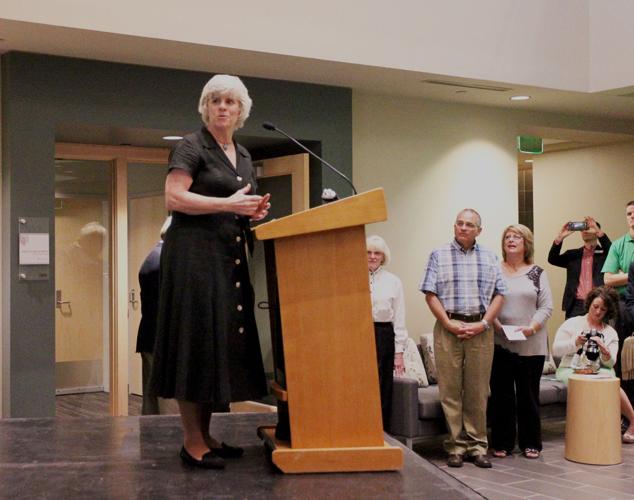

Years before Cindy Rosenthal became Norman’s second-longest serving mayor and its first female mayor elected by popular vote, she was encouraging other women to get involved in local politics.
Rosenthal helped launch Oklahoma’s iteration of N.E.W. Leadership, a program focusing on civic engagement, at the OU Carl Albert Center in 2002. Undergraduate female students in the program are connected with policy makers and community activists who lead them through panel discussions, workshops and a campaign simulation, according to the website.
Then a political science professor with ties to the OU Women's and Gender Studies department, Rosenthal considered running for public office but didn’t feel the timing was right. When former Ward 4 Councilmember David Ray vacated his seat in 2003, Rosenthal said she was ready to set an example for her students beyond the program. Her bid for the seat in 2004 was her first step into the political arena.
While campaigning, Rosenthal encountered a myriad of reactions from residents in her ward. Some expressed full-fledged support for her campaign, while others questioned the appropriateness of a woman in the position. Despite some doubts, she exited the race with 66.4 percent of the votes, though she had two opponents.
More than a decade later, Norman needed a new council member after Ward 2 Matt McGarry vacated the position. Lauren Schueler, inspired by the leadership of Rosenthal in both N.E.W. Leadership and city politics, decided to throw her name in the ring.
Entering city council in the wake of the reported sexual assault of former Ward 8 councilmember Alex Scott’s neighbor, the doxxing of Scott, and online and in-person threats against Mayor Breea Clark, Schueler said she bore in mind the negative treatment she might receive.
“I think it's definitely a calculation that all women have to make when they consider putting themselves out there in this way,” Schueler said. “It's a fact, it's a reality. It's going to happen in some kind of fashion. And I think, for me, I had to kind of sit with that and think ‘What is my answer to that? Is that going to keep me from doing it?’”
In the wake of increased political hostility, past, current and aspiring female political officials in Norman said they believe their gender can prevent them from being viewed as effective leaders and subject them to more hate. Still, they maintained that a local network of female empowerment allows for vulnerability and has helped sustain them while in office.
Cindy Rosenthal: Setting the precedent for Norman’s female politicians
After three years of representing her neighbors in Ward 4, Rosenthal decided it was time to think bigger after former Norman Mayor Harold Haralson decided to not seek reelection. Though she would be the only female candidate, she took another leap of faith and entered the mayoral race in 2007.
Rosenthal said she encountered some “out-and-out” sexism, but recognized campaigning meant asking people for their votes and accepting their answers instead of trying to change minds. Ultimately, Rosenthal’s efforts paid off, as she garnered 52.9 percent of the vote, according to Cleveland County Election Board results.
Despite the challenges of getting elected, Rosenthal said working with the city council consistently allowed her to find ways to break down gender-based biases by proving her skill at her job. She also quickly found herself having to make decisions that put some of her constituents on edge.
Norman residents quarreled since around 2000 over a municipal wastewater facility expansion, Rosenthal said. Many development-friendly voters supported the construction of a new treatment plant on the north side of the city, as they believed this would open up significant space for new development. Many environmentally conscious voters opposed the north plant, as they believed it would further degrade water quality in Lake Thunderbird, the city’s primary drinking water source.
Rosenthal said one of her first important decisions as mayor was collaborating with city leaders to invest in an existing south treatment plant, which she maintained was more fiscally responsible and satisfied development needs for the foreseeable future.
“What I felt was significant at that time was that, until we stopped fighting about wastewater, we weren't going to be able to focus on other quality-of-life issues or even fundamental infrastructure issues,” Rosenthal said.
She knew she’d make enemies of much of Norman’s business community, but she also felt other residents would understand that the expansion of the south plant made economic sense. Because of this, she said her decision was justified.
Nevertheless, Rosenthal soon faced the consequences of her choice. A $49.5 million library bond issue she’d championed failed by almost 300 votes in May 2008, and she said she felt it was “payback.” Norman residents had to wait more than a decade after that vote for a central library in the community.
In September 2010, the Norman City Council voted on a proclamation acknowledging October 2010 as LGBT History Month. The meeting was heavily attended by protestors who debated on the recognition and 2SLGBTQ+ rights for three hours. Zack Harrington, a young gay Norman resident who attended the meeting, witnessed many of his neighbors calling same-sex marriage an abomination and died by suicide a week later.
Rosenthal said she was proud of the council’s 7-1 decision to pass the proclamation, which was the first one in the town’s history, but the meeting was still unpleasant to sit through. In the aftermath of the vote, she said council members received negative reactions from individuals who didn’t support the proclamation and 2SLGBTQ+ allies who were upset city leaders permitted homophobic comments in the council chambers.
To cope with the backlash, Rosenthal said she turned to family, friends and her supportive community at St. Stephen’s United Methodist Church. She acknowledged there are always people with strong feelings, and local leaders have to take those seriously.
Mayors have to be legislative leaders, not executive officers, Rosenthal said. This duty meant she had to calibrate both sides of an issue on each decision she made, engaging in debate with constituents on topics ranging from city growth to the creation of a senior center.
After three terms, she said she felt she’d spent enough time in city meetings and wanted to turn her attention back to family and work at OU. Because of this, she opted out of running again.
The same divisive political environment that’s currently impacting Norman is affecting communities and public meetings nationwide, Rosenthal said. The pandemic created a different dynamic in how people communicate, Rosenthal said, and isolation made people forget their fundamental manners.
Rosenthal said local politics were becoming more partisan during her tenure, as Norman has always had engaged citizens, but the last two to three years have been “exceptional.” She hopes there’s still some chance of returning to greater civility.
Rosenthal said former President Donald Trump’s election has again polarized nonpartisan council elections, making a candidate’s first identifier their party. In Norman, an increasing number of political groups now identify themselves as supportive of either the city council or the local police department following council members’ June 2020 police budget vote.
As political affiliations divide Norman residents, Rosenthal said gender has often bonded them. Though N.E.W. Leadership speakers hail from positions across the ideological spectrum, she said they have empowering similarities with students.
Speakers often felt they weren’t taken seriously as policymakers. Rosenthal said many women reported speaking in meetings without being acknowledged, and then a male colleague would steal their idea. Many women are also judged for their appearance more than men, Rosenthal said, and messages women receive often allude more to physical and sexual violence.
“(It) didn't matter whether you came from a rural district or urban district (or were) Black or white or Native American or Republican or Democrat,” Rosenthal said. “The commonality of some of those women’s experiences really was empowering for our students to hear and (to hear) how these other women overcame some of their own hesitancy or some of the hurdles or difficulties that they encountered.”
Lauren Schueler: Investing in the next generation of civically engaged women

After Rosenthal retired in 2018 from two decades of involvement with N.E.W. Leadership, Schueler stepped up to fill the organization’s director position.
Schueler first became involved with N.E.W. Leadership when she started as a graduate student at OU in 2010 and began working directly with Rosenthal. She likes to say she’s been through the program every year since 2011 as she gets to know the students, sits through sessions and watches students in the program become politically involved. She said this experience helped her understand the landscape of women’s engagement in Oklahoma.
The selection process for the new councilmember involved questioning from a selection committee about candidates’ experiences and stances on various citywide issues, and Schueler would have to beat out nine other applicants. Though she acknowledged the odds were likely stacked against her, she knew she had a chance.
When she discovered she’d been chosen unanimously for the position by the committee on the night of her May 2021 interview with The Norman Transcript, she said she was both overwhelmed and shocked.
Schueler said her entrance in city council was a “whirlwind” and trial-by-fire period of about two months. She said she had basically no orientation by city staff, and voted on the fiscal year 2022 city budget within a month of being sworn in.
To prepare for her new duties, Schueler said she had to learn on the fly and started by reading a budget book hundreds of pages long and attending municipal meetings to get up to speed. Though she knew the council she was entering was polarizing to many, she said she was so focused on her research that she paid little attention to outside forces.
According to the Center for American Women and Politics, Oklahoma ranks 43rd in the country for female representation in office, with women making up 20.8 percent of elected officials. Despite this, five of the nine Norman city councilmembers are women — a legacy Schueler said Rosenthal left after years of supporting young women’s engagement in the community.
Schueler, who was recently elected for a full term as the Ward 2 council representative, said she has a reliable group of friends who act as a sounding board for her decisions and help her recharge physically and mentally. Serving in office also allowed her to be more vulnerable with N.E.W. Leadership participants.
The organization’s 2021 virtual program came on the tail of a “marathon” budget session, Schueler said. She remembers staying up until 3 a.m. at times to ensure she was prepared to invest in her students during their activities. She used the experience as an opportunity to be honest with them and explain the realities of being a working woman in an elected position.
“I think that they just really appreciated that vulnerability, that openness, that willingness to just kind of let my guard down and also show them that it's okay to be human, it's okay to be tired and it’s okay to not always have it together, even though you’re doing really hard stuff,” Schueler said. “And, I think that it really helps me connect in a different way.”
Schueler said several N.E.W. Leadership graduates have run for office recently, including Rep. Cyndi Munson (D-Oklahoma City) and Rep. Mauree Turner (D-Oklahoma City) in the state legislature. Organizations like Sally’s List and the Oklahoma Women’s Coalition are working to ensure women have the resources and understand the logistics of running for office, she added.
While Schueler said pipeline pieces like these have helped running for office seem more doable for women, political activists need to work to strengthen similar mechanisms for candidates from other demographics. She compared making the decision to run to standing at the edge of a cliff.
“I think most of those conversations are about managing the expectation of the fall because … we're going to jump, and we're going to fall,” Schueler said. “But, how do we right ourselves in the air? How do we make sure that we've got a plan in place that's going to make us feel confident and comfortable that, when we do hit the ground, we're going to be on our feet and not on our face?”
Women lead differently, so the political landscape must adapt to them and their strengths, like collaborating and building consensus, Schueler said. As someone who can’t operate from a space of despair, she said she’s always trying to push toward a future that’s “better and brighter.”
“We can show through our actions that this can be different, things can be done differently,” Schueler said. “And I'm not saying that different is necessarily better, but maybe it is. But if we don't know a different way, then how can we even address or see a different path?”
Lisa Meyer: 30 years in Norman turned passion and persistence in local government
Lisa Meyer, a resident in Norman for over 30 years, has been active in the local and county political landscapes. She entered local politics herself for the first time in 2020 by campaigning for Cleveland County clerk.
Though Meyer said she believed she was better fit for the position than its incumbent Tammy Belinson, she admitted she was clueless about the campaign process. She also said that, although her interactions with constituents were generally positive, she was surprised by some responses. She recalled announcing her campaign to the county commissioners and one asked if she was tired of staying at home.
Meyer had known Belinson for years, but she said their relationship deteriorated during the county clerk race. Though both candidates were registered with the Republican Party, Belinson sent voters fliers tying Meyer to Hillary Clinton and Joe Biden donors, which Meyer said was untrue. State legislators told her after the election they hadn’t seen such a dirty campaign for county clerk.
With over 25,000 votes cast in the primary, Meyer lost to Belinson by 87 votes. Though she was surprised by the close vote count, she said she felt she’d done the best she could and laid the results in God’s hands.
“Being an unknown and never running and losing by 87 votes out of 25,000? I'll hang my hat on that election anytime,” Meyer said.
About a year later, Meyer filed to run for office again, this time hoping to win Norman’s Ward 5 city council seat.
Meyer said she came across a Facebook video of then-candidate Rarchar Tortorello and several other Unite Norman leaders drinking and smoking cigars in a multimillion dollar mansion. It was ultimately clear to Meyer that Tortorello didn’t represent the average Ward 5 resident.
The Norman Fraternal Order of Police endorsed all five Unite Norman candidates, and even though Meyer was endorsed by Cleveland County Sheriff Chris Amason, she said Tortorello went door-to-door telling voters he’d received Amason’s approval.
Meyer’s family was also harassed by followers of Unite Norman and Tortorello because of her candidacy, she said. One woman, who Meyer said she’d been acquainted with previously, visited Meyer’s husband at work to threaten him.
Meyer pointed out that, of the 17 candidates in the 2021 city council race, only four were women. As a self-described “very strong, independent woman,” she said aspiring female politicians have to be independent and let voters get to know them. She also expressed frustration that many of the questions she received when she was running centered around her political party, not her qualifications.
Tortorello ultimately defeated both Meyer and incumbent Michael Nash, with Meyer earning 6.36 percent of the total vote.
Though Meyer was defeated in both races, she doesn’t believe she’s sacrificed success for the sake of running a clean campaign. She also said, if she feels again that she’s more qualified than another candidate for Cleveland County clerk, she’s open to running again.
“That's one positive about running. You get much more involved,” Meyer said. “It gets in your blood.”
Cinthya Allen: Pursuing inclusivity in city politics
Cinthya Allen’s job as the city of Norman’s chief diversity and equity officer was created in June 2020 in the midst of both a pandemic and a racial justice movement. Allen — who was hired in January 2021 — said her position has a broad description, including making sure city policies are in line with its diversity and equity commitment and allowing for accountability from public officials.
The reaction to the creation of Allen’s position has generally been positive, with significant support from community members and city department heads, she said. Allen said there were likely some who questioned the necessity of the role at first, but she believes the number of successful programs her department initiated have proven its worth. She’s also received significant support from city council, she noted.
“It's been a positive experience so far of just being able to have communication and have dialogue with our council members,” Allen said. “And I think that we've got a setting of understanding, and I think that that's a good thing.”
Allen said she strives to ensure there’s an open line of communication for women in office which allows formal and informal conversations.
Communities always benefit from having greater engagement and more informed leaders, Allen said. Everyone’s input matters in municipal government, and she added the city’s diversity and equity office aims to help encourage respect for differing opinions.
Allen said serving as a role model through diverse leadership is also important to help girls in the community understand they can make a difference. Her office is also working to make government more accessible through a website with information on city board and commission volunteer opportunities. Her goal is to make sure Norman residents feel empowered to run for a position, she said.
“Everyone in our community is part of this puzzle of an inclusive and a strong and an economically thriving community. Being able to just really extend information is key,” Allen said.
Breea Clark: Navigating political division, recall petitions and personal attacks
Breea Clark, Norman’s current mayor, said she was one of many women whose political career was encouraged by Rosenthal. Clark considered being a political staffer, but the former mayor encouraged her to aim for more. She appointed her to the Tree Board, her first city involvement, she said.
After this, she was appointed Norman PTA council president and became involved in several Norman Public Schools task forces. She also joined the Library Board and Norman Forward Sales Tax Citizens Financial Oversight Committee, but found she was still unfamiliar with her representative on city council. She said she believed this proved they weren’t connecting regularly with constituents.
Clark ran for the Ward 6 City Council seat in an effort to change Norman’s political landscape and make local government more accessible. Endorsed by Norman’s Fraternal Order of Police chapter, the Sierra Club and Professional Educators of Norman, she defeated incumbent Jerry Lang in a runoff, garnering 64.37 percent of total votes.
Three years later, Clark said rumors emerged from community members that she would launch a mayoral campaign. She hadn’t considered running until former Mayor Lynne Miller informed her she wasn’t running for reelection in late November 2018.
After discussing the possibility during a Thanksgiving dinner with her family, Clark said she felt she had enough support to seriously consider entering the race.
She said she ran a very quick, “shoestring” campaign that she felt was strong, despite running against both Ward 4 councilmember Bill Hickman and community activist Evan Dunn. She recalled hearing about one of her opponents’ volunteers telling someone while knocking doors that, because Clark has young kids, she wouldn’t have the time to devote to the position. Clark found the exchange infuriating, as she said she believes being a mom is an “asset.”
“My children keep me grounded and help me look at Norman differently, and especially through an eye of what's best for the future of our community,” Clark said.
Despite joining the race relatively late, Clark was still able to win the election outright with 51.43 percent of the total vote. She said her time on city council has been “phenomenal,” allowing her to interact with people of different socioeconomic backgrounds, races and faiths. Although she now holds a position as city leader, she hasn’t forgotten the influences that lead to her election.
“Most of, if not all, of my major leadership positions in my service to my community have come about because another strong female asked me to consider it,” Clark said. “So, I always encourage women to empower other women and ask them to run because sometimes that's all we need for a good candidate to step up is just (to) be asked.”
Clark said after the trauma the 2010 vote to make Norman’s LGBT History Month official caused for many, local leaders avoided voting on the month again for years. The council finally voted on a proclamation making the month official in 2016, when she was a new Ward 6 council member.
A long-standing council member proposed allowing public comment on the proclamation, Clark said, but she responded by suggesting they take public comment at the end of the meeting instead, given the city’s history with similar votes. The proclamation passed unanimously, coinciding with cheers from the audience.
Clark said LGBT History Month votes have passed without event every following year. After a June 2021 meeting where community members shared the harm therapy aimed at changing sexual orientation and gender identity has caused them or their loved ones, the Norman City Council voted unanimously to prohibit the practice of conversion therapy on minors.
Council meetings discussing changing the name of DeBarr Avenue, which was named in honor of a Ku Klux Klan leader, were also extremely painful, Clark said. She served as mayor during both the start of the COVID-19 pandemic and the resurgence of the Black Lives Matter movement. She said that period of time was “surreal.”
“I firmly believe that the universe, God, whatever you believe in, puts you where you need to be when you need to be there,” Clark said. “And I believe I was the right leader for that moment, and I did the best that I could. And looking back, there are no decisions that I regret, so I'll always be proud of my leadership during that difficult time.”
In May 2020, Clark filed a police report regarding comments in the “Reopen Norman” Facebook group suggesting she be hanged from the courthouse lawn for the city’s COVID-19 response. Clark said the threat highlighted the lack of civility at that period in time, which is still ongoing, in part.
“It's not a joke to me,” Clark said. “I have two kids, and the fact that you joke about taking your mother away because you don't agree with the decision I've made in city hall is ridiculous. You have to stand up for that, and I'll keep reporting it.”
After the threat, Clark said she stopped following a consistent running routine in her neighborhood for her safety. Eventually, she stopped running entirely. Depending on the comments made during city council meetings, Clark said she’ll also occasionally be walked out by a Norman Police Department sergeant-at-arms.
In June 2020, the Norman City Council voted to decrease an $865,000 proposed increase in the NPD budget and reallocate the money toward a community outreach program mirroring national debate over local police funding. A month later, Unite Norman filed recall petitions against five city leaders, including Clark, citing a difference between the priorities of council members and voters. Over 3,600 signatures on Clark’s petition were later found invalid by Norman City Clerk Brenda Hall, meaning it came up too short to force a recall election.
While Clark said no public official expects a recall attempt, she and her team tried to make the best they could of the situation. She also said, because she felt she’d done her research and made educated decisions, she was at peace with the results.
The prevalence of recall attempts across the country were a symptom of the volatile American political climate, Clark said, and hopefully there will soon be a return to civility.
Clark said practicing self-care is especially important while in office, and she’s also part of a Women Mayors' Network where she can share challenges she’s facing in confidence.
“It's difficult being a mayor … but it's very difficult being a female mayor,” Clark said.
In a moment of vulnerability, Clark said she remembers calling City Manager Darrel Pyle and informing him she was 99 percent sure she wouldn’t run for reelection. Since then, considering the experience and training she’s received, she said she’s decided to run again as a “last love letter” to Norman.
In the Feb. 8 mayoral election, Clark received 36.46 percent of total votes, and former Norman safety manager Larry Heikkila garnered 32.01 percent of votes. The two will remain on the ballot for an April 5 runoff election.
“The personal toll has been massive, and it definitely feels thankless at times,” Clark said. “But you don't run for council because it's easy, or because it's fun … or for your own convenience. … You run because you want to leave your community better than you found it.


