
Editor's Note: This article was updated at 6:40 p.m. to include several other OTA related bills.
Sen. Lisa Standridge (R-Norman) filed two bills in the Oklahoma Legislature that would modify a turnpike route scheduled for Norman and Lake Thunderbird and require notices for residents affected by turnpike expansion.
Senate Bill 493 would modify a turnpike route originally planned to begin in the vicinity of Mustang and end in Norman. With the modification, the turnpike would start at the intersection of Interstate 40 and the Kickapoo Turnpike east of Lake Thunderbird and end in Slaughterville. The bill would also prohibit any section of the turnpike from being constructed west of Lake Thunderbird.
SB 493 would also outlaw Oklahoma Turnpike Authority members from transacting with the OTA or any business, person, corporation or firm. According to the bill, punishment would constitute a felony, including five years of incarceration and/or a $500 to $5,000 fine.
All OTA meetings would also be considered public meetings and all records would be considered public, according to SB 493.
If approved, SB 493 would go into effect in “full force."
Senate Bill 80 would require the OTA provide notice to all affected property owners prior to the proposal of a new turnpike or modification to an existing turnpike, including a brief summary of the turnpike and its map in “simple language;” the proposed action; the circumstances that created the need for a turnpike; legal authority; the intended effect of a turnpike; and information for individuals to gather copies of the turnpike and voice their opinions.
SB 80 adds the OTA would be required to have a comment period for individuals to submit written data, views or arguments at least 30 days following publication. The OTA would consider all written submissions and schedule a public hearing within the comment period.
Additionally, the bill notes the OTA would consider the impact of its actions on property owners, businesses, consumers and governmental entities, with probable qualitative and quantitative descriptions of impacts for businesses.
Affected individuals or entities would have standing to take a civil action against any violation of the section, according to the bill. If passed, the bill would take effect on Nov. 1.
House Bill 1188 by Rep. Rick West (R-Heavener) would also require property owners to be compensated for direct or indirect damages to their properties due to turnpike projects, including through light and noise pollution, damage to access and loss of use and enjoyment of property.
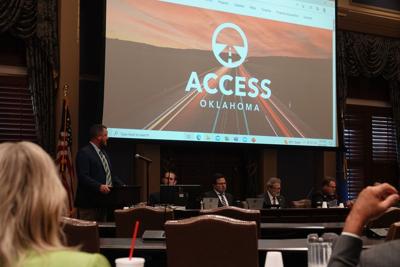
ACCESS Oklahoma is a 15-year, $8 billion plan to develop new turnpikes and expand existing highways across the state. The original project was approved by the Oklahoma Supreme Court in August 2023.
The East-West Connector, one of ACCESS Oklahoma’s proposed turnpikes, is planned to connect I-44 near Newcastle to I-40 at the Kickapoo Turnpike across northern Norman.
On Aug. 27, Norman City Council unanimously rejected a resolution that would have allowed the OTA to construct turnpike facilities through “critical areas” of Norman, including the Lake Thunderbird watershed, the Canadian River Corridor and the city’s flood hazard areas. The staff report stated the OTA would “protect and preserve” these areas.
At the meeting, dozens of members of Oklahomans for Responsible Transportation and Pike Off OTA, a nonprofit designed to protest OTA expansion, filled the audience and wore red in protest.
On Oct. 15, council discussed a new resolution with the OTA at its special meeting. During the meeting, Rick Knighton, city attorney, said the OTA did not require a resolution to construct the East-West Connector through Norman, adding council’s rejection of ACCESS Oklahoma facilities in August did not prevent construction.
“The OTA has eminent domain powers granted to them by the state. … There isn’t anything we can do to stop that,” Knighton said.
On Oct. 22, council voted to postpone a resolution requesting the OTA construct facilities in Norman city limits along ACCESS Oklahoma’s East-West Connector. Council also approved to schedule a public hearing involving representatives of the OTA answering questions from Norman residents.
Over 100 residents filled the Norman City Council chamber in protest of the resolution.
On Oct. 24, the OTA announced it would move forward with its plans for the East-West Connector without the city’s input, declining the city’s request for a public hearing.
At the time, Lisa Shearer-Salim, OTA public information manager, told OU Daily the resolutions rejected and postponed by council did not prevent the OTA from constructing the East-West Connector, citing the Oklahoma Supreme Court’s authorization of ACCESS Oklahoma in August 2023.
“The OTA has legal authority to build the turnpike. We don't need permission from the city of Norman,” Shearer-Salim said.
More OTA-related bills to watch
House Bill 1939, by Rep. Danny Sterling (R-Tecumseh), would modify certain powers and authorizations of the OTA. The modifications include an expiration of legislative authorization for certain turnpike projects, after an expiration the legislature may decide to renew or approve it again.
Senate Bill 966, by Sen. Lisa Standridge (R-Norman), would create a turnpike legislative oversight board. The Governor would be a part of the OTA as an ex officio member and would appoint two members. The oversight board would consist of six members of the House of Representatives and six members of the Senate.
Senate Bill 964, by Sen. Lisa Standridge (R-Norman), would remove the OTA’s authority to revise toll rates and update statutory language to require legislative approval for toll increases.
Senate Bill 975, by Sen. Jonathan Wingard (R-Ada) would require legislative approval for turnpike increases and prohibit the legislature from approving certain toll increases.
Senate Bill 983, by Sen. Lisa Standridge (R-Norman), would require an audit prior to insurance of certain bonds.
Senate Bill 969, by Sen. Lisa Standridge (R-Norman), would require the OTA to issue compensation to property owners for damages made by the turnpike, whether directly or indirectly.
Senate Bill 963, by Sen. Lisa Standridge (R-Norman), would establish a bond debt ceiling for the OTA. SB 963 would require the debt to not exceed $2,710,000,000.
House Bill 1781, by Rep. Jim Shaw (R-Chandler), would require the OTA to only engage in advertising through printing, or electronic billing statements issued to those who use the turnpike system, website and social media platforms owned, operated, or maintained by the OTA and on road signage on turnpike owned property, or within 1.5 miles of access roads and interchanges.
House Bill 2090, by Rep. Annie Menz (D-Norman), would require the state auditor and inspector to perform a special audit of the OTA by a certain date.
House Bill 2097, by Rep. Annie Menz (D-Norman), would remove the OTA’s authority to revise toll rates and require legislative approval for increases.
House Bill 1634, by Rep. Chris Sneed (R-Fort Gibson) would require the OTA to install road spikes on exit ramps. These spikes would automatically retract for safe passageway and deploy to prevent vehicles from entering the exit ramp in the wrong direction.
House Bill 2093, by Rep. Annie Menz (D-Norman), would require the OTA to have a debt ceiling of $3,150,000,000.
This story was edited by Ana Barboza and Ismael Lele. Natalie Armour and Grace Rhodes copy edited this story.


