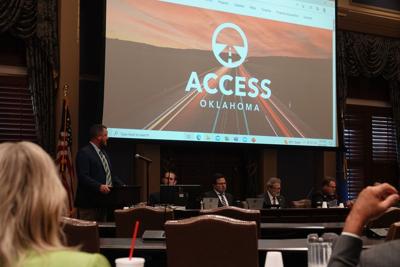

An Oklahoma Supreme Court ruling Tuesday approved the state Department of Transportation’s $5 billion, 15-year turnpike expansion plan, allowing the ACCESS Oklahoma project to proceed.
ACCESS Oklahoma includes three new turnpike routes: the South Extension, the East-West Connector — the two that most greatly affect Norman — and the Tri-City Connector. Norman residents and political leaders opposed the proposed project by holding a protest at the state Capitol in March 2022, chanting “go away, OTA.”
Two lawsuits were filed: one that alleged the Oklahoma Turnpike Authority violated the Open Meeting Act and one that challenged its authorization to construct the turnpike routes. The attorney representing the opponents in the authorization suit, Rob Norman, wrote in a statement that Tuesday’s opinion gives the Oklahoma Turnpike Authority broad powers with unknown limits.
“The dissenting opinions provided a convincing, well-reasoned explanation of why the new turnpikes clearly exceed the critically important guardrails the legislature has placed upon the Turnpike Authority,” Norman wrote.
A judge ruled against the OTA in December 2022 in an Open Meeting Act lawsuit. A week later, OTA halted all previously approved contract work for the ACCESS Oklahoma project due to the ongoing legal challenges. The state Supreme Court would later overturn that ruling in May.
The engineering and site acquisition for ACCESS Oklahoma stopped temporarily on April 11 due to bond market accessibility concerns related to ongoing legal proceedings. With Tuesday’s 6-3 ruling, OTA can proceed to sell $500 million in bonds for the project.
In a press release from OTA, the department expressed gratitude toward the state Supreme Court for Tuesday’s ruling and noted this as the 14th time the Supreme Court has validated bonds for new turnpike routes since 1950.
“This allows one of the most ambitious state transportation plans in Oklahoma history to move forward,” Oklahoma Secretary of Transportation Tim Gatz wrote. “It will increase safety and travel reliability, provide new connections to communities and improve traffic flow by integrating with the state highway system.”
Tuesday’s ruling marked the end of a lawsuit filed by homeowners alleging part of the South Extension Turnpike is not among 35 corridors that lawmakers approved in 1987. Lawmakers struck down a proposal in 1999 to make a similar extension.
Pike Off OTA, a grassroots organization against ACCESS Oklahoma, Vice President Whitney Mullica wrote in a statement recent Supreme Court decisions have left Oklahomans with fewer property rights and less trust in the state’s institutions.
“My initial shock is followed by the disturbing realization that in trying to prevent our neighbors from losing their property we inadvertently gave the Oklahoma Supreme Court the opportunity to eviscerate the Open Meetings Act and grant authority for OTA to build a turnpike anywhere they want in the state,” Mullica wrote.
This article was edited by Peggy Dodd.


