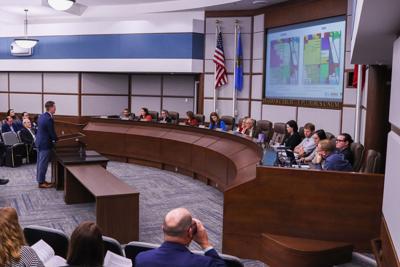

Norman City Council met to discuss an amendment to change its regular meeting time and the Oklahoma Turnpike Authority’s ACCESS Oklahoma project on Tuesday.
Ward 1 Councilmember Austin Ball did not stay for the full duration of the meeting. Ward 7 Councilmember Stephen Tyler Holman was the only councilmember who was absent.
ACCESS Oklahoma is a 15-year, $5 billion plan to construct new turnpikes and expand existing highways statewide. It was approved by the Oklahoma Supreme Court in August 2023.
A Facebook post from Pike Off OTA on Monday referred to the resolution as a “zombie resolution” and called for residents to protest.
“Be the eyes and ears at City Council tomorrow, October 15th, 5:30pm,” the post reads. “NO means NO. NO zombie resolution with the OTA.”
Two turnpikes – the East-West Connector and South Extension – would run through Norman city limits. The East-West Connector would connect I-44 near Newcastle to I-40 at the Kickapoo Turnpike across northern Norman, while the South Extension would connect to I-35 north of Purcell, continuing through east Norman before connecting with the East-West Connector, according to a staff report from Aug. 27.
On Aug. 27, council unanimously rejected a resolution that would have allowed the OTA to construct turnpike facilities through “critical areas” of Norman, including the Lake Thunderbird watershed, the Canadian River Corridor and the city’s flood hazard areas. A staff report stated the OTA would “protect and preserve” these areas.
At the meeting, dozens of members of Oklahomans for Responsible Transportation and Pike Off OTA, a nonprofit organization designed to protest OTA expansion, filled the audience and wore red in protest.
Early last month, the OTA confirmed it would not construct access or frontage roads in the Norman area following council’s rejection.
“The OTA requested the resolution as a step in the public process toward signing an agreement that would determine ownership and maintenance responsibilities of the requested amenities,” the OTA’s statement wrote.
According to the OTA’s statement, constructing frontage roads alone would cost more for taxpayers than if they were constructed alongside a new turnpike.
“Frontage roads help provide long-term solutions for local traffic flow,” the OTA’s statement wrote. “While the OTA was prepared to commit many tens of millions of dollars to design and build what would become City of Norman infrastructure, OTA respects the Norman City Council’s decision to reject the proposed resolution, requesting that the Authority include frontage roads, pedestrian facilities, local road widenings and numerous interchanges as part of the design.”
In an email to OU Daily, Lisa Shearer-Salim, OTA communication and marketing manager, wrote the preliminary estimate for the frontage roads was more than $150 million, including the right-of-way for construction.
“OTA was offering to partner with the city by purchasing the (right-of-way) and constructing the frontage roads,” Shearer-Salim wrote. “However, frontage roads would be part of the local infrastructure system, and therefore, the city would be the owner and maintain them after construction.”
On Sept. 13, Pike Off OTA released a statement celebrating the removal of access and frontage roads in the ACCESS Oklahoma plans. Amy Cerato, president of Pike Off OTA, wrote that limiting access roads removes Norman’s requirement to fund and maintain them, saving hundreds of millions of dollars.
“We all know that the original revenue outlook was still billions of dollars in the red and now with this limited access their revenue projections are even more disastrous,” Cerato wrote. “It is interesting that the Oklahoma Turnpike Authority thinks they can continue with this project without going back to the Council for Bond Oversight or their bondholders and reassessing their revenue studies based on this new information.”
Cerato wrote Pike Off OTA and Oklahomans for Responsible Transportation want the OTA to stop its current work and consider alternatives for traffic improvement, including interchange improvements on Indian Hills Road.
“Compare the finances of a toll bridge and a federally supported bridge from Newcastle to I-35, for example,” Cerato wrote. “The poor financial projections on the East-West Connector make it certain that tolls will have to increase throughout the entire system across the state.”
7 p.m.
The meeting is adjourned.
City Manager Darrel Pyle said after modifications the resolution will likely appear on council’s agenda for its next regular meeting. Ward 4 Councilmember Helen Grant said the discussion will direct the resolution before next Tuesday.
“The final version will be released with the Friday agenda, which doesn’t mean it couldn’t change,” Grant said.
6:26 p.m.
Interim city attorney Rick Knighton is answering all legal questions council has regarding ACCESS Oklahoma.
Knighton said according to Oklahoma Statutes Title 69, municipalities can lend any property dedicated to public use to the OTA for roads and does not apply to private property.
“It doesn't prohibit the Turnpike Authority from using its power within the domain to acquire private property for the purpose of constructing the turnpike,” Knighton said. “It doesn't require that the OTA get consent for anything other than any public real property that they may need for the purpose of constructing.”
Knighton said the OTA does not require a municipality’s consent before constructing a turnpike project.
“The OTA has eminent domain powers granted to them by the state,” Knighton said.
Ward 3 Councilmember Bree Montoya asked if the OTA required a resolution to build the East-West Connector as presented on its website. Knighton said the OTA did not require a resolution.
Ward 5 Councilmember Michael Nash said access roads would need to be widened to accommodate high-density housing.
“If high-density residential does take place, the idea is that you want those high-traffic generators to be located on major transportation corridors,” Pyle said.
Nash said the OTA hasn’t always been forthcoming, adding that the city knows Norman community members don’t want a turnpike.
Nash addressed council and said that some may have the idea that residents are "too stupid to understand."
“Everyone knows the sentiment of the community,” Nash said. “Some of you had the notion implanted (of) the excuse to dismiss the will of the people.”
Nash said that council has a voter-approved responsibility to residents.
Protesters of the turnpike clapped following Nash’s comments. Mayor Larry Heikkila told Rob Norman, an attorney from Cheek and Falcone, LLC, to leave after he clapped. Norman did not leave and said that Nash deserved the applause.
“A lot of times, I don’t think I trust this council,” Nash said. “We don’t need to be resurrecting this.”
Montoya asked if council’s rejection of ACCESS Oklahoma facilities in August prevented the East-West Connector from being constructed. Knighton said it did not prevent the East-West Connector from being constructed.
Montoya asked Knighton if the city could do anything to prevent the construction of the East-West Connector. Knighton said there wasn’t anything he could think of, adding the OTA has state power and eminent domain power.
“There isn’t anything we can do to stop that,” Knighton said.
5:52 p.m.
Council is discussing a resolution requesting the OTA to construct facilities in Norman along ACCESS Oklahoma’s East-West Connector.
Around six people are wearing red to protest the potential ACCESS Oklahoma resolution.
The resolution requests the construction of access points at 60th Ave. NW, 36th Ave. NW, I35, 12th Ave. NW/Broadway, State Highway 77H (12th Ave. NE), 48th Ave. NE, South Extension Turnpike, 120th Ave. NE (S. Choctaw Road) and 156th Ave. NE. The resolution also requests one-way service roads from 60th Ave. NW to 48th Ave. NE.
According to the resolution, 36th Ave. NW would be reconstructed to a four-lane road and a 10-foot wide multimodal path would be constructed on the south side of the East-West Connector.
The resolution includes stipulations for mitigation efforts regarding stormwater effects during construction through the use of green infrastructure practices. These measures would be used to protect the Little River and meet goals of the Lake Thunderbird Total Maximum Daily Load, which determines pollutant reduction necessary to meet water quality.
“THEREFORE, BE IT RESOLVED: as a reflection of its commitment and in support of a partnership between the City of Norman and the Oklahoma Turnpike Authority,” the resolution reads. “The City of Norman commits to the development of the EWC Project thereafter to maintain the EWC Project service roads as city streets.”
City Manager Darrel Pyle is presenting the resolution.
Pyle said the OTA advanced drawings through Norman that excluded frontage roads and multi-modal roads following council’s rejection in August. Pyle said constituents requested council members speak about frontage roads along Indian Hills Road.
According to Pyle, public works determined maintenance costs for Indian Hills Road, which would cost around $18 million without frontage roads. According to Scott Sturtz, capital projects engineer, the $18 million is cumulative.
"It's got a price tag of about $18 million, which would be avoided in the event council requested the turnpike rebuild Indian Hills at their expense, and we wind up with some budget savings along that Indian Hills corridor,” Pyle said.
Ward 2 Councilmember Matt Peacock asked about costs regarding green infrastructure. Pyle said costs would be around $30 million.
“Maybe for that high-density residential development along both sides of that turnpike, cost-estimate wise, it's probably as good a guess to talk about that $30 million round number,” Pyle said.
Ward 4 Councilmember Helen Grant asked if the OTA has constructed anything along wetlands before. Pyle said he was unsure and did not know of any similar wetland projects.
Grant said they would like council to have more conversations surrounding habitat loss and wildlife protections.
Richard McKown, a member of the AIM Norman Housing Subcommittee, said council’s goals regarding housing include 23,000 projected rooftops, which could be developed in north Norman.
According to Pyle, constructing homes requires development in north Norman.
“If you can't get the density going north, there is no place for the 23,000 rooftops,” Pyle said.
Grant asked on behalf of Ward 7 Councilmember Stephen Tyler Holman if the OTA expected to lose any revenue in the event that frontage roads are removed.
According to Pyle the OTA does not project any revenue changes if frontage roads are eliminated.
5:44 p.m.
Council is considering an amendment to change regular meeting times from 6:30 p.m. to 5:30 p.m. every other Tuesday.
According to the proposed ordinance, regular meetings would occur at 5:30 p.m. unless announced by council and with the exception of mandatory city holidays.
The ordinance adds no “business” would be discussed after 9 p.m. unless approved by a majority vote from council. Unfinished business would continue no later than the following regular meeting or a special meeting, according to the ordinance.
Rick Knighton, interim city attorney, said council has discussed feeling unproductive during late council meetings.
Ward 2 Councilmember Matt Peacock asked if the 9 p.m. limit would include miscellaneous comments, voicing concern for limiting public input. Knighton said the limit does not apply to comments and if council met until 9 p.m., it would immediately enter public comments.
Mayor Larry Heikkila said Holman said he would consider a 6 p.m. time change and an 11 p.m. limit, but added that Holman said past attempts at changing meeting times have not resulted in shorter meetings.
Ward 1 Councilmember Austin Ball said council should finish with whatever item they are considering at 9 p.m. before entering public comments.
Ward 4 Councilmember Helen Grant said ending at 11 p.m. would be preferable to 9 p.m.
Ward 3 Councilmember Bree Montoya said she agrees with Holman and Grant.
City Manager Darrel Pyle said the city could amend the time until council was satisfied with it.
Knighton told OU Daily after the meeting that staff will return to council with an adjusted amendment at a later date. According to Knighton the adjusted amendment would propose council not discuss any new item after 9 p.m and have it be placed on the following week's agenda. However if a decision on an item that began before 9 p.m. goes past the proposed stop time council will continue its discussion until a decision is made.
5:30 p.m.
Council is discussing amendments to the tree ordinance. All members of council are present except Ward 7 Councilmember Stephen Tyler Holman.
The amendments include definition changes, updates to regulated and prohibited activities and updates to tree protections.
Regulated trees include trees in street right-of-ways, according to a presentation. The presentation notes consequences for violating regulations could result in a fine of up to $750.
According to the presentation, permits are required before removing or altering regulated trees. Exceptions include environmental events and private street trees.
Tree districts include commercial and historical varieties, according to the presentation. Commercial districts include trees provided by the city and historical districts include residential areas with valuable historic trees residents want to protect.


