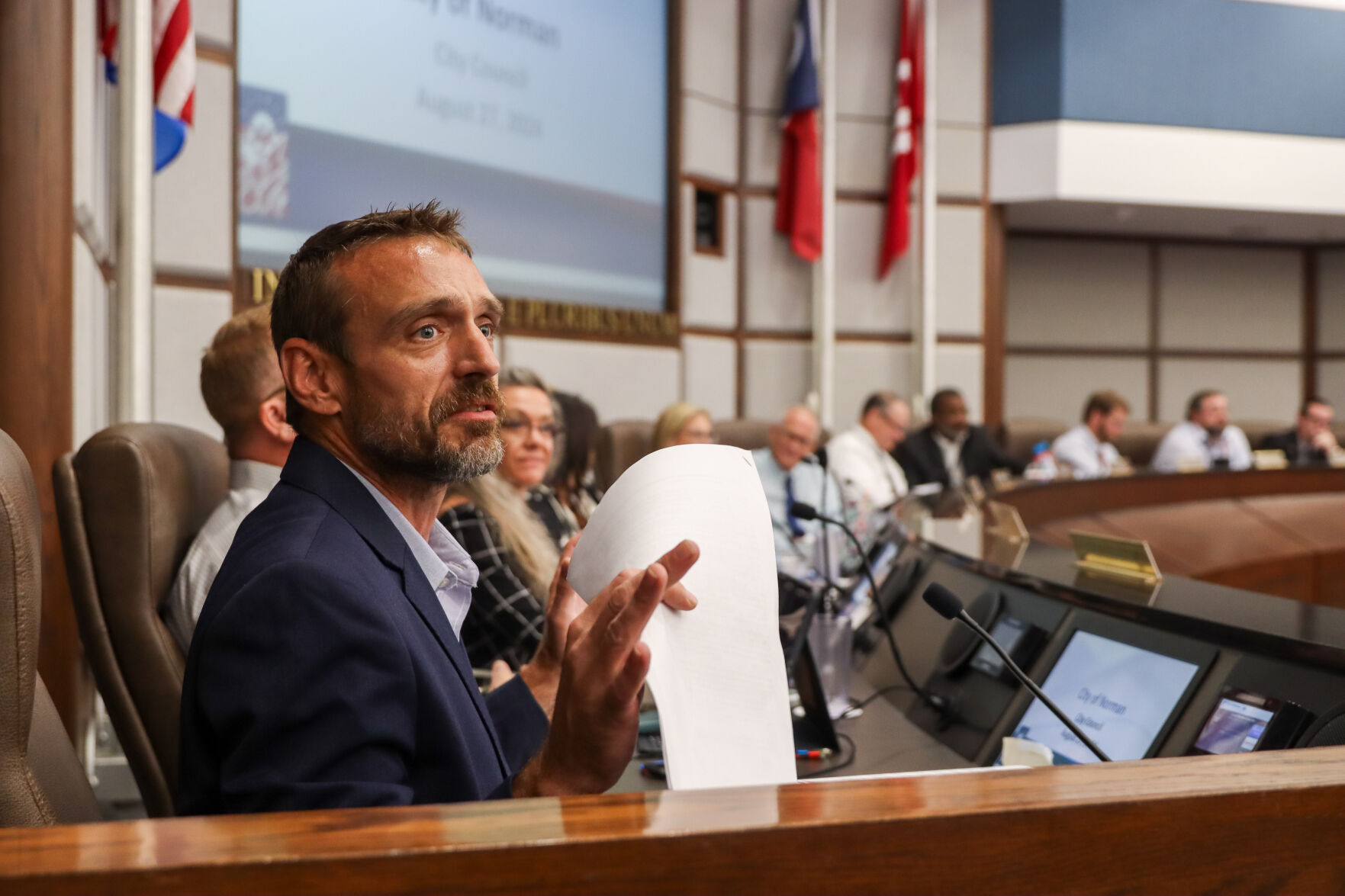



OU Daily fact-checked statements made at the Norman mayoral debate on Jan. 30 featuring candidates including incumbent Mayor Larry Heikkila, Ward 7 Councilmember Stephen Tyler Holman and local attorney Riley Mulinix.
The debate was hosted in partnership with OU Daily, NonDoc, News 9, The Norman Transcript and Gaylord College of Journalism and Mass Communications. The debate was live-streamed on OU Daily, NonDoc and News 9 social media accounts and can be rewatched here.
WATCH: OU Daily breaks down its fact check of the Norman mayoral debate ahead of Tuesday's election.
We used interviews and previous reporting to determine the accuracy of each candidate’s claims. OU Daily used the following rating system, commonly used by The Frontier, a nonprofit investigative media organization. For past debates hosted by NonDoc, The Frontier completed similar fact checks.
True: A claim that is factually correct.
Mostly true: A claim that is somewhat inaccurate but mostly factual.
Mixed: A claim that has a mix of accurate and inaccurate details.
True but misleading: A claim that, while true, leaves out critical details.
Mostly false: A claim that is somewhat accurate, but mostly false.
False: A claim that is not based on fact.
Larry Heikkila fact checks
Claim: The city cannot afford to maintain operations for a homeless shelter.
Heikkila: “As a small town, we don’t have the money to be able to afford to keep on housing homeless people, or anybody else doing any kind of medical kinds of procedures. We aren’t in the business of running mental health programs doing that, we have to sit down and be able to, we’re running out of money now, where are gonna get more millions to be able to go in to pay for more social services.”
Fact check: True.
Kim Coffman, the city’s budget manager, said the city would need to cut other services to sustain funding the homeless shelter. The contract with City Care allocates $62,683 per month, which totals $752,196 per year, according to Coffman. The contract is currently scheduled to expire on June 30.
“We would be able to afford it if we cut something else,” Coffman said. “I don't feel like we have enough surplus funding to continue to support that.”
Comparatively, the city’s budget for fiscal year 2025 allocates $767,400 to code compliance and $776,300 to Norman Public Library and its two branches.
Anthony Francisco, Norman’s finance director, told OU Daily the city’s expenditures are growing at a faster rate than its revenue. If this continues, Francisco said the city is headed toward a negative general fund balance within the next eight years.
Coffman told OU Daily in November the projection is not a cause for concern, adding she has monitored similar projections throughout her career.
“I've been here for seven years, and it's always kind of a doom and gloom situation if we stay on the current path,” Coffman said. “We've always been able to correct the course.”
— Abby Young, senior news reporter.
Claim: State law does not allow for a public vote on tax increment finance districts.
Heikkila: “When we did that agreement, we did it by the law, and the law didn’t allow for a vote. So it doesn’t make a difference to me either way if people vote. It’ll depend on what the judge says on the 19th, I believe the day is, and he tells us what to do. If it does, we’ll go to a vote; we’ll do whatever the people want us done on that.”
Fact check: False.
City Attorney Rick Knighton said because the project plan for the Rock Creek Entertainment District was enacted in an ordinance, residents have the right to bring it to a public vote through a referendum petition, according to the Local Development Act. Knighton said if enough properly documented signatures are collected, the public will vote.
“That allows the citizens, if they so choose, to gather sufficient number of signatures to put whatever issue was up, to put whatever ordinance council approved up to a vote of the electorate,” Knighton said. “That is the process for the citizens if they either oppose or not oppose an ordinance enacted by council.”
If the public votes against the ordinance, it would be repealed, Knighton said. If repealed, developers would have to look for an alternative funding source for the arena and the parking garage within the district, Knighton said.
After Norman residents gathered over 11,000 signatures petitioning to bring the Rock Creek entertainment district to a public vote, four city residents posted a legal notice protesting the petition.
According to the notice, the petition did not adequately summarize the proposed vote in terms easily understandable to those who do not practice law. The notice also states the petition perpetuates the notion that the use of tax increment financing districts would deprive the city of sales tax and the county of ad valorem tax revenues.
Robert Norman, an attorney who provided legal advice to the petitioners, told OU Daily he was concerned about the district’s financing because economic activity would be diverted into the district, but the TIF would collect that tax revenue.
“The problem comes when the city and the county and the schools no longer get the benefit of the tax activity that is diverted into the TIF district,” Norman said.
— Abby Young, senior news reporter
Claim: The Oklahoma Turnpike Authority will not negotiate with the city of Norman.
Heikkila: “We could not reach a negotiating point with the OTA other than to do it exactly their way,” Heikkila said. “That’s not a negotiation, that’s a demand on their part.”
Fact check: Mostly true.
In August, Norman City Council, including Heikkila, rejected a resolution for the Oklahoma Turnpike Authority to build turnpike facilities through “critical areas” of Norman, including the Lake Thunderbird watershed.
In a press release from Aug. 28, the OTA said it recommended the city create the resolution to work collaboratively and determine any potential infrastructure needs.
“It was OTA’s understanding that the City of Norman desired that the Authority add several amenities to the design of the East-West Connector to be constructed in a portion of Norman as part of the ACCESS Oklahoma long-range plan,” the release read. “The OTA requested the resolution as a step in the public process toward signing an agreement that would determine ownership and maintenance responsibilities of the requested Amenities.”
In October, council postponed a resolution allowing the OTA to construct turnpike facilities and requested to host a town hall with OTA representatives. On Oct. 24, the OTA denied the request and informed the city of Norman it would move forward with its turnpike plans without city input.
Lisa Shearer-Salim, OTA communications and marketing manager, directed OU Daily on Tuesday to the press release issued in August.
“OTA was willing to construct frontage roads simultaneously with the new turnpike,” Shearer-Salim told OU Daily Tuesday. “Without an agreement with the city to accept and maintain those local roads after construction, that part of the plan could not move forward.”
On Oct. 16, Knighton, the city attorney, said the city could not stop the OTA from constructing the turnpike through Norman.
“The OTA has eminent domain powers granted to them by the state … there isn’t anything we can do to stop that,” Knighton said.
– Thomas Pablo, senior news reporter
Stephen Tyler Holman fact checks
Claim: The city spends more on the animal shelter than it does on the homeless shelter.
Holman: “We spend $64,000 a month on a shelter for people, and we spend over $200,000 a month on a shelter for animals, which everyone supports, but it’s a matter of perspective that I think everybody needs to consider carefully.”
Fact check: Mostly true.
According to Norman’s fiscal year 2025 budget book, the city allocated $2.4 million toward the Norman Animal Welfare division in fiscal year 2025, which includes the animal shelter and all other expenses pertaining to the division. Norman Animal Welfare comprises response, medical and facility services, including animal cruelty investigations, the apprehending of animals, facility maintenance and the medical treatment for animals under the division’s care.
Additionally, while the budget book does not note any monthly $200,000 payments, $200,000 across 12 months would equate to $2.4 million.
Meanwhile, the city allocates $62,683 monthly to the operations of A Friend’s House, according to the city’s most recent contract with City Care, the shelter’s current operator. The contract notes operations would cost $752,200 annually, though the contract will expire in July unless extended.
The budget book, introduced last year, does not list any allocated payments for the shelter.
— Thomas Pablo, senior news reporter
Claim: Closing the Gray Street shelter will put more than 50 people on the street.
Holman: “There’s over 50 people per night who stay there, and if we decide to close it at any point, there will be 50 more people out on the streets of Norman, on the sidewalks downtown, in the parks and on the front porch in your neighborhood.”
Fact check: True.
City Care confirmed with OU Daily that A Friends Place is operating at capacity with over 50 beds.
“I believe we have 50 or 52 beds. But I mean, yes, if we don't have that shelter in Norman, I don't know where else they would go. We would have to hopefully find a place for them in the city,” Kasie Mason, business administrator at City Care, told OU Daily on Monday.
On Nov. 26, city council voted 5-4 to approve a contract with City Care to assume full operations of the shelter from Jan. 15 to June 30. City Care took over operations of A Friend’s Place from the previous operator, Food and Shelter, a nonprofit that provides housing and food services to Norman residents experiencing homelessness. Food and Shelter operated A Friend’s House from October 2022 to January 2025.
— Ismael Lele, assistant news managing editor
Claim: A commuter rail would relieve traffic on I-35.
Holman: “I think it's one of the best ways that we can provide real relief to traffic congestion on I-35, by providing people other options to get around.”
Fact check: Mixed.
The Regional Transportation Authority is working to construct a commuter rail system that would connect Norman to Edmond and Oklahoma City. The project is expected to be voted on in 2025.
During a 35-day Metropolitan Transportation Strike in 2003, the National Bureau of Economic Research tracked the effects of public transit in Los Angeles. The bureau found that average highway delay increases by 47% when transit service ceases. According to the study, the effects were largest on freeways that parallel transit lines with heavy ridership and “statistically insignificant” during the same period in neighboring counties that were unaffected by the strike.
Jason Ferbrache, Interim Director of Regional Transportation Authority, wrote that the commuter rail would provide an additional mode of transportation along I-35 but was unable to verify what effect it may have on traffic congestion in Norman.
"Currently, the (Regional Transportation Authority) has not studied the impact of Commuter Rail on reducing congestion on Interstate 35,” Ferbrache wrote in an email to OU Daily. “Therefore, we are unable to provide an official position on this matter. The future Commuter Rail project will offer an additional transportation option along the Interstate 35 corridor by connecting Oklahoma City, Edmond, and Norman. As the project progresses and service begins, ridership levels will help us better understand our impact on congestion. The Commuter Rail service will significantly enhance transportation for the residents of Central Oklahoma.”
— Ismael Lele, assistant news managing editor
Riley Mulinix fact checks
Claim: The city sprays chemicals on parks, schools and playgrounds.
Mulinix: “I’m passionate about removing the chemicals that are sprayed on playgrounds and places where our children play,” Mulinix said.
Fact check: Mostly false.
The city doesn’t spray playgrounds or schools but uses some herbicides on grassy areas, according to Jason Olsen, director of parks and recreation.
“We do not spray on playgrounds or at schools as stated by Mr. Mulnix. We only spray grassy areas, mainly focusing on fence lines (to cut down on weed eating) and obnoxious weeds/grassy weeds (to slow down the time between mows and, in some instances, eliminate sandbur stickers),” Olsen wrote. “For sports turf, we fertilize fields to promote healthy bermudagrass growth, reducing the amount of herbicide we use on sports fields.”
Olsen said the city uses the herbicides Farm General Grass & Weed Killer/Buccaneer Plus, Celsius WG, SureGuard SC, Stonewall 4L, Three-way, Plateau and Monument 75WG.
He said the city follows state-level policies regarding the spraying of herbicides.
“All of our applicators are licensed through the State of Oklahoma Dept. of Agriculture, Food, and Forestry, and we follow all policies set forth by that state agency, including auditing by the state every two years. State regulations outline when and where we can spray, temperatures, wind speed, etc.,” Olsen wrote.
Amy Shepard from the city’s public works department said it use a weed spray with a natural base that “doesn't qualify as Roundup or anything like that.”
Shepard said their policies do not deal with applying pesticides due to efforts to not contaminate the watershed.
“We don't typically apply anything that qualifies as pesticides or fertilizers or anything like that,” Shepard said.
— Thomas Pablo, senior news reporter
This story was edited by Peggy Dodd. Gretchen Schultz and Avery Avery copy edited this story.
Norman election guide: February 2025
OU Daily previews all races on the Feb. 11 ballot