
The summer before my high school senior year, I attended the Oklahoma Institute for Diversity in Journalism summer camp. After spending the week building friendships and taking classes, I published my first story outside of my high school yearbook. That story made me realize what I loved about journalism: connecting with a community to share their struggles, successes and stories.
I was invited back to OIDJ the following summer where I wrote about the mental health struggles and lack of support systems for those working in heavy roles, a story I hope to revisit someday.
At the end of the week, OU Daily adviser Seth Prince, one of the OIDJ coaches, invited me on a tour of the newsroom — where I basically fell asleep standing up from pure exhaustion — and encouraged me to apply to be a reporter in the fall.
I did the complete opposite.
I came to OU fully prepared to leave journalism behind and focus on my future in advertising. On the first day of the semester, when I was walking back to my dorm to take a nap and call my mom, Hannah Rystedt — one of my OIDJ camp counselors — saw me and dragged me to my new college home.

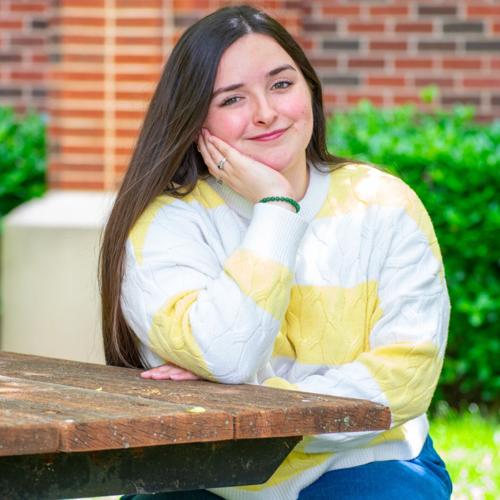
Madisson Cameron.
With no idea of what I was literally being dragged into, I attended my first of many culture meetings. I am 90% positive that I didn’t speak for the first several weeks I was in the newsroom. I’d show up to the desk meeting then leave.
I didn’t think that my work was strong enough to be a part of OU Daily’s legacy, a case of imposter syndrome that still sometimes haunts me.
That feeling followed me into my first assignment.
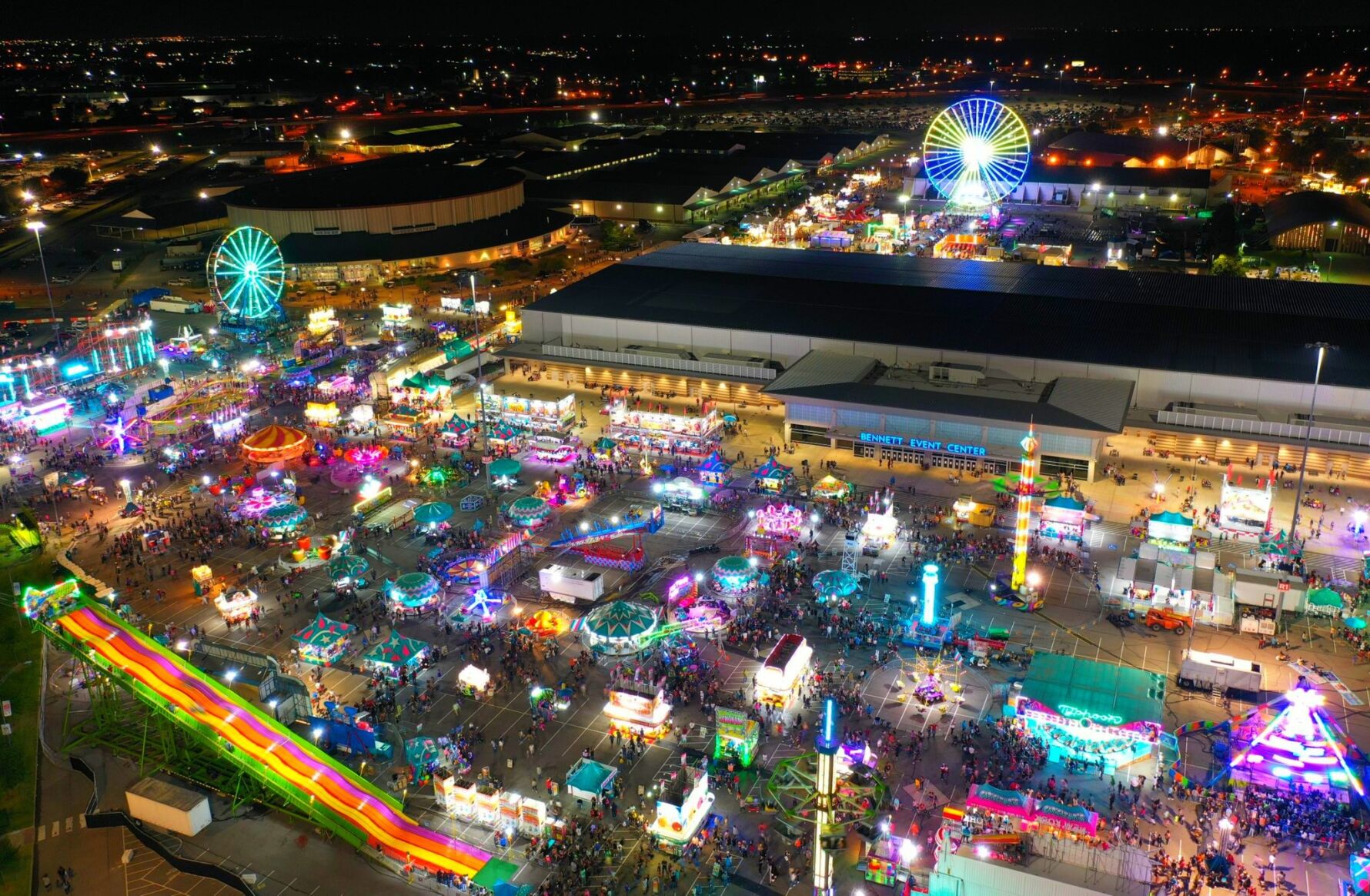
My first story for the Daily was about the Oklahoma State Fair’s inaugural college day. I was told about the story at 9 a.m. and had my interview set for 4:30 p.m. I was terrified. This was my first story at a major publication. I had no idea what I wanted to ask, and I didn’t want to disappoint anyone.
I showed up to the interview 45 minutes early, had five questions prepared and finished the interview in less than five minutes. Luckily as I was getting up to leave, my interviewee Scott Munz told me the interview wasn’t over yet and convinced me to stay for another hour so that I’d leave with a better story.
Not only is that one of my favorite interviews I’ve ever done, but it completely changed how I go about interviewing and training reporters to do them.
I didn’t write much that first year, but that was just how the desk operated. Culture reporters would come to the desk meeting, write one or two stories a month and that was it. No one stayed in the newsroom to work on anything, no one pitched stories.
This was also a time where the culture desk was viewed as less serious journalism, which is far from the truth. I never said it out loud, but I knew early on that if I was going to stay at the Daily, things needed to change.
I returned to the newsroom in the fall of 2024 as a junior culture reporter, where I wrote some of my favorite articles and got to connect with so many wonderfully creative people who had stories to tell. Then after one short semester, I became culture editor.
I say this after every semester, but my first semester as an editor was the most meaningful. It completely changed how I view the coverage I now think of as vital and fundamentally changed me as a journalist. I had no idea what I was doing, let alone how to lead an entire desk of people who I didn't even know despite being on the desk for so long.
I spent winter break settling on my vision for the desk and how I planned to get it there. I didn't receive the same training most people get when they become an editor, so when we returned for the spring I had to rely on my favorite way of doing things: throwing everything at the wall until something worked.
For quite some time, I was too stubborn and scared to ask for help from any of the seasoned editors. I ended up taking the first few weeks to understand the basics: how to use the back end, visual requests, copy systems and a few other tasks I had no clue existed.
I also made it a point to require everyone to spend at least one day a week in the newsroom outside of desk meetings to better their skills, build relationships throughout the newsroom and provide them a deeper understanding of how important the Daily’s, and their, work is.
We went through a lot of trial and error. And really, I mean a lot of trial and error. The biggest failure and success of that semester was our Norman Music Festival coverage.
It was clear from the beginning that NMF was one of the most important things for the spring culture desk. I took that and ran with it. I had seen our past coverage, and I wanted to make everything bigger and better.
The plan was for everyone on the desk to produce videos at NMF, but there was only one issue: I didn’t know how to do that. We interviewed almost a dozen bands and countless festival attendees with nearly 15 video ideas, but only one was actually published.
When I realized we weren’t able to produce this amazing, grandiose series of over-the-top content, I took it as proof of my failure as an editor. After sulking for a few days, I talked to my team and realized that several of the people who worked NMF had an amazing time, got experience taking video and were excited to continue experimenting with multimedia coverage in the future.
After seeing how proud my team was, I knew I had to reflect on myself as an editor. There were things I could have done better, expectations I should have managed differently and systems I needed to improve If I wanted to create the strongest group of culture reporters possible.
I was able to take those lessons with me as I began planning for what would become my favorite publication: Best of Norman 2025.
I had gotten to write two stories for the previous year's edition and, naively, I didn't realize how much went into planning an entire print publication, especially one so community driven. Picking categories started before NMF and creating the poll started right after. Figuring out how we were going to restructure the entire publication so it wasn't the same as the past three and starting to assign stories all happened before the semester ended, all for a newspaper that wouldn’t hit stands until Sept. 29.

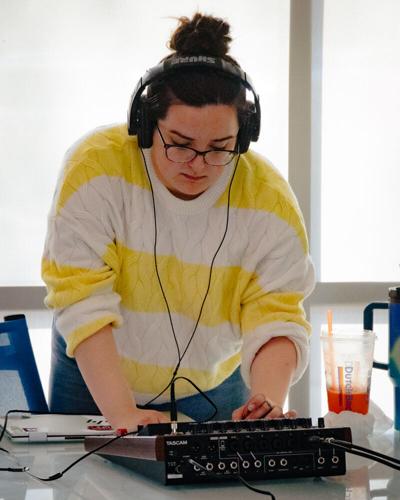
Madisson Cameron.
If it weren’t for then-junior reporter Megan Howarth and intern Kolby Brown, I probably would’ve drowned trying to create that publication. For some reason, those two decided to stick with the culture desk even after my chaotic first semester as editor, and they wanted to help make Best of Norman top-notch.
That summer, I wanted to make sure that I was staying up to date with AP style so that editing Best of Norman would go smoothly. Originally, I was going to join the summer news desk, but decided to shift gears and join the copy desk.
I found that copy is one of the most important desks in any newsroom, and I couldn't be more appreciative of the team Mary Ann Livingood and Sophie Hemker created. Those two, and the copy desk at large, have saved me more times than I could ever possibly count.
Spending the summer on copy gave me an entirely new appreciation for the amount of unseen work that goes into every story before it reaches readers.
When everyone came back to the newsroom that fall, I truly could have never guessed the roller coaster of a semester I’d have. To start, the culture desk that had previously capped at roughly seven people grew to 15, the majority of which were writing and publishing consistently. Only three of the 15 had worked at the Daily before, and 11 of the new reporters had never worked in a newsroom at all.
I refused to believe I had bitten off more than I could chew, so I made a plan: train everyone, build a weekly posting schedule, and do everything I could to create a stronger, more supported desk for my reporters.
There were growing pains, a lot of experimenting, and plenty of moments where things did not go as planned. But I had a desk full of people who genuinely wanted to learn, and their dedication, curiosity and willingness to improve was something I will never forget.
And somewhere in the middle of all of that growth, something else started to happen — the desk started to feel close in a different way. People weren’t just showing up to write anymore; they were showing up for each other. We spent more time together in and out of the newsroom.

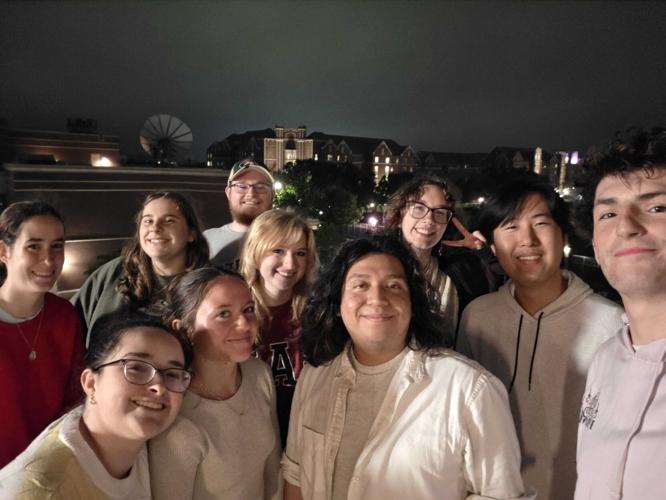
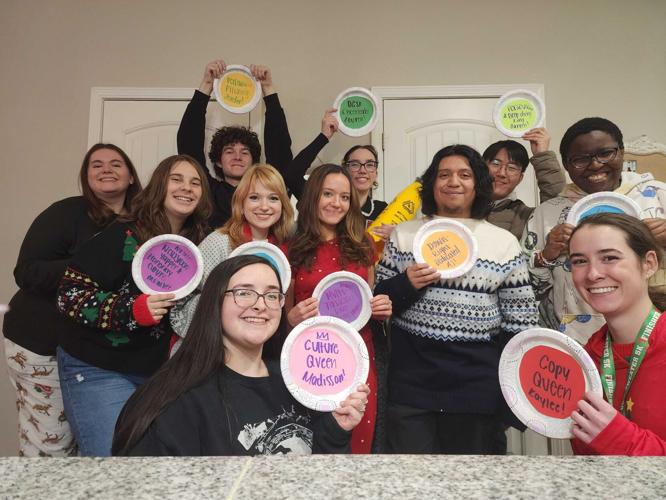
Madisson Cameron with OU Daily staffers.
I've never been more proud of anything than the desk we cultivated that semester. It felt like the culture desk had finally found its place in the newsroom.
At the end of a very successful semester, Seth and Anusha Fathepure, our editor-in-chief, suggested combining the news and culture desks. The idea was to better prepare reporters for the job market and give them experiences they wouldn’t have gotten on the culture desk.
In all honesty I was terrified of what would happen — something I didn’t tell my reporters at the time because I wanted them to go into the merger as confidently as possible. With jobs in journalism becoming harder and harder to find and many in the field being let go, culture and future reporting is often one of the first areas to be cut. I worried this would end up being the case for us.
Culture reporting doesn't always perform, and the business side of me understands that if you want to bring money in, you have to consider analytics. But the storyteller side of me also knows culture is vital in a world that is becoming increasingly harder to navigate, more toxic and more AI-centered than ever before. Without culture stories, it becomes easier for people to find themselves lost among the hard and heavy news.
That’s not to say that all culture reporting is light and happy — trust me, it isn’t — but it provides perspectives that aren’t always seen. My biggest fear in the merger wasn't that my reporters and I wouldn’t get to write the stories we cared about; it was that the community, our audience, our readers wouldn't have the opportunity to experience another side of Norman.
After breaking the news to the desk and taking the holidays to reset, I came back that spring officially as a news editor. For the first several weeks, it felt strange to call myself that.
I won't lie, the semester started out pretty rocky. It felt like I had become that shy, awkward first-year in the newsroom all over again. I had to learn how to edit in a new way, work on a team of people who already knew each other and adjust to areas of coverage I was unfamiliar with.
It was weird, and I will be the first to admit that the merger was hard. From my perspective, it felt like I had spent an entire year building something with intention — training reporters and helping them find confidence in a system I believed in — only to have to step into something completely new and start over in a different way.
That’s a dramatic way of putting it, and at times it felt dramatic too, but I just wanted to do right by my reporters. This was the first semester where I didn’t always know what the right answer was.
The trust I had built with my reporters allowed us to have candid conversations about what was and wasn't working, and I’d like to think we found our way through it together.
And even with all of that uncertainty, there were still really meaningful parts of the semester. I learned so much about a different side of journalism, about how I respond to change and about what it means to rebuild in real time. I was also lucky to experience all of that alongside such a strong team of editors.
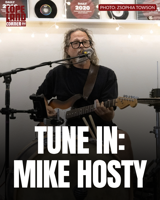
This semester I also got to be a part of a dream project. A year ago, I pitched a video series in the style of NPR’s Tiny Desk concerts. We filmed one before NMF, and I thought that would be the end of it.
That was until two of my reporters, Kayla Reinick and Jordan Johnson, both of whom are deeply invested in the local music scene, pitched to Seth and Will Pry, our innovator-in-residence, the idea for Copeland Corner.
We dove in head first and started reaching out to several local bands, some of whom had reached out to us in the past. Assistant video editor TJ Jenkins was crazy enough to join us in this adventure and became our video producer. Within a few weeks we had almost a dozen bands scheduled to perform.

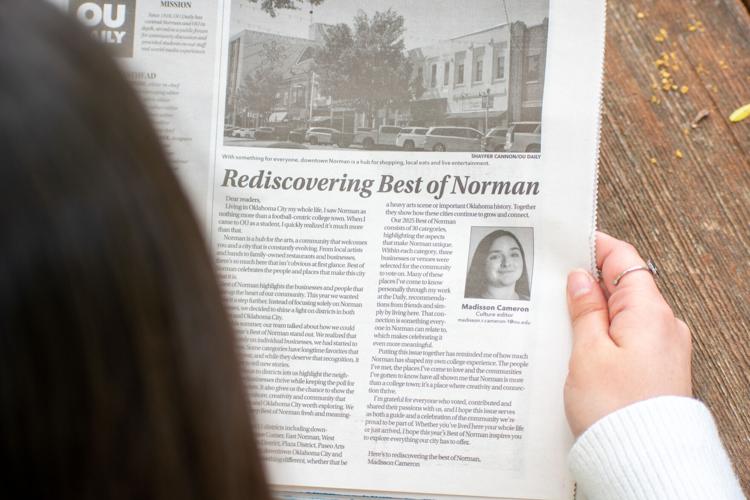
Madisson Cameron in OU Daily.
Like most things, the first few attempts were anything short of easy with sound issues and lighting issues and trying to figure out the best way to edit it was trial and error. We spent hours trying to perfect everything.
We had so many post-show, late night chats about what worked, what didn't and what we needed to do in the future. I also had many chats with TJ about the video process, how we want the series to look and how to train a bigger team.
It was in all of those chaotic moments and conversations that I got to learn something about myself I would have never expected: I really enjoy video production and editing. I had done simple audio and video editing in the past, but this introduced me to a new realm of visual focused coverage, and I'm excited to see how it develops.

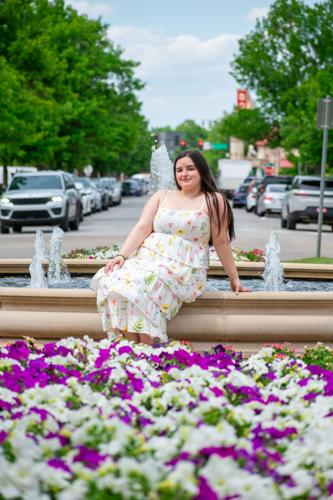
Madisson Cameron in Copeland Hall.
I am insanely fortunate to have gotten to work with so many wonderful people while at the Daily. I have enjoyed watching so many young journalists take shape, from those who had been there early on like Kolby, Megan and Nikki Womack, to the new generation of reporters including AJ Covey, Kaylee Hopkins, Darren Hu, Macie Castellanos, Jordan, Kayla, Parker Newman, Lauren Mackowski, TJ and many more, you have all been so important to my journey and I hope I have done right by you all.
I have learned so much from the people who were supposed to have learned from me. They taught me how to be a better leader, a friend, a communicator and how to stand up for myself and what's right.

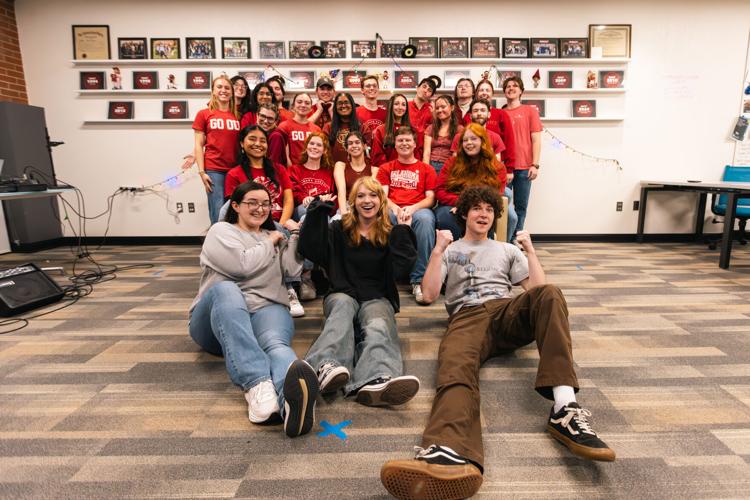
Madisson Cameron and OU Daily staff.
Sometime in the past year, the culture desk stopped feeling like a group of reporters I was responsible for training and started feeling like a family I got to grow alongside and lean on.
There were so many moments where I felt overwhelmed, unsure of myself or terrified I was failing as an editor, and somehow this desk still continued to show up, support one another and believe in the work we were doing. You all reminded me why culture journalism matters in the first place because behind every story is someone willing to care deeply about people.
When I became an editor, my entire goal was to leave the desk better than how I found it. While I can’t say for sure whether I accomplished that goal, I can say I’m proud to have seen what the desk and its reporters could become. I believe everything happens for a reason, and I see that so clearly through my journey at the Daily. From being dragged to my first culture meeting to becoming an editor, the merger and every story and difficult moment in between, it all felt like it was meant to happen, and I’m more than grateful for it.
I am very fortunate to announce that while I will be graduating this May, I will be staying at OU to complete my master’s. In addition to staying at OU, I will be returning to the newsroom as the lifestyle editor in the fall. Y’all can’t get rid of me that easily.
I don’t know what graduate school will look like, but I do know that I will continue to be the best editor I can for my reporters as they start their own journeys. I will be the best I can for them so that they can bring the best culture stories to our community and showcase the heart of Norman.
Throughout my time in journalism, I’ve been told that culture is just soft-ball news or not as valuable as “real news,” but it’s anything but. Culture reporting is digging deep into human interest, emotion and showcasing real people. Behind every culture story is someone with a story to tell — whether that be of hope, joy or heartache — and without those stories, we wouldn’t have real news.
My time at Daily hasn’t always been easy. If anything, I’ve had tougher moments in the newsroom than outside of it. However, they’re moments that I wouldn’t trade for anything.
Every tough day, every upsetting story, every difficult decision has led me to be the person I am today.
While my title is no longer culture editor, culture will always hold a very special place in my heart and I'm grateful to have continued the culture legacy.

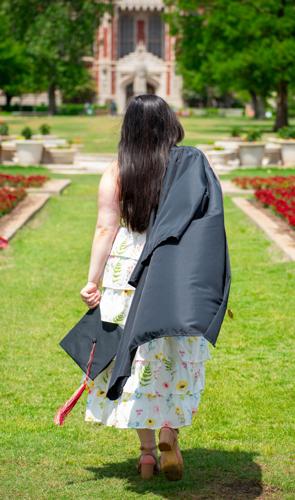
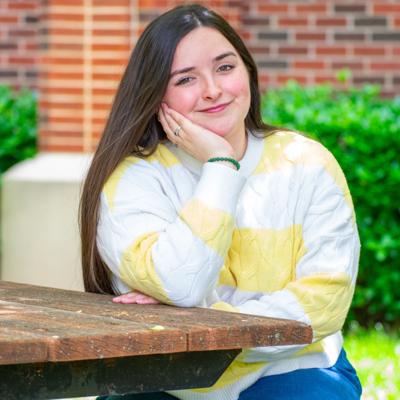
Madisson Cameron outside of the South Oval.
Madisson Cameron is an OU marketing and advertising graduate. At the Daily, she served as a culture reporter intern, junior culture reporter, culture editor, copy editing intern, life and business news editor and Copeland Corner producer. After graduation, she will stay at OU for graduate school and return to Daily as the lifestyle news editor.
THANK YOU
Kolby, you have been a rock for me in more ways than I think either of us ever could imagine. You have also grown tremendously during your time at the Daily and have such a nuanced understanding of community coverage. You’ve produced some of the strongest work I’ve seen come out of the desk, and I know it's only going to get better from here. Keep it up! The world needs to know what's going on and there's truly no one better to tell it than you.
Kayla, I know you've only been at the Daily for a semester and a half, but it's hard to picture the newsroom prior to you being there. You have brought so much life and joy to my world and many others. Thank you for always sticking up for what matters and for reminding people why this work matters too.
TJ, who would have thought that the first-year who walked in the doors at open house in the fall would join the culture desk and then become assistant video editor? Seeing your journey this past year has been nothing but incredible and watching you carry everything with such care just excites me even more for your future. Please take it easy on yourself. You've already accomplished so much in so little time, and you should be proud of yourself.
AJ, another transformation I was lucky to witness. You came in as a shy, quiet first-year and somehow became one of the most dependable people in the newsroom. From video to story writing and putting up with What to Do each week, as well as being a great friend to everyone on the desk, you are what the Daily is all about.
Copeland Corner crew, TJ, Kayla and Jordan, I can’t even begin to express my gratitude for the three of you. Had someone told me my random idea from my first semester as an editor would actually come to fruition, I probably would’ve laughed and gone about my day. This has been a dream project with the dream team. Kayla and Jordan, thank you for believing in this project from the start and for caring so deeply about local music. TJ, thank you for jumping headfirst into our crazy idea and helping turn it into something real. Out of all of my experiences at the Daily, Copeland Corner is definitely one of my favorites and it's because of you three, so thank you.
Culture desk, I don't know if there's much I could say here that I've not already said, but I have loved getting to be a part of this desk. I have put my heart and soul into this desk, and I am hopeful that I have done right by the nature of the desk and the people who have served it. To each reporter who has ever been on the culture desk or will ever write culture, business, lifestyle stories, thank you for caring so much about storytelling and about each other. And remember that your work holds so much value and I hope you never forget that. Even though I was the editor, this desk became what it was because of the people beside me. Thank you for trusting me through every crazy idea, meaningful moment and challenge we faced together.
OU Daily, there truly are not words strong enough to convey how I feel about this place and the people in it. I have learned so much in my time here and made so many wonderful friends and memories that I will always cherish. I'm truly so fortunate to get to stay here for a little while longer, and from the bottom of my heart I want to thank everyone who has been a part of my journey at the Daily and everyone who will be in the coming year.
Read some of Madisson's work: