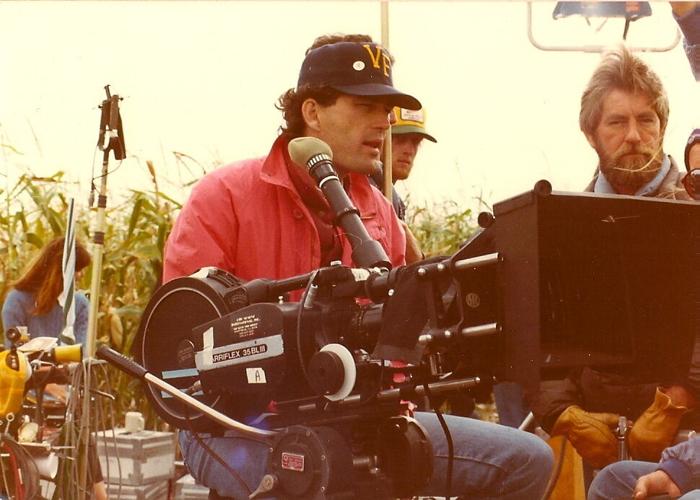

OU Professor Fritz Kiersch on the set of “The Children of the Corn.” Kiersch directed the 1984 film adaptation of Stephen King’s short horror story.
Editor’s note: This article was updated at 1:49 p.m. on Nov. 30 to reflect Fritz Kiersch was paid $35 for his 12 hours of work at Paisley Productions, rather than 35 cents. In a phone call to OU Daily, Kiersch said he did not mean to say he produced television commercials for Target, but instead meant to say he worked on commercials for big stores.
This story is featured in OU Daily's winter magazine, which will be available in print in late-November. Check out the other featured stories at the bottom of this article.
Fritz Kiersch’s TV broke down when he was a kid.
His dad refused to repair it or buy a new one, so every week Kiersch walked to the movie theater down the street as a means for entertainment.
Kiersch was quickly mesmerized by the storylines, the acting and the mechanics of how the films were made. He wanted to know more.
“It piqued my curiosity about (movies), but there must be more involved in making these. So I started to ask questions and read books in my spare time to understand all these things,” Kiersch said.
This fascination pushed Kiersch into pursuing a career in movie production.
Kiersch is best known for his work as the director of the 1984 film adaptation of Stephen King’s “The Children of the Corn” and his two feature films made in Oklahoma, “The Hunt” and “Surveillance,” both in 2006.
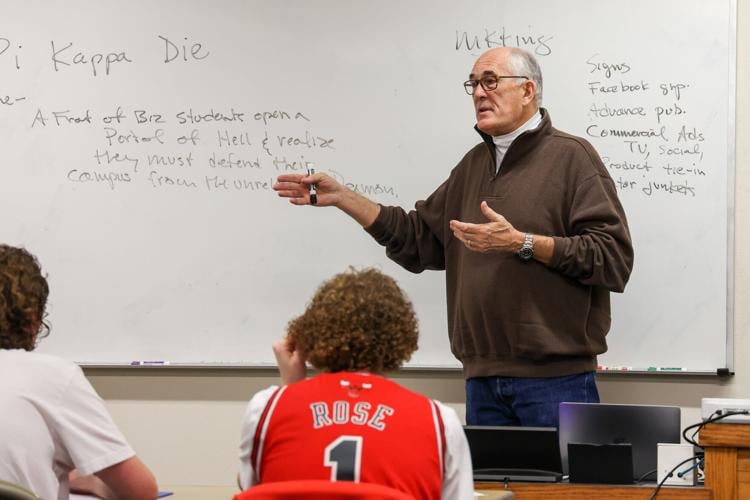
Now, as Kiersch searches for his next project, he has turned his attention toward teaching the next generation of filmmakers as a film professor at OU.
“One of a kind. (Kiersch) has a sense of humor that just gets him through anything. He's very funny but always light hearted,” Clayton Tramel, Kiersch’s former student, said. “It was so fun that you looked forward to going every day.”
Art vs. Science
Kiersch’s father was a geology professor at Cornell University.
By 15, he knew almost all the faculty members, his way around the roughly 745-acre campus and where the best fraternity parties were.
After school, Kiersch said he and his sisters would go to his father’s office and walk around or attend events happening around campus while waiting for him.
Kiersch said, as a kid, he was introduced to themes like politics and science. When he was a teenager, he became vocal about the politics of the 1960s and attended several protests at Cornell regarding the Vietnam War and other social issues.
While his dad taught him and his sisters math and science, his mother, a cartoonist and artist who sold her work to The New Yorker and other magazines, always took him and his sisters to museums or symphonies.
“Our environment was kind of split. It was heavy science, or it was art culture,” Kiersch said.
While his father wanted him to attend Cornell to study law, Kiersch went to Ohio Wesleyan University to earn a degree in economics.
During spring break of his senior year, wearing a blue suit he got as a graduation gift, Kiersch traveled to New York City and hunted for jobs at various international banks on Wall Street. While there, he slowly realized that he looked like everyone else applying for jobs.
“I noticed everybody had a blue suit,” Kiersch said. “I looked and I thought, ‘This is crazy. I look like everybody else here.’”
Kiersch left Wall Street, and instead of getting a job at a bank, he hopped on a subway and visited the film department at Columbia University.
He went into the office of a film professor and spoke with him for 40 minutes about the film industry, and when they were done, Kiersch planned his move to Los Angeles.
The man he talked to was Andrew Sarris, a legendary film critic for The Village Voice and later The New York Observer. Sarris went on to be known for introducing the auteur theory, a theory of filmmaking which centers the director as the major creative force behind a film. As a fan of Sarris, Kiersch followed his advice and moved to California after graduating from OWU in 1974.

OU Film and Media Studies professor Fritz Kiersch teaches his class, Producing for Film, on Nov. 14.
TV commercials to feature films
While in LA, Kiersch pretended to be enrolled in graduate school. In reality, he was working at companies making TV commercials while living in his sister’s garage.
Kiersch said he looked for any job opening, regardless of whether he had any experience in the field.
Kiersch started as a “freelance production assistant and utility person,” and was in charge of picking up equipment or driving files to other TV commercial companies as well as other support tasks.
Paisley Productions, a TV commercial production company, eventually hired him to run errands for a day, Kiersch said, for which he received $35 for 12 hours of work. Due to his enthusiasm and eagerness to work for them, they kept hiring him. He eventually started making about $100 per week, or about $570 today.
When he had a chance while working on sets, Kiersch would watch other people work and learn more about the behind the scenes of filmmaking like lighting, props, cameras and directing.
After eight months of working for the company, he was offered a full-time job as a stage manager.
“I didn't know anything, but I raised my hand and said I know all that stuff,” Kiersch said. “I went to the books and I read everything I could. … I pretended like I knew all about the lights and all about the cameras.”
Kiersch said he would travel to the University of California, Los Angeles and the University of Southern California to watch film classes, go to libraries and learn everything he could about film equipment.
Kiersch worked in that position for four years and later became an assistant for Caleb Deschanel, who he described as the best American cinematographer.
Deschanel worked on movies like “The Patriot,” “The Passion of the Christ,” “National Treasure,” “Fly Away Home,” “Being There” and “Jack Reacher” among others.
He has been nominated for six Academy Awards, most recently in 2019 for “Never Look Away.”
“He (had) just finished '(The) Black Stallion' and some other really cool films, so he brought me along and taught me how to light and how to direct,” Kiersch said. “Then I became a cinematographer.”
Kiersch started by filming commercials for free, shooting extra scenes that directors couldn’t work on during the day.
Kiersch founded a company, Kirby/Kiersch Film Group, in 1981 with Terrence Kirby, business partner and friend, which focused on making commercials with Kiersch as a director and Kirby as a producer.
The company was very successful, Kiersch said, and did commercials with several big stores.
“The Children of the Corn” and “Tuff Turf”
One day, an old worker for Kirby/Kiersch Film Group who was working at New World Pictures, came to Kirby and Kiersch with an offer in return for the job they once gave to him.
He offered them the chance to direct and produce “The Children of the Corn,” a horror film based on Stephen King's short story of the same name.
Kiersch, who was only working with commercials at the time, wasn’t open to the idea of working on a movie, but after some thought, he and Kirby decided to jump at the chance.
The slasher film depicts the story of a young couple trapped in a fictional town in Nebraska where a religious cult of children ritually kills adults.
Kiersch said he wasn’t aware of the power King had in pop culture until the movie was released. He said he wanted the film to be a “tribute to cheap movies” and didn’t think it would do well in theaters.
The movie, starring Linda Hamilton and Peter Horton, was released in 1984 and became a cult classic. The movie later turned into a franchise with a total of nine films.
Kiersch said he was offered to work on the other films but wasn’t interested.
Kiersch began working on films full time. He directed “Tuff Turf”, a teen drama featuring James Spader and Robert Downey Jr. The movie, however, didn’t conclude the way he intended due to costs, and it’s a regret Kiersch still has to this day.
“We just made up this thing where we take them back and show a party, and everybody will exit the theater with a lot of loud music and fun. It's just a letdown,” Kiersch said.
Though “Tuff Turf” didn’t turn out the way he wanted, Kiersch continued to make more movies throughout his career, such as “Winners Take All” and “The Stranger.”
"Making film products or moving image products, takes you all over the world. It's allowed me to be a 'professional tourist', providing lifelong learning opportunities,” Kiersch wrote in an email to OU Daily. “After exploring the places/locals/destinations the projects took me to, I created the events to record for the project. Events that are all artificial, constructed with artificial elements, relationships, behaviors, dialogue, actions, etc that, when organized and executed properly, created a reality.
“That was fun. That was effectively a magic trick which seemed new and fresh every time I did it."
Teaching and inspiring students in Oklahoma
Between 1997-98, Kiersch met and grew close with Gray Frederickson, a legendary film producer from Oklahoma City known for producing “Apocalypse Now,” “The Godfather,” “The Godfather Part II” and “The Outsiders.”
Kiersch invited Frederickson to all his film screenings. Frederickson was always shocked by the size of Kiersch’s small budgets.
“He would always say, ‘How do you do this? You spent to make your film as much as I spend on toilet paper to make my films. I don't understand how you can make a film that looks like that for the budget that we use elsewhere’,” Kiersch said.
They both pitched and worked on films together until 1999 when Frederickson decided to move back to Oklahoma. Some time after he left LA, Frederickson approached Kiersch with a plan to grow the movie industry in Oklahoma.
Frederickson was approached by former Oklahoma Gov. and then-Lt. Gov. Mary Fallin, who was working on a program to improve and develop more businesses in the state. One area of consideration was the film industry.
Because Oklahoma didn’t have a film foundation at the time, Kiersch said they trained people on the mechanics of film and how to shoot, and, since he knew how to direct and produce, they wanted him to go to Oklahoma and help develop these programs.
Kiersch agreed to move to Oklahoma and began teaching at Oklahoma City Community College.
Jon Shryock, a former student of Kiersch, was one of his first students when he started teaching at OCCC.
Shryock told OU Daily that he already had a degree and had been working in the movie business for a while before taking Kiersch’s class. He wanted to learn more from someone with the kind of experience Kiersch has.
“I found his phone number and I called him up and basically interviewed him as to whether I wanted to take his class or not. … I called him up just to find out who he was,” Shryock said. “Then I get on IMDb and find out what he's done and get a bunch of his movies and watched them.”
Shryock took all of Kiersch’s classes. Listening to him talk about his experience was worth more than the books they were assigned, Shryock said.
After five years working at OCCC, Kiersch taught at Oklahoma City University and helped develop the film program for 10 years.
Around this time, Kiersch filmed and released “The Hunt'' and "Surveillance,” two feature films made in Oklahoma. Kiersch’s former and current film students worked on the set alongside their professor.
Shryock helped with “The Hunt” and Tramel, another former student of Kiersch from OCCC, helped with the shooting of both productions.
“We loved his class. He's incredibly funny. He's incredibly experienced. But then to actually go from just talking about it in the classroom to actually being on set was a whole ‘nother deal,” Tramel said.
Last year, Tramel held a screening for a film he worked on. His friends and family attended, and so did Kiersch.
“When he’s your coach, he’s your coach for life,” Tramel said.
Kiersch is now currently in the preproduction phase for his next film, which he said will be a true-crime story.
Kiersch said the plans is to film in New Mexico. He said if he’s able to bring former and current students from OU to work on set with him, he will.
“Hanging around with students and getting them to realize that they have a point of view. … They have to say something and not just be existing, but to do something,” Kiersch said. “Life has a purpose; it’s what makes it fun. Talking to students and getting them excited about saying something, that's what it's all about.”
Read more stories from winter magazine:




This story was edited by Alexia Aston, Taylor Jones and Karoline Leonard. Avery Avery, Mary Ann Livingood and Nikkie Aisha copy edited this story.


