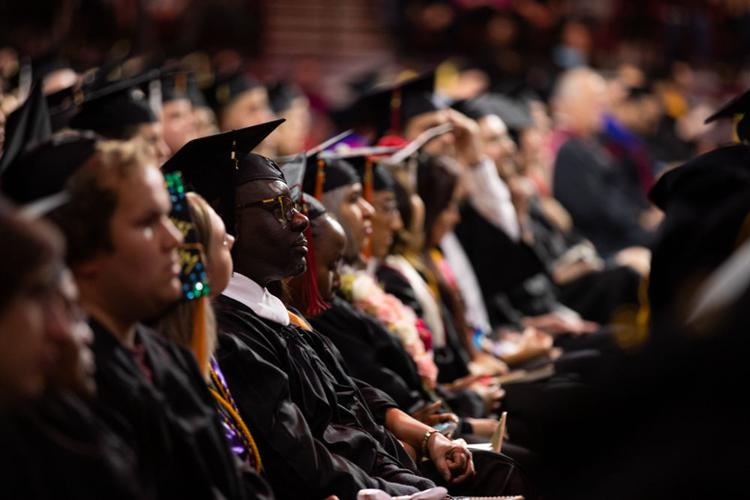

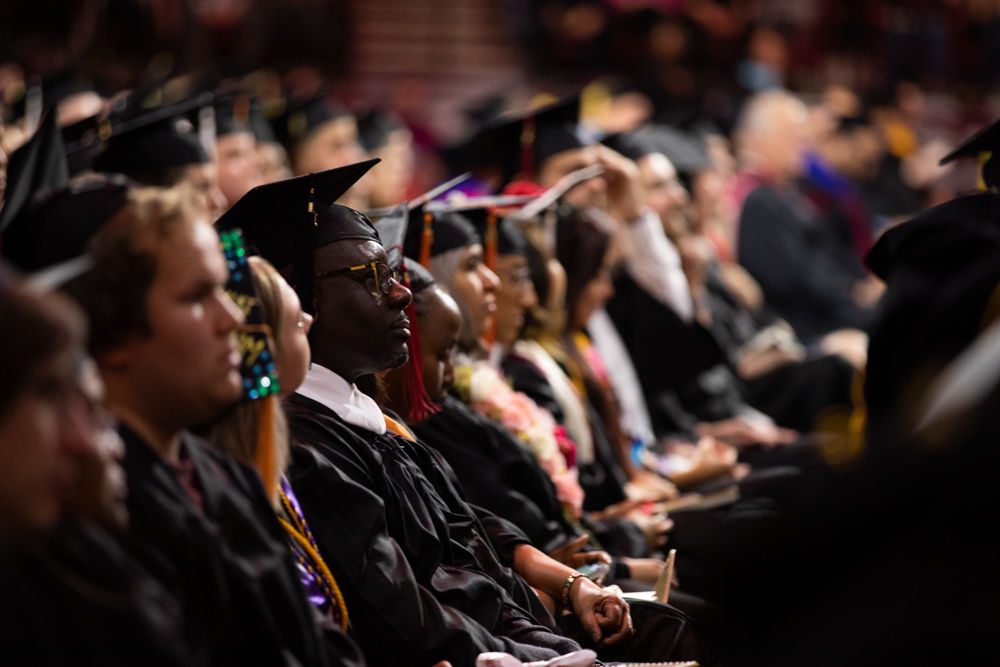
OU graduates attend 2019 OU graduation ceremony at the Lloyd Noble Center on May 10.
Editor's note: This story is featured in OU Daily's winter magazine, which will be available in print in late-November. Check out the other featured stories at the bottom of this article.
Richard Key felt high school eating away at him mentally.
Key attended Norman High School and sitting still for eight hours a day was exhausting.
This, coupled with the rising costs of higher education, led Key to know early on that he didn’t want to attend college.
“Some people don't have the ability to tell whether or not they'll do well in college,” Key told OU Daily. “They just go anyways, and I already knew I wasn't gonna go. There was no way I would have been able to do college, personally.”
Instead, Key attended Moore Norman Technology Center while in high school and for a couple of years after. Now a full-time electrician, Key is financially independent, lives alone and didn’t take out loans to attend higher education.
“I found a career that I really enjoy, and it really doesn't stop there,” Key said. “If more people tried going to a trade school or going into the workforce straight after high school, I think it's a really positive thing rather than going straight out of high school, right back to school and be in crippling debt.”
OU President Joseph Harroz Jr. has started raising questions in interviews, galas and Board of Regents meetings about the decreasing confidence in higher education. With several national studies and articles calling into question the value of attending universities, OU’s president has grown more concerned for the future of higher education and his university.
“I spend an inordinate amount of time thinking about this question. … How many students nationwide are not going to college out of high school right now? And the drop is really concerning,” Harroz told OU Daily in September. “It's a real concern, and not just for the individuals whose life will not be changed by having a college degree, but for the country and its supply of a truly educated workforce.”
Using a compilation of studies, The New York Times recently examined how Americans have started turning away from higher education. About a decade ago, 74% of young adults believed college education was “very important.” That number had fallen to 41% by 2019. About 45% of Generation Z believe that a high school diploma is all that is needed to achieve financial security, and almost half of parents said they’d prefer their children to not enroll in a four-year college, the article read.
Americans ranked K-12’s role in preparing a child for secondary education as the 47th priority out of 57, according to a study by Populace. Before the COVID-19 pandemic, it was ranked 10th. In the study, highly ranked priorities for K-12 schools included preparing a student for a career, developing skills competitive for the job market and doing meaningful and fulfilling work.
College Board’s Trends in College Pricing and Student Aid 2023 report found total undergraduate enrollment at public four-year institutions in the U.S. declined by 3% between fall 2019 and fall 2021. In the same time period, the report found that Oklahoma’s total undergraduate enrollment declined by over 5%.
OU, however, welcomed its largest class in university history this year, seeing an increase of about 10% in new students compared to last year’s freshman class. This was the third consecutive class to break class size records.
An annual study by New America, a group that researches education and other policy issues in the U.S., found that 59% of Americans thought universities had a positive impact on the country, which is 10% lower than before the pandemic. Only 41% of Republicans saw universities as having a positive impact compared to 78% of Democrats.
A 2016 survey from Pew Research Center found that only 16% of Americans think a four-year degree prepares students “very well” for a well-paying job in today’s economy.
Even with these statistics and the decrease in university enrollment nationwide, the U.S. Department of Education said by 2027, 70% of jobs will require education or training beyond high school.
“Why aren't people racing to get a college degree?” Harroz said. “The demand is without a doubt going to be there.”
Higher education is at a turning point and now universities like OU are grappling with how to keep the worth of their degrees viable.
Enriching the value of an OU degree is included throughout the university’s “Lead On, University” strategic plan, from meeting the Association of American Universities benchmarks to boosting OU’s reputation through faculty, branding and career development.
For Harroz, he said it boils down to the value proposition of higher education and how OU can market itself in a time where confidence is down and belief in a future after college is diminishing.
“People don't want the lowest cost education,” Harroz said. “People talking about school choice in K-12, we’re the ultimate school choice, right? Zero people could choose to come here next year if they wanted to. Nobody's compelled to come here. And so you got to look at the market and ask what the market really wants.”
Greg Burge, chair of OU’s Department of Economics, told OU Daily he doesn’t believe there’s evidence that the value of higher education has gone down.
Despite growing questions about the value of a college degree, data shows the wage gap between bachelor’s degree holders and high school graduates has only continued to grow in recent years. According to the National Center for Education Statistics, in 2021 those ages 25-34 working full-time with a bachelor’s degree made a median salary of $61,600 and those with a high school diploma made a median salary of $39,700.
However, Burge said as labor markets shift, as costs rise and as debates around student loan forgiveness continue, he questions whether that value proposition exists across the board.
“With what you get out of college, it's good for students to be thinking critically about this experience,” Burge said. “Is it worth it in their lives? Is it really the best way to use that many years?”

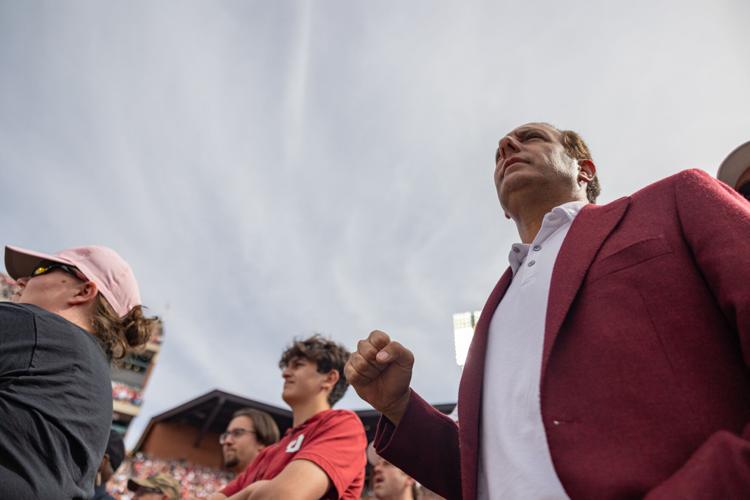
OU President Joseph Harroz Jr. during the game against UCF on Oct. 21.
Rising cost of pursuing higher education
Across the country, the annual cost of being a full-time college student — which includes tuition and fees, books and supplies, transportation and other expenses — averaged at roughly $28,840 for public four-year, in-state students and $46,730 for public four-year, out-of-state students, according to the College Board’s 2023 trends report.
Over the summer, the OU Board of Regents raised tuition and fees for the second time for resident students and for the third time for nonresident students in three consecutive years.
OU’s undergraduate 2023-24 tuition for an in-state student is $5,070 and for out-of-state students, it is $22,140. Students also have to pay fees totaling $9,085 for this academic year, according to the Office of Admissions and Recruitment. Books and supplies are estimated to cost roughly $800 and for students who live on campus, housing and food equals $14,608. OU estimates that housing and food costs for a student living off campus equals roughly $12,500.

Norman apartment and rental rates have risen in recent years and are expected to continue climbing as OU enters the Southeastern Conference next summer.
Added expenses — transportation, loan fees and miscellaneous expenses — bring an undergraduate in-state student to spend roughly $34,342 to $36,412 per year attending the university and an out-of-state student to spend roughly $51,412 to $53,482 per year.
“We're (about) 20% cheaper than the average university. You don't want to be 50% cheaper because, all of a sudden, it decreases your ability to offer excellence,” Harroz said. “So it's a strange give and take that exists, and that's what we're trying to thread, which is how do you walk this line?
“You don't look at tuition increases and say, ‘Well, that's gonna hit everybody.’ It's not because there's a lot of folks that don't have the ability to pay it.”
Jeff Blahnik, vice president for the Division of Enrollment Management and executive director of the Office of Admissions and Recruitment, said that the university tries to address the cost of college by offering financial aid, the money coach program and classes to teach students how to budget.
According to the College Board’s 2023 report, state and local funding for public higher education increased nationwide in 2021-22 and reached $10,240 per full-time equivalent student.
According to the College Board’s 2022 report, Oklahoma had the least amount of state or local funding per student. The percent change between 2010 and 2020 for inflation-adjusted funding per full-time equivalent student was -29% for Oklahoma, according to the 2022 report. The only other states with negative percent changes included Louisiana at -28%, Arizona at -10%, Connecticut at -8% and Kentucky at -3%. The U.S. average was a 25% increase, with states often comparable to Oklahoma such as Texas, Kansas, Alabama, Nebraska and Missouri all increasing.
In the 2023 report, Oklahoma had the only negative 10-year percent change in the country with -2%. The U.S. average was 48%.
Oklahoma offers a little less than 95% of grants solely based on financial need. State grant aid in Oklahoma averaged a little over $500 per full-time equivalent student.
“Oklahoma universities have the eighth-lowest cost of attendance in the nation. Each Oklahoma public institution has a national or regional peer group, and it's important to note that our public colleges and universities continue to keep tuition affordable,” Angela Caddell, associate vice chancellor for communications for the Oklahoma State Regents for Higher Education, wrote to OU Daily.
OU saw a negative percent change of almost 10% for in-state tuition and fees over the past five years, according to the College Board.
Blahnik said, however, the university tries not to compare itself to others when it comes to determining the value of a degree from OU versus from elsewhere in the country, even another in-state institution that has not raised costs recently.
Oklahoma State University’s Board of Regents opted not to raise its 2023-24 tuition for a second year in a row. The last time OSU raised its tuition was 2021, it was raised by 2.5% and had not increased in the three years before that.
“One of the things that we tried to carefully not tread on is, when we're talking about the value of education, we don't want to compare ourselves to other universities,” Blahnik said. “The prospective students will do that themselves.”
Tyler Ransom, OU associate professor of economics, told OU Daily that with the cost of higher education being so high, a lot of people look at the product and compare it to the price of 10, 20 or more years ago. He said the products are not necessarily comparable.
“I don't think that (higher education is) less valuable. I think part of the thing that bothers people in Generation (Z) and younger is that it's like, ‘Well, I'm getting the same product, but I’m having to pay three times the price as someone from a generation or two ago,’” Ransom said. “Maybe it's not exactly the same product. There's other factors that are pushing the tuition upward.”
Ransom explained that having proficient or highly sought after faculty, the additions of on-campus housing that did not exist in the same fashion over 50 years ago and the prospect of a semi-decent football team can all be reasons, or excuses, to drive up the cost of tuition. The product could have appeared to change and become more valuable or more of an experience compared to generations past.
“Having a good football team, the games and also joining the SEC, there's no question that President Harroz was really excited to make that move because it guarantees a certain amount of resources, (a) certain amount of cache that's going to keep people interested in OU,” Ransom said.
Harroz previously told OU Daily that student tuition and fees do not go toward OU athletics, one of the few universities in the country to have a self-sustaining athletic department.
Ransom said, even if tuition and fees do not go toward funding athletics, OU’s football team contributes to a brand and an identity that people want to buy into, so OU can drive the price based on perceived demand. OU’s strategic plan outlines a tactic to boost the university’s marketing and brand by recognizing the value of the OU athletics brand and OU’s ability to capitalize on it.
“There is almost a little bit of monopoly power that OU has, and they claim to have it because they said ‘There’s only one,’” Ransom said. “That’s actually to OU’s advantage because it means that there isn’t a direct competitor.”
If the product hasn’t changed significantly, Ransom said, the university then has to answer to that and explain why OU’s tuition has gone up.
Harroz said the value of an OU degree would diminish if the university lowered tuition significantly because it would no longer provide the excellence and life-changing education people seek in higher education.
Burge said there definitely are places to receive a degree for cheap, like degree mills, but students walk away unprepared for careers upon receiving their diploma. The value of that degree, to him, does not equal the value of a degree from a university like OU.
Burge, however, acknowledged that OU students may walk away questioning whether the past four years were worth the amount of debt some have to pay off, not to mention the added costs of graduate school or advanced degree programs for those who proceed with higher education.
“There's as much, or even more, gains to come to a university as there has ever been,” Burge said. “But at the same time, I do see that it can be challenging. If you're having a hard time paying your rent, is it a good idea to keep paying the tuition dollars, paying those fees versus just getting a job and getting started? That's always going to be a tough choice.”
Ransom said not all universities are forthcoming with their financial strategy or reasoning behind raising tuition and fees.
With the new Free Application for Federal Student Aid that launched in fall 2023, students are required to fill out fewer questions and with less specificity with the intent of offering more federal financial aid to students through options like Pell Grants.
Ransom said if this new application and expanded Pell Grant eligibility really results in more financial aid, some universities might further raise the cost of tuition.
This, along with repeated controversy involving student loan forgiveness and universities’ place in the nation’s culture wars, might contribute to Americans’ loss of faith in higher education institutions.
“People are a little bit dubious of how they think that higher ed institutions are not necessarily the best actors or don't have everyone's interests in mind,” Ransom said.

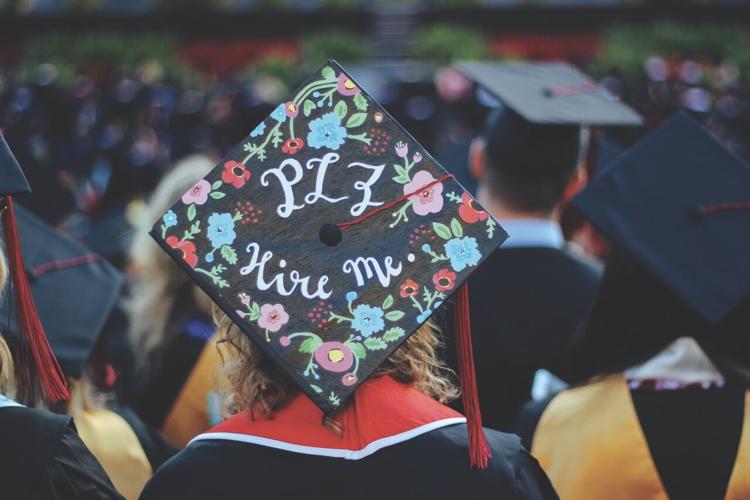
An OU graduate wears a custom graduation cap to the commencement ceremony in 2017.
Politics and student loan forgiveness
U.S. President Joe Biden promised to forgive student loans while on the campaign trail, but the Supreme Court shot down his debt forgiveness plan in June. Now, the Biden administration has shifted to seeking student loan relief through the Higher Education Act of 1965.
With the back-and-forth of student loan forgiveness and the need to address rising costs of higher education on the federal level, Ransom and Burge said it's a bad look for universities nationwide and causes Americans to lose confidence in institutions that have been among the most locally influential and respected.
“Your value proposition is a big thing for students these days, and they listen to folks talking about student loan forgiveness and they face this uncertain environment,” Burge said. “They're kind of watching and wondering how this will all pan out.”
Burge said the back-and-forth, will-they-won’t-they situation of student loan forgiveness is causing high schoolers, college students and parents to question the value of a degree.
“There has been federal policy on trying to assist low income students or middle income students for generations,” Burge said. “I got (a) Pell Grant back in the ’90s, so it's not like the government hasn't had an awareness that the financial burden of college is an issue. … These last couple of years have just been shining a spotlight on it because it's been in the national news.”
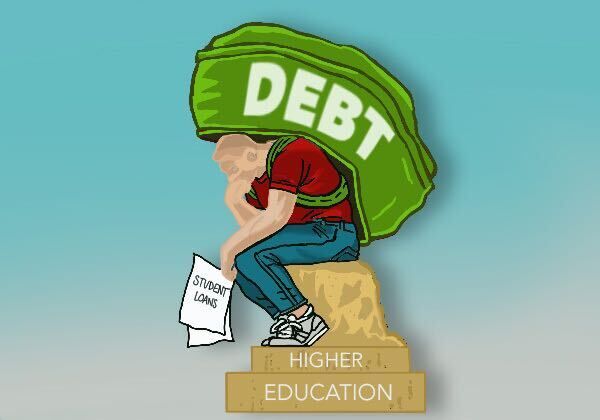
Ransom said some of the discontent with higher education institutions stems from the history of universities staying monolithic in terms of political stances or viewpoints. Premiere or elite universities, such as Ivy League schools, are sometimes generalized to all institutions, he said, and those universities tend to have less ideological diversity than institutions like OU.
“People think that whatever's happening there is also happening at places like OU, even though it's not necessarily happening. There's some of the mistrust in universities that is more perception of reality,” Ransom said. “But that doesn't make it any less of an issue.”
Ransom said communication and transparency can only further trust in higher education and in universities.
According to Ransom, this extends from issuing statements on political stances, such as about abortion, Black Lives Matter protests or the Israel-Hamas war.
In addition, with larger class sizes and the post-pandemic wave of more flexible admission standards, from the elimination of standardized testing to offering more spots in order to boost enrollment across the country, there’s the possibility of accepting students who are less equipped to succeed at OU.
“This is more true at this super high-end of the market, where there’s sort of keeping information from prospective students as a way to capitalize on the students,” Ransom said. “But then it ends up harming students in the end, so I’m thinking specifically about the universities admitting someone who is not on the same par as the typical admit. … And the kid’s looking around like, ‘Hey, why am I not doing as well as everyone else when you let me in with them?’”
Burge said instilling confidence in the value of a college degree cannot be achieved with silence or uniformity.
“That's not really best accomplished when you fall into the traps of group think, or the ‘We're really only going to take one approach politically,’ or whatever that might look like,” Burge said. “I do think, actually, that's one of the reasons why OU’s pretty blessed to have a lot of diversity in the faculty. We have diversity of backgrounds, political thoughts (and) we come from different parts of the world. We would probably be doing different things if we weren't here. I think students can kind of benefit from that if they come with a certain mindset.”

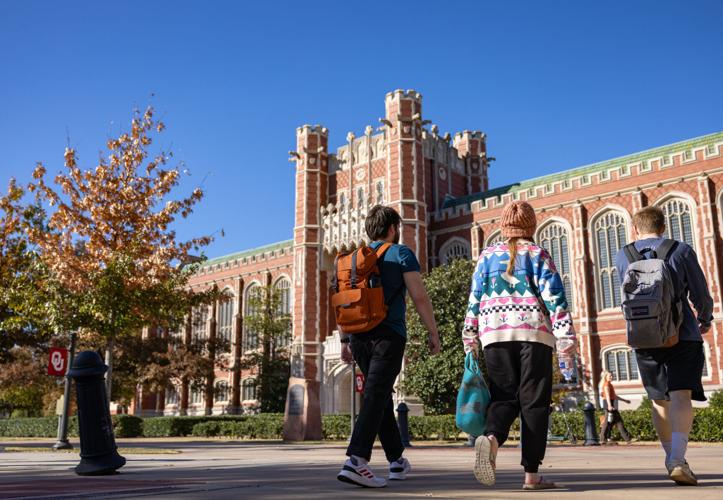
OU students walk to class in front of Bizzell Memorial Library.
Value of an OU degree
As he plans how to promote and deepen the value of an OU degree, Harroz looked at the growing freshman class and the likelihood of an even larger applicant pool for the class of 2028.
Blahnik said while enrollment nationwide might be down, OU’s momentum is rolling.
“It's a sign of health and growth for the university. Not all schools are experiencing that same momentum,” Blahnik said. “We feel very fortunate to be positioned in the situation that we are in.”
Blahnik said OU’s move to the SEC can only grow the university’s branding and recognition, which in turn fuels the worth of a degree from the university. According to Blahnik, his office is seeing an increase in applicants from the Southeast; students who would typically attend places like the University of Georgia or the University of Alabama are choosing OU instead.
Ransom and Burge said they know first-hand the benefits a college degree has created in their own lives, which means they also understand the experiences of college students in debt.
“I've seen the power of education to transform lives. ... So, I think that the value proposition is certainly there,” Burge said. “It can be challenging. If you're having a hard time affording college, you're seeing yourself taking out loans and going more and more in debt, that can be tough to grapple with.”
Even with employment options in and around the university, as well as financial aid, students can remain impeded by debt and expenses, which keeps some people from wanting to attend college, Ransom said.
Harroz told OU Daily that the conversation isn’t one dimensional, and there are outside circumstances, such as inflation and state funding, that play into offering aid and raising tuition.
“How do you keep up excellence, affordability (and) value and make sure everyone that has the talent (and) the ability, at least from Oklahoma and hopefully beyond, has the ability to come?” Harroz said. “The answer is continue to work on cutting costs where you don't have to have them.”
Caddell wrote that the state regents have discussed the growing need for an educated workforce in Oklahoma. The best way for that workforce to grow, specifically in high-demand fields like nursing and education, is for those students to attend college in state, she wrote.
“Higher education helps learners develop critical thinking, problem-solving, and communication skills. College graduates are more likely to be engaged in their communities, lead healthier lives, and have higher levels of job satisfaction,” Caddell wrote. “In terms of meeting workforce needs, we need more citizens with a college degree to help our current business community grow and attract new businesses to Oklahoma.”
Over halfway through his third year as university president, Harroz has helped to usher OU into a new era with the move to the SEC, consistent class size growth and a publicly harmonious administration. This is in comparison to the tenure of former university president James Gallogly, which coincided with revelations about former OU President David Boren’s budget and personal malfeasance.
Harroz said to grow the value of an OU degree, tuition cannot be flat but other measures can be taken to aid students’ ability to attend the university.
“Our students wouldn't come here if we were the cheapest because we couldn't afford to provide excellence,” Harroz said. “It's that dynamic tension that exists. Our home base for all the analyses goes back to those two things, value excellence and affordability and make sure that the American dream is real, that those that cannot afford but have the ability and discipline and drive can afford to go.”
For Key, the Norman High student who became an electrician, studying at OU or another university wasn’t in the picture. He said friends who work in construction or in other technical careers who attended college or dropped out now must work to pay off student loans.
Key said there needs to be less stigma about attending trade school or working straight out of high school to possibly avoid student loan debt.
Harroz is now attempting to ensure those who come to OU find it valuable both now and later in life.
At a time when the state of higher education is constantly evolving and coming off a pandemic that altered the way classes are taught and degrees are earned, Harroz and Key are on two sides of a particularly pricey coin to debate whether higher education is still valuable.
The answer isn’t clear and might never be.
“It's not a binary, all-or-nothing, black-or-white situation,” Burge said.
Read more stories from winter magazine:


This story was edited by Alexia Aston and Taylor Jones. Avery Avery, Cooper Marshall, Mary Ann Livingood and Nikkie Aisha copy edited this story.


