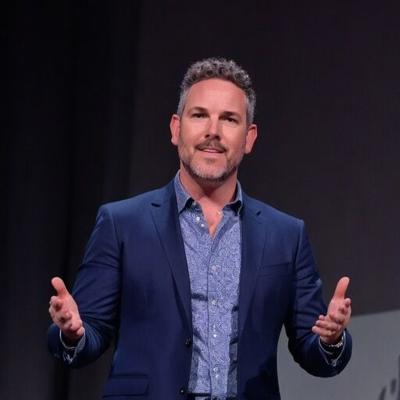

Avery Holton, chair of the Department of Communication at the University of Utah, detailed his qualifications and plans to improve community, understanding, resiliency, vibrancy and emergence during a public forum with students, faculty and staff on Monday as part of his three-day interview process to be Gaylord College dean.
Before joining the University of Utah, Holton worked at the University of Texas at Austin as a graduate research assistant, instructor of record and graduate teaching assistant. He moved to the University of Utah in 2019 where he joined as co-coordinator of research for the university’s Center for Excellence in ELSI Research. Holton also worked as an associate professor in the department of communication and director for the university’s communication institute. He became chair of the department in July 2021, according to his LinkedIn.
Before working in academia, Holton freelanced for Time magazine, where he wrote about women’s issues, and the Austin American-Statesman, where he covered professional, collegiate and high school-level sports. He told community members Monday that he spent a decade as a sports reporter covering volleyball, March Madness and minor league baseball for the Fort Worth Star-Telegram. Holton later worked in public relations for a minor league baseball team. He holds a doctorate in digital media and journalism and disability studies from the University of Texas at Austin.
Holton said Monday that, in his time as chair of the communication department at Utah, he helped grow faculty staff by over 50% after facing staffing issues. Holton said endowment has grown from $2.7 million to $5.4 million, distinct donors are up 93% including a $1.5 million gift for a new communication institute and a $1 million gift for graduate education aimed at amplifying women and marginalized communities since his time as chair.
In his time as chair, Holton said his department built and developed connections with PBS, NPR and The Salt Lake Tribune by communicating with different parties to establish core relationships in an effort to serve as a bridge between professional publications and the department's students seeking work after graduation.
“In my time in Utah, I've made an effort to connect with as many alumni as possible, as many community members as possible to fill my week up to my own detriment with meetings and phone calls and lunches and being in space, but to go to the actual spaces where potential donors might be or where organizations are,” Holton said.
CURVE plan, fundraising
Holton outlined his plan for Gaylord College that he called CURVE, which stands for increasing community, understanding, resiliency, vibrancy and emergence.
Holton highlighted his work in Utah as an example of how he implemented this methodology to help the communication department grow in staff and improve financially.
Gaylord is currently awaiting an external consultant known as the “Dispute Doctor” to assess the workplace environment and assist in strengthening the Gaylord community. Holton detailed his experience in fostering good workplace environments.
Holton said when he arrived at the University of Utah in 2020, the department was suffering from the effects of the COVID-19 pandemic and a toxic workplace environment. Holton said about nine faculty members vacated the department during the pandemic, but by implementing his CURVE methodology, the department was able to recover in staff and improve its environment.
“We've emerged 39 faculty, from 24 to 39 we've lost no staff,” Holton said. “We've gained one mental health and wellness coach with a faculty across a multitude of areas. And we brought faculty together who served as instructors protecting the community and professions with faculty who are researchers.”
Holton said he emphasizes the idea of connecting with communities and students in his approach to improving Gaylord. Holton's plans for fundraising at Gaylord primarily revolved around connecting with alumni and community members, by being transparent about budget necessities and making student career outcomes a topic of focus.
Holton told a story in which he built a relationship over the course of multiple years with University of Utah alum Doug Bowser, president of Nintendo of America, in what they hoped would result in a multi-million dollar innovative project. Over time, discussions fizzled out, but due Holton's resilience, Bowser donated new Nintendo technology to students interested in esports.
“Working with donors, being a steward of funding, being out of the elements, these are all really important things, but at the foundation, what's behind those and what should come first, is the connection,” Holton said.
Holton said in the early parts of his time as chair he attempted to identify faculty members who found parts of their job challenging. Holton began going to lunch with a tenured faculty member who, over time, aired out his grievances and requested a leadership position to help address department issues.
“It was engaging and through this sort of invisible labor, this connection with people, this breaking of bread and showing up in spaces with and for our faculty and our staff and our students over and over again that the culture began to change,” Holton said.
DEI efforts, student engagement
After Gov. Kevin Stitt signed an executive order calling for state universities to review funding of diversity, equity and inclusion programs, OU has begun restructuring its DEI offices to comply with the executive order.
Holton said to maintain diversity and inclusion he would replicate what he’s done in Utah by helping Gaylord students and faculty navigate the logistics of the laws being enforced on universities.
“We've worked directly with our students to walk through what these bills and laws mean. We've asked general counsel to decide the legal operation of the university to articulate the meaning of these bills to faculty, staff and students and the whole open Q&A forum so that we understand,” Holton said.
Holton said, in response to anti-2SLGBTQ+ legislation in Utah, his department adjusted the way it operates to ensure they continue to promote a diverse faculty and student body. Holton said the department has a climate culture course intended to look at displaced Indigenous people and wetlands and summer camp programs that allow K-12 students to visit the university and offer lessons on trending technology.
“And with each of these hires, and with each of our new grad students, we've been open and vocal about the changes that we had, and the ways that we can ensure not only access to diverse perspectives and include elements of inclusivity but also signal the character and virtue of what I mentioned,” Holton said.
Establishing a relationship with students and student media was in Holton's action plan to fulfill his idealized version of Gaylord. Holton said he spent two years as a media adviser in which Holton organized meetings with faculty with the intention of better helping students reach their goals.
Holton concluded his presentation with hopes to build on existing programs in Gaylord and expand the curriculum to include a media harassment program with the intention of helping prepare young journalists, particularly women and members of marginalized communities, before officially entering the workforce.
Gaylord dean search
Holton will meet with Gaylord students at 4 p.m. Monday. He will later meet with the Gaylord Board of Visitors, OU President Joseph Harroz Jr. and Senior Vice President and Provost André-Denis Wright.
The first candidate for the Gaylord College dean position, OU professor and distinguished veteran network news correspondent Mike Boettcher, does not hold a bachelor’s degree, but has extensive professional journalism experience that few could rival. Boettcher told OU Daily and OU Nightly reporters in an interview that he considers his years as a correspondent with CNN, NBC News and ABC as his Ph.D.
The second candidate, professor and former dean of Texas Tech University’s College of Media and Communication David Perlmutter, previously served as director of the University of Iowa’s School of Journalism and Mass Communication. He’s also worked as associate dean for graduate studies at Louisiana State University and at the University of Kansas. His career was mainly focused on academia over professional media experience.
The third candidate, director of Kent State University’s School of Media and Journalism Emily Metzgar, worked at Indiana University’s The Media School for 12 years as an associate professor, director of the honors program and of undergraduate studies. Metzgar’s experience is primarily in academia, research and writing about foreign affairs and its intersection with media and the role of media in society.
The fourth candidate, Andrea Miller, dean and director of Mayborn School of Journalism at the University of North Texas, joined UNT in 2019. She previously worked professionally in broadcast journalism starting in 1990 at KAMU-TV, at WFAA-TV in 1993 and KTVT-TV in 1994, where she later became a producer. She previously was a professor and associate dean for undergraduate studies at the Manship School of Mass Communication at Louisiana State University. There, she taught courses in crisis communications, broadcast news and multimedia reporting.
These four candidates were interviewed prior to OU’s spring break, which was March 18-22.
Wright told OU Daily in September that once the search committee made its selection of finalists, those would be made public. Some faculty and staff were notified on March 1 before Boettcher’s forum that he was one candidate, according to an interview schedule and email obtained by OU Daily that day.
At the time the dean candidate qualifications and requirements were announced, many faculty and staff questioned the composition of the search committee approved by the OU Board of Regents in September.
The search committee, chaired by Price College of Business Dean Corey Phelps, includes Gaylord College professors Robert Kerr, Doyle Yoon, Erin Kökdil, Jensen Moore, senior academic adviser Joshua Kahoe, Director of Student Services Kathy Sawyer and Gaylord Board of Visitors member Roger Frizzell.
Two students within the college, graduate student Alex Eschbach and public relations senior Acacia McDonald, are on the committee. Outside of the college, professor in the department of communication John Banas, classics and letters professor Daniela Garofalo, executive director of advancement for the OU Foundation Emily Reed and senior program officer at the Inasmuch Foundation Tyler Tokarczyk also joined the committee.
The five finalists were officially announced to faculty and staff on March 3. OU Daily’s report came out March 4 early in the morning and the announcements for Perlmutter and Boettcher’s public forums were sent to the OU community later that afternoon.
OU shared the qualifications and requirements for the position in October, stating that “candidates must have a record of accomplishments (academic or professional) to qualify for appointment at the rank of Professor. A Ph.D. is preferred.”
The qualifications and requirements for the position, as outlined in a document prepared by search firm Greenwood Asher & Associates, described the college’s ideal next dean as possessing “a vision that prioritizes community, educational rigor, traditional and applied scholarship, teaching, a global presence, and public service.”
At the OU Board of Regents meeting on March 12, interim dean David Craig’s request for a sabbatical with full pay for the fall 2024 semester was approved.
This story was edited by Anusha Fathepure, Peggy Dodd and Karoline Leonard.
Read more about the dean search:


