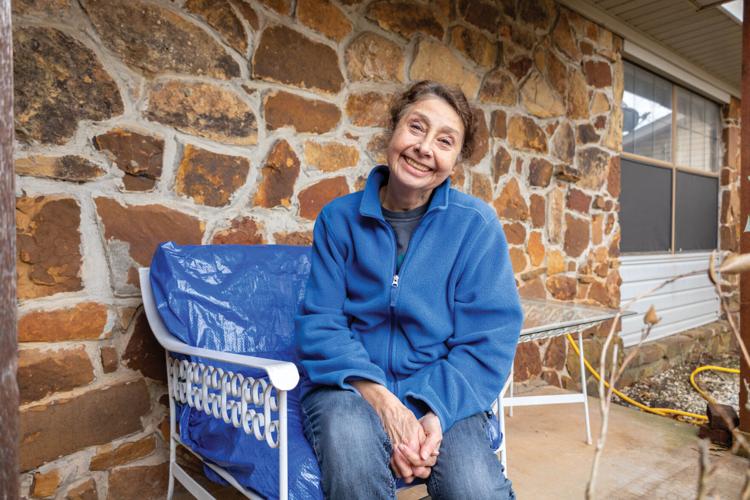


Mary Elizabeth Le Blanc and her husband, Greg, have lived in their red-brick home on Surrey Drive for 34 years.
Unlike west and central Norman, which get a lot of attention from city officials, there are no restaurants or entertainment venues in her neighborhood, Le Blanc said, and candidates seldom knock on doors there. She said her neighborhood’s residents must complain to the city to have their needs met.
“It's just a forgotten group of neighborhoods,” Le Blanc said.
The Le Blancs' home is part of a collection of neighborhoods and apartments nestled between Alameda and Lindsey streets, east of 12th Avenue and west of 24th Avenue.
Home to Irving Middle School and Kennedy Elementary School, the area has a lot of affordable housing, with most of its residents being renters. Le Blanc said she is one of about five homeowners on her street.
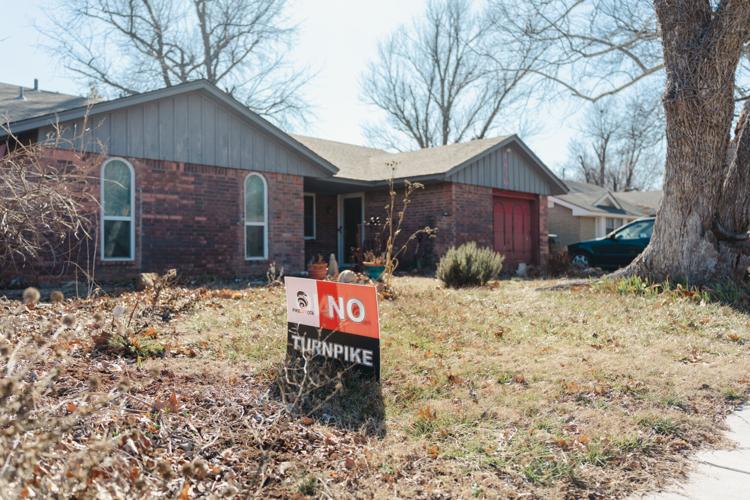
Le Blanc stood on her front porch, overlooking the “no more turnpikes” sign in her front yard. Despite the university to the west and Oklahoma Turnpike Authority’s proposed turnpike to be built to the east, her neighborhood remains underdeveloped.
“This side of town has been ignored,” Le Blanc said.
‘Taking care of the full citizenry’
Le Blanc said she’s concerned the turnpike would dump massive amounts of traffic onto underdeveloped roads, and she’s afraid the “core of Norman” will be full of toll roads someday.
“We don't need these thoroughfares,” Le Blanc said. “We need to keep up with what we have.”

Mary Elizabeth outside Feb. 22.
ACCESS Oklahoma, the OTA’s 15-year, $8 billion turnpike construction plan, was approved by the Oklahoma Supreme Court in August 2023. A year later, Norman City Council voted unanimously to reject a resolution that would have allowed the OTA to develop turnpikes through “critical areas” including the Lake Thunderbird watershed.
Two turnpikes, the East-West Connector and South Extension, would run through Norman city limits. The East-West Connector would connect Interstate 44 near Newcastle to Interstate 40 at the Kickapoo Turnpike across northern Norman, while the South Extension would connect to Interstate 35 north of Purcell, continuing through east Norman near Lake Thunderbird before connecting with the East-West Connector, according to a staff report from Aug. 27.
In September, the OTA confirmed it would not construct access or frontage roads in the Norman area following council’s rejection. The resolution was brought back to council’s agenda in October, where it was postponed in favor of a public hearing with OTA representatives. The OTA then informed the city that it would move forward without city input.
“The OTA has eminent domain powers granted to them by the state,” Rick Knighton, city attorney, said at an Oct. 15 council meeting. “There isn’t anything we can do to stop that.”
Le Blanc’s son, Cedric, and his family live in the pathway of the proposed South Extension turnpike, on 80th Avenue Southeast between Lindsey and Alameda, and are in danger of losing their home due to eminent domain, which is the ability of government entities to seize private land for public use.
“I do not want to see any more turnpike roads going in around anybody's communities,” Le Blanc said. “The OTA needs to go away there. They are not doing anything good for the state of Oklahoma.”
Cedric and his family are not putting their lives on hold because of the turnpike, his mother said, and they are continuing to build onto their home.
Le Blanc said Norman doesn’t need a new turnpike, but she believes the OTA wants to make a quick profit to benefit its developers. Instead, Norman needs to grow naturally, she said.
Le Blanc said the University North Park entertainment district — a $1.1 billion project plan that would include a new arena to replace Lloyd Noble Center in addition to housing, retail and office spaces — would be irresponsible to build. According to Le Blanc, the entertainment district could rob growth from downtown Norman by pulling economic activity away from the city’s core.
“A lot of the growth patterns that they keep doing are not necessarily conducive to taking care of the full citizenry,” Le Blanc said.
Le Blanc is a massage therapist and has owned Therapeutic Massage by Mary Elizabeth in downtown Norman for 18 years. There are often homeless encampments on her property, however, people experiencing homelessness have no other choice, she said. Le Blanc often collects personal items left behind for people to come back to retrieve.
“I don't want to make their lives more miserable, and it really is a population that we need to deal with,” Le Blanc said.
Norman continues to build unaffordable housing, Le Blanc said, and rent under $1,000 is, in her experience, difficult to find, which only perpetuates homelessness.
Le Blanc said her husband, who grew up in Norman, believes the city has changed a lot since he was a kid. She said he remembers when Norman was a sundown town, meaning Black residents were forbidden from public areas after dark, until 1967.
Le Blanc’s mother-in-law told her the city government used to be full of “Dixiecrats,” a Southern sect of the Democratic Party that favored segregation. When Le Blanc and her husband moved to Norman, the representation on council had changed.
“Those were our ancestors,” Le Blanc said. "None of us are responsible for that, but we're responsible for honestly and unbiasedly sharing information of what happened in our communities everywhere."
‘We got kids, too’
The Jacobs family has lived on the east side of Norman for 30 years. Deborah Jacobs, a 55- year-old retired occupational therapist and mother of two college-aged kids, said she and her family have seen the effects of the city’s growing population.
Jacobs said she sees Norman becoming more divided politically, claiming Norman leaders who “chase money and power” are the reason why.
“Homelessness has shot through the roof. Our community refuses to address it,” Jacobs said. “They seem to worship money and power over helping other residents.”
Jacobs said her side of town is often ignored, yet the neighborhood experiences the repercussions of major issues in Norman.
“The majority of people in this precinct voted in favor of helping the homeless, and that’s because we see it everyday,” Jacobs, a Ward 1 resident, said.
While Jacobs believes a developing Norman isn’t a bad thing, she said she has seen her cluster of neighborhoods disregarded and avoided. Jacobs said development is great as long as it doesn’t negatively impact residents.
Similarly to Le Blanc, Jacobs believes the OTA turnpike will do more harm than good. She said a new road is not worth displacing families and destroying land.
In February, the OTA unanimously voted to condemn properties, or exercise eminent domain, on the land reserved for the turnpike. According to Oklahoma law, the OTA has authorization to condemn or purchase properties.
“I don’t think it’ll serve the people I care about on my side of town,” Jacobs said. “I don’t think it needs to ruin some of the land and neighborhoods and what’s out there. We don’t need it.
“It’s just not necessary.”
The proposed University North Park entertainment district has sparked debate among Norman residents since 2018. Jacobs said she opposes the development, stating the build would be a waste of resources.
Jacobs said facilities in Norman aren’t being used and believes using tax money to build a new entertainment district is a waste. She said she would like to see older facilities, like the Lloyd Noble Center, used more frequently before building new ones.
“They do not need my tax money from this city to develop,” Jacobs said. “We have great entertainment centers. We have wonderful facilities already.”
As she looked out at her street, reflecting on her time living in the neighborhood, Jacobs said she wants her side of Norman to be prioritized. She said she sees the community prioritizing the wealthy and influential and ignoring those who need the help of the government.
“People don’t need that much. They need streets, they need sidewalks. The poor people, they’re really, really suffering right now,” Jacobs said.
“Our houses aren’t worth as much as the ones on the other side, but we got kids, too.”
Jacobs said she is an active participant in community activism, and she hopes her efforts will inspire the city to listen.
“I protested, and I’ve marched, and I will continue to do so,” Jacobs said. “I really think that if we listened to the artists, the teachers, the poets, the people that are regular people on the street, … we’ll make ourselves a better community.”
‘It’s a lovely place’
Vicki Monks, a 72-year-old retired journalist and member of the Chickasaw Nation, spent her career traveling around the world as a multimedia freelancer but somehow always found her way back to Norman.

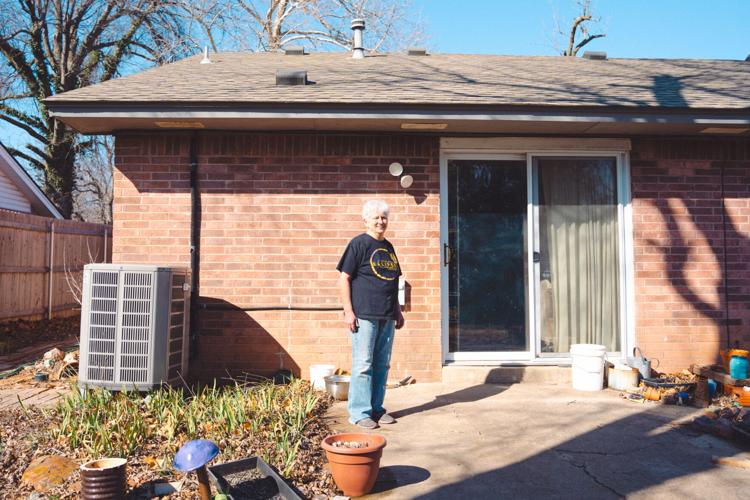
Vicki Monks outside of her house on Feb.7.
Monks graduated from OU’s H.H. Herbert School of Journalism and Mass Communication, now Gaylord College, in 1974 before traveling to chase stories. After a long and successful career in media, Monks moved from Oklahoma City to Norman in October.
“I was a journalism fellow at Stanford and then the Dallas TV (and) Washington, D.C.,” Monks said. “Then I started freelancing and traveled all over the world. I just love journalism.”
Monks will be inducted into the Oklahoma Journalism Hall of Fame in May where she will be recognized along with nine other Oklahoma journalists.
Monks is described as being “among Oklahoma’s pioneering women journalists” and has won state and national awards, including receiving a Peabody Award for her work in television reporting at Dallas KDFW.
In 2006, Monks released “Carbon Black,” a radio documentary that addresses industrial pollution of Ponca Indian land in Oklahoma. Monks received a Society of Environmental Journalists award for the project.
Monks said she has concerns about the pollution issues that could come from building the turnpike so close to Lake Thunderbird. She said runoff from the road will end up in the lake, causing further pollution.
According to the National Library of Medicine, there is a potential for runoff from any road as it accumulates chemicals that are deposited from transportation. Runoff can be caused by rain, snow and excess amounts of water, according to National Geographic.
The city of Norman reports that, while several cities contribute stormwater runoff to Lake Thunderbird, Norman is the only city that drinks the water from the lake. The report states pollution of the lake is caused mainly by stormwater runoff from roads and highways.
“There already are pollution problems concerning the lake,” Monks said. “That could be really bad for Norman’s drinking water supply, and the water’s already kind of bad a couple times a year.”
While the turnpike wouldn’t impact her personally, Monks is concerned people living in the area will be forced out of their homes to create space for the turnpike.
“The turnpike is going to be far enough away from my house that I shouldn’t be impacted by the noise or the fallout,” Monks said. “But there are a lot of people over there who will be displaced.”
Monks said after returning to Norman following years of living elsewhere, she sees how development has impacted the city. Even in her own life, Monks said she knows the effects of development all too well.
When Monks returned to Norman, she decided to take a drive down what is now known as Dean’s Row, where she lived during her time at OU. She said she owned a home, which she renovated into her dream home.
Her college home has since been replaced by an apartment building.
While she thinks building more affordable housing is important to the development of Norman, Monks said she hopes the city will maintain its small-town charm.
“I guess for campus housing, eight apartments beats a duplex, but the character and the charm of that house is something I think that the neighborhood misses,” Monks said.
Standing on the front porch of her new home, Monks could hear the sounds of children playing at the school down the street and families walking together, which she said reminded her why she was drawn back to Norman.
“There’s just a lot of community support, and it’s a lovely place,” Monks said. “If you’ve got to be in Oklahoma, Norman’s the place to be.”
This story was edited by Peggy Dodd, Ana Barboza, Ismael Lele and Anusha Fathepure. Sophie Hemker, Grace Rhodes and Mary Ann Livingood copy edited this story.


