

The Oklahoma Turnpike Authority revealed it will not build frontage roads or other amenities within Norman, following the city council’s rejection of ACCESS Oklahoma.
Last Tuesday, council unanimously rejected a resolution that would have allowed two ACCESS Oklahoma turnpikes through Norman, including the East-West Connector and the South Extension Turnpike.
ACCESS Oklahoma is a $5 billion, 15-year plan to develop new turnpikes and expand existing highways across the state. It was approved by the Oklahoma Supreme Court in August 2023.
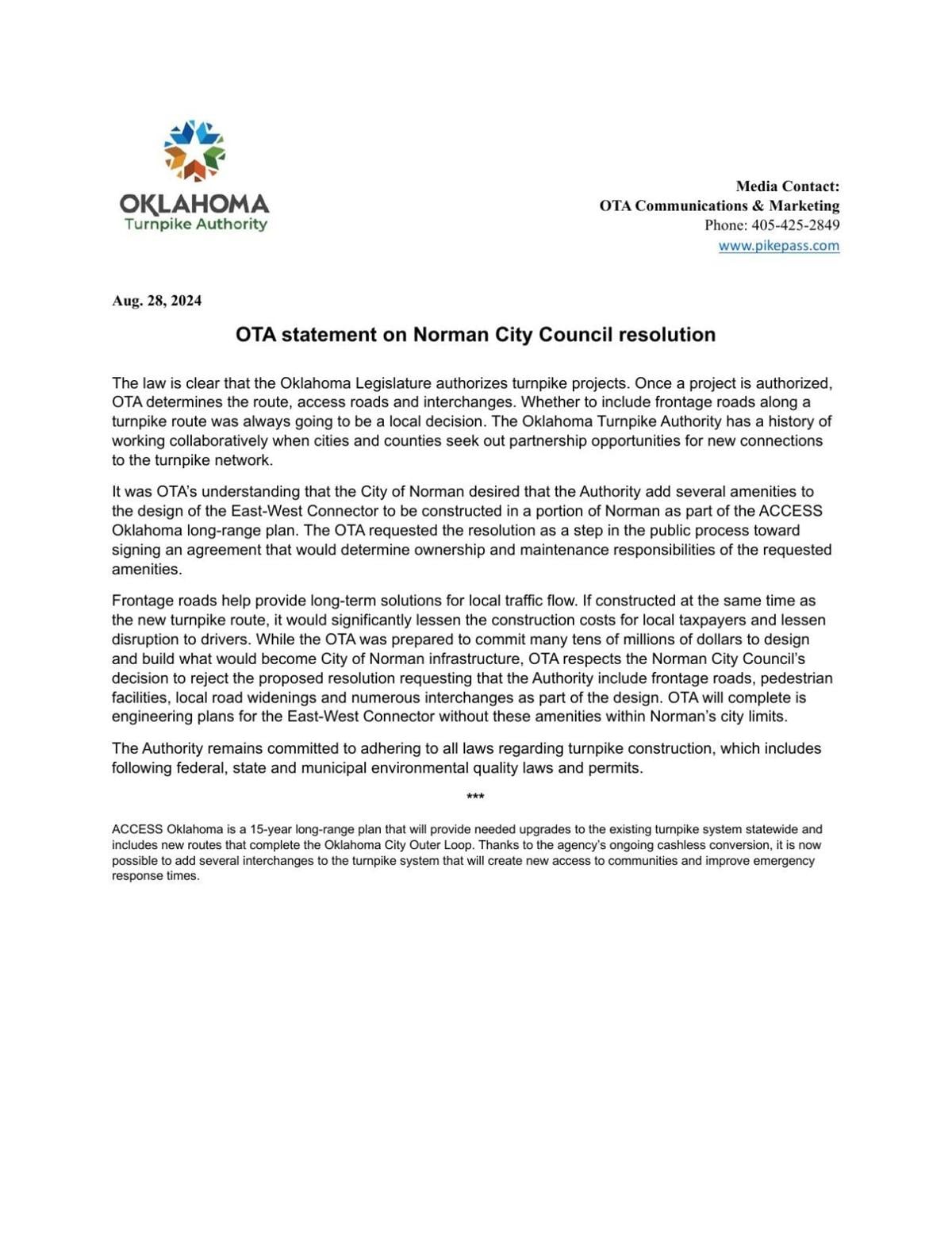
According to a statement from the OTA last week, the inclusion of frontage roads is a local decision. The OTA wrote that the city requested for several amenities for the East-West Connector, which would have been included in an agreement following the resolution.
“The OTA requested the resolution as a step in the public process toward signing an agreement that would determine ownership and maintenance responsibilities of the requested amenities,” the OTA’s statement wrote.
According to the statement, constructing frontage roads alone would cost more for taxpayers than if they were constructed alongside a new turnpike.
“Frontage roads help provide long-term solutions for local traffic flow,” the OTA’s statement wrote. “While the OTA was prepared to commit many tens of millions of dollars to design and build what would become City of Norman infrastructure, OTA respects the Norman City Council’s decision to reject the proposed resolution, requesting that the Authority include frontage roads, pedestrian facilities, local road widenings and numerous interchanges as part of the design.
“OTA will complete its engineering plans for the East-West Connector without these amenities within Norman’s city limits.”
In an email to OU Daily, Lisa Shearer-Salim, OTA communication & marketing manager, wrote the preliminary estimate for the frontage roads was more than $150 million, including the right-of-way for construction.
“OTA was offering to partner with the city by purchasing the (right-of-way) and constructing the frontage roads,” Shearer-Salim wrote. “However, frontage roads would be part of the local infrastructure system, and therefore, the city would be the owner and maintain them after construction.”
Shearer-Salim added that the lack of frontage roads reduces the amount of property necessary to build the East-West Connector, while lessening its footprint.
“There is a cost to changing the design plans as OTA had in good faith put the local infrastructure requests into our ongoing design planning,” Shearer-Salim wrote. “The cost of changing the engineering design is not known yet but will be clearer in coming weeks as design work progresses.”
In a press release from Aug. 28, Randy Carter, Pike Off OTA director of strategic communications, wrote that Norman legally cannot be excluded from the ACCESS Oklahoma planning process.
Pike Off OTA is a non-profit organization designed to prevent OTA expansion.
“OTA cannot legally withdraw its cooperation or refuse to provide access roads or other infrastructure necessary to integrate new toll roads into the transportation architecture of the city,” Carter wrote. “By rejecting OTA’s proposed ‘cooperation resolution,’ the City of Norman affirms its right to self-determination and refuses to subordinate its own interests in the building process."
Carter wrote that the city has the final say in agreements regarding highway construction, citing the Oklahoma Turnpike Authority Enabling Act. Oklahoma statute 69, section 1716(b) notes all counties, municipalities and political subdivisions in Oklahoma can grant, lend, lease or convey land to the OTA at its requests if such municipalities, counties and political subdivisions deem the request reasonable.
According to Shearer-Salim, Norman is still considered a project partner in the ACCESS Oklahoma process but would need to reach out regarding local infrastructure requests connecting to the turnpike.
“We naturally will continue to work with the city on any issues of concern,” Shearer-Salim wrote.
According to Shearer-Salim, the OTA will move forward with its ACCESS Oklahoma plans and intends to open the first segment of the East-West Connector by late 2027.
This story was edited by Anusha Fathepure and Ana Barboza. Josh McDaniel and Sophie Hemker copy edited this story.


