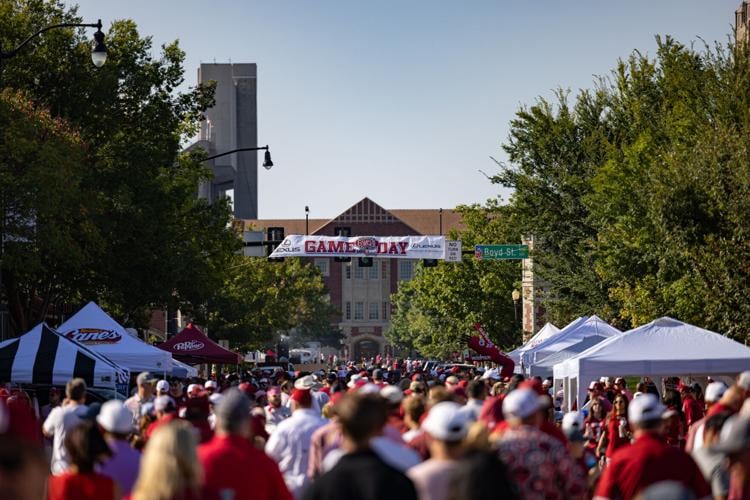


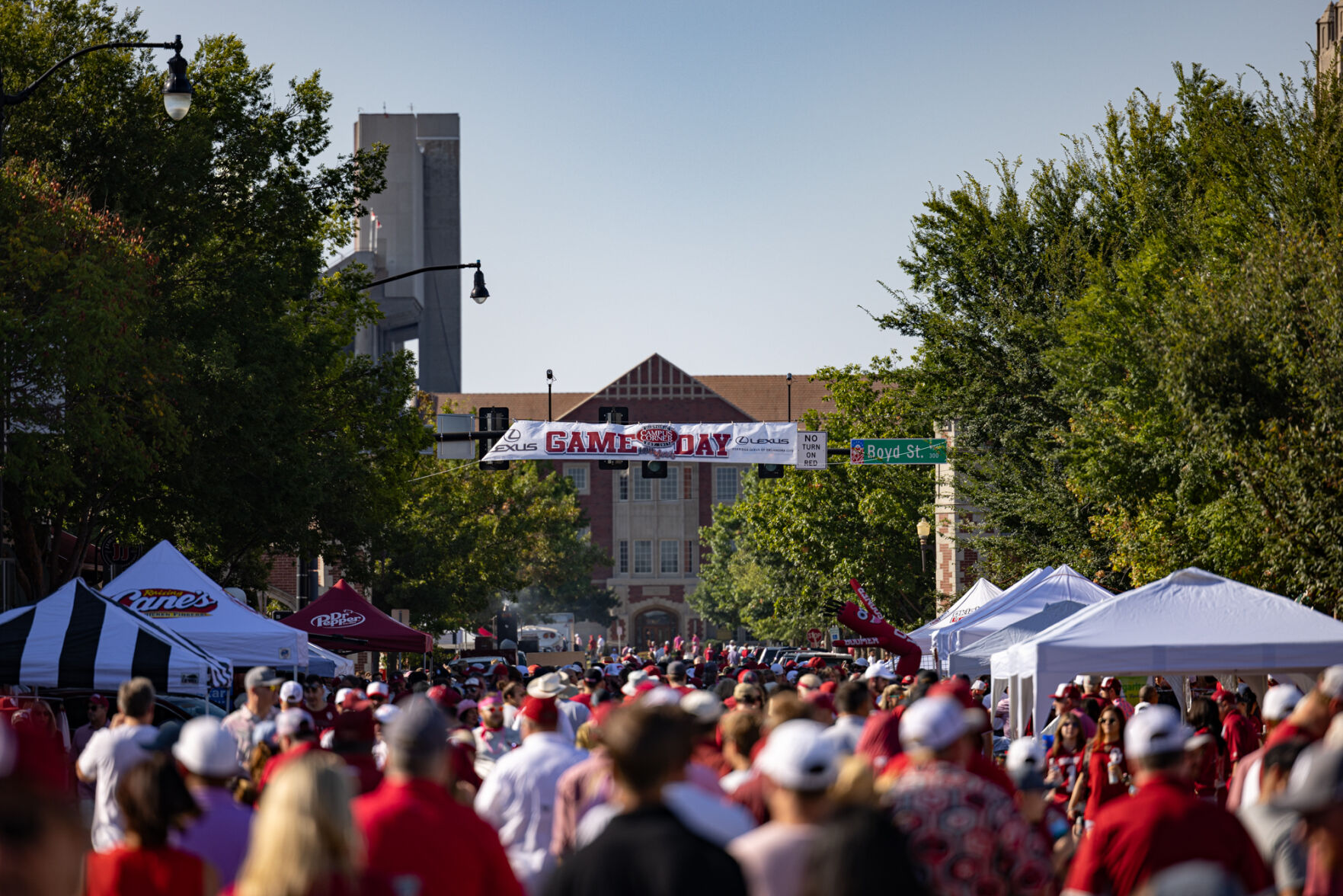
Campus Corner packed with OU fans on the morning of the Arkansas State football game on Sept. 2.
Editor's note: This story is featured in OU Daily's fall magazine, which will be available in print in mid-October. Check out the other featured stories at the bottom of this article.
Oklahoma’s first game of the 2023 season marked the beginning of the end of its time in the Big 12 Conference.
On the cusp of a new era, it was also the first time since 2017 that fans were allowed to tailgate on Lindsey Street. With very few opposing fans and an 11 a.m. kickoff, the game was a tough sell, and the new tailgating zones flopped.
In 2023, OU (4-0, 1-0 Big 12) is hosting its traditional six home games, a relatively lackluster slate that brought Arkansas State and SMU and will bring Iowa State (2-2, 1-0 Big 12) at 6 p.m. Saturday, before welcoming UCF, West Virginia and TCU to Norman.
From Evans Hall to City Hall, OU and city leaders are determined that 2024, when OU transitions to the Southeastern Conference and gets a rare seventh game in Norman, will look different.
Compounding with that excitement is the fact that along with nonconference matchups with Temple, Tulane, Maine and Houston, the Sooners will host marquee conference games against Alabama, South Carolina and Tennessee. Norman officials expect the road traveling parties for OU football games in the SEC to at least double and maybe even triple.
The current average economic impact for Norman during an OU football weekend: $11 million.
The current average economic impact for Tuscaloosa during an Alabama football weekend: $30+ million.
While Tuscaloosa city officials refer to the boost in the Crimson Tide’s economy as “The Saban effect,” it serves as a blueprint for Norman’s leaders to follow and to see what is possible for a town that houses a blue blood program in the conference.
“It's very safe to say that (visitor traveling parties are) going to be significantly higher in 2024 than what we’ve experienced in the last few years,” Scott Martin, president and CEO of Norman Chamber of Commerce, told the OU Daily. “In the past it has been kind of a one-off big game.
“In addition to these great traditional rivalries we've had with other colleges and universities even in state I mean, our in-state rival (Oklahoma State) is always great. Great game, great experience, all those things. But just to have consistently more fantastic games and rivalries is going to be really neat.”
Research from Learfield’s 2021 Intercollegiate Fan Report shows there are more college sports fans in the United States than there are for any professional league. Over 182 million individuals across all 50 states have a favorite college team or teams that they follow regularly. Of the teen and adult population, age 12 and older, 65.5% identify as college sports fans. By comparison, 64% identify themselves as fans of the NFL, the most popular professional league.
College sports’ popularity, and the revenue it generates, was the driving force for Oklahoma and Texas to bolt a year early from the Big 12 to the SEC in time for its $3 billion television deal with ESPN. The universities, which the Big 12 announced in February would forgo $100 million from the conference under an agreement to leave early, will suffer a lesser financial impact than originally thought.

OU, per its top leaders, couldn’t wait any longer to secure a more stable future.
Since 2005, USA Today has tracked revenue and expenses for more than 230 public NCAA Division I schools. In data covering the 2022 fiscal year it published in April, OU was one of just 12 schools to be self-sustaining.
Five are from the SEC (LSU, Texas A&M, Kentucky, Arkansas and Mississippi State), four from the Big Ten (Ohio State, Penn State, Nebraska and Purdue) and three from the Big 12 (Texas, Kansas State and Oklahoma).
Of those 12, in the most recently available data, OU’s margin of self sufficiency was the narrowest, at $1,322,760. By comparison, the top revenue-generating program, Ohio State, was $25,881,927 in the black.
With the move, OU President Joseph Harroz Jr. has said the university will avoid passing along to students part of the burden of helping underwrite the Sooners’ athletic successes. Furthermore, not only do SEC institutions benefit from being in the conference, but their host cities get transformed economically, which Norman officials are preparing for less than a year from the transition. In Tennessee's economic impact and community benefits report from 2017, an average football game weekend reflected an average of $42 million, almost four times the average economic impact Norman sees on a given weekend.
Leaders will tell you there’s work to be done to get Norman where it needs to be, but the city, its officials and the university are proactively working toward improvements — not just for next year, but for decades to come.
“You get one time to make a first impression,” Martin said. “So, we’ve got to work really hard to be prepared next summer and next fall when these guests come to town.”

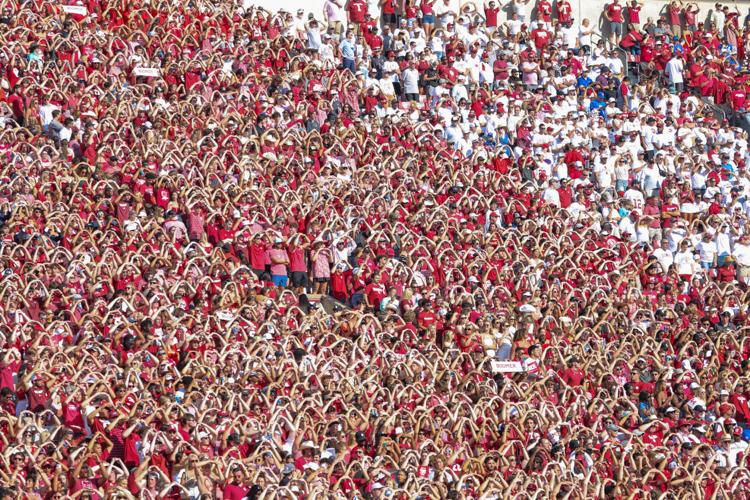
OU Fans during the game against SMU on Sept. 9.
More visiting fans expected
One thing officials are sure of is that SEC fans travel.
The minimum ticket allotment for the conference is much greater than it is for the Big 12. It requires at least 5,000 visiting tickets, including 2,000 in the lower level of its stadiums.
The Big 12 requires each home school to provide a minimum of 2,500 tickets for visiting Big 12 teams. For years, OU relied on nonconference and some conference schools to give back tickets for the school to resell, which the SEC does not allow.
More visitors means more business for Norman. Daniel Schemm, Visit Norman’s executive director, is already seeing this in his team’s projections.
“They're coming, and they're spending double, which means double the sales tax as well,” Schemm told the OU Daily. “For those big games also, you have more visiting fans coming. So more visiting fans here means more restaurants and more food.
“The visitors stay longer than someone coming from Edmond. So if you're coming from Ohio State or Alabama or Georgia or wherever, you're coming longer. You're experiencing more because it's more of a vacation and an experience. You're spending more money while you're here.”
The city saw this during high profile home nonconference matchups with Notre Dame in 2012, Tennessee in 2014, Ohio State in 2016 and Nebraska in 2021.
For example, Schemm says the typical average daily hotel rate for any given game weekend in Norman was $189. When the Buckeyes came to town, that number jumped to $400.
Talking to Norman hoteliers this summer when OU’s 2024 conference schedule was released, Schemm says projections already show rates will double or triple in some cases. Currently, OU fans from around the state make up a lot of the travel to Norman for a game weekend.
The SEC will bring more visitors from the opponent’s turf.
Lawrence McKinney, president and CEO of the Norman Economic Development Committee, and his wife Elizabeth see tremendous potential in Norman and the opportunity the SEC move presents to the city.
It’s why they, along with other city leaders, unveiled plans for a $1 billion entertainment district at Rock Creek Road and 24th Avenue Northwest to host OU basketball games and gymnastics meets, as well as other events. The proposed plan will be debated by city council this fall with a vote expected to come before the end of 2023 or in early 2024.
“(I’m) very excited,” OU Athletic Director Joe Castiglione said. “ … (If it passes), it becomes a hub. A hub for activity, a hub for new jobs, a hub for attracting people to live, work and play in Oklahoma. And for us, a state of the art sports venue that highlights our three teams — men’s and women’s basketball and women’s gymnastics — but also puts us in the forefront to go after some other NCAA championship events.”
Lawrence has over 35 years of economic development experience in Georgia and Florida but says Norman is a unique challenge. City leaders and residents have been at odds for years not only over a new arena, but also the broader direction of Norman.
“What’s held a lot of the community back,” Elizabeth told the OU Daily, “Is it’s really hard when we want things the same, people who have been here a long time. We like it how it is, (change is hard).”
The McKinneys, as well as other Norman leaders, have Missouri and Texas A&M to learn from. The two schools departed the Big 12 for the SEC in 2012 and serve as a study on transitioning to the conference.
While studying different SEC schools, one area OU lacks in is its homecoming parade. The McKinneys arrived in Tuscaloosa on Oct. 22 for Alabama’s matchup with Mississippi State with no inkling about just how busy campus would be during the Crimson Tide’s homecoming.
“It lasted at least an hour longer,” Lawrence told the OU Daily. “There were so many more activities and floats and stuff in this thing. It was just in the community pride and in the spirit.”
When they arrived back to Norman, Lawrence passed this along to OU and heard that as long as the Sooners were in the Big 12, most of their games would kickoff at 11 a.m. This year, that’s led OU to move its homecoming parade into Friday night.
Another factor of Norman that’s unique compared to other SEC towns is its football stadium sits about two miles from a major interstate.
It also has features both metro and rural areas contain, being 20 miles south of Oklahoma City. Another rarity is OU’s football stadium sits less than four miles from Max Westheimer Airport, a complex adjacent to the new proposed basketball/gymnastics venue, and one officials envision upgrading in the years ahead.

View of a bustling Asp Avenue on game day Sept. 2, 2023.
Campus Corner
As the north entry to the university, Campus Corner is an area many see with high potential for improvements.
Lawrence says Fortune 100 companies around the country are interested in Norman, with the historic neighborhood as “a focal point.”
“We've got some nice businesses, some quaint businesses,” Lawrence said. “It does well, but it doesn’t do well year-round, and it is the entrance to the university, right? So, the doorstep of the university needs a serious upgrade.
“It needs upgrades on its infrastructure, the roads, the sidewalks, the lighting. Certainly, the businesses could look and feel different than what they do today. With more restaurants, bars, specialty shops and so there's some plans in the works.”
However, Team Norman has also discussed a “Campus Corner remake,” in other locations around the city. One location Lawrence envisions is the 696 acres Griffin Memorial Hospital occupies northeast of campus, but it’s unclear what would potentially replace it.
The Oklahoma Department of Mental Health and Substance Abuse announced Sept. 12 it will construct a new behavioral health hospital on the Oklahoma State University-Oklahoma City campus replacing Griffin as the state’s primary mental health hospital.
McKinney says those he’s working with are “close” to figuring out where they fit in with the potential offers for the Griffin land and expects an update by the end of the year.
The main message from Norman’s leaders is Campus Corner needs more.
“We've got the bones and a really great historic downtown,” Martin said. “But we need more. … Our downtown Campus Corner area needs to be a priority for everybody. We always need to be looking for more unique restaurants and shopping opportunities. An area that I think we could really excel in and that we could improve in is live music.
“Most of the places we visited had some fantastic live music on the Friday night before the home football game. And so we've got some but I think we all agree we need more entertainment and things like that around these games.”
One of NEDC’s main priorities is figuring out how to keep OU students spending their dollars in Norman and not going to concerts or bars in OKC or Tulsa. Lawrence is hopeful Campus Corner will see improvements in the near future.
After releasing master plans for the west and east sides of the city, the next step is to put together a master plan for the south side, which includes Campus Corner.
“I do think you're going to see some new things down there,” Lawrence said. “ … Businesses are going to come in, and I'm sure they're going to do well there but it's not as big as it should be in terms of things to do that are year-round.”

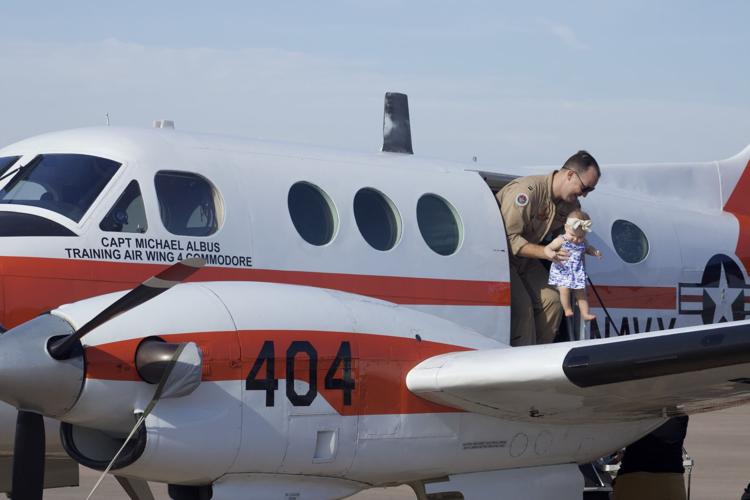
A festival attendee brings his baby out of an airplane at the 17th annual aviation festival at Max Westheimer Airport Sept. 23rd.
Max Westheimer Airport
Another unique feature about Norman and OU compared to current SEC schools is the closeness of an airport to campus.
The airport isn’t fit to welcome commercial flights or team jets, but it is the base for traveling fans to fly in privately. Lance Lamkin, the airport’s administrator, expects a significant increase in air traffic with OU’s move to the SEC.
Currently, the airport sees an average of 25 to 45 aircrafts flying in specifically for a football contest in the Big 12 against a conference opponent that is unranked and not a rival.
When Nebraska traveled to Norman in 2021, Lamkin said there were 70 to 90 flights throughout the day. While he has no way of predicting SEC crowds, he expects the number to be similar.
“All I know is that there will be more,” Lamkin told the OU Daily. “The trend that we've seen is the bigger the games, the more people that are going to come to the college and come to Norman to attend the game here. I won't even try to guess on it. I've contacted several different airport managers and other SEC towns across the southeast, and there's just no way of knowing the traffic count until it gets here.”
Rep. Tom Cole (R-Okla.) of Oklahoma’s 4th Congressional District has backed legislation requesting $34 million in upgrades to Westheimer, which would bring more runways and better infrastructure ahead of the influx of SEC fans.
“We're just trying to capture the biggest market we can, and the only way to do that is to expand our runway a little bit longer and beef up the runway to be able to handle the heavier aircraft,” Lamkin said. “And (Cole’s) bill will help us do that and that bill will also help us expand our hangar development areas, which has been greatly needed out here at the airport, for at least the last two decades.”

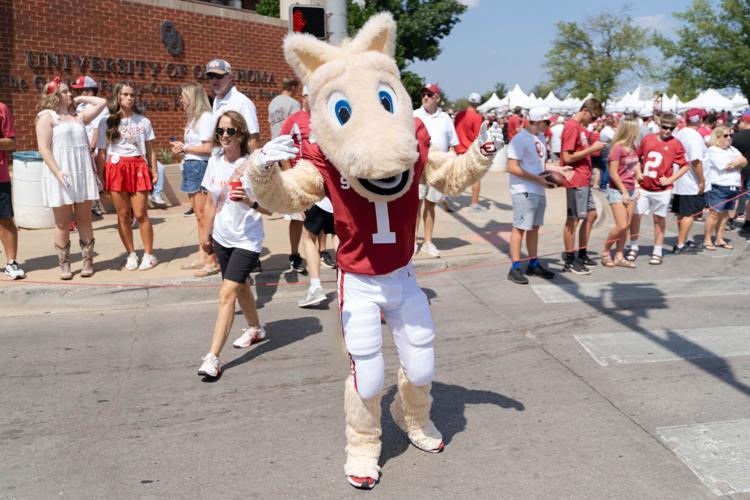
Boomer during Walk of Champions on Sept. 9.
‘It’s a new day’
OU athletics is working in real time on game days to improve its game day operations.
This includes adjusting its tailgating strategy, which improved along Lindsey during Week 2 with the addition of speakers and increased advertising, and finding a signature song to play during the game to increase fan engagement. OU also installed upgraded LED lights last season to put on light shows other SEC schools have for years.
This is the good stuff, Lindsey Street. pic.twitter.com/8dGAP3lxv2
— Colton Sulley (@colton_sulley) September 9, 2023
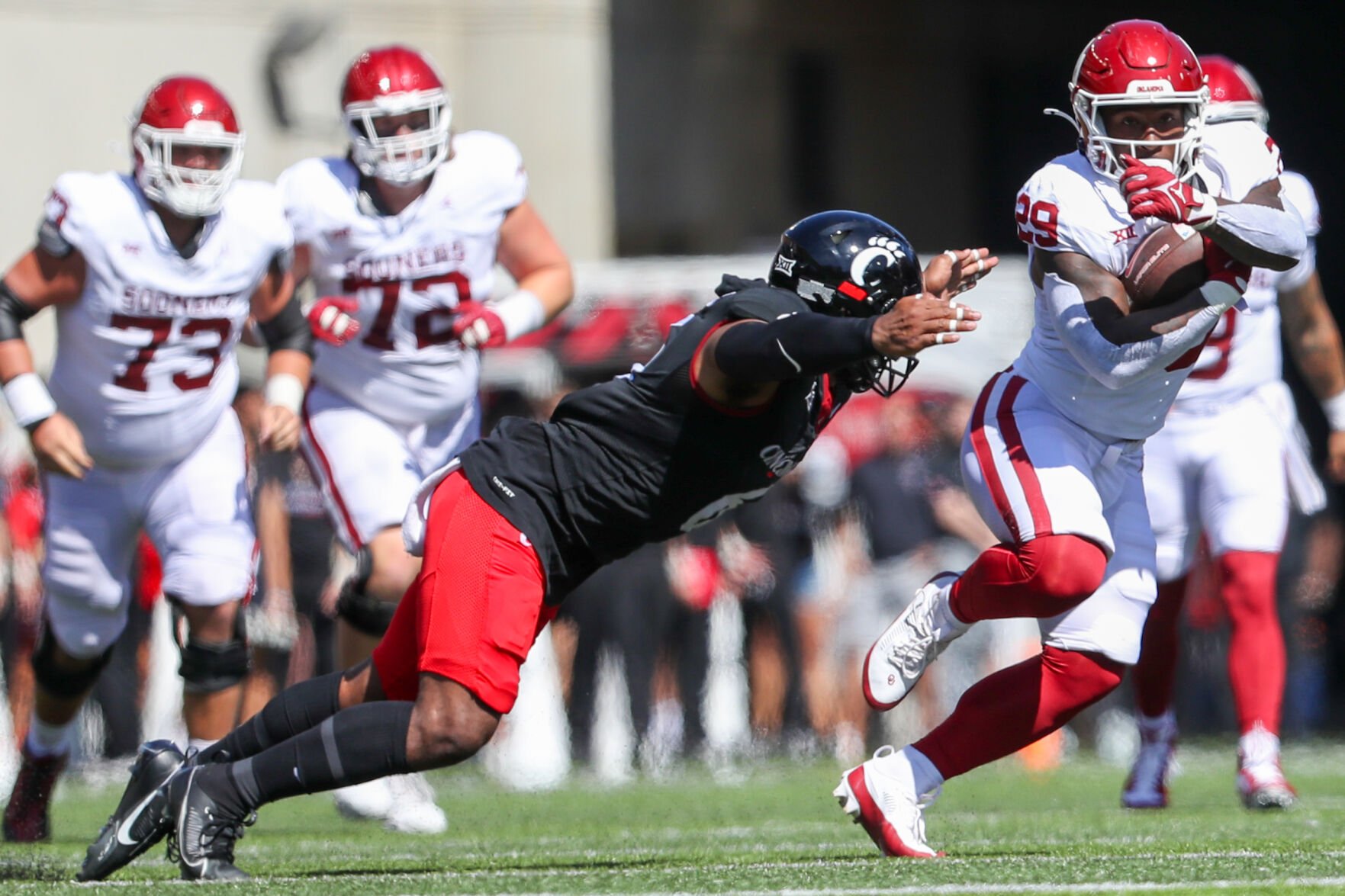
Traveling to various road sites during the season offers insight into game day improvements. When the Sooners defeated Cincinnati 20-6 on the road Saturday, Nippert Stadium’s crowd of 38,193, less than half of what Gaylord Family-Oklahoma Memorial Stadium holds, affected the game.
The Bearcats’ end zone student section is supplied with thunder sticks, and the crowd is prepared with organized chants.
Castiglione and head coach Brent Venables are going to continue doing what they can to ensure OU competes on the football field, while city leaders work to get Norman ready.
The announcement of the entertainment district was a step in the right direction to them; however, only time will tell if it passes or spurs greater change.
“It's a new day,” Elizabeth said. “ … We're all competing on every different level. OU is competing in football and to get the best, the best professors and researchers and students to come to their school. We're competing for talent.
“In everything, there's a theme of competition there. Every community around us and every state is competing. So if we don't get in the game and change our mindset about why it is important to evolve, we're left behind.”
Read other stories featured in OU Daily's fall magazine: