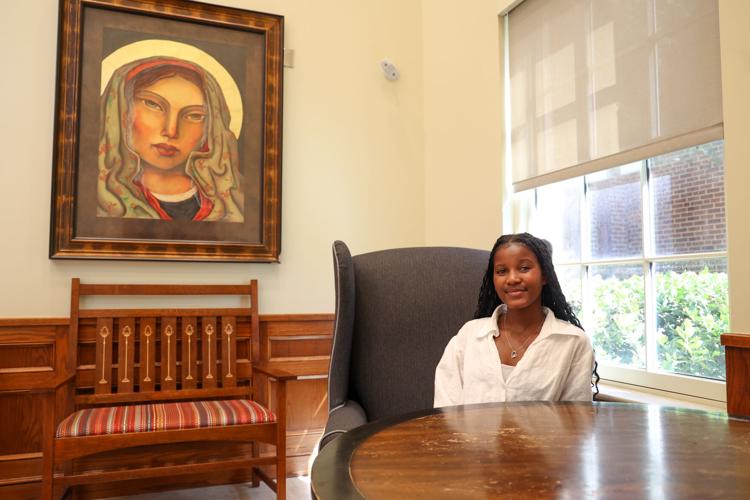


Senior Mandi Kanhema sits in her 'special spot' in Farzaneh Hall. Kanhema is the president of the OU’s International Advisory Committee.
Editor's note: This story is featured in OU Daily's fall magazine, which will be available in print in mid-October. Check out the other featured stories at the bottom of this article.
This article was edited at 5:48 p.m. on Oct. 19 to correct an attribution to a quote from Kanhema that was previously attributed to Schultz.
Crossing the South Oval, Mandi Kanhema lugged a plastic tub of decorations and materials the International Advisory Committee will use to host events during the school year.
Since she doesn’t have a car, Kanhema rushed to get from the Oklahoma Memorial Union to her job at the Honors College as a student assistant on time. She works 20 hours per week between two jobs to make ends meet while studying as a pre-medical student.
These are only a few of the responsibilities Kanhema juggles while facing obstacles as an international student on campus.
Kanhema, a student from Zimbabwe and president of OU’s International Advisory Committee, said struggles such as not having a car, are common for members of the international student community. Limited work hours and resources are additional challenges for the community while studying at OU.
“It all boils down to how resources are provided to you,” Kanhema said.
Emelie Schultz, vice president of the OU Student Government Association, said international students’ struggles are complex.
Schultz, who is originally from Sweden, said that international students are unaware of many things that can be common knowledge for American students.
“There are so many levels that you have to go through to just make it to the basic level. You need legal advice because you could compromise your F-1 visa. You need to build a good credit score. … Not every career or college decision is just an application. There is always a process that many international students don’t know about,” Kanhema said.

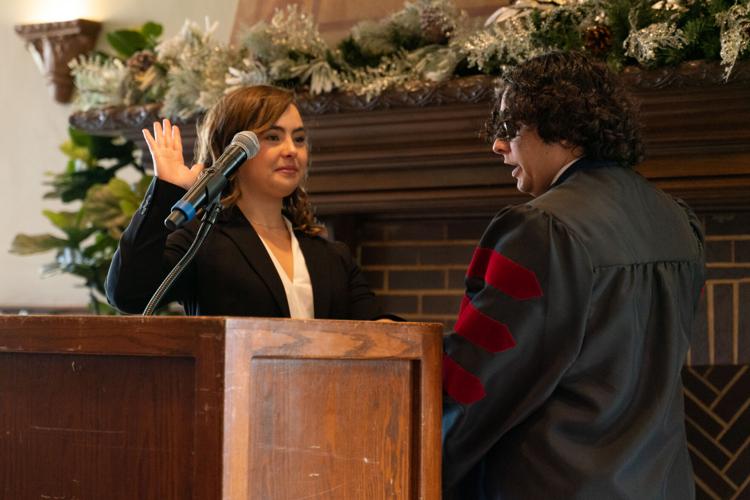
2023 SGA vice president Emelie Schultz during the University of Oklahoma Student Government Association Presidential inauguration on Dec. 5.
At OU, international students who are enrolled full-time and in valid F-1 status can work for a maximum of 20 hours per week while classes are in session. To avoid violating their visas, they are limited to on-campus jobs, meaning they can earn between $7.25 to $10 per hour. If students work off-campus jobs, they must count toward degree requirements.
Kanhema said most international students are eager and willing to work, but these limitations restrict opportunities.
“It's that aspect of trying to navigate your life here and trying to make ends meet when you don't have the capacity to do that,” Kanhema said.
Schultz said the financial strain could be exacerbated in situations where international students need to send money to their families on top of covering their own expenses.
Schultz and Kanhema said the limitation on work hours and wages can create obstacles for international students that affect other parts of their lives.
International students often don’t have driver’s licenses or access to a vehicle. Schultz said there can be safety issues for students who need to rely on others, sometimes even strangers, for rides.
Schultz emphasized the importance of protecting international students from unsafe situations. She said students can use rideshare services, like Uber, Lyft or Norman’s public transportation system, but these services often include high prices, unreliable timing and potentially dangerous circumstances.
Schultz said she was excited this year about OU SafeRide’s partnership with Norman On-Demand, a pilot microtransit program for late night and Sunday service in core Norman. The program extends available transportation options and is accessible to all residents of Norman, including OU students. The first six trips are free and will be $2 after. Schultz said this partnership could potentially be a cost-friendly transportation solution for students.
Kanhema said last summer, she was offered an internship at the American Heart Association in Oklahoma City.
It was an opportunity she could not refuse, but public transit was not a reliable way of getting to work. Kanhema spent approximately $100 per day, five days a week for 10 weeks, to travel back and forth between Norman and her internship.
Kanhema said working at the lab helped build her resume and learn as a scientist, but it took a toll on her.
“You are having to journey back and forth, but it's such a great opportunity to build yourself as a person,” Kanhema said. “It's one of those (situations) where I know a lot of international students have passed on a lot of opportunities because of the transportation aspect.”
Kanhema said these difficulties are not limited to summer internships. As a pre-med student, she has struggled with transportation to get volunteer and clinical hours; most medical schools expect at least 100 hours of volunteer and clinical hours each.
“You're making yourself vulnerable to just reaching the basic level of being a successful student,” Kanhema said.
Karen Molina Castro, student programs coordinator with International Student Services and former international student from El Salvador, said even if international students want to get their driver’s licenses, they run into a number of difficulties.
Students have to ask a friend to dedicate time and their own vehicle to teach them how to drive. Alternatively, students can attend a driving school, but those can range from approximately $300 to $800, money many cannot spare.
Castro said that even if international students manage to get driver’s licenses, cars can be an expensive investment, especially if students are not sure if they are staying in the country post graduation. Castro said that when she was a student, some friend groups pooled money to buy a car to share between them.

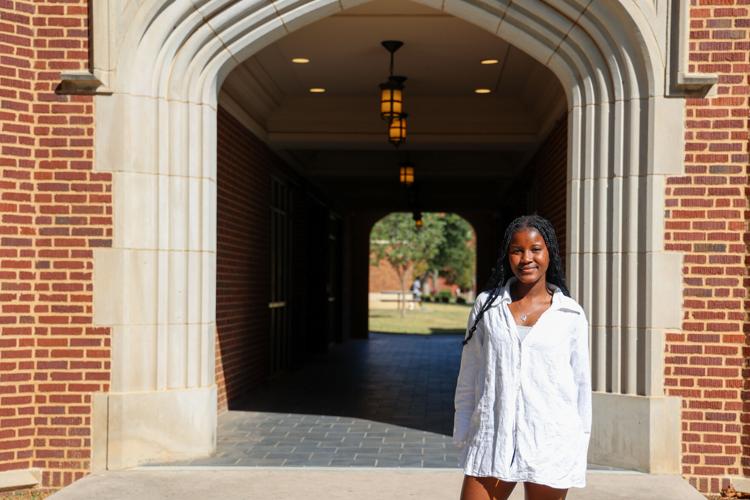
Senior Mandi Kanhema struggles as an international student with transportation. Kanhema is from Zimbabwe.
Schultz and Kanhema said that asking someone for a ride can be a very vulnerable experience, even if they know their friends are willing to volunteer.
“It's about the whole integration of international students in the American student society because it creates a barrier,” Schultz said. “If you tell your American friend, they always say, ‘God, just tell me. I can drive you everywhere.’ But then, when you do, you become a strain?
“You become dependent on your friend; … that enhances the gap between international and American student groups.”
Without transportation and reduced funds because of work limitations, international students can often face food insecurity.
“It's really very important to highlight that because I think a lot of people have been like, ‘Okay, I'm really hungry,’ or ‘I didn't make it to dinner, and I don't have anything at home. I'm just not going to eat.’ That becomes a big issue.” Schultz said.
Kanhema and Schultz described experiences of using water in oats after their milk had spoiled because they didn’t have a car to drive to the grocery store.
“It easily (becomes) secondary. Not because food is not important, everyone knows food is important, but it's your classes, your clubs … all the other things that are going on for international students,” Schultz said. “Buying milk is just not the first thing that you prioritize.”
Being far from home can be difficult for students, especially if their families are facing difficulties abroad.
Engineering junior Ziyad Asli is from Marrakech, a city in Morocco that was recently hit by the deadliest earthquake in the area since 1960 with a reported magnitude of 6.8.
Asli’s family safely escaped the damage, but when he first found out about the earthquake, Asli said he struggled to get in contact with his family because of network connection failures. He spent a day calling friends, frantically trying to get more information.
“During that instant of time when I was trying to find my family, I felt like I would have no one else in my life,” Asli said. “I felt very alone for a short period of time.”
Asli said that, in these times, it's important for everyone in the OU community to come together and support those impacted abroad and in Morocco. He said awareness and acknowledgment are the first steps in supporting your international friends.
Kanhema said the combination of work limitations, financial stress, homesickness and food insecurity can deeply impact international students' mental health.
“I know a lot of students that start off with such a great level of academics, but they just trickle down because of these things,” Kanhema said. “These factors compound because of the helplessness that is associated with not even being able to help yourself.”
Schultz said because of the unique difficulties international students face, they can feel isolated from the rest of the university. The lack of transportation can prohibit students from attending social events occurring off campus which can make students feel even less connected to their peers.
“If you stay in your American bubble, and you don't have an international friend, you won’t understand their lives, and they won’t understand yours,” Schultz said.
Read more stories from our fall magazine:

This story was edited by Alexia Aston, Taylor Jones, Peggy Dodd and Karoline Leonard. Cooper Marshall, Avery Avery, Nikkie Aisha and Mary Ann Livingood copy edited this story.


