

OU Max Westheimer Airport on April 23.
A crimson and cream King Air 350 taxied up the tarmac of Norman’s Max Westheimer Airport while its engines purred before takeoff.
In seconds, the plane’s propellers spun to life, and its metal frame jolted forward before it soared into the sky. Like that King Air 350, Norman’s Max Westheimer airport, OUN, is set to ascend from its quiet universe into a new beginning as OU gears up for its SEC move on July 1.
OUN is the gateway to Norman and the University of Oklahoma. On April 4, the airport secured $36.5 million as part of the fiscal year 2024 appropriations package for infrastructure improvements and runway expansion.
Those upgrades come as Norman is set to see an increase of SEC air traffic over the next several years, which will result in larger private jets and rich out-of-state SEC fans, donors and alumni visiting Norman during gamedays.
“We're going to put on the best face we possibly can as people come in from the SEC.” Lance Lamkin, the airport’s administrator, told OU Daily. “It works out beautifully for us.”
Many city and university leaders view the airport as a future pillar to the proposed $1.2 billion University North Park entertainment district, a hub for OU athletics and opposing programs to fly in and out of and, less likely, a home for commercial airlines.
With ideas surrounding a potential entertainment district, which includes a new 8,000-seat arena to replace the 49-year-old Lloyd Noble Center, a corridor connecting the airport to the district is a centerpiece of the proposal.

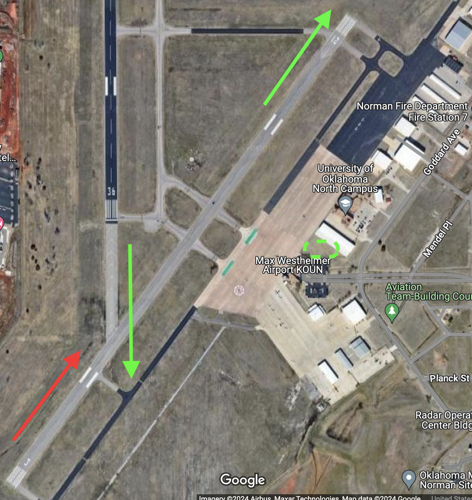
The green arrows indicate where the two runways will be extended, while the singular red arrow shows where northeast-facing landing strip will shortened. The green dotted area represents where the new, 108-foot air traffic control tower will be constructed.
While those are just mere ideas, those points of tension are indicative of Norman and Max Westheimer’s evolution into SEC country.
“We know that this airport, right now, cannot handle not just the volume, but also the aircraft SEC fans bring in because they're too heavy,” OU President Joseph Harroz Jr. told OU Daily. “A lot of folks do not want to travel, especially those that do spend a lot of money, unless they have the convenience of being able to do it here.”
According to Lamkin, the southbound runway — the airport’s largest landing strip — will be repaved and extended from roughly 5,200 to 6,800 feet. Its northbound runway will be shortened to accommodate the southbound tarmac’s extension and will be elongated to the northeast.
With its current infrastructure, Max Westheimer’s design aircraft is a Bombardier Challenger 300 — which is a business jet that accommodates eight passengers and has a takeoff weight of 38,850 pounds — but that’s set to change with upcoming improvements. Over the years, the airport has seen an influx of Gulfstream Vs and IVs, but there’s only so many it can land before the airport diminishes the 20-year lifespan of its asphalt runway.

Once the renovations start, OU’s largest runway will be closed for a year, meaning private jets won’t be able to fly in and out of Norman. While there is no timetable for the construction, the plans will increase the airport’s sustainability in the future.
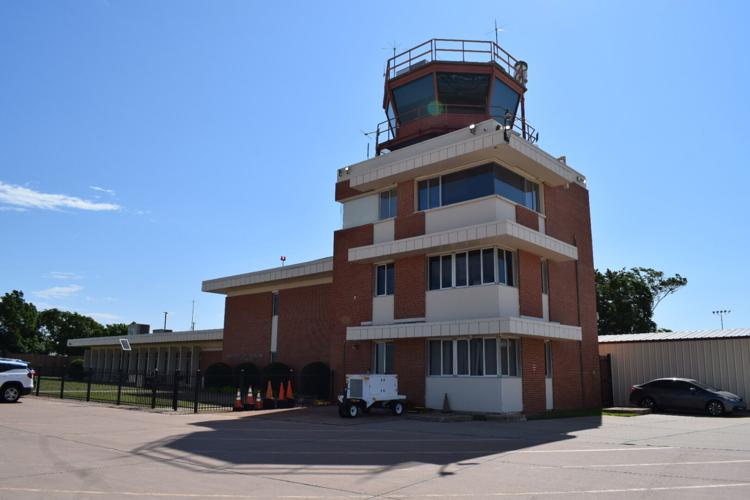
The renovations will double the max landing weight for planes at OUN from 50,000 to 100,000 pounds. The airport will also build a new 108-foot air traffic control tower adjacent to its current 42-foot tower.
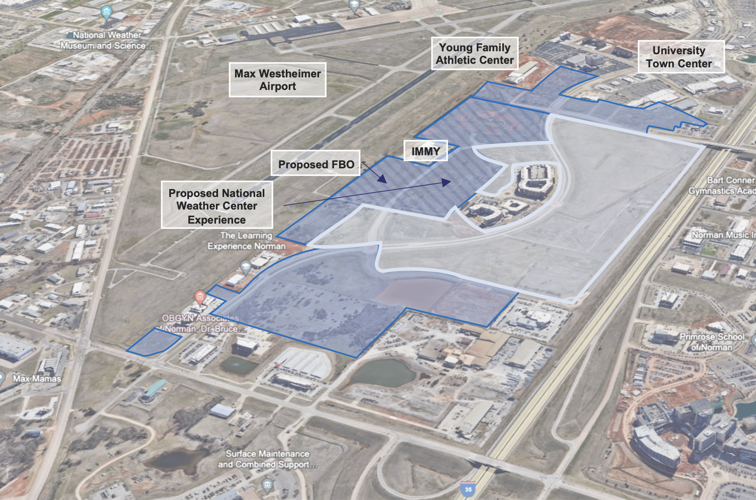
City leaders have also expressed interest in constructing a second, 68,000 acre fixed-based operator, or FBO — an organization or company granted the right by an airport to provide fuel, hangars, maintenance and other aircraft services — on the west side of the airport alongside the proposed entertainment district.
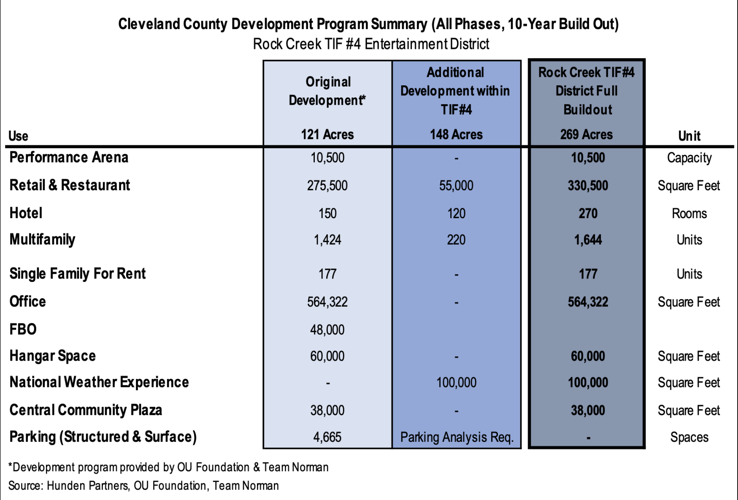
The current proposal, which was approved to be adopted to Norman City Council by the city’s review committee on Thursday, also includes 48,000 acres for additional hangar space in that same area. Currently, Max Westheimer has 68 hangar tenants, and it plans to construct 35 additional hangar spaces in a zone referred to as The South 24 acres.
Lawrence McKinney, the Norman Economic Development Coalition president and CEO, wants to use the airport to provide direct access for traveling parties to and from the entertainment district.
“I think the overall potential economic impact is gonna be huge,” McKinney told OU Daily. “With the entertainment district being next to the airport, having an FBO here where you can fly in, and you can go to the entertainment district, which isn't all about sports — it's about concerts, and it's about Disney, and it's about Broadway — that’s all the other things that we need.”
If it wasn’t more clear, the SEC is coming.
“I’m confident that we can handle what the SEC is gonna throw at us now,” Lamkin said. “This funding will really ensure that we can handle it well into the future.”

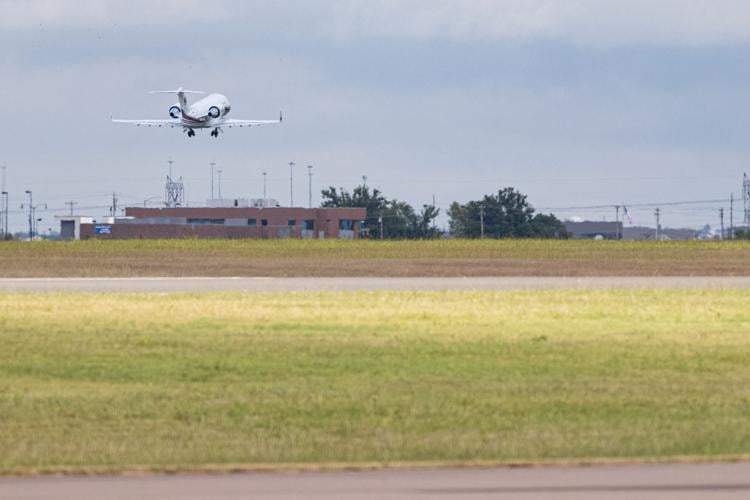
A private jet takes off during the 15th annual aviation festival at Max Westheimer Airport Oct. 2.
‘We know how they travel’
On the morning of Sept. 17, 2016, Lance Lamkin was busy.
The airport welcomed 109 plane arrivals from Thursday, Sept. 15 to Sunday, Sept. 18, 2016. That Saturday alone, Lamkin helped usher 55 incoming planes during the weekend of OU’s contest against Ohio State.
Once OU joins the SEC, when wealthy alumni, donors and fans will rotate their private jets in and out of the airport, Harroz expects weekends like the one in 2016 to be a regular occurrence.
“They say it's just different, right? It just means more,” Harroz said. “We're going to see that there are a lot of people coming, and it's a huge opportunity to showcase our city, our university and, more importantly, our state.
“We know how they travel, and having an airport right here on our own property puts us in a position that very few people have.”
Over the last decade, the airport has seen its fair share of heavy air traffic when OU faced marquee non-conference programs like Notre Dame in 2012, future SEC-foe Tennessee in 2014, Ohio State in 2016 and Nebraska in 2021 at home.
OUN saw at least 50 airport arrivals on the Saturday of each of those gamedays. If those contests are any indication of Norman’s future, Max Westheimer will be packed in the SEC.
Mike Mathews, airport director for Athens-Ben Epps Airport, located less than five miles from the University of Georgia, has helped host SEC traveling parties since 2018.
During the airport's busiest weekends, Mathews said Athens-Ben Epps has parked between 140-150 planes on its ramp and resorts to move heavier planes on a closed runway if it maxes out of parking space. Lamkin says OUN would do something similar if it reached max capacity.
“It all depends on how well the team is doing and also how well the opposing team is doing,” Mathews told OU Daily. “When Georgia faced Texas A&M a couple years ago, if you looked at Flight Aware it was like Athens was being invaded by aircraft. It was just coming from every direction.”
Adam Foutz, deputy director for the 423-acre Auburn University Regional Airport, told OU Daily he has seen over 100-200 planes parked for bigger contests vs. Alabama and Georgia, but traffic has slowed down with Auburn’s recent SEC struggles.
Max Westheimer will join the University-Oxford Airport at Mississippi, Easterwood Airport at Texas A&M and Auburn University Regional Airport as the only university-owned airports in the SEC.
Westheimer is 727 acres, making it the largest airport of the four. Texas A&M’s Easterwood Airport follows with 700 acres, but it has the longest runway with a length of 7,000 feet and a weight capacity of 156,000 pounds.
Jacob Pind, director for University-Oxford Airport, said Mississppi’s airport can hold 90 planes at its airport during game days, but, unlike Norman, it is unable to lengthen its runways for larger flights.
“It is vitally important to match the growth of the SEC,” Pind told OU Daily. “As far as lengthening the runway or anything like that, I’m not gonna say we're tapped out, but we're close to it.”
Flashbacks of 2016 popped into Lamkin’s mind when the Sooners announced their plan for a conference move in 2021.
However, the airport administrator, who feverishly called SEC airport directors to measure Norman’s readiness after the announcement, has felt relief knowing that improvements are coming at Westheimer.
“This will go into keeping and making this place better for the future, so we can expand the operations that we have and get the economic impact that we want for our local community,” Lamkin said. “Whether it's SEC football games or just a random Tuesday in April…we want to be able to handle all types of business.”

The entertainment district development would be adjacent to I-35 and includes the entirety of the approximately 269-acre proposed tax increment finance district between Rock Creek and Tecumseh roads. This area includes about 121 acres of OU Foundation land, about 60 acres of land controlled by NEDC and about 88 acres owned by others.
‘Folks can fly in and get immediate access’
When Jamie Pollard, Iowa State’s athletic director, fortified a $200 million plan to develop CYTown — an entertainment district at the heart of ISU’s basketball and football facilities — he never paid any mind to out-of-state visitors.
Iowa State is already in the construction phase of its on-campus entertainment district, replacing a once-decadent plot of parking lots, formerly known as Tent Row, into a sprawling pillar of commerce for the university and the city of Ames.
In Norman, city and university leaders have struggled to cobble up plans for their own proposed entertainment complex. Since the plans were unveiled to the public on Sept. 7, 2023, the Norman Planning Commission postponed discussions on the project five times.
CYTown is a 10-minute drive from the Ames Municipal Airport and nearly an hour from the Des Moines International Airport. Oklahoma’s proposed entertainment district in Norman’s UNP, by comparison, would be under seven minutes from Max Westheimer’s terminal and over 20 minutes from Oklahoma City’s Will Rogers World Airport.
Despite different proximities to their respective airports, OU and Iowa State have different target consumers for their entertainment districts.
“I don't know if I put a nexus to the airport into CYTown,” Pollard told the OU Daily. “Most of our regional airports only host non-commercial flights. It's all private planes. The air traffic that's coming in and out of Ames, I don't see people using the airport to come to CYTown.
“I don't see that being a traffic driver to CYTown at all. I'm not spending any time worrying about that.”
Norman’s city and university leaders echo a different sentiment, noting the proximity of the entertainment district, the airport and OU’s campus would provide a formula of success that no other SEC institution has. As it stands, Oklahoma’s campus is less than four miles from Max Westheimer, making it the second-closest SEC institution to a regional airport outside of Mississippi State.

The feasibility study showed three phases of a build out for the entertainment district over 10 years.
“Oklahoma City provides way more choices for our visitors who are coming in for football,” Dan Schemm, the executive director of VisitNorman, told OU Daily. “The entertainment district would provide us something that would keep them engaged and really impact Norman with those extra dollars right when they land.”
On average, according to the Max Westheimer Airport business plan conducted in 2021, the airport brought in over 46,000 landings and departures in each year from 2016-2019, a figure that Schemm expects a 10% increase once OU enters the SEC.
Based on a 2017 Oklahoma Aeronautics Commission research project, the airport also brings in an estimated $37.4 million annual revenue. Those figures could increase with Max Westheimer's future upgrades and increased air traffic.
According to the entertainment district’s feasibility study, the Hunden Partners estimated the development would generate $3.7 billion in net new spending, $1.6 billion in net new earnings and $553 million in local taxes for Norman. The entertainment district would also provide more on-site hotel rooms, resulting in a 31% increase of hotel revenue in the city.
Scott Lambert, a managing partner for the NOUN hotel located next to Campus Corner, views upgrades to Norman’s airport as a net positive for the potential visitors staying at the entertainment district. For years, Norman has had a shortage of hotel rooms, causing visitors to go to options in Moore or Oklahoma City.
“Right now, there’s gonna be a balancing act to (gamedays) because it can also go into peace and famine,” Lambert said. “Even if the entertainment district is a ways away from the NOUN hotel, we see that as driving even more opportunity into the city of Norman.”
While questions remain about the potential entertainment district being voted and passed by members of Norman’s City Council, Lamkin’s focus is on gearing up for the SEC.
“I really don't have anything to say about that project,” Lamkin said of Norman’s proposed entertainment district. “I'm focused on the airport and how it can help the community.”

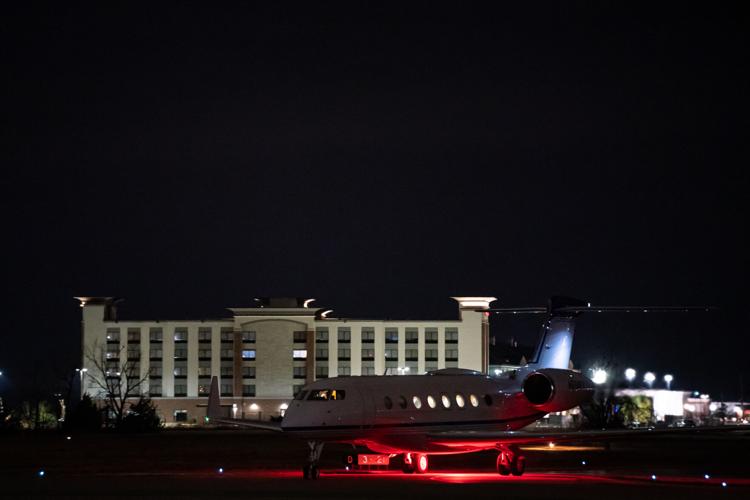
The jet that delivered OU football head coach Brent Venables to his welcoming at the Max Westheimer airport Dec. 5.
‘Everything is a vision’
In 2022, Stillwater Regional Airport suffered significant damage to its tarmac after a C-17 Globemaster made an unauthorized landing.
A C-17, which was carrying Air Force’s women’s basketball team, generally weighs 400,000 pounds, and the Stillwater Regional Airport has a max landing capacity of 310,000 pounds.
Unlike Max Westheimer, Stillwater’s airport is contracted with American Airlines to offer daily flights to Dallas-Fort Worth International Airport often using CRJ-700s. In addition, Big 12 programs, including football teams, can directly fly to and from Oklahoma State.
Unlike Stillwater, Westheimer is focused on maximizing its sustainability for hosting heavier regional jets. Stillwater’s unauthorized landing is an example of what can happen if a larger-than-capacity plane lands on a runway.
Due to Max Westheimer’s infrastructure, OU’s softball; men’s and women’s basketball; tennis; golf; and gymnastics programs can fly out of Max Westheimer for away competitions. Soon, all of OU’s athletic programs — outside of football — could have the same capability.
Skip Johnson, OU's baseball's head coach, wants to have more charter flights out of Max Westheimer once the Sooners join the SEC. Alongside NIL and facilities, the opportunity to have private flights could sway recruits and add a developmental aspect to his program, as Oklahoma gears up to travel longer distances in its new conference.
"Those guys make decisions on that, unfortunately," Johnson said in an interview on April 4. "It makes those guys understand they're better prepared walking into a program when they take a charter flight versus getting delayed commercially."
When BYU softball traveled to Love’s Field to face the Sooners in April, the Cougars departed in a Bombardier CRJ-200, which can accommodate up to 50 passengers. Lamkin noted the Sooners and opposing programs often fly through Max Westheimer using this same kind of jet.
Rick Nagel, U.S. Rep. Tom Cole’s treasurer and a member of OU’s Board of Regents, told OU Daily he envisions a future where commercial flights will have a home in Norman, which would theoretically accommodate Norman's residents and Oklahoma's athletic programs.
“I think the idea is, largely, going forward to get teams to fly in and out of Norman,” Nagel told OU Daily. “There is less wear and tear on our athletes. You're talking about an extra 30 or 40 minutes on each leg of that flight back home with potential delays. ”
When West Virginia made its move from the Big East, a conference composed of schools mostly on the East Coast, to the Big 12 in 2013, it signed a contract with United Airlines to accommodate its longer flights.
Patrick Johnston, WVU’s assistant athletic director of football operations, estimates that OU might be in the same situation given its upcoming move to the SEC.
“When they go to Auburn, Florida and even Tennessee, the length of the trip and time is a price increase,” Johnston said. “From an expense standpoint, they’d go from busing to Oklahoma State, TCU, but when they fly in the SEC it's a game changer. You're probably talking $100,000 every time.”
While Lamkin thinks OU’s football program will never be able to fly out of Max Westheimer, Nagel envisions a future where it can. Stillwater, by comparison, is over an hour away from Tulsa and Oklahoma City's airports, while Max Westheimer is over a 20 minute, 19.4 mile ride from Will Rogers World Airport.
“A lot of it is about being economical. If you can get somebody here on a direct flight on American Airlines, you're gonna do it,” Nagel said. “Like American Airlines flies into Stillwater, I would love to see a day where American Airlines or Southwest or Delta are flying into Norman. That might be a long way off, but it may not be that far off either.”
Lamkin, on the other hand, disagrees with that notion and doesn’t expect commercial airlines in Norman. He also says hosting the football team would require the airport to land Boeing 737s or 757s, which can have a takeoff weight of 155,000 and 255,000 pounds, respectively, making the operation cost prohibitive.
“Unless in like 50 years when I'm dead or Norman is the new DFW,” Lamkin says, “then we might see this place get commercial service, but I have no interest in it, and honestly I don't think any airline I go to to talk about it has any interest in it.”
Lamkin tries his best to keep his Max Westheimer visions based in a strict reality.
“Everything is a vision,” Lamkin said. “A vision is something you want your place to be in 20, 30 and 40 years. I focus on this place, and we have a vision to be able to handle what the community wants.
“The one thing I don't want happening is somebody in the city start saying, ‘well, the university airport is going to do this,’ when in reality there's no way we ever can.”
This story was edited by Gracie Rawlings. Avery Avery and Grayson Blalock copy edited this story.


