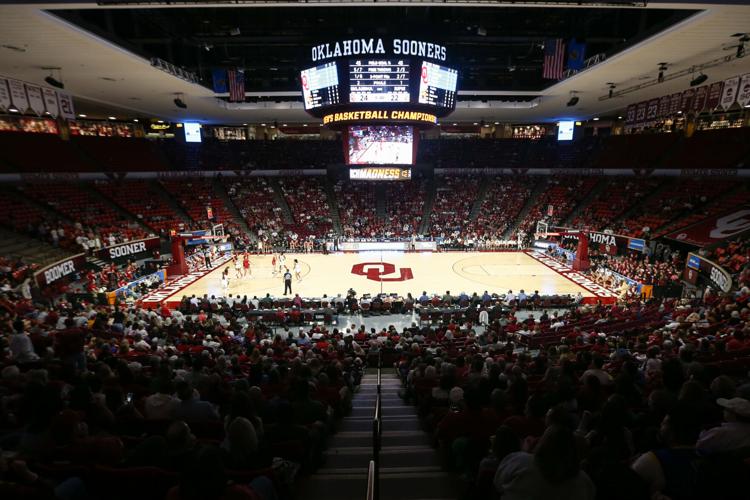


Lloyd Noble Center during the Sooners' game in the first round of the NCAA Tournament against Indiana University-Purdue University Indianapolis on March 19.
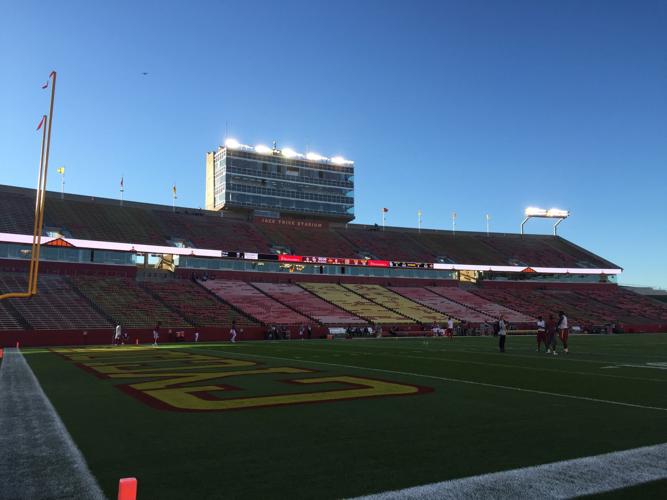
Empty parking lots separate Jack Trice Stadium and the Hilton Coliseum in Ames, Iowa.
The space, commonly known to Cyclone fans as Tent Row, typically hosts hundreds to thousands of tailgaters during home games.
As No. 14 Oklahoma (4-0, 1-0 Big 12) takes on Iowa State (2-2, 1-0) at 6 p.m. Saturday on the field at Gaylord Family-Oklahoma Memorial Stadium, both programs are exploring the future of game day fan experiences on their respective campuses and in the cities they call home.
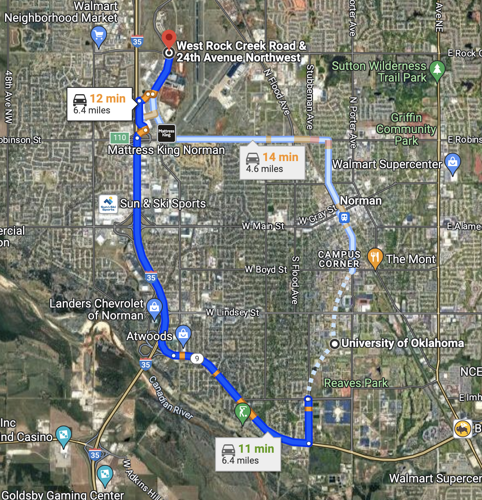
In Norman, that’s preparing for the transition to the Southeastern Conference in 2024, from elevating football game days on campus to envisioning a new multi-use arena in the University North Park area roughly 5-6 miles, depending on the route, from the university.
Iowa State has unveiled plans for a $200 million community district between its football stadium and basketball arena 🏗CYTown will have:➖ Amphitheater for concerts➖ Retail, office space➖ Luxury suites➖ Public plazaThe project is inspired by Lambeau Field's Titletown. pic.twitter.com/JhOtFkm1bW
— Front Office Sports (@FOS) September 19, 2022
In Ames, that’s doubling down on growing the experience Iowa State fans can enjoy in a new entertainment and arts district known as CYTown that will capitalize on the close proximity of its football and basketball venues.
Iowa State Athletic Director Jamie Pollard and the city of Ames have worked to improve and evolve their game day experience with an entertainment district, aiming to appeal to students, average fans and families.
Similarly, Team Norman, a group of city and university leaders unveiled its master plan for its own entertainment district on Sept. 6, containing an 8,000-seat multi-purpose performance venue that OU’s basketball and women’s gymnastics teams would call home. Retail businesses, restaurants and other forms of entertainment are also planned.
While CYTown is already approved and moving forward, the Norman district is expected to be voted on by city council later this year or next spring.
Both projects speak to the reality of college sports in the era of conference realignment where standing still is akin to how college football was played before the advent of the forward pass: OU officials call this a once in a generation opportunity to dream big as it changes conferences. Whereas, while Iowa State is staying put in the Big 12, it wants to stay ahead of the curve in its own state, city and conference, which expands to 16 teams next season.
While the complex is only in the early stages of development, it will finish in the infrastructure phase likely in 2025.
Pollard knows that entertainment districts are the standard for the future.
“The gist of this project is that at its core, (it's trying) to identify new solutions for old problems,” Pollard told the OU Daily. “The old problem is, we have an area, which is called the Iowa State Center, which is the arts and entertainment area. That was built 50-some years ago, and in its prime was not only great for Ames and Central Iowa, but it was for the Midwest. It was the big stop. We were the first to have that kind of space back in the 1960s.”
While the entertainment districts differ in ways, the proposed complex in Norman has the same method in mind.
Oklahoma is not only looking for a new home for its basketball teams, but city leaders also want to create a vibrant atmosphere similar to those found in other cities in the SEC.
Even if things are just grander in the SEC, places like Ames continue to show that entertainment districts are one pillar of college towns’ future economic models.
“I would say to you that municipalities and professional teams have been doing it forever, not forever, but so clearly been doing it in the more recent times,” Pollard said. “College has not, and I think there's a reason why. … I'm glad we're trying to do something that I think is where the puck is going and not where the puck is.”

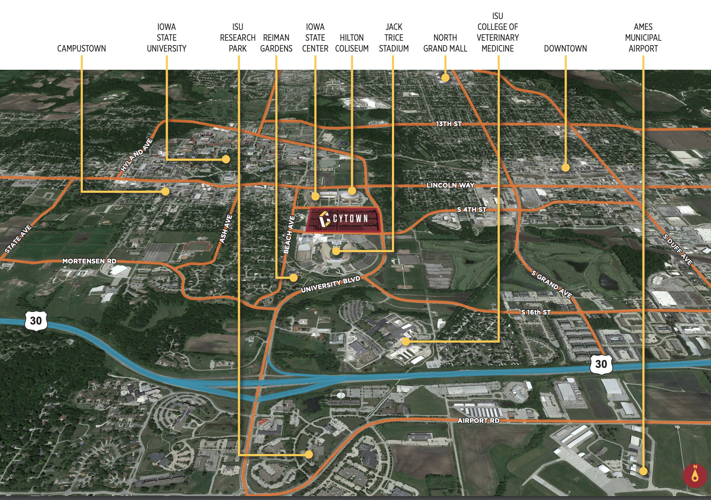
CYTown rendering alongside ISU's campus, Ames Metroplex.
Differences in proximity
CYTown differs from the proposed entertainment district in Norman due to one key difference: the distance between Iowa State’s football and basketball venues.
The entertainment district will sit right between the 61,500-seat football stadium in the south end and the Hilton Coliseum on the north, making it accessible to any fans attending either football or basketball games.
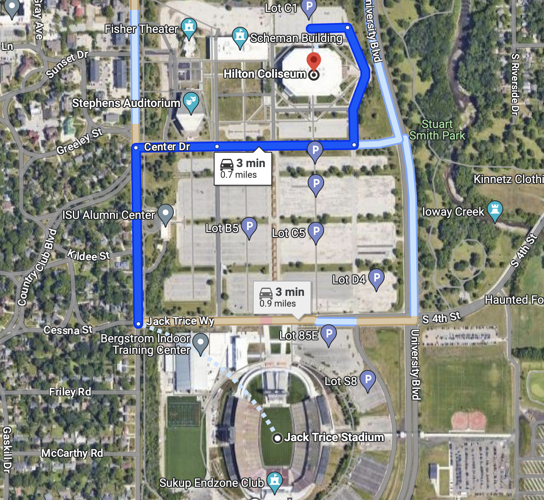
Through this, and other special events through the year, Iowa State estimates roughly 1.3 million-plus people will visit the district annually. The city envisions that as an easy feat due to just 0.6 miles separating the football and basketball stadiums.
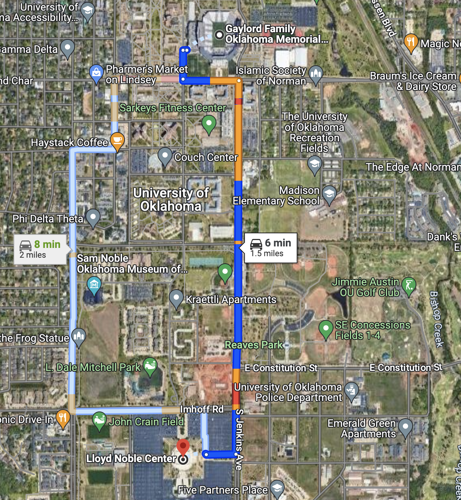
The campus provides easy access to the district, as it is only 0.8 miles from its location. The Lloyd Noble Center and Gaylord Family Oklahoma-Memorial Stadium, in comparison, are nearly 1.5 miles apart in distance.

Hilton Coliseum to Jack Trice Stadium.

OU stadium distance to the Lloyd Noble Center.
“You've got all this parking that is full on football Saturdays, but we only have six of those every year,” said Dan Culhane, the president and CEO of the Ames Chamber of Commerce. “How do we maximize the existing infrastructure? I think that was the initial thrust. How do you augment these facilities that already exist: by bringing other uses and other services there where people can spend more time there than just a handful of football Saturdays.”
The potential new multi-purpose complex for Oklahoma basketball and gymnastics, if approved, would be in the heart of Norman’s proposed entertainment district on Rock Creek Road and 24th Avenue Northwest, sitting roughly 6 miles from OU’s campus.

The University of Oklahoma distance from proposed entertainment district.
For basketball games, which already lack consistent student attendance, there are concerns that students will not attend games off campus.
Brent Norwood, an assistant professor of economics in OU’s Price College of Business, says sustaining a lively game day atmosphere in Norman has already been a struggle compared to SEC schools.
He fears that if other sports move away from campus, the programs will continue to struggle with student and fan engagement.
“I went to Texas A&M, and we never left the game until it was over,” Norwood said. “I did my (doctorate at OU) and students were gone by halftime. If (I’m a student), and I live in the dorms, and it's free for me to go to the Lloyd Noble Center, I'll go. Now I have to drive 10 miles off campus. I'm that much less likely to go.”
At Iowa State, Pollard never considered placing the entertainment district anywhere else in Ames.
Having CYTown close to campus provides a hub for constant movement from people in and out of the district.
Like the proposed entertainment district in Norman, the scene will have all types of bars, restaurants, hotels and offices. ISU’s multi-use facility will also work in an amphitheater for live music and concerts throughout the year.
The McFarland Clinic, an anticipated 60,000-square foot multi-level medical facility adjacent to the north entrance of the football stadium, is also planned.
When the McFarland Clinic, which is expected to break ground in the summer of 2024, is complete, it will be the first building developed as part of the new multi-use district.
The developers of CYTown hope that having the entertainment district near campus, in the heart of its athletic complexes, will create a reliable source of revenue year-round.
“I think what makes this project really valuable,” Pollard said, “(Is that) it's built into a space that has activity in and around it already. Then if we can have some tenants that drive even more activity into that space, all boats float higher. … The medical facility estimates that they're going to have 800 appointments a day.
“Like, what are you gonna do in the summer when students aren't here? Well, the medical facility just answered 800 of those daily.”
In Ames, a downtown district called Campustown, similar to Norman’s Campus Corner, will neighbor CYTown. Norwood has concerns of the potential economic development on the city’s far north side lacking involvement from students who are regulars on Campus Corner, immediately north of campus.
“You might get some people, but you're not going to get the college crowd,” Norwood said. “The college crowd is always going to go to the Campus Corner.”
There are also potential regional in-market concerns due to the current construction of the OKC Fairgrounds arena, the already-existing Paycom Center and the newly proposed $900 million Oklahoma City Thunder arena, set to be voted on by the public on Dec. 12. It’s about 17 miles from University North Park to downtown Oklahoma City and 22 to the state fairgrounds.
Nice weather for the last weekend for the @okstatefair, which runs through Sunday.You can see the new coliseum under construction next to the midway and the old Jim Norick arena which will eventually be demolished. pic.twitter.com/2XlK5nymcR
— OKCTalk.com (@OKCTalk) September 22, 2023
Iowa State, by comparison, has no such near-geographic rivals and serves as the biggest draw for athletic events in the area. Des Moines, which has no pro sports teams, sits 37 miles away.
“When you look at Oklahoma City compared to Dallas, Fort Worth, Houston, or Austin, which are all very close regionally to us, we don't have the same population size or the saturation,” Norwood said. “We're going to be competing regionally for the same events, the same concerts.
“That's just more competition. The competition goes up. It drives the price down. And so if they're looking to maximize, it would kind of be like a cartel. It'd be like, ‘OK, you build one. I'll build one.’ But we need to leave at least one out.”
Despite the closeness to downtown Ames and Campustown, Pollard thinks the city lacks an attractor that makes people want to stay in the city for longer and targets all kinds of audiences, not just the game day crowd.
In Norman, like Ames, city leaders hope the proposal will serve the same purpose despite being well apart from campus.
The goal, especially once the Sooners enter the SEC, is to have something that will keep people around beyond Saturday. OU and Norman leaders are gauging an entirely new audience like those in Ames.
“It doesn't mean that the Ames residents or the students can’t use this space but it's really not geared or marketed directly towards them,” Pollard said. “It's directed toward bringing either new visitors to the space or to the town, or creating amenities that will encourage more, what I call, young graduates to stay in Ames.”
OU’s leaders, President Joseph Harroz Jr. and Athletic Director Joe Castiglione, remain confident that student and fan engagement wouldn’t decline despite the proposed district’s distance from campus. They pin their confidence on the feasibility study done earlier this year.
“We've looked at that,” Harroz said in a media scrum on Sept. 6. “We put some real time into feasibility studies, (detailing) who will come, where will they come from. All of the folks who have helped us in designing it indicate the students will make that trek, and they don't want to wait because the traffic issues could be superior to where we are right now.”

Jack Trice Stadium at Iowa State University is named after an African-American football player who died as a result of on-field injuries in 1923.
Cost analysis
When Team Norman announced the $1 billion cost for a multi-purpose entertainment venue and complex, the top-line number shocked many.
Their mission was to lessen the burden on the community by incentivizing private investment.
That resulted in the proposal being pitched to rely on 80% private investment and 20% contribution public funding.
Iowa State paid for its entertainment district’s first phase of infrastructure work with $14.25 million from existing athletics and university cash reserves, $10.25 million in private giving and $4 million of investment income.
The second phase, Pollard said, will likely cost another estimated $12 million.
“That $40 million in infrastructure was basically getting the site ready,” Pollard said. “We had to tear off the parking lots, putting in all the utilities underground. Then (we had) to refill the parking lots, but then fill that up, raise it up about 7 feet in most places, because it's a flood plain. Then we repaved all the parking. (That makes it) $25 million from athletics and $15 million from the university.”
Through that, Pollard projects it will help re-invest back into the university, athletic venues and training facilities for the future.
“The vertical infrastructure will generate a revenue stream that will fund up to what we are estimating about $200-$250 million of what I call infrastructure improvements,” Pollard said. “But those tenants will then generate revenue, which will allow us to do further infrastructure beyond the $40 million and it's estimated that in all total, we'll spend about $200 million.”
In comparison to Norman’s model, Iowa State is taking on the brunt of the costs up front but will reap the benefits of it in the future. Where investors serve as rental tenants on ISU’s properties, OU would sign a 25-year lease with the city, according to Norman Economic Development Coalition President Lawrence McKinney, to hold events in the multi-purpose arena as the anchor tenant.
Instead of reaping benefits from the entertainment district on the university level, the city of Norman would garner most of the funds directly.
“Because this one specifically is 80% private, it's going to have more of a net benefit than it would have net loss,” Norwood said. “You're not going to see people 30 miles away have an increase in some sort of sales tax or property tax.”
Norwood sees the arena burdening the city in the long run, however, due to the likelihood of it having to keep the arena “up to standard” for the Sooners to remain a rental tenant. This is unlike Oklahoma City’s arena proposal where the city would take on 95% cost, but the Thunder’s ownership group would be responsible for any future upgrades.
“This is where it’s on the city of Norman side to keep it updated,” Norwood said. “They have to keep OU happy if they want to keep (them as a renter). That would depend on (how) we have elections and we have changes in public officials. What if it's February of 2020, and there's a pandemic, so, the variability is very high.
“If not, we're gonna have to be funding an area that's sucking money and not growing money. It's not like a business where if I'm selling lemonade and an iced tea, but the iced tea is not selling I can just get rid of it. You can’t get rid of a whole stadium.”
This is different from Ames because the burden falls on Iowa State and Pollard to keep its entertainment district infrastructure sound because it’s on university land. To keep tenants locked in for the long run, however, Pollard is aiming at having long-term leases.
The $30 million McFarland Hospital has signed a 50-year lease to stay in CYTown once it opens.
“We have built into the proformas for the whole project a revenue stream of re-investment,” Pollard said. “That was really important with our deal with the city of Ames. We didn't want to repeat what happened 50 years ago when we built something really neat, but we didn’t build in a funding stream to maintain it.
“We've spent considerable time developing a financial model that essentially creates the reserves to replenish the space over time.”
Despite it being on university land, Ames will still benefit from the complex economically.
“I think the goal would be that people will stay longer,” said Culhane. “The more hotel stays we have, the better is for hotel/motel sales tax and things of that nature. The economic impact of an Iowa State football game on a football Saturday is really hard to match for our community. And so anything we can do to augment that, and I think this will augment that it's really good way.”
As OU and Norman’s city leaders continue to wait for the city council to take up the matter, Norwood is skeptical about how the entertainment district would work financially. While answering questions on Sept. 6, McKinney said he expects a 4-to-1 reinvestment back in the city.
Norman’s city and university leaders potentially plan to model the proposed entertainment district with a TIF, a Tax Increment Financing, by refunding or diverting some of their taxes for the redevelopment of the district itself.
“There will be a component that is being proposed as a component of public financing,” Norman Chamber of Commerce President and CEO Scott Martin told the OU Daily. “The details of that are being worked out right now based on what the needs are. There are multiple economic impact studies being conducted. And so, the exact plan, which is very important, will be rolled out once the city establishes a statutory TIF committee, so that's in state statute.
“There will be a request made in the city to create a statutory TIF committee. And what I would anticipate is that at that point in time, the public component of that will likely be TIF but that's to be determined.”
Norwood thinks having the right oversight on said funds would be pivotal if Norman moves that direction to make sure the TIF funds aren’t used in the wrong way. Still, having the entertainment district, he said, puts a lot of stress on Norman’s financial future.
“In the long run, the economics of it are kind of like a net negative,” Norwood said. “It's burdening people that are outside of OU and in Norman that don't use it or don't go. The single mom that owns land property rights go up, so she has to pay more property taxes, or sales tax.”
Despite some skepticism, Martin and Norman’s city leaders suspect OU will eventually re-up with the city and its entertainment district once its initial agreement gives way.
“Certainly, it's safe to say that they're going to continue to want to be there just like they've been in the Lloyd Noble Center,” Martin said. “They're not going anywhere. The venue's not gonna go anywhere. I would suspect that that'll be renewed at that point in time for another significant time.”

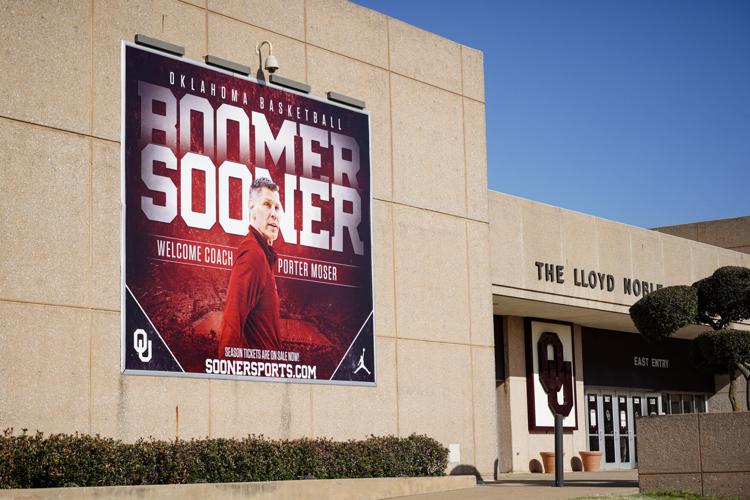
A poster of new OU basketball head coach Porter Moser hung on the outside of the Lloyd Noble Center before Moser's initial press conference April 7, 2021.
New vs. old
Strategically, while both Norman and Ames share similar goals building entertainment districts, they differ significantly in renovating their respective basketball arenas.
OU is seemingly ready to move on from 48-year-old Lloyd Noble Center. Iowa State, Pollard and ISU Research Park President and Director Rick Sanders have chosen the path to eventually renovate the Hilton Coliseum, which is four years older than OU’s aging arena.
“The beauty about Hilton for us is it's a really, really well constructed building,” Sanders said. “Our fans for whatever reason have not really gone down the road of having suites and stuff like that, but we have a club in there."
CYTown follows the model of the Green Bay Packers’ Titletown District, which Sanders and Pollard spent several days visiting and analyzing. Like the Cyclones, the Packers transformed the area surrounding the 66-year-old Lambeau Field.
Iowa State has similar plans to completely reshape the outside structure of the Hilton Coliseum by adding more glass and making it more presentable for visitors of CYTown. Almost like the Lloyd Noble Center, the Coliseum dons a dreary, gray concrete appearance that Pollard desperately wants to improve on.
Iowa State’s arena was renovated in 2019 for $25 million, with prior facelifts occurring in 1980, 1994 and 2002. The Cyclones’ arena currently seats 14,356 people, which is larger than the Lloyd Noble Center’s +10,000 seats.
“We've tried to keep it modern from a functionality standpoint,” Pollard said. “But, when you think of vibrancy and what attracts people to want to come to certain areas, people want to feel like they're coming do something that is exciting that it gives off a vibe and, so that's what a big part of the renovations that we're talking about doing the Hilton are really exterior renovations. … It's not like a beacon as you're coming on campus.”
In March, OU athletic director Joe Castiglione said the program was working on a “double faceted” solution to analyze both the feasibility for a new arena but also completely re-imagining and renovating the Lloyd Noble Center. September’s announcement would suggest the university is now most focused on a new future rather than a remodeled one, if it’s approved.
#Sooners athletic director Joe Castiglione on the potential for a new arena. He mentions that the university is working to either “completely re-imagine” the Lloyd Noble Center or create an arena off campus. pic.twitter.com/Yckq1pnfbN
— Jason Batacao (@J_batacao) March 7, 2023
While the Sooners and Norman wait to see what becomes of the new University North Park vision, OU will continue to play in the Lloyd Noble Center for the foreseeable future.
Accordingly, the Sooners recently spent $9.5 million to update approximately 13,400 square feet of team spaces, including locker rooms, and approximately 8,400 of office, meeting and support spaces. As the Sooners enter the SEC, however, only four arenas are older than Norman’s current arena in its future conference.
Even with minor renovations, OU men’s basketball head coach Porter Moser remains adamant about building a new complex.
“I think everyone knows the commitment needs to be toward having a new venue, a new venue for men’s basketball,” Moser said on July 31. “You look at some of the (other) teams’ venues and atmospheres in this league … it becomes very hard to play in. Everything I’ve heard is that everything is about moving in that direction.”
The Lloyd Noble Center sits roughly 1.5 miles from Gaylord Family-Oklahoma Memorial Stadium, almost twice the distance separating Iowa State’s two venues. In the new model, OU’s basketball and football homes would be more than 5 miles apart.
“OU’s is going to be really, really interesting if it's … miles away,” Sanders said. “How the hell do you tie that in on a game day where ours is going to be naturally tied right in?”
This story was edited by Colton Sulley.


