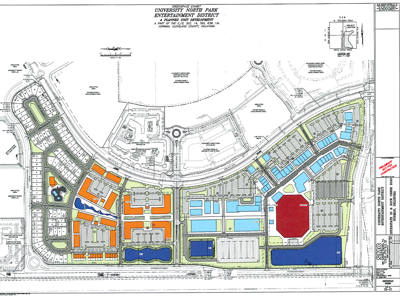

The proposed University North Park entertainment district project statutory review committee motioned to adopt and recommend the plan to the Norman City Council Thursday.
The Rock Creek Entertainment District Project Plan was brought to the statutory review committee’s attention on May 13 and 16. The proposed plan is to divide the district into two tax increment financing districts, or TIFs.
A TIF is used to support the redevelopment, infrastructure and community-improvement projects within a certain area to stimulate private investment in the area in need of economic revitalization.
In the proposed plan, one TIF would be for sales or use tax, expected to be activated on May 1, 2025. The other would be an ad valorem increment district and expected to be activated on Dec. 31, 2026, to capture the property tax that would begin when the first-year properties in the project area are developed.
The City, OU and Team Norman leaders first proposed the entertainment district on Sept. 6. When initially proposed, Team Norman, a group of leaders focused on preparing the city for OU’s transition to the Southeastern Conference, said the district would be 80% privately funded, and the remaining would come from public sources.
The proposed entertainment district would host concerts and events as well as OU basketball games and gymnastic meets. It would also include a hotel; family and residential areas; retail spaces; and offices.
In a Nov. 14 meeting, Norman City Council adopted a resolution to form a review committee for a possible TIF within the entertainment district. The role of the review committee is to make findings and recommendations on eligibility of the district to the council.
On Thursday, City Attorney Kathryn Walker presented the proposed plan and addressed several items that were discussed during last week’s meeting.
Walker said the budget amount represents what is necessary to finance the $230 million for the performance venue and infrastructure costs. Under the proposal, $600 million is the maximum amount of the project cost, and Walker said it won’t exceed that amount.
Under the financing plan in the proposed plan, the developer is receiving what’s called an assistance in development financing, which, according to Walker, means that the city is not pledging any revenue in advance but rather pledging revenue as it comes in.
Neither the city nor Norman Tax Increment Finance Authority intend to authorize or issue any public debt to finance any of the costs of the project.
Walker said there were meetings with Norman Public Schools Superintendent Nick Migliorino and other school representatives to discuss the possible impacts this could have on the schools.
According to the proposed plan, NPS may experience growth in enrollment as a result of the project’s employment, new residences and the ancillary economic impacts from the project.
Walker said $1.6 million annually is anticipated to go to the school district after all the state aid formula calculations are done.
Migliorino said NPS is generally funded through student growth and that the amount of growth doesn’t cover the cost of the school but there are still conversations in place to help with that.
The challenge schools in Oklahoma face is as they receive more local funding, less funding comes from the state, Migliorino said. The proposed entertainment district area would provide that local funding, according to the plan.
Sean Rieger, OU Foundation representative, said the foundation believes that there’s a good reason to have a school site in the district. He said it could help develop and grow the city’s population, and they’re working closely with NPS to find a solution.
Migliorino said his vote is based on his appointed role as part of the committee and as superintendent but doesn’t indicate complete support from the NPS Board of Education.
In a statement released after the meeting, Migliorino said his role on the committee was to ensure the schools’ and students’ interests were taken into account throughout the review process, and, while he can’t predict the outcomes, the council is now equipped to thoroughly evaluate the potential impacts to the school district.
When it comes to transportation, Walker said OU is also looking for ways to get students to the arena for games and is considering a shuttle service.
According to Walker’s presentation, the city currently has improvements funded and planned for both Flood and 24th Avenues that will make traffic better in that area. Walker also said developers are working with the Oklahoma Department of Transportation to get highway access to Rock Creek.
Walker said the Department of Transportation wants to see the project be approved before they move in that direction.
Walker said that property taxes from the arena’s parking garage, regardless of who owns it, have to be paid, and she anticipates that people would be charged to park there.
Mayor Larry Heikkila made a motion to adopt the resolution, making the committee’s findings and recommendations, to the city council. The vote to approve was unanimous.
The proposed plan will go to the planning commission, which will consider whether the project is in conformance with the comprehensive plan. After that, the first city council public hearing will be scheduled.
This story was edited by Taylor Jones. Avery Avery copy edited this story.


