





Construction of the proposed entertainment district that would feature a new arena, for which OU basketball and women’s gymnastics would be the anchor tenants, will cost an estimated $1.205 billion, up over $200 million from prior statements, and would create a negative 10% day trippers loss for OU athletics events, according to two feasibility studies obtained by OU Daily Thursday.
The proposed development would be built in three phases, according to the feasibility studies. The construction costs would total $1.205 billion, with $723 million in labor costs and $482 million in materials.
The study predicted OU sports to see a 10% decline in the number of day visitors in Cleveland County and only an 8% increase in overnight visitors in Cleveland County. According to the study, projections currently “assume” a negative net new for OU athletics events.
Team Norman, a coalition of private sector, state, city and university leaders, announced plans for the entertainment district during the Norman Economic Development Coalition’s annual State of the Economy breakfast in September, with 80% of the initially proposed $1 billion to be funded through private funds and the remaining 20% through public sources and a tax increment finance district in the area of the development.
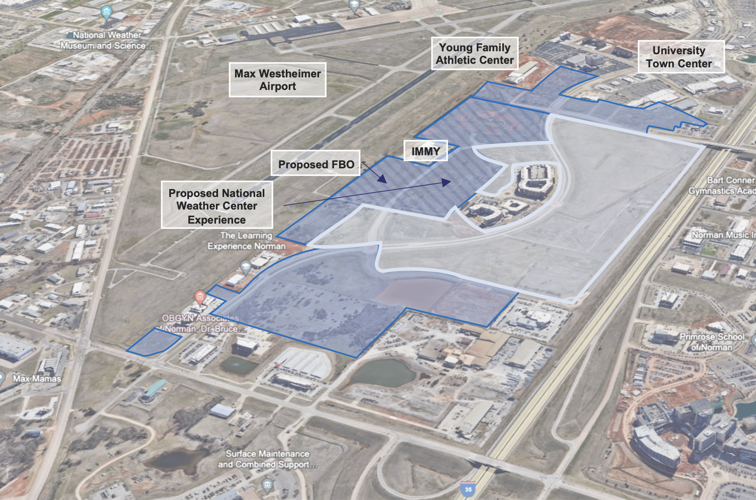
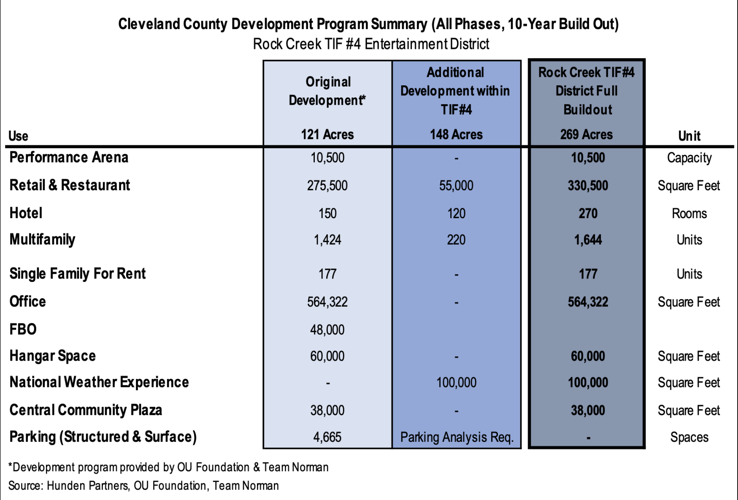
The proposed development would be east of Interstate 35 between West Rock Creek and West Tecumseh roads. It would encompass 269 acres: 121 acres from the OU Foundation, 60 acres currently controlled by the NEDC and about 88 acres currently owned by others, the study read.
The roughly 8,000-seat arena featured in the proposed development would sit on OU Foundation land alongside the highway.
One feasibility study was done by Hunden Partners, a real estate consulting firm based in Chicago, which has consulted on entertainment or mixed-use developments surrounding athletics facilities for several major cities and college towns in the U.S.: Chicago; Arlington, Texas; University of New Mexico in Albuquerque, New Mexico; Indianapolis; Lexington, Kentucky; College Station, Texas; and Louisville, Kentucky, to name a few. The firm was hired by the Cleveland County Industrial Development Authority.
The study read that the location of the entertainment district near the interstate would provide it with visibility, and the planned Oklahoma Turnpike Authority turnpikes to run through east Norman would not pose a threat to traffic and visibility alongside the interstate.
“Even with the new toll turnpikes being built near and around Norman’s east side, those new highways will never have nearly the traffic volumes and visibility that I-35 has currently,” the study read. “The site is better than the current Lloyd Noble Center for travelers going to games, although college kids will no longer have an on-campus event venue to go to, and it may lack some of the college campus vibe.”
OU Daily attempted to reach several private sector leaders and local economists who could help clarify and add insight into the report but were unable to reach them before publication.
The study cited regional growth in central Oklahoma and proximity to other major cities as factors for positive projections for the proposed entertainment district development. The feasibility study detailed projections for taxes, net new spending, earnings, jobs and more.
25-year development projections
Hunden Partners estimated in the study that the initial stage of the development would generate $3.7 billion in net new spending, $1.6 billion in net new earnings, $553 million in local taxes and 1,513 full-time equivalent jobs over 25 years, according to the feasibility study.
The additional development for the project located in the proposed TIF district could generate an estimated $4.5 billion in net new spending, $1.8 billion in new earnings, $617 million in local taxes and 1,804 full-time equivalent jobs over 25 years, according to the feasibility study.
Hunden Partners estimated the project would support roughly about 2,000 construction jobs in Cleveland County. According to the city of Norman, the current unemployment rate in Norman is 4.5%.
The initial development was estimated to generate $446 million in on-site property taxes and $116 million in sales tax revenue over 25 years. As the proposed additional developments would not take place on OU Foundation land, on-site property taxes to be generated over 25 years on additional developments are estimated at $482 million and sales tax revenues increase to an estimated $138 million. The on-site hotel occupancy tax for the entirety of the project over 25 years is estimated to be $31 million.
“Hunden acknowledges that there would be a loss to the City of Norman general fund from the sales tax that will no longer be generated at Lloyd Noble. The sales tax generated at the new performance venue/arena will contribute to the Rock Creek TIF #4,” the feasibility study read. “However, Hunden expects this will be negated by positive benefits shown in the 25-Year Conceptual Impacts, which shows the estimated level of net new spending within the greater Cleveland County economy.”

The feasibility study showed three phases of a build out for the entertainment district over 10 years.
Arena, venue
The arena, which would be the centerpiece to the entertainment district, would seat about 8,000 people, however the feasibility study reads that for certain events, such as concerts, the seating could expand to fit 10,500.
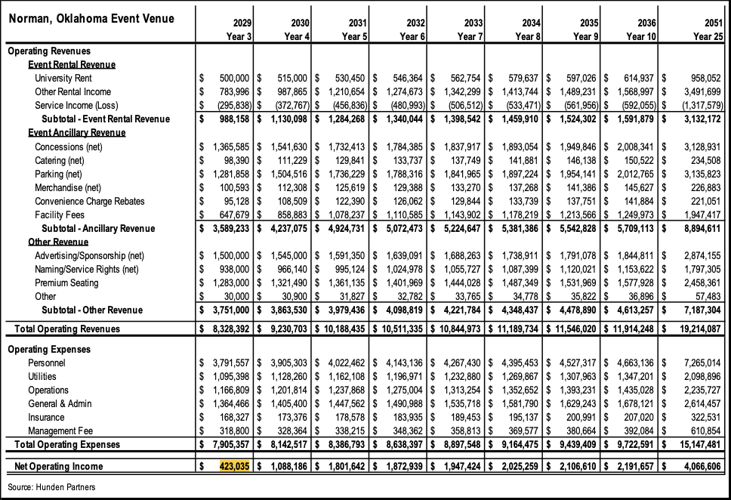
OU would pay $500,00 in rent starting in 2029, with the rent to increase approximately 3% every year after.
Hunden projected a total event rental revenue for 2029 to be $988,158. The feasibility study projected a total event rental revenue to be over $3.13 million in year 25.
Hunden Partners conducted case studies of arenas, both with entertainment districts and without, of eight universities, none of which were in the Southeastern Conference and three of which are not Power Five.
The eight arenas ranged from 4,000-seat arenas to 22,000-seat arenas: Foster Pavilion at Baylor University, Moody Center at the University of Texas at Austin, Chesapeake Employers Insurance Arena at the University of Maryland Baltimore County, Pinnacle Bank Arena at the University of Nebraska, KFC Yum! Center at the University of Louisville, Tsongas Center at the University of Massachusetts, Chaifetz Arena at St. Louis University and Addition Financial Arena at the University of Central Florida.
Of the arenas examined in the case studies, Moody Center cost the most at $375 million and has a zero percent public share. The venue hosted 72 non-university events in 2022, the most out of the group. KFC Yum! was both university private and publicly funded, and the Pinnacle Bank Arena was 100% publicly funded through an incentive athletics tax.
“Hunden’s assessment of several privately managed arenas was aimed at understanding the potential visitation increase of the Project compared to what is currently experienced at Lloyd Noble,” the study read. “The baseline visitation increase compared to the visitation at (Lloyd) Noble in 2022 is an estimated to be 256,500 additional annual visits.”
Hunden Partners looked into Oklahoma’s current entertainment venues, determining an opportunity gap between the number of events and capacity, saying in the study that Oklahoma needs a medium-sized venue smaller than Paycom Center but larger than The Criterion or Tower Theatre.
The proposed venue in the entertainment district is hoped to be similar to Moody Center in Austin, Texas, or Dickies Arena, a 28,915 square foot event center in Fort Worth, Texas.
According to the feasibility study, Oklahoma City ranks 42nd in number of ticket sales, between November 2021 and November 2022. Oklahoma City averaged $28.26 million in ticket sales during that period, with an average price of $73.63 for the 85 shows reported.
The study said neither the Oklahoma City Thunder’s new $1 billion arena which was approved by voters in December nor the Fairgrounds Coliseum would detract from the value of the proposed arena in the entertainment district.
“There is a gap in the market for a medium-sized indoor entertainment venue. Neither of the proposed Projects will truly be directly competitive to the Project (the proposed entertainment district),” the report read.
Hunden Partners predicts the proposed venue would be able to host approximately 25 to 30 ticketed non-university events in 2029, year three. That year would see a total number of 136 events, including university and non-university events, leaving the venue unoccupied on roughly 229 days of the year.
OU’s basketball teams play about 18 home games each season and OU gymnastics intends to host five home meets in 2029, according to the feasibility studies. The study projects nine concerts in the venue in 2029, five family shows, 14 graduations and 35 meetings, among others projected that year.
“With an arena that only contains 8,000 fixed seats for basketball games, Hunden assumed that there would be negative net new for OU Sporting events,” the study read.

Financial, tax projections
Hunden expects the arena and event venue will generate a net profit of approximately $423,000 in year one of operation and stabilize at approximately $1.8 million in year three of operation. However, in the corresponding chart, year three’s income is estimated to be $423,035, with the venue expecting to see over $1.8 million in year five.
By 2029, listed as year three in the studies, the event venue is projected to make over $988,000 in rental revenue and over $3.5 million in ancillary revenue — concessions, catering, parking, merchandise, convenience charges and facility fees.
Other revenues include $1.5 million in advertising and sponsorships, $938,000 in naming and service rights, over $1.2 million in premium seating and $30,000 from “other” sources. In total, the event venue is estimated to draw in $8,328,392 in operating revenues during its third year.
Total net new spending impact to Cleveland County over the 25-year time period is estimated to total $3.7 billion.
Regarding employment, in the third year of operations, the district is set to bring in over 500 full-time equivalent jobs. Overall, the district is expected to bring in over $9.4 million in fiscal impact dollars in 2029.
The project in its entirety — including development on OU Foundation land and property owned by NEDC and other entities — is expected to generate $617 million in local taxes over 25 years, with a majority of this coming from onsite property tax generation.
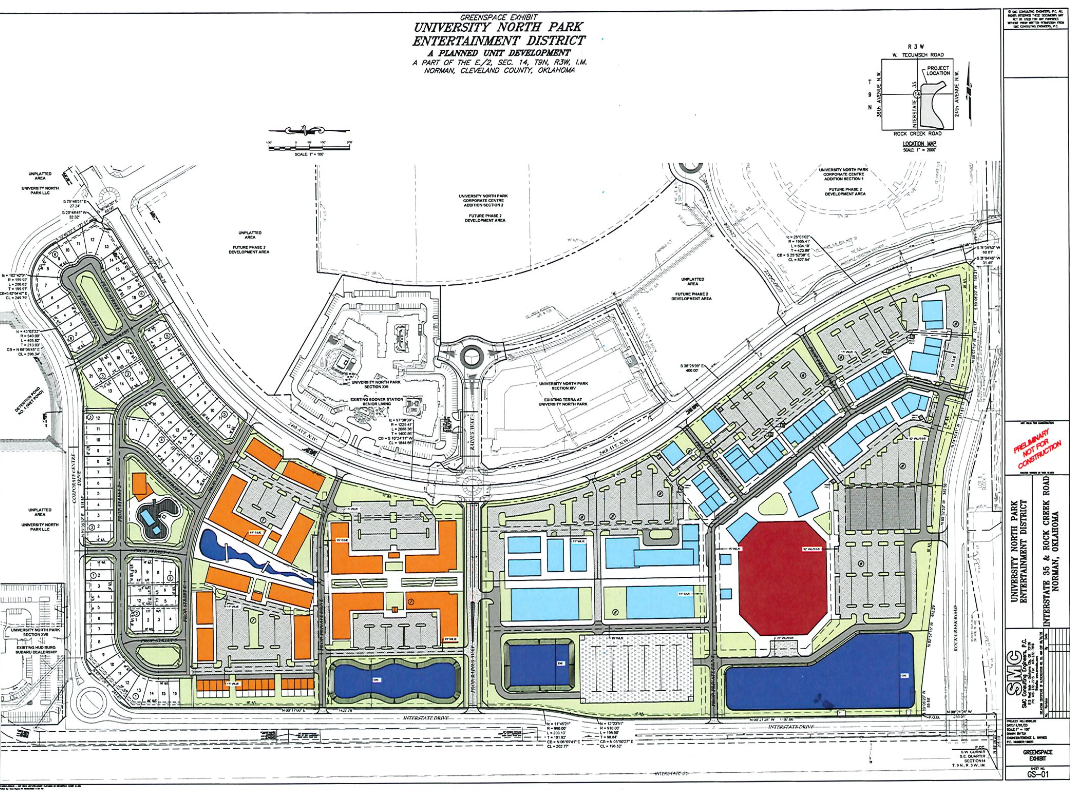
A preliminary plan for the proposed $1 billion entertainment district project development. The red represents the proposed arena and the orange is the mixed-use housing development. The light blue represents other entertainment, restaurants, retail, office, hospitality and conference locations. The dark blue is detention space, the spotted grey is a parking garage and the green represents green space.
Retail, dining, entertainment
Hunden Partners wrote that as Norman expands on the multipurpose event center, there will be a large demand from visitors for shopping and dining locally.
According to the feasibility reports, leisure and dining venues are most popular for visitors to frequent before and after visiting Lloyd Noble Center and Riverwind Casino, so Hunden Partners predicts these will be large industries in the proposed entertainment district.
Already near the project area are major retail and dining businesses. University Town Center generated an estimated 4.9 million visits in 2022 with 503 walkable hotel rooms over three properties.
According to Hunden Partners, there is potential to enhance Norman’s retail, dining and entertainment assets. They believe the proposed district can infuse additional entertainment assets to help activate the district on a year-round basis and generate additional economic impacts and taxes.
“A dense and vibrant mixed-use district surrounding the proposed entertainment venue would aid in providing a sense of place, providing unique offerings beyond the mostly traditional retail and restaurant development currently in Norman,” the report read.
Hunden Partners assumes that 17% of retail sales would be net new to the county.
According to the report, there is a wide variety of entertainment driven assets in Norman, such as casinos, outdoor sports and recreation and arts facilities, and these types of assets serve the local community and aid in generating long-distance visitation and spending.
The feasibility reports also explore the potential of “eatertainment” venues. Eatertainment venues combine dining with entertainment options but are higher-end experiences than traditional arcades or bowling alleys.
According to the reports, eatertainment venues can serve as an anchor for a sports or entertainment district.
“These venues are often very successful in sports and entertainment districts because of their ability to accommodate large groups,” the report reads. “Eatertainment venues are typically large in size, which is beneficial for meetings and events as they can host groups looking for entertainment and restaurant options.”
Hunden Partners also predicts the proposed district will create space for food halls, similar to The Collective in Oklahoma City. The report also details the potential for campus-style clustering. This kind of district design would include large indoor spaces and rooftops, recreational trails and plaza spaces.
Hotels, multifamily housing, offices
According to Hunden Partners, the proposed entertainment district would generate new hotel demand to Norman. According to the feasibility study, there are only 374 upper upscale rooms in the broader Norman and Moore markets.
Specifically in Norman, the only recent hotel developments have been the NOUN Hotel, Hampton Inn and a Residence Inn nearing completion in Norman south of the project.
According to the report, while the Embassy Suites boast 283 rooms and substantial meeting spaces, the property needs major improvements, and management at the Embassy Suites has indicated the property is scheduled for renovation in 2025.
“A new high-quality hotel that offers additional on-site amenities would complement the proposed entertainment venue,” the report read.
Hunden determined that 31% of the room revenue generated from onsite hotels would be net new to the county.
According to the feasibility reports, there is potential to develop housing units alongside the overall development plan.
“As the Norman submarket has low vacancies and stable rent growth, there is potential to accompany a growing community and student population in newer multi family facilities,” the report read.
Hunden utilized the Bureau of Labor Statistics and Lightcast to assess migration to Cleveland County. From these statistics, the firm estimated 14% of new residents would move from outside of Cleveland County to the area.
Hunden assumes 78% of the incomes/employees onsite would be net new to the county.
What’s next?
In an interview with OU Daily, OU President Joseph Harroz Jr. said if Norman City Council does not approve the district, he’d look to other cities for a potential new arena for OU athletics, taking the university’s basketball and gymnastics teams with it.
“I’m very hopeful and do everything I can to keep it here in Norman,” Harroz said. “But if this isn’t approved by the city council for whatever reason, then we’re going to be looking at other (cities), Oklahoma City, Moore, surrounding areas and figure out where is there a group that wants to do this.”
In response to Harroz’s threat, Dan Schemm, executive director of Visit Norman and member of Team Norman, told OU Daily it would be a “travesty” for Norman if the district is moved out of the city. Schemm said he’s seen various versions of the plan but has not seen the complete project plan.
The Harroz interview was days before the April 11 Norman Planning Commission meeting, where the district was set to be discussed and voted on by commission members. However, the district would be postponed at that meeting for a fourth time.
Ward 7 Councilmember Stephen Tyler Holman told OU Daily that in his 11-year stint on council, he has not seen a potential development postponed that many times, noting that applicants typically only go to the commission when they have a completed plan or ask for postponement once.
In November, council adopted a resolution to create a TIF review committee. Since then, that committee has met once and will meet again on Thursday. At the April 11 commission meeting, the lawyer for the applicant Gunner Joyce of Rieger Law Group said the committee would see the project plan at the next meeting.
“There is a project plan that that body (TIF review committee) will review and make a recommendation and that will also come in front of (the planning commission) that same night and then we will have preliminary plat, PUD and the project plan all together for presentation,” Joyce said.
According to the April Planning Commission agenda, the development will now be heard during the May 9 meeting.
Mary Ann Livingood copy edited this story.


