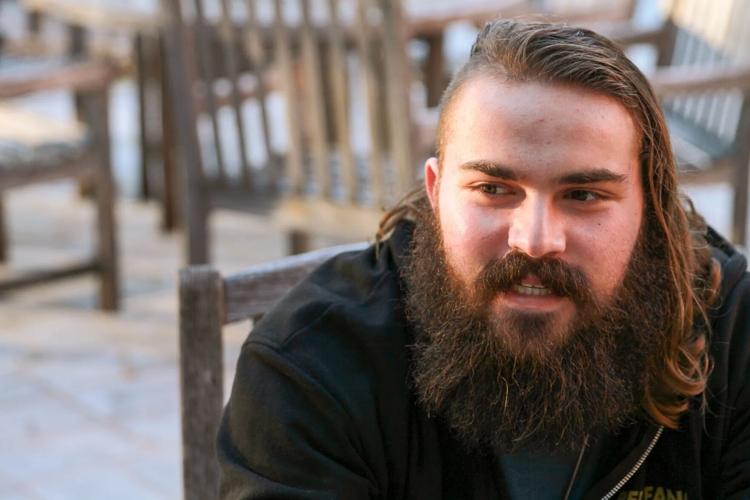


Mason Cullen, geology and math senior, describes his experience at OU's Goddard Health Center and his wait time for an appointment there.
Editor's note: This story was originally published on Feb. 16, 2017, on the Daily's projects website. Due to degradation issues on that platform and to preserve the continuity of the Daily's digital archive, this version replicates that story backdated to its original time of publication.
Mason Cullen spent six weeks enduring worsening panic attacks and suicidal thoughts in fall 2016 before he was finally able to receive mental health care.
“Just being told that it would be six weeks, that on its own kind of made it worse — it made things feel just kind of worthless,” said Cullen, geology and math senior.
Although not all who seek mental health services through the University Counseling Center endure extended wait times — measured from the day a patient calls the center to the day of the intake appointment — like those Cullen experienced, the counseling center still experiences severe understaffing and a lack of resources relative to OU’s student population.
Without access to the help he needed, Cullen felt his schoolwork slip, he said.
“I tend to have a pretty good grasp on school and going to class and stuff, but I definitely noticed that I kind of lost a lot of motivation to do stuff,” Cullen said. “I would deliberately just not care about whether I did a good job or not and kind of just do things to get them done.”
Scott Miller, director of the University Counseling Center, said in an email that in fall 2016 the center saw one-third of appointments within one to two days of the patient calling to schedule the intake appointment, and he said that the average wait time was only 9.6 days.
BY THE NUMBERS
1: Emergency
In a crisis situation, students can see a mental health professional at the University Counseling Center the same day they call
9.6: Average
Students wait an average of 9.6 days to see a mental health professional at the University Counseling Center
60: Outlier
Some students have waited two or more months to see a mental health professional at the University Counseling Center
This ratio can mean that some students experience wait times far above the average Miller provided. Of the 72 students who completed The Daily's questionnaire, 59 reported seeking mental health care at Goddard’s University Counseling Center, but only three students reported a wait time of one to six days. Six reported waiting one to two weeks, 17 reported two to three weeks, 16 reported three weeks to one month, 13 reported one to two months, and four students said they waited more than two months to be seen at the counseling center.
Miller also said in the email that the counseling center currently employs 17 staff members — six Ph.D-certified psychologists, two psychiatrists, one licensed alcohol and drug counselor, four psychology interns and four graduate students.
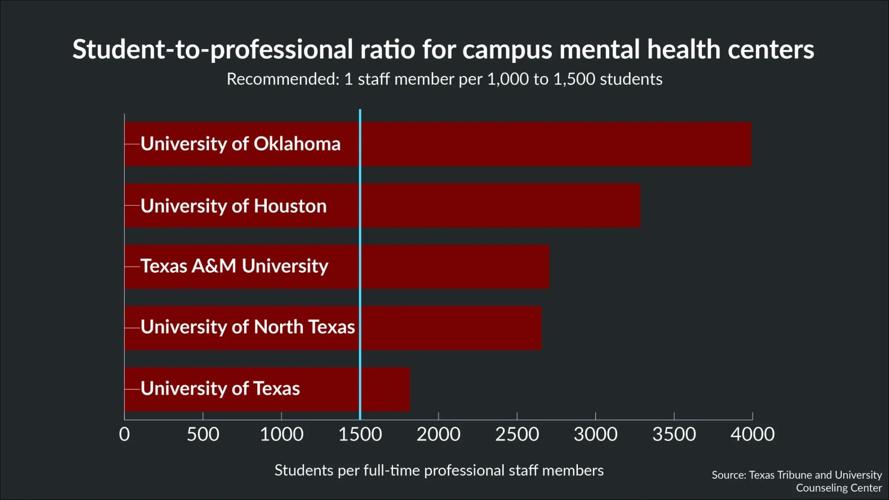
According to the International Association of Counseling Services Inc., campus mental health centers should maintain a ratio of one professional full-time staff member to every 1,000 to 1,500 students for overall campus well-being. This recommended number excludes temporary interns or trainees as well as psychiatrists, who primarily fulfill prescription needs rather than counseling needs. Well below these standards, the counseling center only employs seven full-time professional staffers to serve the Norman campus’ student population of 27,937.
This means OU’s Norman campus has one mental health professional per 3,991 students, a number more than twice the association's recommended ratio. Even if interns, graduate students and psychiatrists were included in those numbers, the ratio would be one mental health professional per every 1,643 students.
Miller said while three-to-four-week wait times do not surprise him, he is unaware of cases in the two-month wait time range.
OU students are not the only university students experiencing these mental health professional ratios. The Texas Tribune reports that the University of Houston, Texas A&M University, the University of Texas-Austin, Texas State University, Texas Tech University and the University of North Texas are all understaffed by the International Association of Counseling Services Inc.’s standards as well.
According to the Texas Tribune, the University of Houston is furthest from the ideal ratio with one full-time professional staffer per 3,285 students, and all of these institutions report that a two-to-three-week wait time is normal at their campus counseling centers.
While he said he understands the counseling center’s staffing difficulties, Cullen said six weeks was a lot of waiting to endure.
“I’m sure that they see a lot of people, but I think six weeks is kind of ridiculous,” Cullen said. “And I think they need to do what they can to kind of bump those intake wait times down.”

After Elaina Fees waited six weeks for a counseling appointment that she ended up canceling, she found herself urgently needing mental health care.
Fees, a public and nonprofit administration and women’s and gender studies freshman, said she called the University Counseling Center in fall 2016 for an emergency appointment around 10 a.m. and was asked if she could make it through the day without coming in. When she said no, she was scheduled for a 3:30 p.m. appointment.
Waiting through the day was a struggle for Fees, who said she skipped classes without a doctor’s note and spent the afternoon wrestling with her mind.
“I think that one was the hardest for me with my experiences with Goddard is like, I really needed somebody, I really did,” Fees said. “I consider myself a strong person — I consider myself able to move and shake and do all the things you need to do, but whenever you’re at war with yourself and it’s not a war you want to fight, it’s really difficult.”
Though she arrived at the counseling center at 3:15 p.m. for her appointment, Fees said she was not able to see anyone until 3:50 p.m. and could only stay for 25 to 30 minutes so she could make it to a 4:30 p.m. class.
“I felt a little bit better just because I was able to unload, but it really just — you unpack all of it and then there’s nowhere for it to go,” Fees said. “You kind of need to, once you decompress a little bit, you kind of need to kind of put things back in and work it out. So I kind of threw out all my bad, and all my bad was still out there.”
But Fees had tried the center before her emergency appointment. Early in fall 2016, she called to make a counseling appointment and was given an appointment time of four to six weeks away, she said.
Fees waited from September to late October or November, she said, but ended up canceling the intake appointment the day it was supposed to occur.
“It was the day of, and I was laying in bed and I was like, ‘I can’t get out of bed — I’m not going to go see the counselor,’” Fees said. “Which is like, really self-defeating and makes absolutely no sense, but it was like, ‘You know what, this is swell, this is what you need to do right now to take care of your brain.’”
Her call to schedule an emergency appointment came one to two weeks after she canceled her initial appointment, Fees said. She said she is unlikely to return to the counseling center.
Related stories
OU students suffer from lack of mental health resources
Mental illnesses more significant among college students than non-students
Faith in healing: The taboo of mental health in the black community

The University Counseling Center is often the cheapest option for students, and other mental health practices in the Norman area are not without major wait time issues, either.
Communications senior Lilia Shahbandeh called Balance Women’s Health in Moore in August 2016 to schedule a psychiatric appointment so she could be prescribed ADHD medication. Her appointment was scheduled for the first available time — Nov. 4.
“My doctor was just like, ‘Well, since you’re starting school again, let’s get you on the right track before you get all these, like your final semester gets out of whack or anything like that,’ and now we’re here, mid-November, and I’m finally getting my ADHD medication that I probably could have used way back in August,” Shahbandeh said.
Shahbandeh said she was wary about Goddard’s effectiveness because of what she'd heard from friends, so she chose the only other place that would accept her insurance.
Just a month after she was able to begin the ADHD medication, she said she had seen an improvement in her eating and sleeping habits as well as her academic performance — moving her from receiving C’s and D’s to receiving A’s and B’s.
“I feel like my medication helped (my grades) tremendously, but it’s just that the fact that I had to wait so long for that to happen was just a big barrier that just was like madness,” Shahbandeh said.

At the core of wait times at all of these facilities is a systemic undervaluing and underfunding of mental health care, Miller said. Miller said salaries for mental health professionals are some of the lowest for their levels of education, even with doctorate-level training.
“What that leads to are fewer people going into training programs to be trained as mental health counselors. Less funding causes smaller staff and less staff to see the people that need to be seen,” Miller said. “And then on top of that, you have a current generation of students who are willing to seek mental health care, value mental health care, want access to mental health care.
“So we have a group of students that see it as something that is appropriate and healthy to do, and so they’re coming in at good-sized numbers, which is a good thing, but we haven’t done a good job nationwide of funding mental health.”
OU has made attempts to improve situations that students like Fees and Cullen have experienced. President David Boren authorized the hiring of a new psychiatrist at the University Counseling Center in November 2015.
While psychiatrists are not part of the International Association of Counseling Services Inc.’s recommended mental health professional numbers, Miller said OU’s psychiatrists have been helpful in many areas of wait time.
Mental health resources
• Goddard Health Center — University Counseling Center. Call: 405-325-2911
• OU Psychology Clinic. Call: 405-325-2914
• Norman Regional Hospital Behavioral Medicine. Call: 405-307-5555
• OU Behavior Intervention Team (BIT). Call: 405-325-7700 or fill out an online form
• 24/7 National Suicide Prevention Lifeline. If you or someone you know is in immediate danger of harming themselves or someone else, call 911. Call: 1-800-273-8255 or start an online chat


