
Editor's Note: The name Stacy Marks is a pseudonym used to preserve the student's anonymity.
Trigger Warning: This story contains content regarding suicide.
When English and women and gender studies sophomore Stacy Marks came to OU, she thought she would be okay.
A National Merit Scholar, Marks did well academically in high school and was captain of the cheerleading team. When she was offered the scholarship, she realized she would be far away from her support system in Iowa, but she saw it as a new start.
When she ran out of her depression medication her first month at OU, things became complicated. Marks had not found a new counselor since moving, and without her medicine, thoughts of sadness overwhelmed her, making her feel worthless. She had trouble motivating herself to do things, feeling defeated when she did not accomplish them.
“The depression just kind of sucks out all my energy,” Marks said. “It’s not the content that I struggle with, it’s just getting to class and being there when things are due. I want to go, the logical reasoning part of me understands that I need to go to class, but my body and the depression part of me just controls me. It takes over. Especially because it keeps you from sleeping, I don’t have the energy to go. It just zaps your energy.”
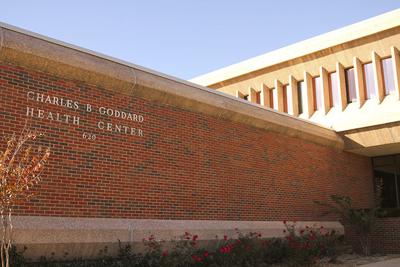
Marks went to a pharmacy in Norman, but they could not refill her prescription because of laws across state lines. She could not afford to spend school days and money going home to see her doctor, so she visited Goddard Health Services on campus.
Taking her prescription bottle with her, Marks went to Goddard, but was told the psychiatrist who could prescribe her medicine was booked until the school break in December. However, they said, she may be able to see a counselor.
“I remember crying in the counseling center of Goddard and saying ‘Please help me. I need to see someone who can write me a new prescription’,” Marks said. “It was just very cold and not understanding.”
Eventually, Marks went to a doctor in the community who fit her in, but she was discouraged. She was switching medicines to find the right fit, each with its own myriad of symptoms. She fell behind in classes and realized the extent of the affect of her depression on her grades when a professor emailed her saying she had missed too much class and could not redeem her grade.
Her lowest grade in high school was a B.
This was not a new struggle for Marks. Depression runs in her family, and she first sought help her junior year of high school. At first she thought she was just having a bad day, a bad week, a bad month, but when she found herself on the suicide hotline, she realized it was more than that.
Marks is not the first student to express frustration with the availability of mental health resources at OU. Members of OUr Mental Health, an organization started on campus in October, have raised concerns at the organization’s meetings about their desire for more resources for and better education about mental health on campus.
Goddard Counseling Center has eight full-time staff including one psychiatrist, five post-doctorate interns and three practicum students in the last year of their doctoral program, according to Scott Miller, director of the University Counseling Center.
Students, faculty and staff in severe need of help are assigned to permanent staff members, but the rest are assigned to any of the 12 counselors. Patients also have the right to request to see a permanent staff member.
Scott Miller said at the beginning of the semester it is easy to get appointments, and it progressively gets harder as the semester goes on. He said every year the psychiatrist is booked earlier.
JD Baker, co-founder of OUr Mental Health, said more should be done. He has a meeting planned with Jabar Shumate and Clarke Stroud of the University Community office in December to talk about it.
“For a campus of 20,000 students, we definitely need more,” Baker said. “Mental illness is a disability. It is something they cannot control all the time, and they need that help. That’s the only way students will be able to succeed academically, if they are mentally healthy.”
Scott Miller said the problem is that the need for counseling appointments exceeds the number of counselors, not just at OU but in society at large and that the counseling center is doing the best they can.
“I don’t think we have enough mental health professionals for folks. It’s not an OU problem, it’s a bigger issue,” Scott Miller said. “But we try to get students in as quick as we can because we’re well aware that you can’t lose time in a 15-16 week semester. If you have a couple of weeks where you’re not functioning well, that’s going to impact school, and we try to get folks in as quick as we can to make sure that we don’t have them skip a beat with their school.”
Jeff Dismukes, public information officer for the Oklahoma Department of Mental Health and Substance Abuse Services, said many counseling practices in the community book up quickly, so the problem is not unique to OU.
Dismukes attributed the disconnect between resources and need to a lack of professionals who treat mental illness, insurance covering mental health appointments and medication to a social stigma against mental illness and treatment.
“Behavioral health is a little different than other health issues in the way the system is set up when you compare it to the way we treat physical or other illnesses. There’s a discrimination that exists,” Dismukes said.
However, Dismukes and Scott Miller both said things are getting better. Goddard Counseling Center now offers walk-in counseling appointments if students, faculty and staff members call early enough in the day. Additionally, Miller said the counseling center tries to do work with freshmen to make them aware of Goddard’s resources.
The next blow for Stacy Marks came during the summer when she received an email from the OU National Scholar's office. Her GPA had fallen below that required of students receiving the scholarship, and she lost it. She appealed on medical grounds but was denied.
Without her scholarship, Marks could not afford school. It was too late to transfer to a smaller school closer to home, so she decided to try to make it work. She emailed the National Scholar's office explaining her difficulties, but she did not hear back.
"If I’m not in their system anymore, I’ve already admitted defeat, so I guess they don’t see a reason to help me anymore,” Marks said. “I felt cheated. They got me here. They got me to be one of their National Merit Scholars and to commit to OU, and now that I’m going to be gone, they don’t see a reason to put resources into me anymore.”
Marks said her friends and family have been supportive and helpful, but when she tries to speak about her depression openly, she does not feel they take her seriously.
“One thing I hear from people a lot is that happiness is a choice — that I need to change my outlook and just be happy,” Marks said. “If I had the flu, you wouldn’t tell me to just not throw up. It’s an illness, and people don’t see it that way; they see it as a frame of mind, and that’s an inaccurate way to view it.”
Schelle Miller, a psychologist with a practice in Norman, said the social stigma against mental health issues is better than it use to be but is still a problem.
“It’s heartbreaking because what mental illnesses are is physical illness, but the organ that has the dysfunction is the brain,” Schelle Miller said. “The difficulties are neurological instead of with blood sugar or with your kidney or some other internal organ. So people get blamed for having a mental health condition rather than supported and they feel shame about getting services at times.”
Scott Miller said OU’s environment and acceptance of mental health problems is not where it should be but is improving.
“I don’t think we’re there yet, but I think we’re all getting better at being aware of it, building resources, kind of living out what President Boren has talked about ... being a family,” Scott Miller said. “I think we’re doing a better job at putting it on the agenda and making sure there are enough support resources for students. I think that students are doing a better job of speaking up and asking for help, so I think we’re getting a lot closer to where we need to be.”
Baker said a large part of changing this stigma at OU is increased awareness of what mental health is and what resources are available. He said OUr Mental Health aims to promote awareness by tabling on the South Oval and hosting lectures and panel discussions.
“If the university does that part, we’ll do the other part,” Baker said. “We’ll push more awareness, we’ll advocate. We want to be a support program for what the university has. We love OU. We love our classmates and the faculty and the staff. We wouldn’t be doing this if we didn’t love it. But in that love, we’re also going to be putting some pressure on and use tough love. This is for all of us.”
Baker said he would love to hold a campaign similar to the ‘My costume is not my consent’ campaign hosted by the OU Woman’s Outreach Center in October.
“We’re not trying to take over their brains and brainwash them. We’re trying to knock on their door and ask them to explain their mind and how they think about mental illness,” Baker said.
Dismukes said because of the lack of education, people suffering from mental illnesses often do not fully understand what they are going through. He said many people have the wrong picture of what treatment looks like, so when they finally seek it they are experiencing a crisis.
He said people also expect treatment to work quickly, when it often takes time.
“It can take some time to find exactly what works,” Dismukes said. “Often it takes a long time to get sick, and we’re very ill when we finally seek services. We shouldn’t expect to just be able to take a pill and be well overnight.”
Dismukes said people, especially college students, who experience mental illness, often do not know where to go to seek help if the resources at the university level are unavailable. He said an important step in getting help is having an open dialogue with family and friends about problems and how to get help.
Scott Miller said another important step is focusing on diet, exercise and sleep. While none of these can fix a mental illness, they can help offset some symptoms.
“Think about legs of a chair. Those are things that also have to be there, too. Sometimes if you focus on those, it’s amazing how much things feel better,” Scott Miller said.
Dismukes said anyone having problems should keep a crisis number on hand but reach out to counseling services around the community if Goddard is full.
“When you get the right services, they absolutely work. If you stay engaged in treatment and you learn about your illness and become very involved in your wellness process, it really really works,” Dismukes said.
On Sunday, Nov. 8, Stacy Marks was hospitalized for suicidal plans.
Her roommate had already taken the antifreeze out of her car, so she needed to find another way. The stress of keeping up with classes, staying motivated and figuring out how to pay for school had built up, and one night, sitting on a close friend’s bed, she decided it was too much.
“I just started crying. He asked what was wrong, and I said everything. I told him I’ve got a list on my computer of people I have to say goodbye to before I kill myself. I have plans. I have to do this, I can’t handle life anymore,” Marks said.
At 11 p.m. Marks’s friend called her dad and explained the situation. He did not let her leave his room, for fear he would not see her again. Her dad’s directions were simple: ‘Get her to the emergency room. I’m on my way.’
As he started the eight hour drive from Iowa to Norman, Marks went to a local hospital, where she was later admitted to the behavioral unit. By Wednesday, a doctor determined it not to be in Marks’s best interest to stay in school and advised her to withdraw.
“Honestly, I was so relieved. I knew that I was really struggling this semester and finally, someone was validating my need to get out of here,” Marks said.
Marks’s dad visited campus, filling out paperwork for her to withdraw. He was underwhelmed with the lack of help offered by the National Scholars office.
Currently, Marks is at home and taking a much needed break. She plans to enroll in a couple of classes in a community college next semester and hopes to attend a university near home in fall of 2016.
Now that she is home, Marks said she does not regret attending OU, but she thinks a key character was missing from her experience: an advocate for students with mental health problems. She still feels as though she was brought to OU with a promise she would be taken care of and did not have an advocate looking out for her success.
“The big thing advertised when I was touring was that OU had this National Scholar's office that was just going to do all they could to take care of National Merit Scholars. I don’t think that’s something they should promise because they don’t follow through with it,” Marks said. “It was like they put so much of their resources intro recruitment that they are not paying attention to how the rest of us are doing.”
LeeAnn Burns, director of the National Scholars Program, declined to comment on Marks’s situation, but said in an email that it would be inappropriate for the National Scholar's office to assume the role of a mental health counselor.
“As an office, the National Scholars Program has an open-door policy and is committed to students and their needs from the time they enter the university and throughout their time on campus," she said in the email.
Burns also stated in the email that the National Scholars office offers a 'First-Year Experience Group’ which helps freshmen adjust to life at OU, and if students express concerns to them about mental health, they are encouraged to seek help at Goddard.


