
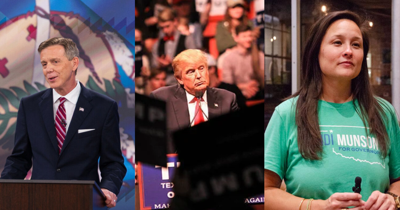
President Donald Trump visited southeastern Oklahoma — a solid red state — Thursday night, leaving questions surrounding the strength of Oklahoma’s Republican gubernatorial candidate Mike Mazzei’s campaign one month before the midterms.
OU professor Michael Givel, whose research specializations include comparative politics and public policy, told OU Daily he doesn’t believe the choice to visit Durant — the seat of Bryan County, which Trump won by more than 75% his last three times on the ballot — was a coincidence.
“If it's safe, why waste time?” Givel asked. “The fact that he came here means there's a doubt about the viability of the Republican gubernatorial candidate. … This was designed to fire up the gung-ho supporters in Oklahoma, particularly for the governor's race.”
The rally was attended by names including former OU football coach Barry Switzer, Gov. Kevin Stitt and OU’s largest donor Harold Hamm, who spoke for several minutes at the beginning of the rally. While on stage, Trump shouted out Switzer: “This guy’s a good football coach, OK?”
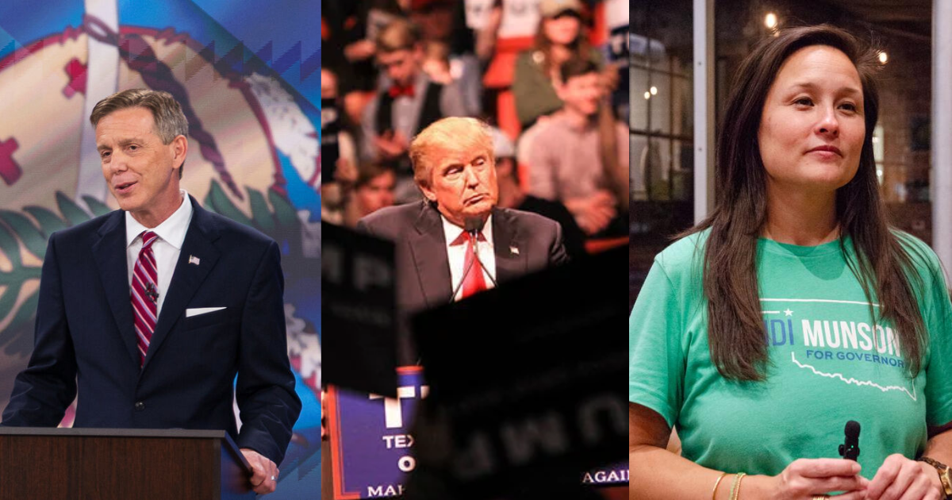
The timing of the President’s rally forced changes to a planned debate Thursday night between Republican gubernatorial candidate Mike Mazzei, a former state senator, and Democratic gubernatorial candidate Rep. Cyndi Munson (D-Oklahoma City).
The two were set to debate live on OETA, but the event was pre-taped due to Trump’s last-minute rally, at which Mazzei spoke. The event was the only debate scheduled between the two, per Oklahoma Voice.
“This happened when the debate was happening at the same time, so I don't necessarily think that's a coincidence. And even if it wasn't, it was interesting timing,” Givel said. “I think there's a plausible argument that somebody's worried, whether that means anything in terms of Munson winning, we shall see.”
Andy Moore, founder and CEO of Let’s Fix This, a nonprofit supporting civic engagement and voter outreach in Oklahoma, said the race could be closer than expected.
“What polling we do have would indicate that Mazzei has a comfortable lead, but maybe that's not the case,” Moore said. “If the president feels compelled to come down here and campaign for him, it might mean that the race is more competitive than we think.”
He believes the race will be within ten points.
“Looking back at the Democratic candidates from the last several gubernatorial elections, they've been stuck below 43%,” Moore said. “I think the last Democrat to get above 43% was Brad Henry, and so I think that's what everyone would be looking to see is how well Munson can perform based on historic standards.”
Oklahoma’s last Democratic governor was Brad Henry, who won the 2002 gubernatorial election with 43.27% of votes, according to Ballotpedia. Henry was in office from 2003 to 2011.
Since 2011, the state has had two governors, both Republicans — Mary Fallin and Stitt. Fallin won the 2010 gubernatorial election with 60.45% of the vote. Stitt won with 54.3% in 2018, with his Democratic counterpart — Drew Edmonson — claiming 42.2%.
Liza Inbody, a senior public relations major at OU and civic engagement fellow with Oklahoma Votes, said events like the rally and the debate attract people who are already paying attention, rather than appealing to new voters.
“What we've seen is that young voters just simply do not vote. It's really hard to get people out to the polls … ,” Inbody said. “Those events specifically are attracting people that are maybe already engaged.”
OK Votes is a student-led nonpartisan organization that seeks to register OU students and community members to vote and educate them about voting.
Moore said in order for a party to drum up new supporters, its message has to resonate.
“If people don't feel like what you support matters to them, then they're not gonna get behind it,” Moore said. “And the double-edged sword of that is that you have to make promises, and you have to deliver on those promises. And I think that's the real question right now is voters trying to decide if their party allegiance is more important than results.”
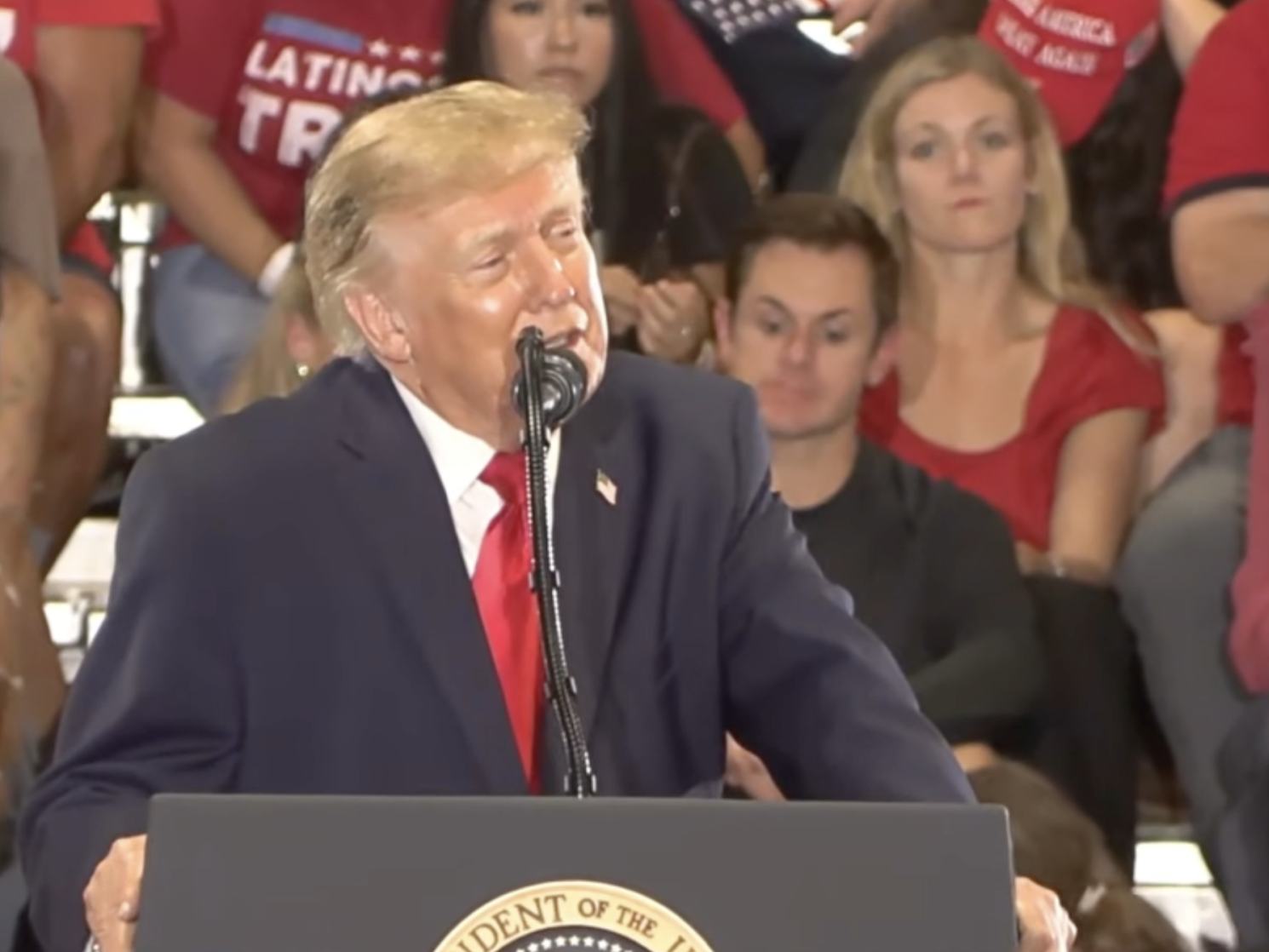
President Donald Trump during his Durant rally on Oct. 1, 2026.
Mazzei vs. Munson
Mazzei’s campaign goals include eliminating property taxes for seniors and veterans, creating more high-paying jobs and opposing abortion — which is illegal in Oklahoma with very limited exceptions.
“We’re going to elect Mike Mazzei … as your next governor,” Trump said during the rally.
Despite Trump’s endorsement, Givel does not believe the rally will have a large effect on Mazzei’s support in the Nov. 3 election.
“In about a week or two, people are not going to remember this. That's how it works,” Givel said. “So it would have probably been more effective if (Trump) was here the week before the election.”
He also believes Munson, currently Oklahoma’s House minority leader, is a strong gubernatorial candidate, noting her campaign visits to small towns across Oklahoma. Her campaign goals include tribal sovereignty, opposing data centers and prioritizing affordable and accessible healthcare — in which she includes overturning Oklahoma’s abortion ban.

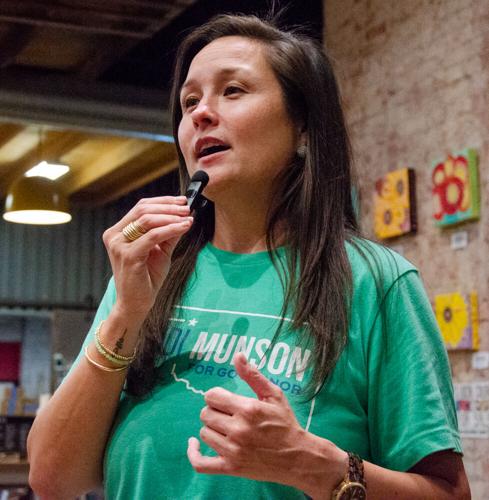
Gubernatorial candidate Cyndi Munson at Yellow Dog on Sept. 13, 2026.
“The Democrats have a pretty exceptionally strong candidate this year. She's a moderate, and she's very personable, and she's been running a very strong campaign. And she has decided, her campaign, to not only campaign in Tulsa and Oklahoma City and Norman, but she's been all over small towns and all over the state of Oklahoma, …” Givel said. “So she comes off very friendly and personable. Is that going to matter in Oklahoma?”
Moore believes the difference in the two candidates’ campaigns lies in their focus.
“In the debate, we saw Mike Mazzei’s message being, ‘Here's my vision for the state. Here's what I'll do for you,’” Moore said. “And Cyndi Munson's campaign message was more, ‘Hey, I'm listening to the people right now. This is not my plan, it's the people's plan. I want to govern with you, not on top of you.’”

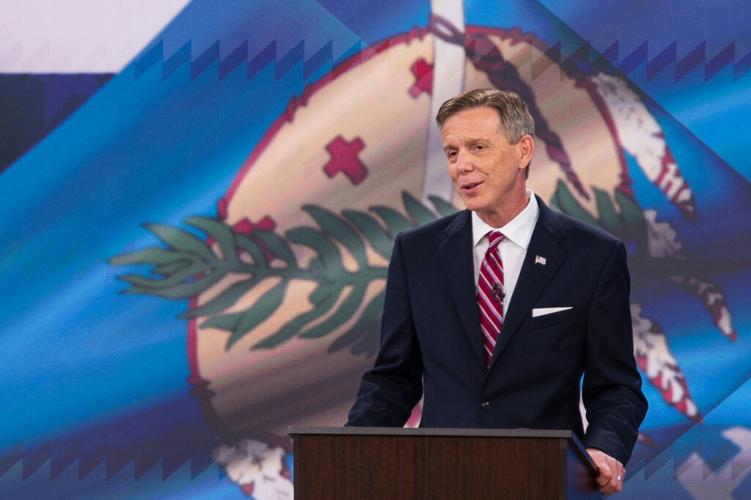
Oklahoma Republican gubernatorial candidate Mike Mazzei delivers his closing remarks at a televised debate in Tulsa, Okla., Monday, Aug. 3, 2026. (Jake Ramsey/Oklahoma Watch via AP)
Munson, who Trump called a “radical left Dumb-ocrat” during the rally, claimed 74.93% of votes in the June primary election for the gubernatorial Democratic nominee spot, beating out candidates Arya Azma and Connie Johnson, according to results from the Oklahoma State Election Board.
Mazzei won 25.97% of votes in a highly contested primary race for the Republican gubernatorial spot, according to results from the election board, with Oklahoma Attorney General Gentner Drummond claiming 26.25% of votes. The two advanced to the August runoff, where Mazzei beat out Drummond, narrowly claiming the majority with 50.28% of votes after Drummond conceded the race.
Moore said Trump's decision to visit Durant could be due to decreasing support.
“I think this is pretty similar to what George W. Bush did in 2006, where it was a lot of the swing states or competitive states don't want the president to come because he might swing it in the wrong direction,” Moore said, “and so it's a bit of a trip around to his bases of support to try to drum up some additional support there from audiences that might be feeling more apathetic this year than they were two years ago.”
President George W. Bush visited Oklahoma State University for a commencement address in May 2006 during his second term. In November of that year, he conducted a last-minute tour of red states, just days before the 2006 midterms. Republicans maintained Oklahoma’s House and Senate majorities after that election, with Henry holding his seat until 2011.
Backing up Moore’s belief, Givel said public opinion polls have indicated Trump’s popularity is lessening. Since March, Trump’s approval rating has dropped from over 40% to 37% as of Monday, according to polls consolidated by The New York Times.
“In fact, some Republicans around the country, not here in Oklahoma, as far as I know, have actually been trying to distance themselves from the Republican policies,” Givel said.
He attributes this to issues such as the Iran war, tariffs and rising costs across the country.
Moore said the cost of living in particular has frustrated a lot of voters.
“I got gas yesterday, and it's just oppressive the amount of increase and how quickly prices have increased,” Moore said. “We are all hoping for some relief, and that is not at all what's happened.”
According to AAA’s national gas price average as of Monday, the average cost of a gallon of gas in the U.S. is about $4.37. In Oklahoma, this is closer to $4. According to NBC, gas averaged under $3 a gallon before the Iran war.
“There's places where it's double that — eight bucks a gallon in some places. So I think that's a main thing,” Givel said.
According to AAA, the highest average cost for a gallon of gas in a state is $6.38 in California.
“There were a lot of promises made about the price of eggs and groceries dropping, and the exact reverse happened,” Givel said, “and that is translating either into discontent with the government in Washington and its subunits around the country, like Oklahoma City.”
Givel ultimately does not believe the party majority will change in Oklahoma, however. The Republican party has held power in all three branches of the state’s government — known as a state government trifecta — since 2011, when Fallin was sworn in. Republicans have controlled the Senate for 17 consecutive years and the House for 21.
“The supermajority of the Republicans, which have been in power what, 15, 20, years, will continue … ,” Givel said. “There's some wiggle room in terms of some incumbents maybe losing, but I don't see the Republicans necessarily losing the House or the Senate.”

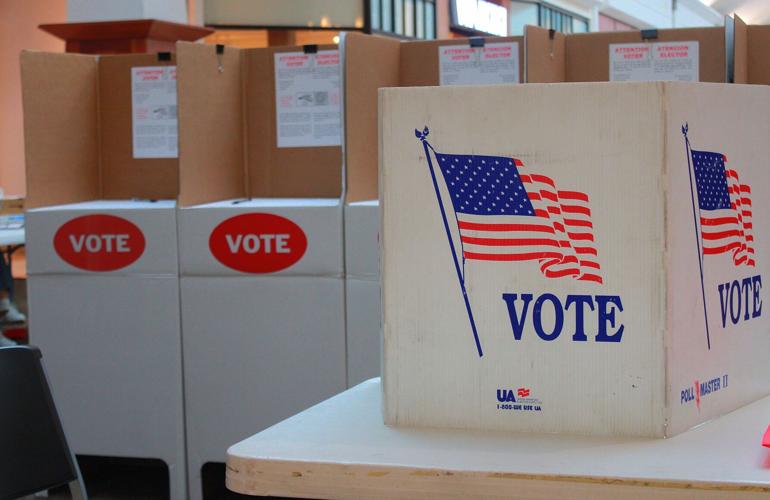
Voting booths during early voting at Sooner Mall on Aug. 21, 2026.
Civic engagement, young voters
Moore said growing enthusiasm for midterms has caused many voters to confirm or update their voter registration, but frustrations with closed primates have increased as well.
“That obviously doesn't play as big of a role in November, but I think a lot of people look at the ballot in November and say, “This ballot could have looked very different if we had open primaries,’” Moore said. “We might have had candidates that were more oriented around the issues rather than just political polarization.”
Moore hopes the November election will lead to more Oklahomans supporting open primaries, which is an election where voters can choose which party’s ballot they receive, regardless of their registration. He said one voting barrier comes from a lack of guidance from the state election board.
“I would love to see the state election board be more proactive in pushing out information to voters. Several other states mail out voter guides to voters across the state. I would love to see Oklahoma move that direction,” Moore said.
He said various voter guides can be found with the League of Women Voters, the Rural Schools Coalition and information about state questions from the Oklahoma Policy Institute.
In a September interview with OU Daily editors, OU President Joseph Harroz Jr. said the university has worked well with the state Legislature over the past six years. In his time as president of OU, Harroz has worked only with Stitt, who has been governor since 2019 — one year before Harroz was appointed.

Harroz said in September that the university is shifting toward shared governance this year, a model of power he says helps prevent the Legislature from dictating how OU governs itself.
“What is shared governance? What does that really mean? … ” Givel said when asked about the effect of the November election on OU’s governing system. “If it means we're all equals at the table, that's not what's been happening at OU for a long time. … I don't see that changing. In fact, I think it's been eroding in a couple areas.”
Inbody said everything the state government does affects the day-to-day lives of students, especially as it relates to infrastructure.
“Particularly there's an issue, in my personal opinion, with OU with housing and OU with parking. And our state legislators can help implement policy that affect the housing market and affect real estate in Norman, and also parking, which plays a huge role right now just like in students' lives … ,” Inbody said.
Harroz said one reason the public funds research universities is to produce citizen leaders, regardless of party affiliation.
“We see the numbers around how divided society is, … so that's a huge obligation for us,” Harroz said, “and we have to be a part of creating citizens that know how to lead, and not just for a party, but for the country first.”
Inbody said it has been hard to engage people to register to vote. OK Votes works with All In To Vote, an organization encouraging nonpartisan, student democratic engagement. Inbody said All In To Vote has seen low civic engagement across the nation.
“This isn't an issue just in Oklahoma. It's an issue across the board. A lot of colleges are having trouble getting students to vote, … ” Inbody said. “It's important to have people that really do care about these things, and a citizenry that cares about these things in order to make a better future.”
Inbody urged students to register and vote, adding that there’s not any one issue that students care about, and civic engagement is instead about feeling heard.
“It may feel like, ‘Oh it doesn't matter, it's just one vote,’ but if everyone has that collective ideology, nothing's going to change,” Inbody said. “But if everyone essentially gives their opinion and votes, OU students — just us — have the ability to entirely flip an election.”
Givel encouraged students to research each candidate, and said issues students may want to pay attention to include student loan and work study programs. Givel also urged students to continue to pay attention to politics after the November election.
“If your party happens to lose or (your) candidate happens to lose this time, that can be very disappointing. But guess what? There's another election, and you become the loyal opposition. Or if your party wins, then it seems like a good thing,” Givel said, “But I suggest (you) keep watching after the election. Just make sure that your candidate is doing what they said they would do during the campaign.”
Oklahoma has one of the lowest voter turnout rates in the country, hovering around 50%, according to Ballotpedia. Moore said because of this, voters can have a large impact just by showing up.
“The Oklahoma Constitution is written such that all political power is inherent in the voters. This is our chance to use our voices to say, ‘This is the future we want.’ We can't leave it up to some politician in some building far off to make decisions for us when we have the chance to make decisions ourselves.”
The deadline to register to vote in the November election is Friday, Oct. 9, and the deadline to request an absentee ballot is Oct. 19. Early voting will take place Oct. 28-31.
Read more about registration and voting locations in Norman:

This story was edited by Willie Gillespie. Parker Newman, Kennedy Johnson, Sophie Hemker and Larkin Bock copy edited this story.


