Just weeks after welcoming OU’s largest first-year class in state history, OU President Joseph Harroz Jr. spoke to OU Daily editors about how campus infrastructure will keep up with growing enrollment, working with the state legislature and the planned arena in the Rock Creek Entertainment District.
This interview has been edited for length and clarity.
Student enrollment and infrastructure
Q: We're just going to jump right into it, starting with student enrollment. You said last week at the State of the University address that this time next year OU is going to hit the 40,000 student enrollment mark. What's that plan going forward for enrollment? Will the university continue to increase enrollment or stop and let the infrastructure catch up?
A: Let's talk about (it) by campus: the Norman campus has grown — well, the first-year class has now gone up 45% in six years. The Health Campus has gone up 37% over the last six years. We've doubled the size of the online (program) now, so we're now at 5,000 online. We're 4,000 in person on the Health Campus.
In the first couple years of growth, we weren't sure whether it would be sustained, and so you weren't sure about what infrastructure changes to make, and it became clear after really the third year … that we were going to need to make sure we had the infrastructure to meet all of this. …
We've started a project across the campuses, a focus on Norman, but really across all three campuses, on “What size do we think we're going to be and want to be, and why?” and then “What is the cost to grow?” …
The other thing we did was (we) engaged a group called Ayers Saint Gross, and they're national experts with universities of our size and larger, around “How do you plan out the design of, and the flow of a campus to make sure it works the way you want it?” We'll have, in the next year, that full plan laid out on what we want …
As we sit right now, we'd like to grow some more. What is that exact number? … Maybe it's in that 7,100 range in a freshman class. The key is, you have to make sure that the experience you're providing for students doesn't diminish. … The growth shouldn't be infinite; it should be purposeful, and you should make sure that you can provide. …
We announced this summer the new parking garage, a new 650-space parking garage. We added 150 surface spaces this year over towards where Parkview used to be, and we've changed the dedication of some spaces more for commuter lots.

Consolidation of Life Sciences Laboratories Building
While speaking about university growth, Harroz touched on the construction of the new Life Sciences building.
A: Right now, we have seven different locations where labs for biology and chemistry are being held. Some of them are as old as 60 years old. We're going to move all those into one location — state-of-the-art labs.
It'll be 80,000 square feet for undergrads, and then the top floor, 20,000 square feet, will be (for) biomedical research. It's this idea of “How do you not just grow, but how do you grow in a way that enhances the student experience, benefits outcomes and better positions our students to be successful?”
And the idea that, as a research university, making sure that our students see and are a part of the research enterprise … We were given $80 million from the legislature to build a new engineering research space. We were working today on what does that layout look like and how do you make sure it serves the research function but also the students?

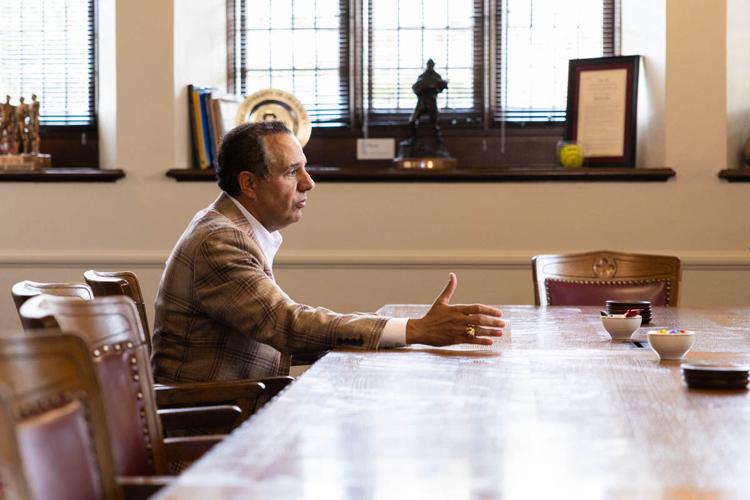
President Joseph Harroz Jr. on Sept. 10, 2026.
Rock Creek Entertainment District
Q: This summer, Oklahomans for Responsible Economic Development filed a lawsuit (against the Rock Creek Entertainment District), and then … a judge dismissed some of those motions. So, how does the university feel about that community response changing so much since we last spoke, and where do you guys stand on the arena now?
A: We think it was a really sound decision. Obviously, it was in our favor, so you would typically say that, but it gives the full green light for the entertainment district. And when we think about you know why is that important to us — us, the university. It's important to us for a couple of reasons. The first one is that people immediately go to the arena and say, “Well, that arena is important,” and it is. That's only a small fraction of it. …
I know folks want to focus, and we do focus, on the arena. But the story is much bigger, which is how do we play a role not just for the student, but for the state? Having an entertainment district like this, where you have so much housing, where you have the ability to live there and work there, and then with the arena — and other entertainment venues — play there. This is what has led to the success of places like Austin and other cities. Right now, if you look at Nashville and what they do with the universities that surround it, including one from the SEC with Vanderbilt, that's the formula. …
We're coming very close to making a final selection on who's going to develop it, and we're going to see a lot of action around that soon.

Turnpike interchanges
While speaking about the Rock Creek Entertainment District, Harroz touched on turnpike interchanges.
In late August, Norman City Council rejected a resolution that would have supported the development of interchanges in Norman as part of the Oklahoma Turnpike Authority’s South Extension Turnpike. The OTA later removed two interchanges from its planned route.
A: You may have seen that I also have an opinion on the interchanges. …
That whole debate went through, and the decision was that a turnpike was coming through. I didn't lend a university voice during that process. There was a lot of discussion, and it really impacts individuals. The question that came before the city council recently was whether or not they were going to ask to have interchanges in Norman. …
The decision has already been made. There's going to be a turnpike running north-south. And then when we looked at it, to not have any interchanges in Norman would really create everything from health and life safety issues to the ability to prosper economically, and the two interchanges that are being discussed don't take any additional property or rooftops. No one else is impacted by it. …
And so it's not being unconcerned about what we have here, but it is after that decision was made, going ahead and taking what I think is a really common sense approach to what you do once there is a turnpike.

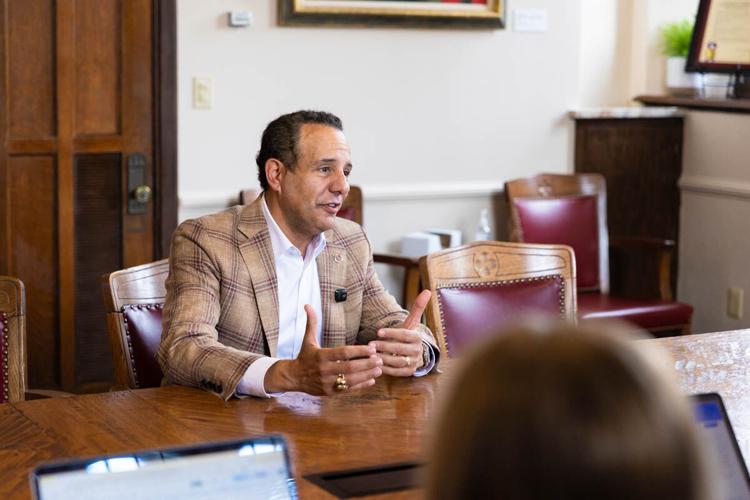
President Joseph Harroz Jr. on Sept. 10, 2026.
Government influence
Q: An annual survey of Southern faculty conducted by state AAUP conferences actually just included Oklahoma for the first year. It found an increasing worry about government intrusion into curriculum. As a new governor takes office, what are some specific steps that OU has taken, or will take, to protect curriculum, grading independence and professors from any state pressure?
A: This is really important. … I think public trust has to be earned …
If you ask certain people, and you say, “What's wrong with higher education?” A number of people will say, “Well, tenure,” and then you say, “What do you think tenure is?” and they'll say, “Well, it's a lifetime job protection, no matter what you do.” Well, that's not right. …
Right now, you see governments that are taking positions because they don't believe, in their eyes, that the universities are listening, that there has to be a meritocracy and there has to be accountability. And so, the question is, “Are we, the faculty, engaging in an evaluation of ourselves and holding ourselves accountable? Are we able to do a better job of it than those outside?” The answer is yes, I believe. …
There's a couple ways you can handle this. You can step back and let the legislature do it, if you don't react, or you can work as a university together on this. And what is really special at the university is, over the last five years, we have worked together as a faculty on this. A perfect example is post-tenure review. We have one of the most, I believe, honest and excellent post-tenure review standards in the country. We wrote ours. We didn't have them imposed from the outside. …
We did the same thing around endowed chairs and professorships. They're not a grant forever. They have to be evaluated. And if someone's not producing, then we're going to deal with that in a way that's honest.
What we're doing this year is we're engaging in a project called “accountable shared governance” … There's a special president's advisory committee on accountable shared governance that's been working last semester, all summer and working right now with the product to come out to our board at the last meeting of this year … that lays out what we believe accountable shared governance is. …
If you don't want people to, or governments to, come in and dictate how we govern ourselves, we have to do it in such an effective way that we earn that trust, and we also demonstrate that trust, and I think this is what we're going to see from OU. I think we're a leader in this area, and I'm so proud to work with our faculty on this. I think it should be a model for the country.

Work with new legislature
Q: What are your thoughts on the November election and some future collaboration with new leadership at the state level? There’s going to be a new governor; it’s going to be the first time in your tenure that you’re going to work with somebody in that position that’s not Kevin Stitt. So I’m curious to hear kind of your thoughts on what’s coming up here. … I’m kind of also additionally curious about voting and civic engagement on campus too.
A: I know that everyone involved has the best interests in the state at heart. We've had a remarkable run over the last, really, six years with the state legislature. …
If you look at what the legislature, along with the governor, have done the last six years just to OU alone, there has been almost $250 million in special appropriations over the last five years to OU. And then when you add in OU Health and what's taken place there, (it’s an) absolutely game changing investment. …
We're not an island, … and I think what we've seen is an increasing partnership with the state and private sector. When I think about how do we move this forward in a way that we can accomplish our goals while still making it affordable for students, … The answer to that is increased state contribution. …
I don't think Tom Cole gets enough credit. This past year, he's the chair of appropriations, and he's our representative here at OU. And this past year, we received $178 million, mainly towards our research enterprise, because of his leadership and his ability to see, in his own words, that what we're doing matters. …
I believe that both of the Democrat and Republican gubernatorial candidates understand that as well.
Q: Did you want to touch on civic engagement on campus?
A: We think about, “Why does the public fund research universities?” We know it’s only three things, as I see it. One of those is to give us a chance, right? (It) gave my dad a chance, gave me a chance. …
The other is to create a workforce and entrepreneurs that benefit the state and society.
The third is to produce citizen leaders, and it's a really important part of this. Individuals that graduate need to understand, whether you are a physicist or a poet, that your duty and your obligation is to be a civic leader, and so the only required class at OU for every single student, regardless of discipline, is American Federal Government. … There's a reason that I guest lecture in as many first-year American Federal Government courses that I can, which is I want to be a part of that education of civic obligation, which we have, and citizen leadership. And we see the numbers around how divided society is, … so that's a huge obligation for us, and we have to be a part of creating citizens that know how to lead, and not just for a party, but for the country first.

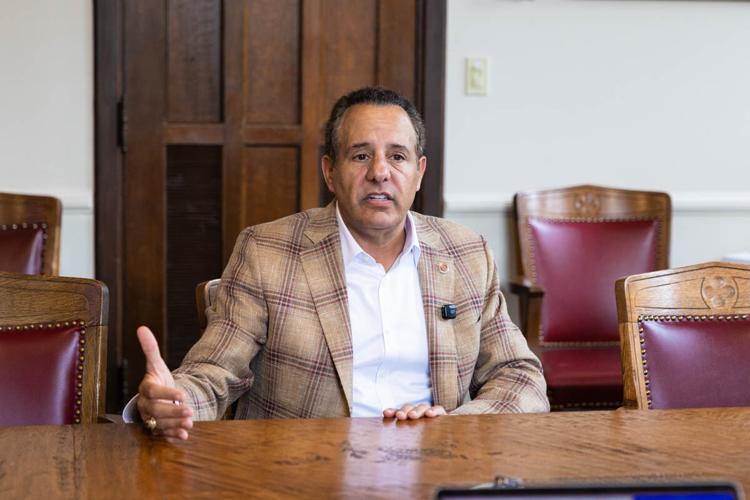
President Joseph Harroz Jr. on Sept. 10, 2026.
90-hour degrees
Q: The state regents recently approved OU's request for a 90-hour degree program for social work. Following that accreditation progress, will that degree be offered next fall? And is the university going to request another 90-hour degree program? I know that cybersecurity was the other one that was proposed. Is that going to be in the near future?
A: We have to innovate. We have to meet students where they are, and we have to be aware of the goals the students have. I think the biggest problem with universities — and maybe you can see this theme throughout this interview — is that universities need to be responsive to the students. Universities need to be responsive to the market. There is too much of a belief, and I think there's a lot of reality behind it, that sometimes institutions are there to serve themselves. …
We have to do things in a non-traditional way to make sure that we are providing the greatest access to the American Dream, which is higher education to the greatest number of people, and that means we cannot stick by the old calcified idea of what getting a college degree has to be.
Q: So will the university offer that one in the fall?
A: Yes.
Q: And you are going to propose some more?
A: There’ll be more.
Q: Do you know when that will be?
A: We're working on it right now, and look, these are things that you don't know if they're perfect, but we have to also not be scared to fail.
And if we look at social work, we had first-generation students over at Boyd House earlier. … One of the students said she was in social work, first-generation student, very financially conscious, and if she can do that degree in three years instead of four, and if that time, that extra year to her isn't worth staying here, but needs to be out there working or pursuing her next degree, and given the huge workforce needs in our state around social work, it just seems to me that you have to try a thoughtful three-year degree. …
One of the biggest fears I see is individuals and institutions being terrified of change. It is a human instinct I never fully understood until this job, and in an era where we have artificial intelligence and the impact that it is having in real time, I think the best thing we can do is think dynamically, have an open mind, not be afraid to experiment with new things and not be afraid to fail. So this 90-hour degree, I think, is an exceptional idea. We will have more, and it will either be a good idea and flourish, or it'll be a bad idea and we'll end it in the future, but never leave any students stranded.
Lauren Brogdon, Parker Newman and Tori Pham copy edited this story.


