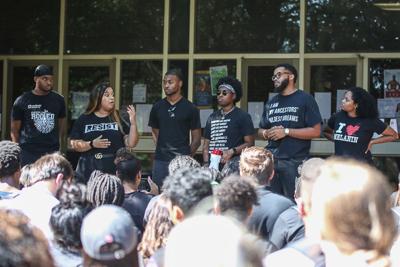
OU students saw a man wearing blackface and a racist t-shirt walking around campus on a January afternoon last semester — one of a series of public racist incidents that shook OU in the spring.
That night, then-Black Student Association President Taylor Wilson and then-Vice President Shelbie Walker created a group chat with various leaders of black community organizations at OU to discuss the best way to respond to this and other incidents, said political science and women’s and gender studies senior Destinee Dickson.
One of the group chat members gave this group of leaders a name: The Black Emergency Response Team, or BERT, said BERT's co-director and political science and African American studies senior Miles Francisco.
Since then, BERT has acted as a voice to respond to racist incidents on campus, helped plan marches and events to advocate for the black community and worked with OU’s administration to create structural change and prevent racist events from happening on campus.
“There was clearly a need for an activist wing of the black community, full of black leaders who had been doing activist work,” Francisco said, “(to) come together to really address structural racism and the structure of oppression that the University of Oklahoma is built upon.”
In less than a year, BERT has established itself as an activist voice for the black community. As an organization that is separate from the BSA and not registered with the university as an official student group, BERT has taken the lead in advocating for black students at OU, said African and African American studies junior Jamelia Reed. Reed is also a BERT co-director.
“Black students can focus on being students,” Reed said. “And BERT can be like, ‘We’ll worry about the media, we’ll worry about the things that’s up in your face. You don’t have to be the activist — we’ll carry that burden for you.’ If something happens, reach out to BERT.”
For many students, BERT is a resource they can use if they are unsure of how to handle possible racist incidents, said Dickson, who is now BERT’s director of recruitment.
“BERT has also been used as a place and a tool for students of color to send in things that they're seeing,” said Dickson. “Not everything just goes viral.”
Just this semester, the group exposed another racist incident, where a freshman student posted a video of himself in blackface, and held a press conference afterward. When the student first posted the video of himself in blackface, another student who saw the video brought it to BERT for them to handle, Dickson said.
In the wake of the racist incidents last semester, the group planned the Better Together march on campus to demand change at OU. The march was just one of the things BERT did last semester to address issues of racism, Francisco said.
“Spring was truly a whirlwind. (We had) multiple meetings and town halls, meetings with upper administration,” Francisco said. “(We were) getting calls for quotes and things every other day, from every newspaper in the entire state. So, last semester was a lot.”
As BERT approaches one full year since its creation, the group has tried to become more active and strategic in how it conducts its operations, rather than just reacting to events on campus, Francisco said.
“I think the main difference (from last semester) is just being significantly more strategic than we were last year,” Francisco said. “We're wanting to ensure that when (racist) things do happen, we have been proactive enough so we're prepared for those things.”
One of these strategies is also ensuring BERT’s continuation, Dickson said. BERT will set up an ambassador program for younger students in the spring.
“A lot of us are seniors. We're about to graduate, but we obviously want BERT to keep going, as well as making sure we're educating students,” Dickson said. “This ambassador program is for anyone interested in wanting to take some of our positions and roles and keep BERT going after we graduate.”
Recruitment for BERT and continuing its work is important to hold the university accountable in the future, said Francisco.
“So often, higher ed institutions rely on student activists coming in ... and really getting active in the second year, and then they’re out within a year or two,” Francisco said. “So it's really important that we're laying the foundation and the groundwork so that the next generation of young people aren't coming in and starting exactly where we were, but are starting at the place where we've built to.”
As the original members of BERT get ready to graduate, they hope to see the group continue its primary focus of calling out racism on campus, said Reed.
“BERT is always going to be this whistleblower,” said Reed. “I think it will continue to do that. ... OU is great, but it can be better.”


