
Editor's Note: This article was updated at 10:40 p.m. to clarify that tuition is covered for students from families earning $60,000 or less.
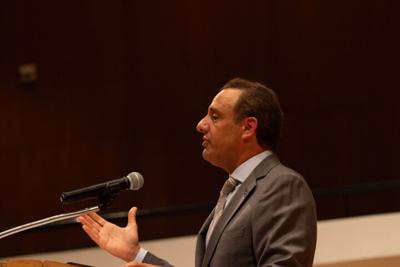
OU President Joseph Harroz Jr. delivered the State of the University and answered questions on tuition support and diversity, equity and inclusion efforts at the Faculty Senate meeting Wednesday.
Harroz emphasized OU's efforts to make education affordable by covering tuition for students from families earning $60,000 or less. He noted the trade-offs and the satisfaction of making higher education attainable.
At a June Board of Regents meeting, the board approved a 3% tuition increase and mandatory fees for all Norman campus students. The tuition increase will cost roughly $145.50 more per semester for resident undergraduate students, and roughly $400.80 per semester for out-of-state undergraduate students.
During the June meeting, Harroz said that while tuition is increasing, need-based aid has also grown and, through these efforts, OU is helping students with financial needs.
“If you earn $60,000 or lower in income, it costs you nothing to go to OU for tuition and fees. Dollars are also available to offset the price of room and board” Harroz said at the State of the University address. “That's what a great public research university does. That's what differentiates us right there, which is attainable excellence.”
Harroz said of the roughly 5,600 first-year students, 40% are from historically underrepresented communities while 25.5% are the first in their families to attend college.
Sarah Robbins, chair-elect of the OU faculty senate, asked Harroz how the university plans to support efforts in diversity, equity and inclusion.
“How will the university continue to support critical diversity equity and inclusion efforts, especially as it applies to teaching and research, given the state's pushback on anything DEI?” Robbins asked.
In December, Gov. Kevin Stitt signed an executive order that called for a review of Oklahoma’s diversity, equity and inclusion. The order resulted in the restructuring of OU’s Division of Student Affairs. OU’s Gender + Equality Center was replaced with a new office called the Office of Advocacy and Education.
Harroz said the university’s main goal is to ensure faculty and staff are additive to the current conversation and not a source of intolerance or anger. He said OU’s value is opportunity and the lowest socioeconomic students are going to be part of living in those values and getting away from words that have become divisive in charge.
Harroz stressed the importance of realizing what the executive order doesn’t touch.
“It doesn't enclose student organizations' and groups' rights,” Harroz said. “It doesn't apply to academic course instruction, it doesn't apply to research and doesn't apply to creative endeavors.”
Harroz emphasized the importance of working to find solutions to issues such as attracting new deans and faculty members to spearhead the university's forward progress.
OU’s current strategic plan, “Lead On, University,” involves providing affordable, quality education and elevating the experience of students, both socially, emotionally and academically.
Part of the Lead On strategic plan is for OU to become an institution recognized by the Association of American Universities. The plan to become an AAU institution includes hiring 25 new faculty members every year for the next seven years to maintain the university’s excellence and provide further academic opportunities for OU’s student body.
“Nothing is ever perfect. You can always do better,” Harroz said. “There's always a miss here and there, but it feels like there's a lot of respect going both ways. We're all trying to achieve the same outcome when problems occur.”
This story was edited by Anusha Fathepure, Ismael Lele and Ana Barboza.


