
Recent organizational reconstruction in OU’s Division of Student Affairs will bring changes to leadership and offices such as OU’s Gender + Equality Center, which was closed in April and replaced with a new office called the Office of Advocacy and Education.
The GEC closed as a result of Gov. Kevin Stitt’s December executive order calling for a review of diversity, equity and inclusion programming and services in higher education.
The Office of Advocacy and Education provides services related to sexual violence prevention and response, according to an email sent by Vice President for Student Affairs and Dean of Students David Surratt, to the Division of Student Affairs and stakeholders. It also provides critical health education and wellness-related programs that ensure students can access support in Oklahoma City; Tulsa; and Arezzo, Italy, where OU has programs.
Mandatory student training and the management of the OU Food Pantry were also moved into this office.
These mandatory trainings, according to an email by Kesha Keith, OU Student Affairs director of strategic initiatives, will include sexual violence prevention and response, which is required by Title IX and covers topics related to gender-based violence, awareness and prevention strategies. Keith wrote this training aims to create a safe and affirming environment for all students by educating them on recognizing and preventing sexual violence interactions.
The alcohol and other drugs education training, which is part of the OU’s Comprehensive Alcohol & Other Drug Program, will include mandatory education based on the current Student Alcohol Policy for all incoming first-year students on safe practices, harm reduction strategies, and the dangers associated with alcohol and drug abuse.
OU’s Board of Regents recently approved an update to the alcohol policy, which Keith said was to better streamline the policy. The student alcohol policy and three strikes policy were moved to Presidential-level policies, allowing for faster updates, Keith wrote, which means any changes to these policies can be approved and implemented directly by the OUpresident and appointed chair without waiting for regents approval.
Student Affairs will manage the alcohol policy through training, wellness education and resources such as ongoing education and support programs. It will also offer health and counseling services to address alcohol and drug use; enforce the policy for students and registered student organizations; and collaborate with other departments. These departments include OU Housing and Residence Life; Fraternity and Sorority Programs and Service; and the OU Police Department, which monitors and enforces the updated alcohol policies.
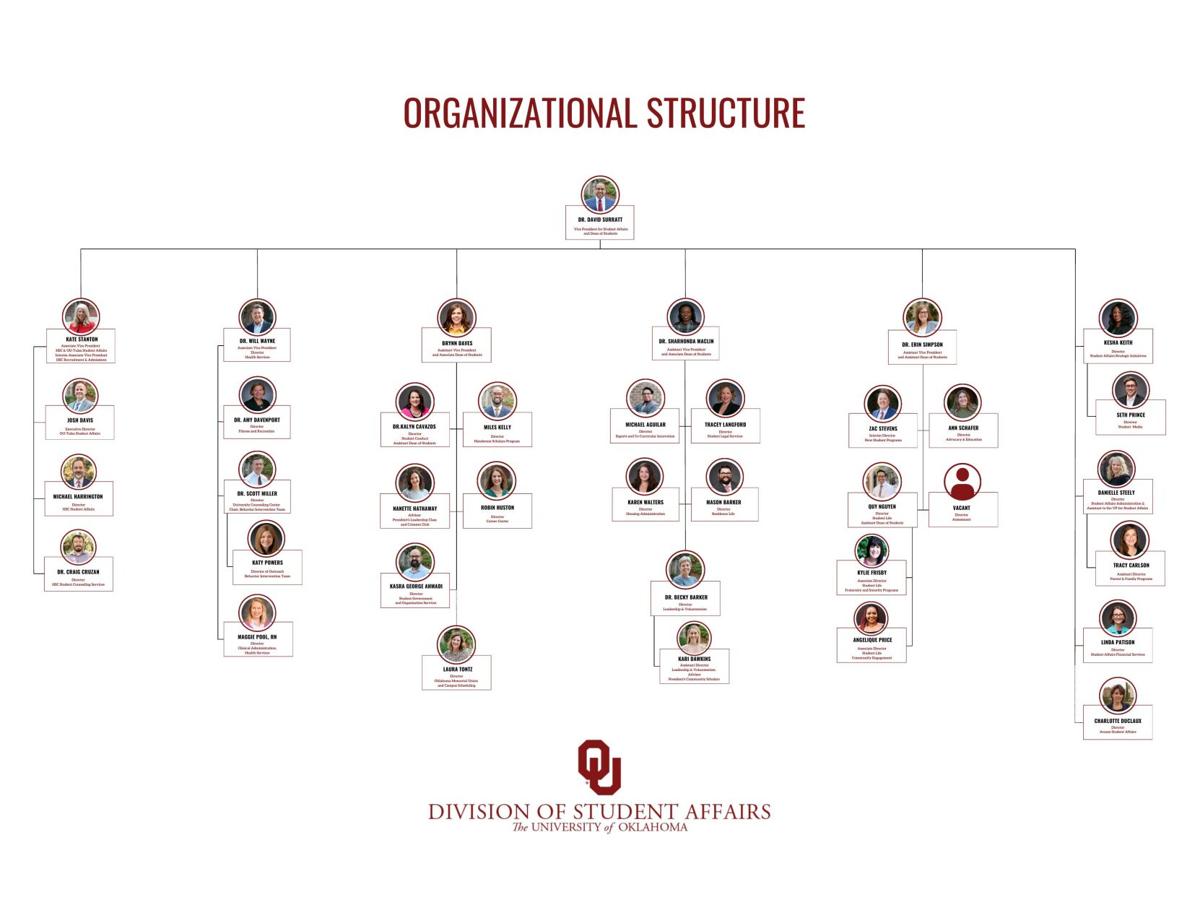
Erin Simpson, the previous director of the GEC, was promoted to assistant vice president of Student Affairs and assistant dean of students, according to the email. Simpson will now oversee the Office of Advocacy and Education; Office of Student Life; New Student Programs; and Assessment.
Ann Schafer, former associate director of Outreach and Education at the GEC, will now serve as the new director of the Office of Advocacy and Education.
Along with the opening of this new office, the division also renamed the Office of Student Life’s Multicultural Programs and Services to Community Engagement. This shift, according to Surratt’s email, aims to better allocate resources toward supporting Norman campus student involvement, belonging, retention and leadership development.
Community Engagement will also include advising and support for 2SLGBTQ+ student services.
The deadline to comply with the executive order was May 31. While the university and academic colleges made changes ahead of the deadline when OU was required to sign a letter of attestation saying it had complied with the order, the email regarding the details of these changes was forwarded to OU Daily on June 21.
Other changes include appointing Zac Stevens, a former senior fellow at Dunham College, as interim director of New Student Programs, and Amber May, former advocate case manager of the GEC, as associate director of the Office of Advocacy and Education. May will continue to oversee OU Advocates and will also supervise the OU Food Pantry.
Matt Marks, who served as student director of the food pantry, will now be the organization’s assistant director.
Other updates to leadership, according to the email, include the following:
Associate Vice President for Health Sciences and OU-Tulsa Student Affairs Kate Stanton will additionally serve as interim associate vice president for Health Sciences Recruitment and Admissions within the Health Sciences Senior Vice President and Provost Office.
Brynn Daves, the assistant vice president for Student Affairs and associate dean of students, will continue to lead multiple student-centered areas such as Student Conduct, Norman Student Government Association and Student Organization Services and the Henderson Scholars Program. Her new responsibilities are the Career Center and the President's Leadership Class, including the Norman Crimson Club.
ShaRhonda Maclin, the assistant vice president for housing and residence life and associate dean of students, will continue to lead OU Housing and Residence Life and will also manage Esports and Co-Curricular Innovation; Student Legal Services; and Leadership and Volunteerism, including President’s Community Scholars.
Danielle Steely, director of administration and assistant to the vice president will additionally supervise Parent and Family Programs.
Director of Strategic Initiatives Kesha Keith will oversee Student Media, including OU Daily, which continues to operate with full editorial independence.
Changes to offices and leadership within the Division of Student Affairs are not the only result of the executive order. In February, OU President Joseph Harroz Jr. announced in a campus-wide email that OU’s Division of Diversity, Equity and Inclusion will change its function and name to the Division of Access and Opportunity due to Stitt’s executive order.
The order reads that “executive state agencies shall not utilize state funds, property or resources to grant or support diversity, equity, and inclusion positions, departments, activities, procedures, or programs to the extent that they grant preferential treatment based on one’s particular race, color, ethnicity, or national origin over another’s.”
On June 4, the American Civil Liberties Union of Oklahoma, American Civil Liberties Union, Lawyers’ Committee for Civil Rights Under Law, and Schulte Roth & Zabel LLP, attorneys for Oklahoma educators and students challenging HB 1775, published a press release stating the “Executive Order is only a convenient excuse the Board of Regents invokes to avoid scrutiny as they eliminate diversity, equity, and inclusion efforts at OU.
“In short, outside of appointing the Regents, the Governor has no power to control OU—and certainly not with respect to its DEI programming,” the release read. “The OU Board of Regents itself often emphasizes this independence, claiming to have 'plenary power over decisions regarding the health, welfare, and education of its students.'”
Adam Hines, a Skadden Fellow on ACLU Oklahoma’s legal team, clarified that the ACLU argues the Board of Regents could have done more to resist changes to programs, such as the DEI Office, by the power granted to them in the state constitution.
OU launched a website to provide updates and answer frequently asked questions about the executive order. The website interprets the order as meaning a university should not operate or maintain offices or have employees whose sole job is to provide programs and activities for a specific group of students based on the classifications in the executive order.
“For example, offices that are focused on African American, Hispanic, or LGBTQ+ students likely violate the Executive Order,” the website reads. “Even though offices solely dedicated to these students will need to be restructured, programs supporting these communities may be incorporated into a framework that broadly supports student success.”
When asked about the university’s response to the executive order, OU President Joseph Harroz Jr. said following the June Board of Regents meeting that every change has been made in keeping with the university’s core values.
“There’s a discreet number of core values and a place of belonging for everyone is a core value,” Harroz said. “So, you can comply with the executive order and accomplish that value. The approach we’re taking we think is yes, and we have more things that will be coming out about what we’re doing to make sure that every student has not just the opportunity, but feels welcomed on our campus and feels like they belong.”
This story was edited by Ana Barboza. Matthew Moore and Avery Avery copy edited this story.


