


This story will be featured in the edition of OU Daily’s magazine commemorating former OU President David Boren. The magazine can be found on racks on campus and throughout Norman and online in mid-March.
With the sharp decline of confidence in higher education over the last decade coupled with political polarization surrounding education, university presidents' obstacles are growing.
University presidents often enter their roles with lofty goals and visions of transformation. However, outside stakeholders routinely stifle these goals, hoping to drive change in directions they deem favorable.
“It started at the higher education level, now it’s gone to public education for God’s sake, and so basically all education is under attack right now on a partisan basis,” said former Gov. David Walters, who also served as an associate provost at OU Health Sciences Center. “That’s a very difficult element to add on top of the other challenges of managing a major university.”
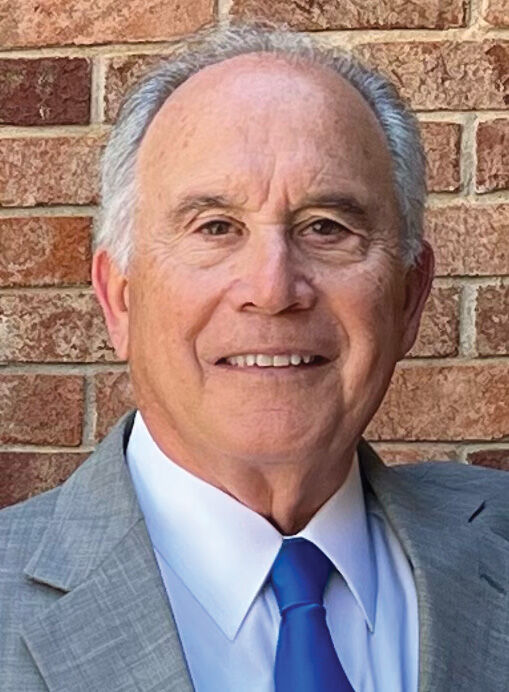
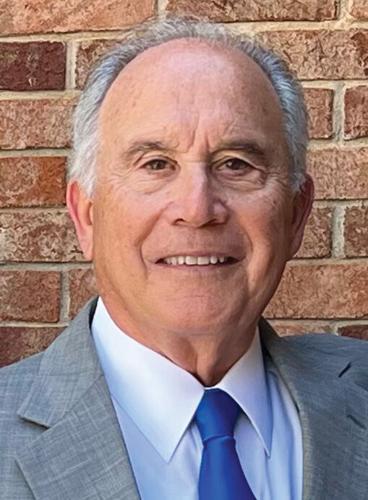
Headshot of former Gov. Walters.
In July 2024, a Gallup poll found 36% of Americans had a great deal or quite a lot of confidence in higher education, 32% had some confidence and 32% had little or no confidence.
Compared to the 2023 survey, the percentage of Americans with some confidence in higher education decreased by 8 percentage points while those with little or no confidence increased by 10 percentage points. Almost a decade ago, 57% of Americans had a great deal or quite a lot of confidence in higher education and only 9% had little or no confidence.
A 2023 survey by the American Council on Education found, at the time of the study, college and university presidents had been in their position for an average of 5.9 years. Since 2007, the average length of service at the time of ACE’s survey has dropped by 2.6 years.
According to the survey, the average length of tenure for a university president at a doctoral degree-granting university, such as OU, is 6.5 years.
The difficulty of the job has been publicly recognized by individuals who have no shortage of experience in difficult roles.
At his final board of regents meeting as chancellor of the University of Texas System in May 2018, retired U.S. Navy Adm. William McRaven said the toughest job in the nation is an academic or health institution president.
Day-to-day, university presidents face political scrutiny, pressure from donors, criticism from their campus community and a public that increasingly lacks confidence in their institution. The challenges that accompany such external pressure were not lost on McRaven.
“Every day, they must balance the needs, the opinions and the desires of countless constituents all while trying to move their institution towards greater excellence,” McRaven said. “It is a herculean task, and they do it with remarkable skill.”
Before his stint as chancellor, McRaven spent 37 years in the Navy. During his service, he oversaw the operation to kill Osama bin Laden and spent three years leading the Special Operations Command under former President Barack Obama.
In late 2023 and early 2024, as campus protests over the war in Gaza began and university presidents were put on the hot seat, Washington Post, Wall Street Journal and the Chronicle of Higher Education published pieces highlighting the declining interest and difficult nature of the job.
While OU’s president may not be under the same campus protest-inspired pressure as the University of Pennsylvania’s or Columbia University’s presidents were, plenty of challenges remain from conforming to policy reshaping initiatives such as diversity, equity and inclusion to solving financial issues.
While the job is difficult, accomplishing something meaningful might be even more so. However, according to Walters, one recent OU president not only accomplished what he set out to do, he transformed the university.
“You could argue that he made a bigger contribution than Dr. (George Lynn) Cross, who is considered to be the touchstone in history for presidents,” Walters said. “I don’t know of anybody that transformed the campus at a level that David Boren did — and quite frankly, rapidly.
“He really took the university and stepped it up — not a notch, but maybe two notches — and put it on a different plane. That’s a very difficult thing to do.”
President David Boren
Before returning to Oklahoma, former OU President David Boren had a lengthy, storied and powerful political career.
The son of a U.S. representative, Boren was no stranger to politics. In 1966, at 25, Boren was elected to the Oklahoma House of Representatives where he served four terms.
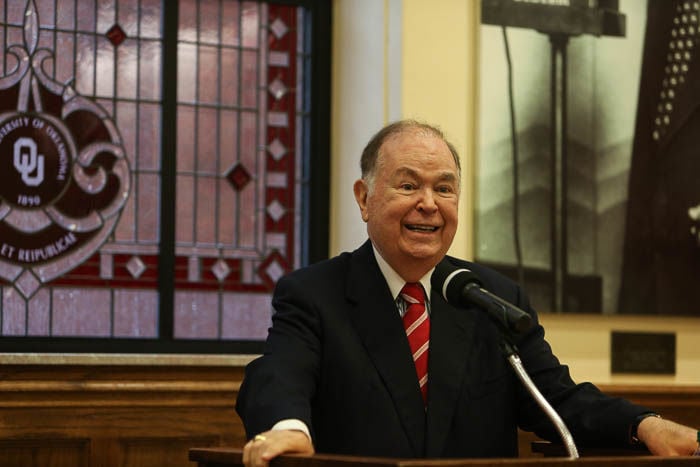
President David Boren gives a speech after unveiling the statue April 21.
Boren’s time in the state house helped catapult him into the governor’s office where he served one term as governor from 1975 to 1979. Boren chose not to run for reelection as governor, instead opting to take his political talents to Washington, D.C.
From 1979 to 1994, Boren represented Oklahoma in the Senate and was the state’s senior senator from 1980 until his departure from the Senate.
During his tenure, Boren became one of the Senate’s most influential lawmakers. In 1994, The Almanac of American Politics listed him in the top five most influential senators, according to a spring 2018 issue of Sooner Magazine. He also served a historic six-year tenure as chair of the Senate Select Committee on Intelligence until 1993. His tenure is tied for the longest tenure as chair of the committee with former Sen. Dianne Feinstein (D-Cali.).
Despite the influence he had in Washington, Boren opted to cut his time short and return to Oklahoma to lead his law school alma mater. However, Boren didn’t leave politics behind. He used his experience in Washington and the statehouse to shape and guide him.
“All of that built around him a cadre of loyal and smart people that could get things done and also a very large network of people that were very happy to help him,” Walters said. “I think his creativity in that regard, in the U.S. Senate and his work there and the network that was built, carried with him to the University of Oklahoma.”
Walters, whose term as governor was coming to an end when Boren took over at OU, said Boren’s time as president was like an explosion of energy.
During his more than two-decade tenure as president of the university, Boren had various goals and plenty of accomplishments, but they all circled back to transformation, excellence and his fundraising skills.
“He just was enormously successful at raising huge amounts of funds,” Walters said. “And a lot of people get credit for that, but he raised a lot of money to make things happen.”
Walters ultimately attributes Boren’s fundraising ability to his political connections and prowess.
“He engaged this incredible network that he had to raise funds for the university at a level that had never been seen before,” Walters said.
State Rep. Chris Kannady (R-Oklahoma City), who served as student body president during the 2000-01 school year, echoed Walters’ amazement at Boren’s fundraising ability but said Boren’s ability to engage his network went beyond fundraising.
“I got to meet some really, really incredible people because he could pick up the phone and bring in people that, frankly, just weren’t really traveling,” Kannady said. “Archbishop Desmond Tutu, that guy was old and frail and wasn’t the type of person that was on a speaking circuit.
Kannady said he was also able to meet and take a photo with former Sen. John McCain (R-Ariz.). That photo now hangs in Kannady’s legislative office.
Flying with OU’s football team during their 2000 national championship run was another experience Boren made possible for students like Kannady.
“It was f***ing awesome,” Kannady said. “I was in a position to do so, I realized that not every student can do that, but I had the opportunity.”
While not every student had the same opportunity as Kannady, he said it spoke to Boren’s efforts to keep students involved.
Fundraising initiatives and outcomes
In 1995, “The Reach for Excellence” campaign was officially launched at Boren’s inaugural banquet at the Lloyd Noble Center. The five-year campaign sought to raise $200 million. The plan showcased Boren’s intent to launch OU to new heights.
“The $200 million we seek would truly move us into the front ranks of American higher education,” Boren said about the campaign in 1995. “I am convinced that within five years or less, when people say, ‘Well, what is one of the greatest public universities in the county?’ people are going to say ‘The University of Oklahoma.’”
The campaign sought to strengthen funding for professors through endowments, facility improvements, increase scholarship opportunities, extend OU’s public service mission, assist the completion of new building projects and expand support for research.
By the end of the campaign in 2000, it raised over $500 million.
The success of the first fundraising campaign under Boren indicated what was to come.
In 2014, Boren unveiled the “Live on, University” fundraising campaign. The campaign had a goal of $500 million and sought to raise funds for projects such as scholarships, facility upgrades and a residential college system.
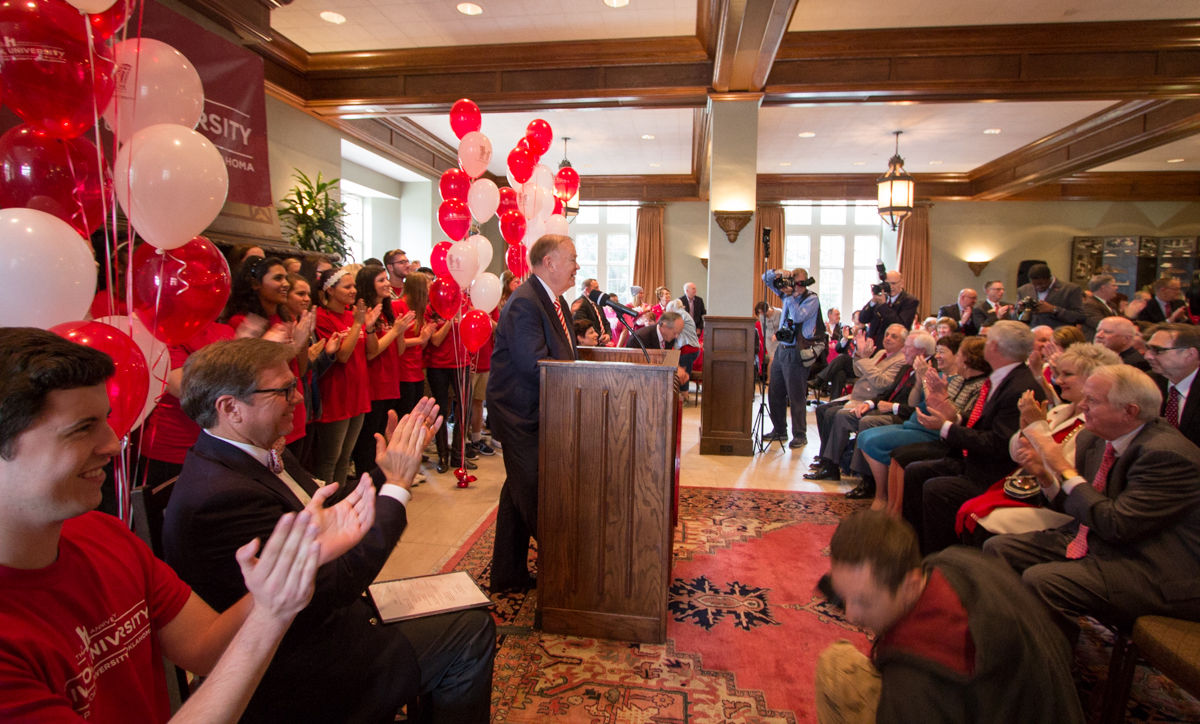
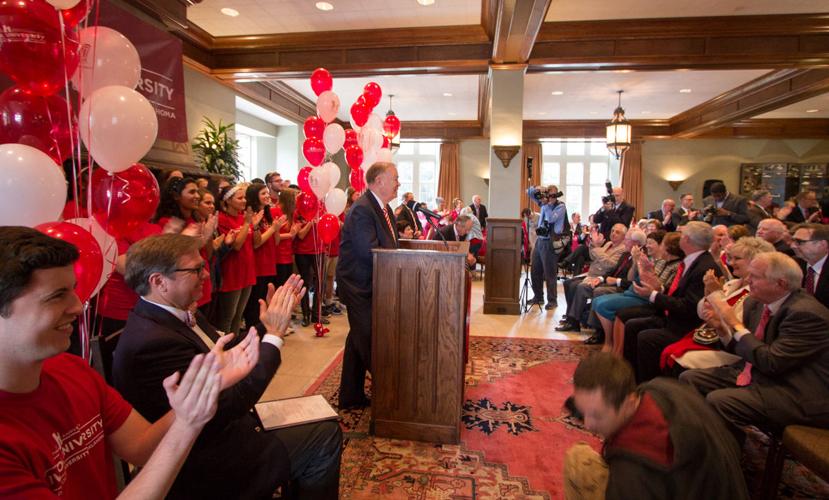
Students, faculty and staff welcome President David Boren to the podium as he prepares to give a speech announcing the "Live On, University" campaign. The campaign includes plans to add $100 million in scholarship money for undergraduate and graduate students.
By September of the last year of his presidency, Boren had raised over $3 billion from private donors, increased endowed faculty positions from 94 to over 550 and quadrupled private scholarships for students.
Under Boren, OU was the No.1 college for freshman National Merit Scholars in 2014, 2016 and 2017. Boren invested heavily in the recruitment of merit scholars, likely to the tune of hundreds of millions of dollars, according to a 2018 report by Oklahoma Watch.
Rep. Daniel Pae (R-Lawton), who served as the 2016 Student Government Association president, took issue with how the scholarship was based on standardized testing scores.
“I would rather an applicant be based on their overall background and not just one number,” Pae said. “I think that there has been, in retrospect, that lesson learned. Let's try to get as many scholarships, many financial aid opportunities to high school students, especially those right here in Oklahoma.”
Inspiration and a legacy undermined
Potential university presidents seek the position for a variety of reasons, from the pursuit of prestige to a longing for public service.
Walters, a fellow former governor, believes he knows why Boren took the position four years into his third term as the senior senator from Oklahoma.
“I think he knew that (OU) needed strong leadership and that it could do much, much more, but then I also think he had a sense of history,” Walters said. “I think he saw Dr. Cross, for example, lead the university for so many years. And to be such a transformative, influential and, quite honestly, historic figure — he never verbalized that to me, but I can’t help but think, knowing how many times he talked about Dr. Cross — he was inspired by (him).”
While a sense of duty may have played a part in his decision to return to Norman, a love for students did, too.
“There is no satisfaction like seeing a young person filled with talent. What a privilege to share in their lives,” Boren said in a spring 2018 issue of Sooner Magazine.
Or a love of university may have drawn him away from Washington.
“I asked myself, ‘What’s going to be the main purpose of your life going forward? Where can I be of greatest service?’ The University of Oklahoma is somewhere I could invest my life,” Boren told Sooner Magazine.
Regardless of what brought him back to Norman, Boren was devoted. Due to his devotion, he found himself being compared to another OU president: his mentor Cross
In terms of time in office, Boren was closer than anyone to surpassing Cross. From Dec. 1, 1994, to June 30, 2018, Boren served as president of OU for 24 years, while Cross served 25 years from 1943 to 1968.
While his 24-year tenure is remembered as a transformative time for OU, Boren’s memory has been tarnished by allegations that came to light after his presidency.
In December 2018, OU Daily reported that OU had misreported alums’ donorship data to U.S. News & World Report during Boren’s tenure. In 2019, OU was stripped of its U.S. News & World Report ranking.
In the final 2018 report under Boren, OU was ranked 97. In 2025, OU ranked 132. From 2004 to 2018 OU’s average rank was 107. From 2019 to 2025 OU’s average rank is 128.
Along with investigating misreported alums’ donorship data in 2019, OU also investigated allegations of sexual harassment by Boren and then-OU Vice President of University Development Tripp Hall. Jess Eddy, an OU graduate and one of Boren’s former teaching assistants, alleged that there were multiple instances of unwanted sexual contact by Boren and once by Hall. Another graduate, Levi Hilliard alleged that Hall had inappropriately touched him between 2017 and 2018. Hilliard later settled in court, and the file was sealed.
Both Boren and Hall denied the allegations, and the Oklahoma State Bureau of Investigation did not file indictments against either.
OU paid law firm Jones Day $1.5 million to conduct an investigation into the allegations. The reports compiled by Jones Day, which have not been released to the public, have been the subject of a lawsuit pursuing their public release under the Open Records Act. On Jan. 4, a Cleveland County judge ruled against media outlet NonDoc, the party suing for the release of the reports. NonDoc editor-in-chief Tres Savage said he plans to appeal the case to a higher court.
President Joseph Harroz Jr.
During the 2018 presidential search, Joseph Harroz Jr. was one of three finalists. He was ultimately passed over for James Gallogly. After Gallogly’s short stint as president ended in May 2019, Harroz was tapped as the interim president and was later named OU’s 15th president in May 2020.
“He was part of the group that president Boren brought in to run the university,” Kannady said. “I would argue that Joe Harroz would not be where Joe Harroz is without (Boren).”
Harroz has been in Boren’s orbit since 1992 when he joined then-Sen. Boren’s office as legislative director and legal counsel in Washington. In 1994, when Boren returned to OU, Harroz followed. Harroz served as vice president of executive affairs and then legal counsel under Boren until 2008. Harroz then joined the private sector until he returned to OU in 2010 as dean of the OU College of Law.
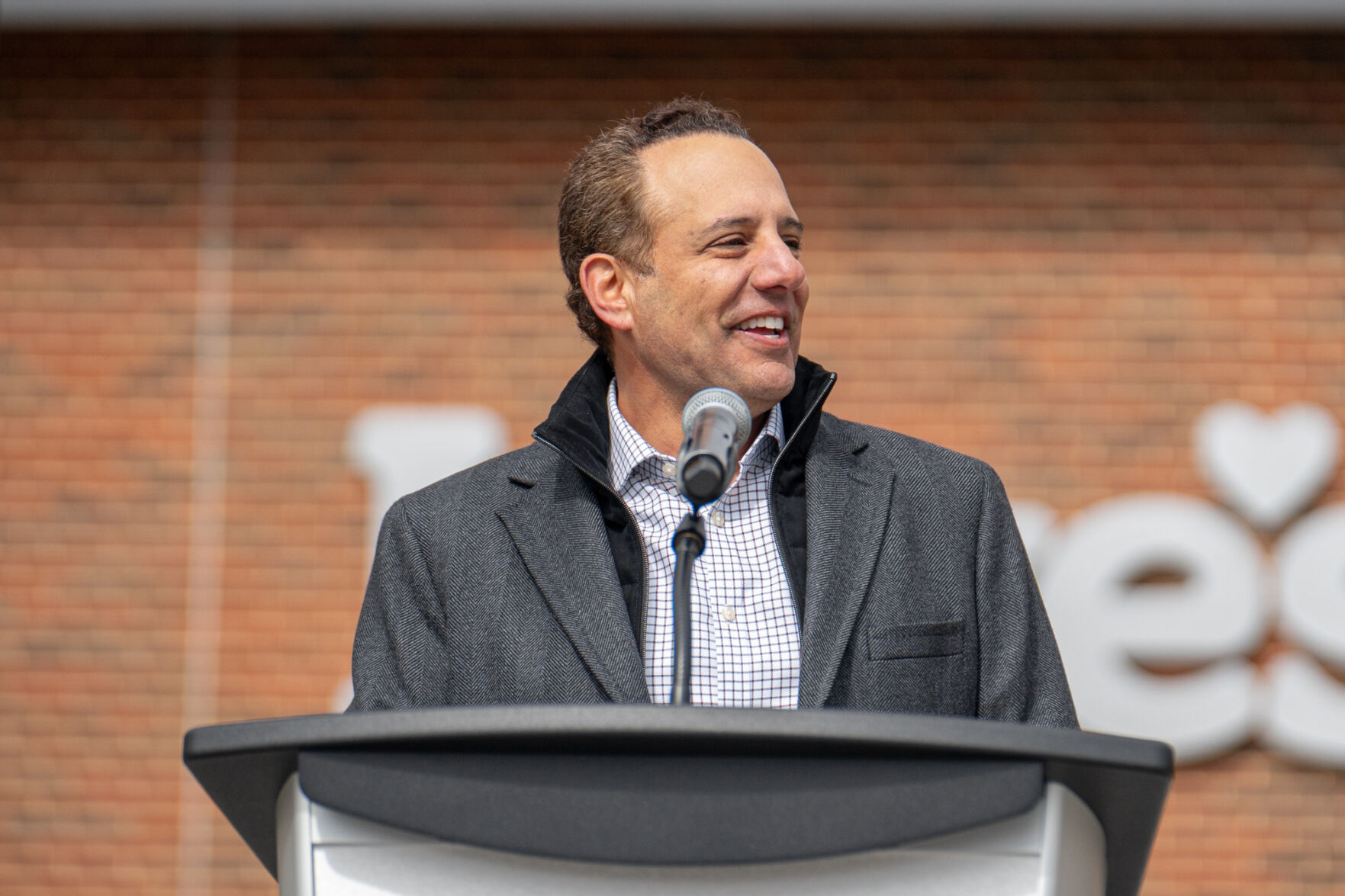
OU President Joseph Harroz Jr. during the Love's Field opening ceremony on March 1.
Though Harroz’s appointment and Boren’s tenure were divided by Gallogly, some still see Harroz as Boren’s natural successor.
Pae said he felt Harroz was the person to continue Boren’s mission.
“He did an excellent job at OU law school when he was over there,” Pae said. “And so I appreciate his emphasis on building relationships with the Legislature and trying to communicate the importance of investing in higher ed.”
Walters also believes Harroz is up to the task of elevating OU.
“Joe’s certainly got the capacity to do that and is a smart and affable guy, and I think (he) has been very successful, as well,” Walters said. “He’s got a few years to go to meet the tenure of Boren and what he accomplished, so hopefully Joe can use that as a touchstone of how high one person’s leadership can raise the university.”
So far, Harroz is moving forward with his plans to transform the university through the “Lead On” campaign. The campaign was officially announced in 2022 and sets out to raise $2 billion by June 2027.
In 2024, OU joined the Southeastern Conference, fulfilling one key aspect of Harroz’s envisioned transformation.
However, the SEC is not the only organization Harroz is vying to join.
“Our strategic plan includes our ambition to join the Association of American Universities — a prestigious coalition of tier one research universities — and moving into a conference with more AAU institutions offers an opportunity to align OU to our aspirational peers,” Harroz wrote in a 2023 press release.
The Association of American Universities is a nonprofit organization comprised of leading public and private research universities.
“AAU’s membership is limited to institutions at the forefront of scientific inquiry and educational excellence,” said Mary Sue Coleman, former Association of American Universities president, in a 2019 press release.
Membership to the association is invitation only and, according to the 2019 release, is “based on an extensive set of quantitative indicators and qualitative judgments that assess the breadth and quality of a university’s research, graduate, and undergraduate education programs.”
In 2023, six universities joined the association: Arizona State University; George Washington University; the University of California, Riverside; the University of Miami; the University of Notre Dame; and the University of South Florida.
“We’re going to provide accessible, affordable excellence,” Harroz said during his 2022 State of the University Address.
This story was edited by Peggy Dodd, Anusha Fathepure, Ismael Lele and Ana Barboza. Gretchen Schultz, Mary Ann Livingood, Grace Rhodes and Sophie Hemker copy edited this story.


